Car Detailing Business Profit Margins: What You Actually Keep

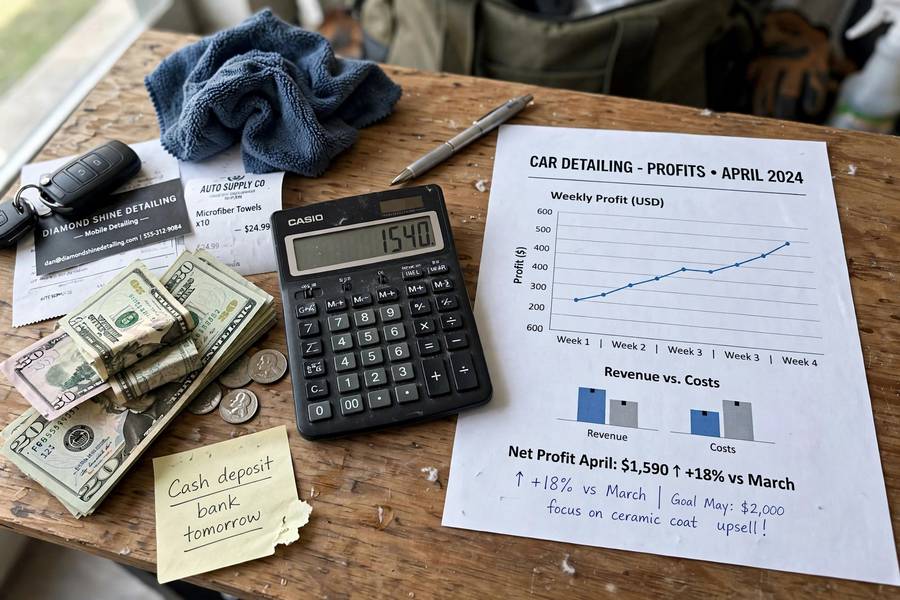
Ask ten detailers about their margins and you will get ten confident, contradictory answers. That is because most operators confuse revenue with profit, gross margin with net margin, and “I had a great month” with a sustainable business. I am going to give you the real numbers — per service, per model, and per year — because pricing without margin knowledge is just guessing with extra steps.
The headline: car detailing is a high-margin business done right, with gross margins of 60–85% and net margins of 20–40% for well-run operations. But the range within those numbers is enormous, and where you land depends on service mix, pricing discipline, and whether you understand your true costs. (For the launch context, see how to start a car detailing business.)
Gross Margin vs Net Margin: Know the Difference
Gross margin = (revenue − direct job costs) ÷ revenue. Direct job costs are chemicals, consumables, and any per-job expenses. This tells you how profitable the work is.
Net margin = (revenue − ALL costs) ÷ revenue. All costs means rent, insurance, marketing, equipment replacement, your salary, taxes, everything. This tells you how profitable the business is.
Detailers love quoting gross margins (“I make 80% on coatings!”) because they are impressive and ignore the expensive parts. The number that determines whether you survive is net margin. A business grossing 80% and netting 10% is a hobby with overhead. Throughout this guide, I will give you both — and show you where the gap between them hides.
Margins by Service Tier
Realistic numbers from well-run operations:
Express wash ($50–$75): Product cost $2–$4. Gross margin 93–95%. But labor time is 30–45 minutes, so profit per hour is modest — $40–$70/hour solo. High gross margin, low ticket: the volume game.
Maintenance wash plan ($99–$149/month, 2–4 washes): Effective per-wash revenue $25–$50, but acquisition cost amortizes and scheduling density improves. Gross margin 90%+. The real value is predictability — recurring revenue you can borrow against and plan around.
Full detail ($200–$350): Product cost $8–$15, consumables $5–$10. Gross margin 90–93%. Three to four hours of labor. Solo profit per hour: $50–$85. This is the bread-and-butter tier — it pays the bills.
Paint correction ($500–$1,200): Product cost $15–$30, consumables $10–$20. Gross margin 93–96%. Six to twelve hours. Solo profit per hour: $60–$110. The skill premium starts showing here.
Ceramic coating ($800–$2,500): Product cost $50–$300 (tier-dependent), consumables $30–$60. Gross margin 85–92%. One to two days including correction. Solo profit per job: $600–$1,800. This is the margin king — fewer jobs, dramatically more profit per job.
Add-ons (engine bay $50–$100, headlight restoration $75–$150, odor removal $100–$200, pet hair $50–$100): Product costs $2–$10. Gross margins 90–95%. Add-ons are the quiet margin heroes — they lift average tickets 30–50% with minimal extra time.
Notice the pattern: gross margins are excellent across the board (this is a service business with cheap materials). Profitability differences come from ticket size and throughput, not from material costs. The operators who struggle are not overpaying for chemicals — they are underpricing their time.
The Real Cost of Goods Per Job
Know these numbers cold — they are your pricing floor:
- Express wash: $2–$4 (shampoo, towels amortized, tire dressing, glass cleaner)
- Full detail: $10–$20 (APC, degreaser, iron remover, clay, wax/sealant, interior chemicals, towels, pads amortized)
- Paint correction: $20–$40 (compounds, polishes, pads, panel wipe, tape, towels)
- Ceramic coating: $80–$300 (coating product by tier, prep chemicals, applicators, suede cloths)
- Interior-only detail: $8–$15 (extractor chemicals, brushes, protectants)
Buying smart: professional concentrates cut per-job chemical costs 30–50% versus ready-to-use retail products. A $40 gallon of concentrated APC that dilutes 10:1 beats a $12 spray bottle every time. The operators with the best margins buy like businesses, not hobbyists.
The hidden COGS: towel and pad replacement ($200–$700/year), equipment wear per job (polisher rebuilds, extractor maintenance), and water/power for mobile operators. Add 10–15% to your chemical costs to cover these, or they silently eat your margin.
Labor: The Margin Killer (or Maker)
Solo operators often claim 90%+ “margins” while paying themselves nothing. That is not a margin — it is unpaid labor disguised as profit. Price your jobs as if you pay yourself $30–$50/hour (because eventually you must, or you will hire someone at that rate and discover your pricing was fiction).
With employees, labor is 30–45% of revenue in detailing — lower than most service businesses, because the ticket sizes are high relative to hours. The math per employee: a detailer doing $1,200/day in revenue at $25/hour labor cost ($200/day) generates $1,000 in gross profit daily. That is why good detailers are worth retaining aggressively.
The throughput factor. Margins per hour depend on speed as much as price. Two detailers doing the same $250 full detail — one in 3 hours, one in 5 — have radically different businesses. Efficiency training is margin training. Time every service, set targets, and track actuals. What gets measured gets faster.
Your pricing must carry the labor. If you are doing $150 details that take 5 hours, you are earning $30/hour before costs — fast-food wages with chemical exposure. How to price car detailing packages covers the pricing mechanics; the margin principle is simple: price for the business you want, not the customers you fear losing.
Margins by Business Model
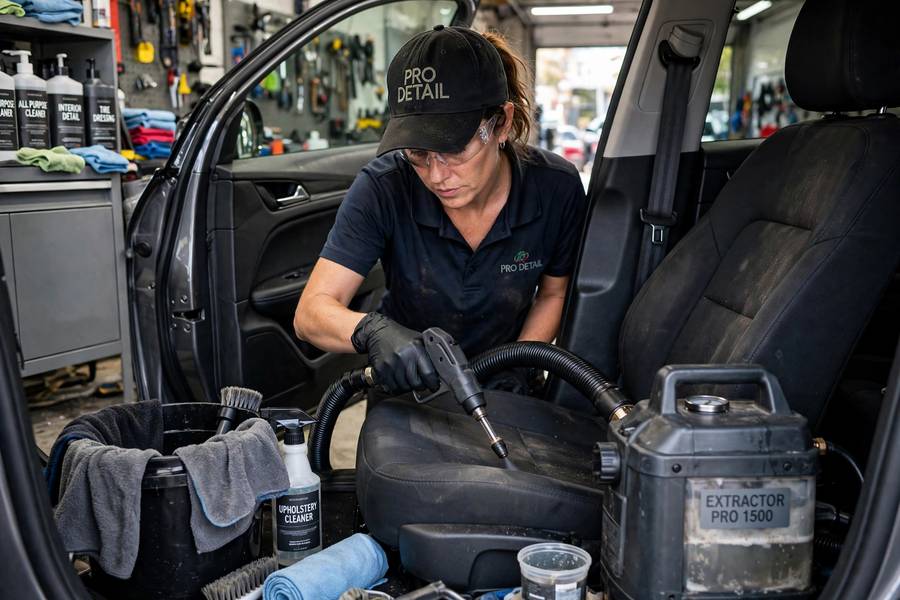
Lean mobile solo: Revenue $80,000–$150,000/year. Costs: chemicals/consumables $3,000–$6,000, fuel/vehicle $4,000–$8,000, insurance $1,500–$3,000, marketing $2,000–$5,000, equipment replacement $1,500–$3,000, phone/tools $1,000–$2,000. Net margin: 35–50% — the highest net margins in the industry, because overhead is minimal. Net income: $30,000–$70,000. The constraint is your hours, not your margins.
Professional mobile (1–2 employees): Revenue $150,000–$300,000/year. Add labor $40,000–$80,000, better vehicle costs, more marketing. Net margin: 25–35%. Net income: $40,000–$100,000. You have bought back some of your time at the cost of margin points.
Fixed shop (2–5 employees): Revenue $250,000–$600,000/year. Add rent $30,000–$72,000, utilities, shop insurance, front-desk labor. Net margin: 15–25%. Net income: $40,000–$150,000. Lower margin percentage, higher absolute dollars — the classic scale tradeoff.
Coating studio (premium positioning): Revenue $200,000–$500,000/year with 2–3 staff. High tickets, controlled costs, minimal advertising (reputation-driven). Net margin: 25–40%. The best risk-adjusted model in the industry for skilled operators.
The pattern: net margin percentage falls as you scale, but absolute profit rises. Do not chase margin percentage at the expense of dollars — a 20% margin on $500,000 beats a 45% margin on $100,000 every time.
What Top Operators Actually Net Per Year
Honest ranges for established (2+ years) operations:
- Solo mobile grinder: $40,000–$80,000 net. Good living, capped by hours.
- Solo premium (coatings-focused): $80,000–$150,000 net. Fewer jobs, bigger tickets, waiting list.
- Small team (2–3): $80,000–$180,000 owner net. Systems starting to work.
- Shop owner (absentee-ish): $100,000–$250,000 net. The business works without your hands on cars.
The jump from solo to team is where most operators stall — it requires pricing that carries labor, systems that maintain quality, and the management skills nobody taught you. The operators who make it treat the transition as a separate business to learn, not just “more of the same.”
Five Levers That Move Your Margins
1. Service mix shift. Every 10% of revenue moved from washes to correction/coatings lifts overall gross margin meaningfully. Track your mix monthly and set targets. The goal: premium services as the growth engine, washes as the base.
2. Add-on attachment rate. Train yourself (and staff) to offer relevant add-ons on every job. A 40% attachment rate at $75 average lifts revenue per job 20%+ with near-zero extra cost. This single habit is worth $15,000–$30,000/year to a busy operation.
3. Price increases. Most detailers underprice by 20–30%. Annual 5–10% increases, communicated as quality investments, rarely cost customers and flow directly to net margin. If you have a waitlist, you are underpriced — that is the market telling you.
4. Chemical cost discipline. Buy concentrates, track cost per job, eliminate product overlap (you do not need four brands of APC). Saves $1,000–$3,000/year — small in absolute terms, but it is pure margin.
5. Recurring revenue. Maintenance plans and fleet contracts smooth seasonality and reduce acquisition costs. A customer acquired once who pays monthly for two years has a CAC-to-LTV ratio that makes every other marketing channel look expensive.
Marketing efficiency deserves mention too — great auto detailing marketing ideas lower your acquisition cost, which drops straight to net margin.
The Margin Traps
Discounting premium services. A 20% discount on a $1,200 coating costs you $240 — nearly pure margin. Discounts train customers to wait for sales. Never discount coatings; add value instead.
Underpricing to “get started.” Low introductory prices attract price-sensitive customers who leave when you raise rates. You have built a customer base with negative lifetime value. Price correctly from day one — slower start, healthier business.
Scope creep. The $250 detail that becomes a $250 detail plus “can you also…” — two extra hours unbilled. Define inclusions precisely, price extras explicitly, and hold the line kindly.
Ignoring equipment replacement. Running equipment to failure, then emergency-buying at retail. Budget replacement reserves monthly; buy backups for critical tools before they die mid-week.
The tax surprise. Set aside 25–30% of net for taxes quarterly. The detailing founders who get in trouble are not unprofitable — they are profitable and unprepared for April.
Frequently Asked Questions
Gross margins run 60–85% (materials are cheap); net margins run 20–40% for well-run operations. Lean mobile solos net 35–50% on $80,000–$150,000 revenue; fixed shops net 15–25% on higher revenue. Ceramic coatings and paint correction have the best per-job margins.
Express wash ($50–$75): $40–$70 profit/hour solo. Full detail ($200–$350): $50–$85/hour. Paint correction ($500–$1,200): $60–$110/hour. Ceramic coating ($800–$2,500): $600–$1,800 profit per job. Add-ons lift average tickets 30–50% at 90–95% margins.
Extremely — it’s the margin king of detailing. A $1,200 coating job with $150 in product grosses ~$950 before labor. The premium exists because it requires paint correction skill, controlled environment, and trust. Never discount coatings; the positioning justifies the price.
Five levers: shift service mix toward correction and coatings, raise add-on attachment rates (worth $15,000–$30,000/year), implement annual 5–10% price increases, buy chemical concentrates to cut cost-per-job, and build recurring maintenance plans that lower acquisition costs.
Underpricing labor — quoting jobs as if their time is free, then discovering the “profit” was unpaid wages when they hire. Price every job carrying $30–$50/hour labor cost, even solo. The second mistake is discounting premium services, which destroys the positioning that justifies premium prices.