
Detailing founders tend to skip the business plan. “It’s just me and a polisher — why do I need a plan?” Then they need a loan for a shop, or a partner for expansion, or they hit the wall where working harder stops working, and they discover that the thinking they skipped was the thinking that mattered.
A detailing business plan is simpler than a daycare’s or a restaurant’s — but it still needs to answer the questions lenders and partners actually ask: is there demand, do the unit economics work, and can this person execute? Here is the template: nine sections, what each must prove, and the mistakes that kill detailing plans specifically. (For the venture overview, see how to start a car detailing business; for startup pricing benchmarks, see car detailing pricing guide for beginners.)
Table of Contents
- Why Detailers Need Plans Too
- Section 1: Executive Summary
- Section 2: Business Model and Services
- Section 3: Market Analysis
- Section 4: Organization
- Section 5: Service Menu and Pricing
- Section 6: Marketing and Customer Acquisition
- Section 7: Financial Projections
- Section 8: Funding Request
- Section 9: Milestones and Appendix
- Mistakes That Kill Detailing Plans
- Frequently Asked Questions

Why Detailers Need Plans Too
Detailing looks like a cash business with no complexity: wash car, get paid. The complexity is hidden in the unit economics. Your profit per job depends on service mix (a $50 wash and a $1,200 coating correction have wildly different margins), throughput (how many jobs per day per person), seasonality, and customer acquisition cost. A plan forces you to model these instead of discovering them through your bank balance.
Banks, for their part, see detailing as high-risk: low barriers to entry, seasonal revenue, owner-operator dependence. Your plan must dismantle each concern with specifics. “I love cars” is not a business plan; “here is my service mix, my customer acquisition cost, and my path from mobile to shop” is.
Section 1: Executive Summary
One page. What you are building (mobile operation, shop, or mobile-to-shop path), how much you need, and the three numbers: average revenue per job, jobs per week at maturity, and months to profitability. Write it last. Every number must trace to a later section.
Section 2: Business Model and Services
Model choice — and the path. State your starting model (lean mobile, professional mobile, fixed shop) and your 3-year trajectory. Lenders love the mobile-to-shop path because it de-risks the shop investment: “I will build the client base mobile for 18 months, then lease when I have 40 recurring clients.” That sentence is worth more than any mission statement.
Legal structure. LLC, ownership, EIN. If you have a partner, define roles and equity now — detailing partnerships die over vague agreements about who does the bookkeeping.
Location and territory. Your service area (mobile) or shop location. For mobile: the zip codes you serve and why — affluent suburbs with long commutes are detailing gold; dense urban cores with street parking are detailing deserts.
Section 3: Market Analysis
Local demand sizing. Count the vehicles, not the people. Your market: registered vehicles in your service area × detailing penetration rate (2–5% use professional detailing regularly). Cross-check with competitor capacity — if three established shops each do 30 cars/week, that is 90 cars/week of proven demand.
Competitor audit. Every detailer within 20 miles: services, prices, reviews, positioning. Mystery-shop two of them. Note what they do badly — slow booking, no online presence, limited services. Your plan should explicitly target their weaknesses.
Target customer. Be specific: “affluent suburban professionals aged 30–55 who own vehicles worth $40,000+ and value convenience” beats “car owners.” Different segments need different service menus and marketing — define yours.
Trend alignment. Ceramic coatings, paint protection film adjacency, eco-friendly waterless options, subscription maintenance plans. Show you are positioned for where the market is going, not where it was.
Section 4: Organization
The team. Founder bio with detailing credentials and business experience. Planned hires by milestone: “hire first employee at 25 jobs/week; second at 40.” For shops: shop manager, detailers, front-desk roles.
The owner-dependence problem. Address it head-on: what happens if you are injured or sick? Cross-training, documented processes, key-person insurance for larger operations. Lenders worry the business is you; show them it is becoming a system.
Advisors. Accountant, attorney, and ideally a mentor who has run a detailing business. Named advisors signal seriousness.
Section 5: Service Menu and Pricing
This section is the heart of a detailing plan — it is where unit economics live:
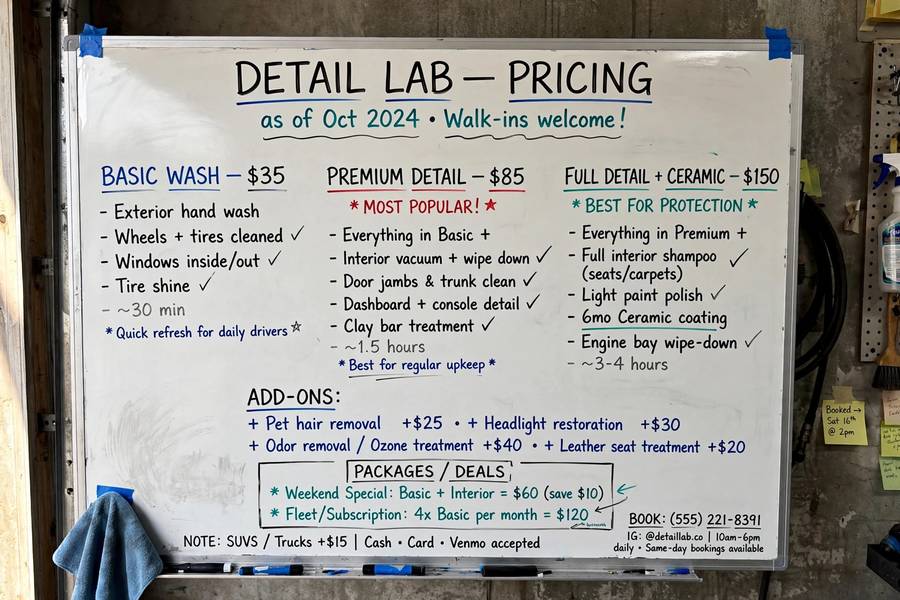
Tiered service menu. Design 3–4 packages with clear value ladders. Example structure: – Express Detail ($75–$125): wash, interior wipe-down, windows, tire shine — 1 hour – Full Detail ($200–$350): deep interior, wash, clay, wax — 3–4 hours – Paint Correction ($500–$1,200): machine polishing, 1–2 step correction — 6–12 hours – Ceramic Coating ($800–$2,000+): correction + coating — 1–2 days
Unit economics per tier. For each package: price, product cost, labor hours, gross margin. The numbers should show the pattern every successful detailer knows — volume tiers pay the bills, premium tiers make the profit. See how to price car detailing packages for the pricing mechanics behind these margins.
Add-ons and upsells. Engine bay, headlight restoration, odor removal, pet hair surcharge. Add-ons are pure margin and the difference between a $150 average ticket and a $220 one.
Recurring revenue. Maintenance plans (monthly wash + quarterly detail subscriptions), fleet contracts, dealership partnerships. Recurring revenue de-risks everything — lenders notice it immediately.
Section 6: Marketing and Customer Acquisition
The portfolio engine. Before-and-after photos are your entire marketing foundation. Your plan should describe the photo system: consistent angles, good lighting, posted within 24 hours. Fifty great before/afters outperform any ad budget.
Channel plan with costs. Google Business Profile (free, critical), Instagram/TikTok (free, portfolio-driven), local SEO, targeted social ads ($300–$800/month), referral program ($25 credit per referral), partnerships (realtors, dealerships, office parks).
Customer acquisition cost target. Know what a customer costs to acquire and what they are worth (lifetime value). A $40 CAC against a $600 annual customer value is a healthy engine; the plan should show you have done this math.
Review strategy. Systematic: ask every satisfied customer, make it frictionless (QR code at pickup), respond to every review. Review count and rating are the #1 conversion factor for local service businesses.
Section 7: Financial Projections
Startup costs (itemized — equipment, vehicle, chemicals, legal, branding, working capital).
Monthly P&L, year one. Revenue by service tier × jobs per week ramp. Most detailing businesses ramp over 6–9 months; show it. Expenses: chemicals/consumables, fuel/vehicle, insurance, marketing, labor (when hired), loan payments.
The seasonality plan. Show winter (or rainy season) revenue dip explicitly and how you handle it: interior-focused services, coating maintenance, reduced hours, cash reserves. A plan that pretends revenue is flat year-round loses all credibility.
Break-even. Jobs per week to cover fixed costs. For lean mobile: often 6–10 jobs/week. For shops: 20–30. State yours and show the math.
Three-year outlook. Year 1: establish. Year 2: hire and systematize. Year 3: expand (second van, shop lease, or additional services). Each year’s revenue, margin, and headcount.
Section 8: Funding Request
Amount and allocation. Itemized — not “I need $50,000” but “$50,000: $18,000 van down payment and outfitting, $8,000 equipment, $4,000 chemical stock, $5,000 branding and marketing, $15,000 working capital.”
Owner equity. Your cash in the deal. 15–25% is the expectation for small business lending.
Repayment. Monthly payment from projections, debt service coverage at 70% of projected revenue. Show the loan is serviceable even if growth is slower than planned.
Section 9: Milestones and Appendix
Dated milestones. LLC filed → insurance bound → equipment purchased → first 10 customers → 25 jobs/week → first hire → shop lease evaluation. Dates turn intentions into commitments.
Appendix. Equipment quotes, van listings, competitor price sheets, sample service menu, before/after portfolio samples, insurance quotes, market data. Evidence for every major claim.
Mistakes That Kill Detailing Plans
“I’ll charge premium prices from day one.” Without a portfolio and reviews, you cannot command premium rates. Show the pricing ramp: competitive entry pricing → premium as reputation builds.
Ignoring seasonality. Flat monthly revenue projections in a seasonal business. Lenders in northern states will laugh.
No customer acquisition plan. “Word of mouth will grow the business.” Word of mouth is a result, not a strategy. Show the engine.
Underpricing labor. Pricing jobs as if your time is free. Your plan must include owner labor cost — otherwise the “profit” is just unpaid wages.
The shop too soon. Requesting shop funding with no existing client base. The mobile-to-shop path exists precisely to avoid this.
Fantasy throughput. “I’ll do 5 full details a day solo.” A quality full detail takes 3–4 hours. The math does not work, and anyone who has detailed a car knows it.
Frequently Asked Questions
Yes — for loans, partners, or expansion, and for your own clarity on unit economics. Detailing’s complexity hides in service mix, throughput, seasonality, and customer acquisition cost. A plan models these before your bank balance does.
Nine sections: executive summary, business model and services, market analysis, organization, service menu with unit economics per tier, marketing and customer acquisition, financial projections with seasonality, funding request, and milestones plus appendix. The service menu’s per-tier margins are the heart of the plan.
Lean mobile operations typically break even at 6–10 jobs per week; fixed shops need 20–30. Break-even depends on your service mix — premium tiers (paint correction, coatings) break even faster than volume wash work. Calculate yours from fixed costs divided by average gross profit per job.
Show the winter revenue dip explicitly with a plan: shift to interior-focused services, offer coating maintenance packages, reduce hours, and maintain cash reserves from peak season. Lenders reject plans with flat year-round revenue in seasonal markets.
Requesting shop funding without an existing client base, and projecting premium pricing without a portfolio to justify it. The proven path is mobile first (build reputation and recurring clients for 12–18 months), then lease a shop when demand exceeds mobile capacity.