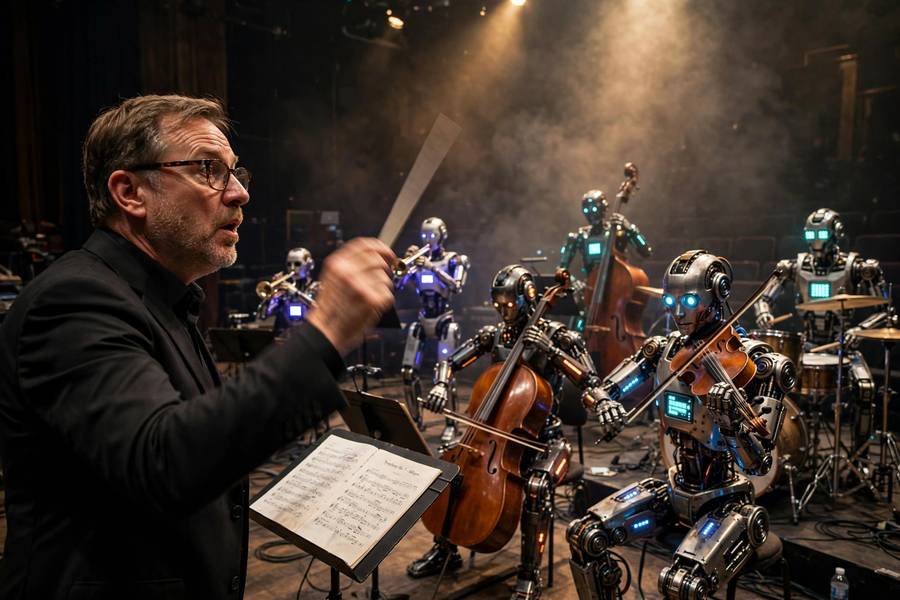
One smart agent is a demo. Five agents doing useful work together is a system — and the difference between those two things has a name: orchestration. It’s the layer that decides which agent does what, in which order, with what information, and what happens when something goes wrong. I’ve watched teams spend months perfecting individual agents and then watch the whole thing collapse because nobody designed the coordination. The agents were fine. The orchestra had no conductor.
Agent orchestration is the design of how multiple AI agents (or multiple steps) coordinate to accomplish tasks too complex for a single pass. This guide covers the core patterns — routing, parallelization, orchestrator-workers, evaluator-optimizer, and more — with honest guidance on when each fits. For the single-agent mechanics underneath, see my explainer on how AI agents work.
Table of Contents
- What Orchestration Actually Means
- Pattern 1: Prompt Chaining
- Pattern 2: Routing
- Pattern 3: Parallelization
- Pattern 4: Orchestrator-Workers
- Pattern 5: Evaluator-Optimizer
- Pattern 6: Autonomous Agents
- Choosing the Right Pattern
- The Cross-Cutting Concerns
- Frequently Asked Questions

What Orchestration Actually Means
Orchestration is everything about coordination: decomposing a task into steps, assigning steps to agents, sequencing them, passing context, handling failures, and deciding when the work is done. It’s the workflow layer above individual agent intelligence.
The key insight, borrowed from Anthropic’s engineering guidance: most successful “agent” systems aren’t one brilliant autonomous agent — they’re workflows with defined structure. A well-orchestrated pipeline of simple steps routinely beats a single agent left to figure everything out, on reliability and cost.
This reframes the builder’s job: not one mind handling everything, but a process where each step is simple enough to be reliable. Less glamorous than “autonomous AI” — and it works.
Orchestration also includes the unglamorous machinery — retries, timeouts, fallbacks, logging, cost tracking, human escalation. Budget your engineering accordingly.
Pattern 1: Prompt Chaining
The simplest orchestration pattern: break a task into steps, run them in sequence, feed each step’s output into the next. Research → outline → draft → edit. Each step is a separate model call with its own prompt, possibly its own model.
Why it works: each step has a narrow job, so each prompt can be precise. You can verify intermediate outputs, failures localize (bad outline vs. bad drafting is diagnosable), and you can use cheap models for easy steps.
The weakness: errors compound — downstream steps polish upstream mistakes rather than fixing them. Mitigation: verification gates between steps, and keep chains short. Every additional link is another chance for drift.
Use prompt chaining when the task decomposes into known steps with clear handoffs — it handles a large fraction of real-world agent work. Don’t reach for fancier patterns until chaining proves insufficient.
Pattern 2: Routing
Routing means classifying the input, then sending it down the right path. A support request gets classified as billing, technical, or account — each handled by a specialized sub-flow. A query gets classified as factual (needs search), computational (needs code), or conversational (answer directly).
The router can be a small model, a classifier, or deterministic rules. The power: specialization — each downstream path optimized for its input type, and efficiency — you only run the machinery the input needs.
Routing fails two ways: misclassification sends work down the wrong path, and ambiguous inputs fit no category — every routing system needs a fallback for “none of the above.”
Design advice: make categories match genuinely different downstream handling, and log routing decisions — when the system misbehaves, “why did this go to path B?” is the first question you’ll ask.
Pattern 3: Parallelization
When subtasks are independent, run them simultaneously. Two flavors:
Sectioning splits a task into independent subtasks run in parallel, then combines results. The speedup is real — wall-clock drops toward the slowest subtask — and subtasks don’t contaminate each other.
Voting runs the same task multiple times and aggregates — majority vote, best-of-N, or a judge picking the best. This trades cost for reliability where verification is easier than generation: generate five code candidates, run the tests, keep what passes.
The catch: cost (you’re multiplying model calls) and the synthesis step, which is itself hard. Don’t treat the aggregator as an afterthought — it often determines whether parallelization helped or just produced disconnected fragments.
Pattern 4: Orchestrator-Workers
This is the pattern people picture when they hear “multi-agent system”: a central orchestrator breaks the task into subtasks, delegates each to a worker agent, and synthesizes the results. The orchestrator plans dynamically — it decides the decomposition based on the actual input, not a fixed template.
It shines when you can’t predefine the steps. “Research this market and write a report” decomposes differently for every market; a fixed chain can’t adapt, but an orchestrator can. The workers are typically simpler agents (often single-purpose tool users), and the intelligence concentrates in the orchestrator’s planning.
The honest costs: the orchestrator is a single point of failure and a single point of expense. Every decision it makes is an LLM call, and complex tasks need many decisions. Debugging means interrogating the orchestrator’s plan — why did it spawn these workers and not those? And there’s a failure mode I call “orchestrator theater”: the orchestrator generates elaborate multi-step plans for tasks a simple chain could handle, burning tokens on planning overhead that adds nothing.
My guidance: use orchestrator-workers when the decomposition genuinely varies per input. If you find yourself writing down the same decomposition every time, that’s a prompt chain wearing a costume — simplify it into one. For the framework-level view of these dynamics, my piece on types of AI agents goes deeper.
Pattern 5: Evaluator-Optimizer
One of the most effective patterns, and conceptually simple: a generator produces output, an evaluator critiques it, the generator revises, repeat until the evaluator is satisfied or a limit hits. Writer and editor. Coder and reviewer. Drafter and fact-checker.
Why it’s powerful: generation and evaluation are different skills, and separating them lets each be optimized independently. The evaluator can use a stronger model, a rubric, or even deterministic checks (run the tests, validate the JSON, check the citations resolve). The loop continues until quality clears a bar — which means output quality becomes a guarantee (modulo evaluator quality) rather than a hope.
The evaluator is the linchpin, so design it carefully. A vague evaluator (“is this good?”) produces vague loops. A rubric-based evaluator (“check these five criteria, fail if any are unmet”) produces reliable improvement. And deterministic evaluators — tests, validators, schema checks — are gold wherever they apply, because they don’t hallucinate approval.
Watch for two failure modes: infinite refinement (the evaluator is never satisfied — cap the iterations) and evaluator-generator collusion (in multi-agent setups, the generator learns what the evaluator likes rather than what’s actually good — keep the evaluator’s standards grounded in external checks where possible).
Pattern 6: Autonomous Agents
The pattern with the most hype and the least deployment: give an agent tools, a goal, and the freedom to plan and act until done. No predefined steps, no fixed workflow — the agent figures it out.
I’ll be direct: this works impressively in demos and unreliably in production. The autonomy that makes it exciting is the same autonomy that makes it unpredictable — different runs produce different plans, different tool sequences, different costs. For open-ended exploration and research tasks, that flexibility is genuinely valuable. For anything with reliability requirements, it’s usually the wrong choice.
The pragmatic middle ground — and where I think the field is settling — is bounded autonomy: agentic behavior inside orchestrated structure. An orchestrator delegates a subtask to a worker with freedom to use tools as needed, within a defined scope, with the orchestrator verifying the result. You get flexibility where it helps (the worker adapts to the subtask) and reliability where it matters (the structure constrains the blast radius).
If someone tells you their production system is “fully autonomous agents all the way down,” they’re either working on unusually forgiving problems or they haven’t measured reliability yet.
Choosing the Right Pattern
Here’s my decision framework, refined from watching these patterns succeed and fail:
Start with the simplest pattern that could work. Prompt chaining for sequential tasks, routing for classified inputs, parallelization for independent subtasks. Complexity is a cost you pay on every run — in tokens, latency, and debuggability.
Add evaluator loops where quality matters. If the output needs to clear a bar, an evaluator-optimizer loop is the highest-ROI pattern in the catalog. It’s the difference between hoping for quality and enforcing it.
Use orchestrator-workers for variable decomposition. When you can’t write the steps down in advance because they differ per input, dynamic orchestration earns its keep.
Reserve full autonomy for exploration. Open-ended research, creative tasks, problems where you genuinely don’t know the shape of the solution. Everywhere else, structure wins.
Combine patterns freely. Real systems are hybrids: a router sends inputs to different chains; a chain includes an evaluator loop at the quality-critical step; an orchestrator delegates to workers that are themselves small chains. The patterns compose, and the art is in the composition.
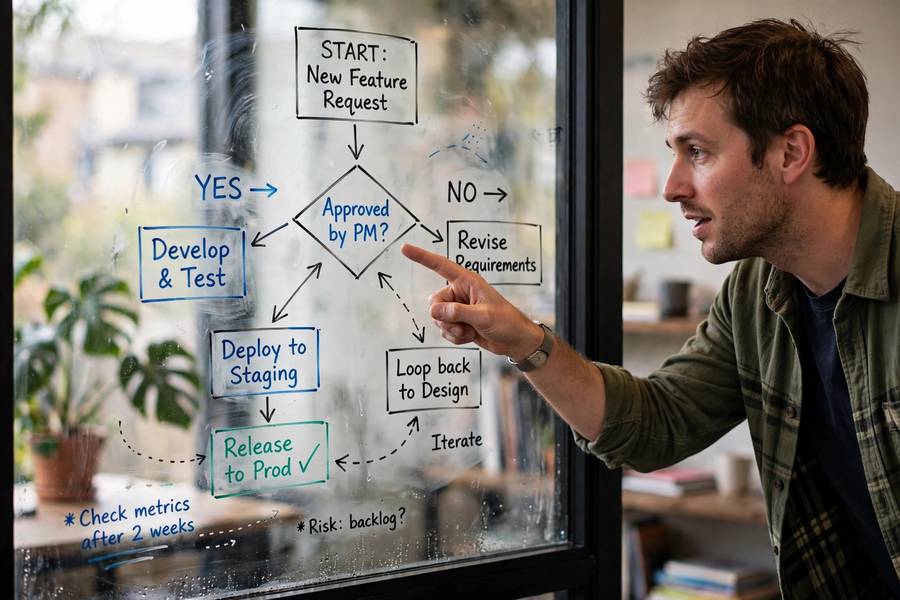
One more heuristic I trust: if you can’t draw the workflow on a whiteboard, it’s too complex. Every pattern above is drawable. If your design isn’t, simplify until it is. For implementation, the agent frameworks behind how AI agents work exist precisely to turn these whiteboard drawings into running systems.
The Cross-Cutting Concerns
Whatever patterns you choose, these concerns cut across all of them:
Context management. Each step needs the right context — enough to do its job, not so much that it drowns. Passing full transcripts everywhere is the lazy default and it degrades performance. Curate what each step sees.
Failure handling. Steps fail — model errors, tool errors, timeouts. Define retry policies (which steps retry, how many times, with what backoff), fallback paths (degraded but useful output beats no output), and escalation (when to involve a human). The happy path is the easy part; the failure paths are the system.
Cost tracking. Multi-step systems multiply costs. Instrument per-step token usage from day one, set budgets and alerts — the number of teams surprised by their agent API bills suggests this advice is under-followed.
Evaluation. You need ground truth for what “working” means — test cases with expected outcomes, run regularly. Orchestration without evaluation is flying blind; you’ll tweak prompts based on vibes and wonder why reliability drifts.
Human checkpoints. For consequential actions, build in approval gates. This isn’t anti-automation — it’s how automation earns trust. Start with humans approving everything, relax the gates as reliability is demonstrated, never relax them for irreversible actions.

Frequently Asked Questions
Agent orchestration is the design of how multiple AI agents or steps coordinate: decomposing tasks, assigning work, sequencing steps, passing context, handling failures, and deciding when work is done. It’s the workflow layer above individual agent intelligence.
The core patterns are prompt chaining (sequential steps), routing (classify then dispatch), parallelization (sectioning independent tasks or voting), orchestrator-workers (dynamic delegation), evaluator-optimizer (generate then critique in a loop), and fully autonomous agents. Real systems usually combine several.
Use prompt chaining when you can write the steps down in advance — fixed sequences with clear handoffs. Use orchestrator-workers when the decomposition varies per input and must be planned dynamically. If the steps are always the same, an orchestrator is expensive overhead.
A generator produces output, an evaluator critiques it against criteria, and the generator revises — looping until quality clears a bar or a limit hits. It’s one of the highest-ROI patterns because it enforces quality rather than hoping for it. Deterministic evaluators (tests, validators) work best where they apply.
Rarely. Full autonomy is unpredictable across runs — different plans, costs, and outcomes each time. The pragmatic standard is bounded autonomy: agentic behavior inside orchestrated structure, with verification and human checkpoints for consequential actions.