I once watched a friend climb into his new SUV, engage the lane-centering, and announce to the back seat, “Okay, the car is driving now.” The car was not driving. The car was helping him drive, and there is a canyon of difference between those two things — a canyon measured in liability, in engineering, and occasionally in lives. He thought he had autonomous driving. He had ADAS.
ADAS — Advanced Driver Assistance Systems — and autonomous driving are related the way a calculator is related to a mathematician. One assists the human; the other replaces them. The confusion between the two is the single most dangerous misunderstanding in modern motoring, and the car industry has done embarrassingly little to clear it up. This guide draws the line properly: what ADAS is, what autonomous driving is, where one ends and the other begins, and why it matters which side you’re on. For the deeper mechanics, see my guide on how self-driving cars work.
Table of Contents
- ADAS: The Assistant That Never Drives
- The ADAS Feature Menu
- Autonomous Driving: The System That Replaces You
- The One-Line Test That Separates Them
- Where the Confusion Gets Dangerous
- The Technology Overlap (and Why It Fools People)
- Why Automakers Blur the Line
- What This Means for You as a Driver
- Frequently Asked Questions
ADAS: The Assistant That Never Drives
ADAS is a bundle of features that assist the driver. The keyword is assist. Every ADAS feature operates under a non-negotiable assumption: a human is driving, watching, and responsible. The features make that human safer and more comfortable, but they never take the job.
Think of ADAS as a very attentive co-pilot. It watches your blind spots, warns you about drifting, brakes if you’re about to rear-end someone, and holds your speed on the highway. But a co-pilot doesn’t fly the plane. When things get complicated, ADAS steps back and says, “Your turn” — and it expects you to have been paying attention all along.
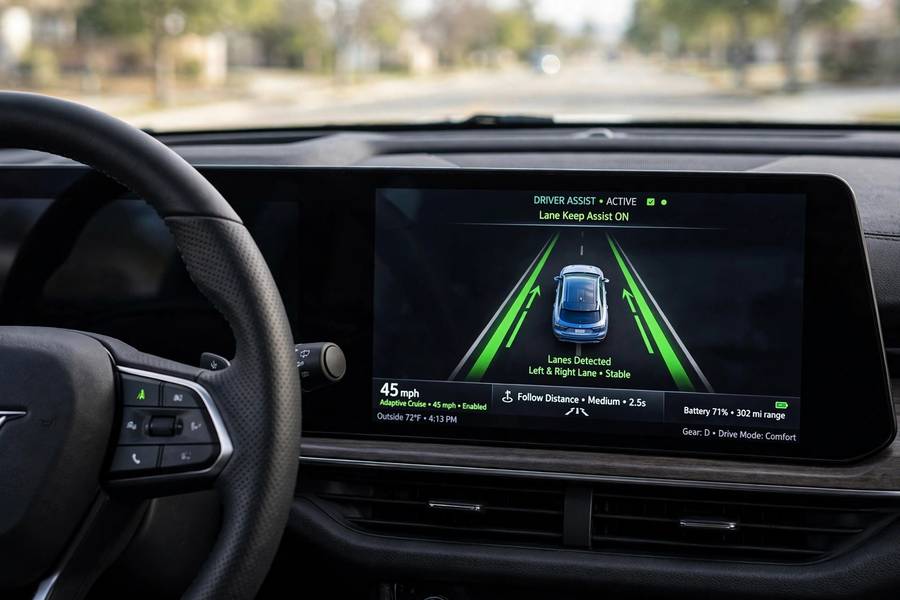
On the SAE scale, ADAS lives at Levels 0 through 2. Even the most advanced ADAS — combined adaptive cruise control plus lane centering, the thing my friend mistook for a chauffeur — is Level 2: the human supervises constantly. The moment you believe otherwise, you’ve left the feature’s design envelope, and you’re on your own.
The ADAS Feature Menu
ADAS isn’t one thing; it’s a menu of features that cars mix and match. The common ones:
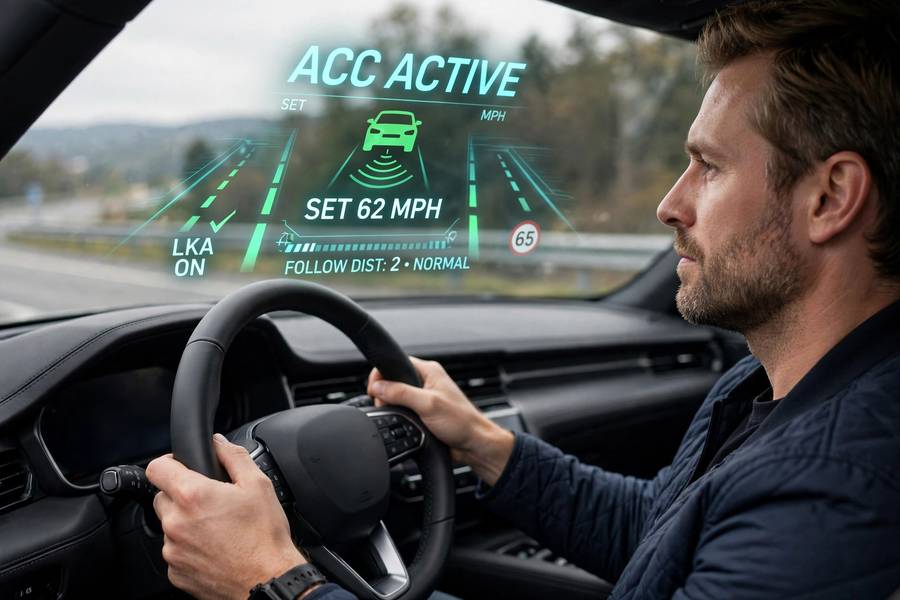
Adaptive cruise control (ACC). Holds your speed and adjusts it to maintain distance from the car ahead. The feature that made highway driving civilized. Still requires you to steer and watch.
Lane keeping assist / lane centering. Nudges the steering to keep you in the lane. Ranges from a gentle warning vibration to active steering correction. It is not lane driving — it loses the lane in construction zones, faded markings, and bad weather, cheerfully and without apology.
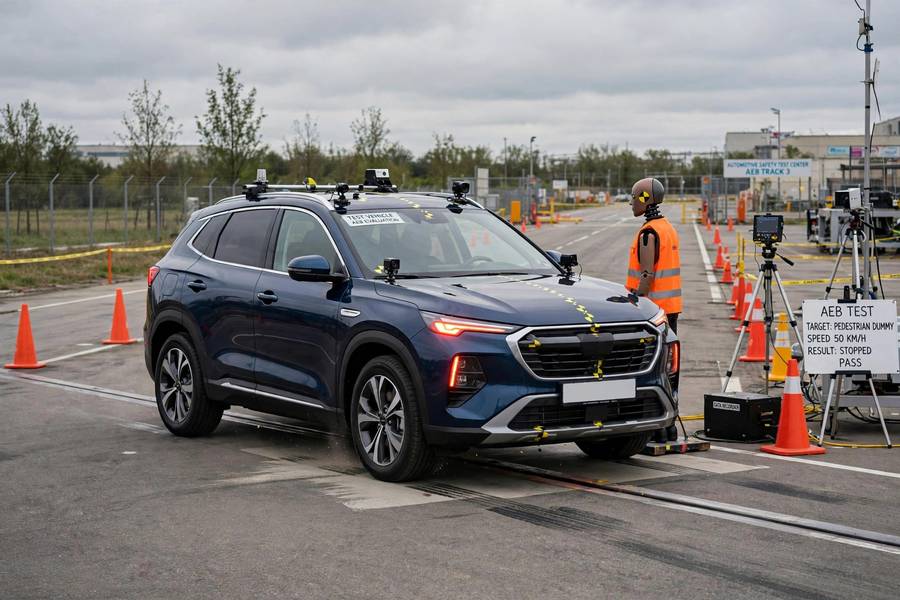
Automatic emergency braking (AEB). Detects an imminent collision and brakes if you don’t. This one genuinely saves lives — regulators in many markets now require it. But it’s a last-resort intervention, not a driving strategy.
Blind spot monitoring. Warns you about vehicles you can’t see. Simple, effective, and one of the least controversial features ever shipped.
Parking assist. Steers the car into a parking spot while you manage the pedals (or supervise fully, in newer versions). Genuinely useful, genuinely still your responsibility.
Driver monitoring. Watches your eyes and head position to confirm you’re paying attention. The feature that exists because the other features work a little too well.
Notice the pattern: each feature handles one slice of driving, and the human integrates them all. ADAS is a team of specialists reporting to one general — you.
Autonomous Driving: The System That Replaces You
Autonomous driving starts where ADAS ends: the system takes the driving task. On the SAE scale, this means Level 3 and above. The defining change isn’t technological — it’s relational. The system is now the driver (Level 3+), not the assistant (Level 0-2).
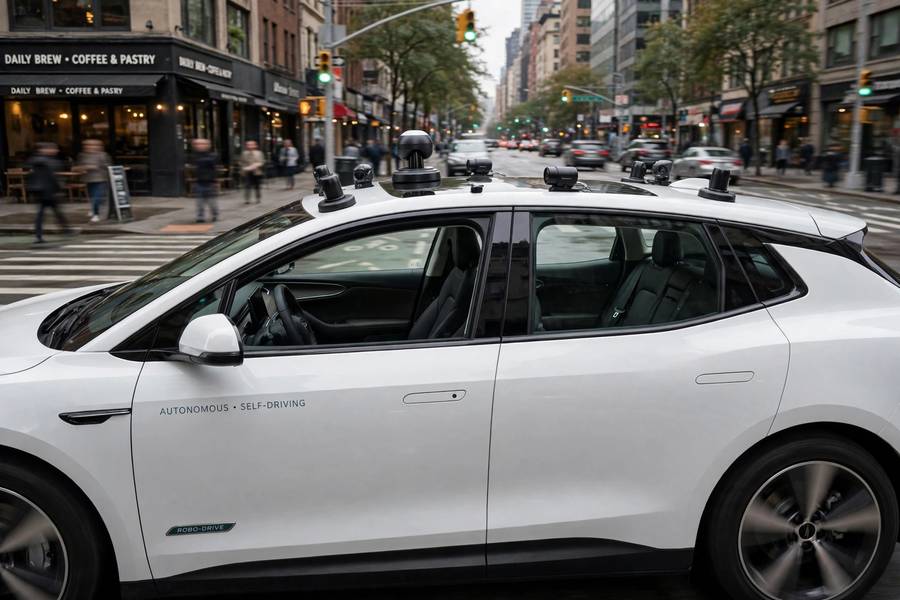
This is why the two categories feel similar but are legally and practically different worlds. An autonomous system at Level 4 doesn’t need you at all within its operating area. It monitors itself, handles its own failures, and in the robotaxi case, there’s nobody in the driver’s seat. That’s not an assistance feature with delusions of grandeur — it’s a different kind of machine.
The engineering reflects the difference too. ADAS can be built with cameras and radar and a reasonable computer. True autonomy demands redundant everything — sensors, compute, power, braking — because there’s no human to catch the failure. How self-driving cars use AI to perceive the world shows just how much heavier the lift gets when nobody’s watching.
The One-Line Test That Separates Them
Here’s my favorite diagnostic, and I use it constantly: can you legally look away from the road?
If no — and for every ADAS feature ever shipped, the answer is no — you have assistance, not autonomy. You are the driver. The features are helping.
If yes — explicitly, in the manual, backed by the manufacturer’s liability commitment — you have at least Level 3 autonomy, and the system is driving.
This test cuts through every marketing name, every demo video, every “but it basically drives itself on the highway” claim. Tesla Autopilot? Eyes on the road: ADAS. GM Super Cruise? Eyes on the road (it watches your eyes to enforce this): ADAS. Mercedes Drive Pilot in a traffic jam? Eyes off allowed, manufacturer takes liability: autonomy.
It’s a beautifully simple test because the industry’s own lawyers built it. No automaker will let you look away unless they’ve engineered and certified the system to a standard where they can defend that permission. The permission is the product.
Where the Confusion Gets Dangerous
The confusion isn’t academic. People die from it.
The pattern repeats: a driver engages an advanced ADAS feature, the feature handles easy highway miles competently, the driver’s attention drifts, and then the feature encounters something it can’t handle — a stopped fire truck, a lane split, a construction zone. The driver, now effectively a passenger, can’t re-engage in time. The crash investigation finds the driver’s hands were off the wheel for minutes.
This is called automation complacency, and it’s a well-studied human-factors trap. The better the assistance, the worse the complacency. ADAS is good enough to earn trust it hasn’t earned. Autonomous driving, paradoxically, is safer in this specific respect — because at Level 3 and above, the system is designed for the human to be disengaged, with engineered handoffs and fallback plans.
Every one of these incidents becomes a case study in AI incident reporting, and the lesson is always the same: the danger isn’t the technology’s capability, it’s the human’s mental model of the technology. If you think ADAS is autonomy, you’ll use it as autonomy, and ADAS will not save you from that mistake.
The Technology Overlap (and Why It Fools People)
Part of the confusion is honest, because the technology genuinely overlaps. Both ADAS and autonomous driving use cameras, radar, and neural networks. Both do lane detection, object detection, and path planning. A Level 2 highway assist and a Level 4 robotaxi are doing recognizably similar computations — which is why demos look similar and why people assume the difference is just “more of the same.”
But the difference is in the margins, and the margins are everything. An ADAS lane-centering system can fail gracefully by handing control to an attentive driver. An autonomous system must fail gracefully with no driver at all — which means redundant sensors, redundant compute, redundant braking and steering, and a validated safety case for every scenario in its operating domain. The jump from “works when supervised” to “works unsupervised” is not incremental.
This is also why ADAS features can be updated and improved over the air while remaining ADAS. Software updates make the assistance better; they don’t change who’s responsible. Responsibility changes only with certification, and certification is a legal event, not a software one.
Why Automakers Blur the Line
Let’s be candid about incentives. “Autonomous” sells cars. “Assistance” sounds like something your insurance company nagged you into buying. So marketing departments reach for the language of autonomy — Autopilot, Full Self-Driving, ProPilot — to describe systems that their own legal departments classify as driver assistance.
Regulators are pushing back, slowly. Advertising standards bodies have challenged misleading names. Some jurisdictions restrict what autonomy claims can be made for uncertified systems. But the fundamental tension persists: the closer ADAS gets to feeling autonomous, the more valuable the autonomous-sounding name becomes, and the more dangerous the confusion gets.
My rule is simple and I recommend it to everyone: ignore the name, find the SAE level, apply the look-away test. If the company won’t state a level clearly, it’s ADAS, and you’re the driver. No exceptions, no matter how smooth the demo felt.
What This Means for You as a Driver
Practical advice, distilled:
Know what you bought. Check the manual for the SAE level and the supervision requirements. It takes five minutes and it’s the most important five minutes you’ll spend with the car.
Never test the boundary. ADAS features fail at boundaries — faded lines, weird merges, stopped vehicles, bad weather. The boundary is where the marketing video ended. Drive like you know that.
Respect the monitoring. If the car nags you to keep your hands on the wheel or eyes on the road, it’s not being annoying — it’s telling you the truth about what it is. The nag is the feature’s honesty leaking through the marketing.
Don’t “upgrade” ADAS in your head. A software update that improves lane centering doesn’t promote your car a level. Levels change with certification, not with version numbers.
And if you ever find yourself thinking “the car has got this” while using a driver-assistance feature — it hasn’t. That’s the thought the whole ADAS-vs-autonomy distinction exists to correct. For the full technical story of what the car is actually doing when it assists you, read how self-driving cars work.
Frequently Asked Questions
ADAS (Advanced Driver Assistance Systems) assists the human driver, who remains fully responsible — the driver can never look away. Autonomous driving (Level 3+) replaces the driver within defined conditions, with the system taking responsibility. The practical test: if you must watch the road, it’s ADAS.
It is ADAS — a Level 2 driver-assistance system. The driver must supervise constantly with eyes on the road, and Tesla does not accept liability during operation. Despite its name, it is not autonomous driving.
Common ADAS features include adaptive cruise control, lane keeping assist, automatic emergency braking, blind spot monitoring, parking assist, and driver monitoring systems. All of them assist rather than replace the driver.
No. Even the most advanced ADAS (Level 2) requires constant human supervision — eyes on the road, ready to take over instantly. ADAS that feels self-driving on easy highways still fails at boundaries like construction zones and stopped vehicles.
Because it causes automation complacency: drivers disengage their attention, treating assistance as autonomy. When the system reaches something it can’t handle, the disengaged driver can’t re-engage in time. This mismatch has caused fatal crashes.