How to Price Car Detailing Packages: Build Tiers That Sell

Most detailers price packages by copying a competitor’s menu and shaving 10% off. That is how you inherit someone else’s bad math and add a race to the bottom on top of it. I have audited dozens of detailing menus, and the profitable ones all share the same architecture — built from costs up, not from competitors down.
This is the step-by-step method for how to price car detailing packages: time your work, set your rate, build the tiers, and layer the upsells. It sits inside our broader how to start a car detailing business guide, but honestly, this is the page that determines whether the business makes money.
The Good-Better-Best Framework
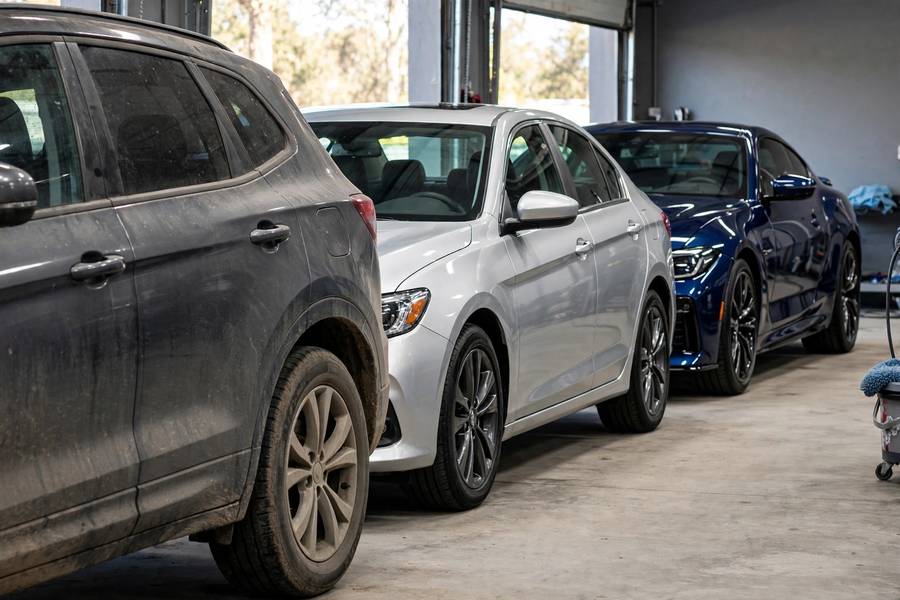
Three tiers outperform one price and outperform five options. The psychology is well documented: with a single price, the customer decides yes or no. With three, they decide which one — and 60-70% land in the middle. Your job is to engineer the middle tier to be the obvious choice and your best seller.
The tiers have distinct jobs:
- Good (entry): Low commitment, gets the customer to try you. Designed for conversion and recurring plans, not margin.
- Better (flagship): The package you actually want to sell. Best value perception, healthiest margin per hour, highest volume.
- Best (premium): The aspiration. Bought by 15-20% of customers, highest absolute margin, and its real job is making Better look reasonable.
Price gaps matter: the jump from Good to Better should feel small ($50-$100), and Better to Best should feel like a real step up ($100-$200). If Good is $129 and Better is $139, nobody buys Good and you have wasted a tier. If Good is $129 and Better is $329, the gap is too wide and customers default down. The sweet spot is a 60-100% step between tiers.
Step 1: Time Every Service
You cannot price what you have not timed. For two weeks, run a stopwatch on every distinct task: exterior wash, wheels and tires, interior vacuum, shampoo seats, windows, door jambs, engine bay, headlight restoration, one-step polish. Log the times by vehicle size (sedan / SUV / truck).
You will discover two things. First, your estimates are wrong — almost always optimistic by 20-30%. Second, your times vary wildly by condition. A maintained sedan interior takes 45 minutes; a neglected one takes 2.5 hours. That variance is why flat pricing without condition adjustments bleeds money.
Build a simple time table:
| Task | Sedan (maintained) | SUV (neglected) |
|---|---|---|
| Exterior wash + wheels | 45 min | 75 min |
| Interior vacuum + wipe | 40 min | 90 min |
| Seat/carpet shampoo | 60 min | 120 min |
| Windows + jambs | 25 min | 40 min |
| Engine bay | 30 min | 45 min |
| One-step polish | 3 hours | 4.5 hours |
Your packages are just bundles of these tasks. A “Full Detail” = wash + wheels + interior + shampoo + windows + jambs = roughly 3 hours on a maintained sedan, 5+ on a neglected SUV. Now you know what each package costs you in time — the foundation everything else stands on. This is the unglamorous work that separates a real operation from what a startup actually is in the wishful-thinking phase: a business with numbers.
Step 2: Set Your Base Hourly Rate
Your hourly rate is not what you pay yourself — it is what the business must earn per labor hour to survive and grow. Calculate it honestly:
- Target personal income: Say $72,000/year ($6,000/month).
- Add business overhead: Insurance, vehicle, phone, software, marketing, supplies — typically $1,500-$2,500/month for a solo mobile operator. Call it $2,000.
- Total monthly need: $8,000.
- Billable hours: You will not bill 40 hours a week. Between driving, quoting, admin, and gaps, a solo operator bills 20-28 hours weekly. Use 100 billable hours/month as a realistic figure.
- Rate: $8,000 / 100 hours = $80/hour.
That $80/hour is your floor, not your price. It covers costs and your salary with zero profit and zero growth. Your package prices should target $90-$120 in effective hourly revenue, leaving 15-30% margin for profit, slow weeks, and reinvestment.
Beginners routinely discover their “competitive” $149 full detail earns them $45/hour after costs. That is not a business; it is a low-paying job with extra steps. How to become an entrepreneur in detailing starts with refusing to work for less than the rate the math demands.
Step 3: Design the Three Tiers
Now build the actual packages using your timed tasks and your hourly rate. Here is a worked example for a mobile operator at an $80/hour floor:
Good — “The Refresh” — $129 – Exterior wash, wheels, tires, windows – Interior vacuum, wipe-down, windows – Time: ~1.5 hours | Revenue/hour: $86 – Positioned as the monthly maintenance plan ($119/month recurring)
Better — “The Full Detail” — $249 – Everything in Refresh, plus: – Deep interior: shampoo seats and carpets, stain treatment, vents and crevices – Door jambs, trim dressing, spray sealant – Time: ~3 hours | Revenue/hour: $83 – Your flagship — 60%+ of bookings should land here
Best — “The Showroom” — $429 – Everything in Full Detail, plus: – Clay decontamination and one-step machine polish – Engine bay detail – 6-month paint sealant – Time: ~5.5 hours | Revenue/hour: $78 (lower per hour, highest absolute margin: ~$200+)
Notice the flagship sits at the price most competitors charge for their basic full detail — because your Better includes more and is presented as the middle. The names sell outcomes (Refresh, Full Detail, Showroom), not processes. And each tier’s description lists 6-9 bullet points — long enough to feel substantial, short enough to scan in 30 seconds.
Vehicle size adjustments: +15% for large SUVs/trucks, applied automatically at booking. State it on the menu so it never feels like a surprise.
Step 4: Price Add-Ons and Upsells
Add-ons are priced differently from packages: they ride on sunk setup time, so they should carry 60-75% margins. The customer is already committed; the upsell is incremental.
| Add-On | Price | Time | Margin |
|---|---|---|---|
| Engine bay | $69 | 30 min | ~70% |
| Headlight restoration | $99 | 45 min | ~75% |
| Pet hair removal | $59 | 30-45 min | ~70% |
| Odor elimination | $89 | 60 min | ~65% |
| Seat shampoo (standalone) | $79 | 45 min | ~70% |
| Paint sealant upgrade | $49 | 20 min | ~80% |
| Trim restoration | $59 | 30 min | ~70% |
The upsell moment is at booking, not pickup: “Your Full Detail is $249 — while we’re doing the interior, most customers add the engine bay for $69. Want me to include it?” This single sentence, asked consistently, lifts average tickets 25-40%. At pickup, the same offer closes at a tenth of the rate — the wallet is already closing.
Bundles are the advanced move: “The Road Trip Package — Full Detail + Engine Bay + Headlights, $379 (a $417 value).” The customer perceives $38 in savings; you lock in three services at protected margins with one yes. Build 2-3 seasonal bundles and rotate them.
Step 5: Test, Measure, Adjust
Pricing is not set-and-forget. Run it like an experiment with a 90-day review cycle:
- Track conversion by tier. If 80% buy Good, your Better is overpriced or under-described. If 40% buy Best, your Best is underpriced — raise it. Healthy split: 20% Good / 60% Better / 20% Best.
- Track average ticket monthly. It should rise as your upsell process improves. Flat average tickets with rising costs means margin erosion — the silent killer.
- A/B test one change at a time. Raise Better by $20 for new customers for a month. If bookings hold, keep it. If they drop more than 15%, revert. Never change two variables at once.
- Survey lost quotes. When someone does not book, ask why — one question, no pressure. If “price” comes up more than 30% of the time, your value communication is broken, not necessarily your price.
- Annual increase: 5-10%. Costs rise every year; prices must follow. Grandfather loyal recurring customers for 60-90 days, raise new customers immediately.
The operators who treat pricing as a living system end up charging double the set-and-forget crowd within three years — for identical work. The menu is a product. Iterate on it.
Pricing Mistakes That Cost Real Money
The greatest hits of detailing pricing self-destruction:
- Copying competitors minus 10%. You inherit their bad math and start a price war you cannot win. Price from your costs up.
- Hourly billing. Customers hate watching the clock and you get punished for efficiency. Package pricing rewards speed and skill.
- Too many packages. Seven packages plus twelve add-ons causes decision paralysis. Three tiers, seven add-ons max on the first quote.
- No condition surcharge. Quoting a biohazard interior at standard rates is charity. Build “excessive soiling” surcharges (25-50%) into the menu and quote from photos.
- Discounting to close. Every discount trains the customer to wait for the next one. Hold the price and add value instead — a free air freshener costs $2 and closes as well as a $20 discount.
- Forgetting the mobile premium. If you drive to the customer, that convenience is worth 10-20%. Bake it in. Shops cannot offer it; it is your structural advantage.
- Never raising prices. The detailer who has charged $199 for five years is earning less every year in real terms. Annual increases are maintenance, not greed.
Avoid these seven and your pricing will outperform 90% of the market on day one.
Frequently Asked Questions
Time every task, calculate your required hourly rate (monthly income need plus overhead, divided by realistic billable hours), then build three tiers — Good, Better, Best — priced from your costs up. Target $90-$120 in effective hourly revenue to leave 15-30% margin.
A basic (Good tier) package typically includes exterior wash, wheels and tires, windows in and out, interior vacuum, and wipe-down of surfaces — about 1.5 hours of work, priced $99-$149. Position it as the entry point and monthly maintenance plan.
Three tiers plus up to seven add-ons on the first quote. Three options convert best because 60-70% of buyers choose the middle; more than five packages causes decision paralysis and kills bookings.
Yes — add 15% for large SUVs and trucks and 10-15% for three-row vehicles, applied automatically at booking and stated on the menu. Also build in a 25-50% excessive-soiling surcharge quoted from photos for neglected interiors.
Price add-ons at 60-75% margins since they ride on sunk setup time: engine bay $69, headlight restoration $99, pet hair removal $59, odor elimination $89. Offer them at booking (40-50% close rate), not at pickup.
Plan 5-10% annual increases. Test changes on new customers first for a month — if bookings hold, keep the increase; if they drop more than 15%, revert. Never change two pricing variables at once, and track average ticket monthly to catch margin erosion early.