How to Buy an Existing Business: A Step-by-Step Buyer’s Guide


I’m Jonathan. Starting from scratch gets the glory, but buying an existing business is often the smarter path: immediate cash flow, existing customers, trained staff, proven systems. You skip the brutal first two years where most startups die. The trade-off? You’re buying someone else’s problems along with their assets — and your job is to find every one of them before you pay.
I’ve been on both sides of acquisitions. Here’s the buyer’s process, done right.
In This Guide
- Why Buy Instead of Starting?
- Step 1: Define What You’re Looking For
- Step 2: Find Businesses for Sale
- Step 3: Evaluate Like a Skeptic
- Step 4: Value It and Structure an Offer
- Step 5: Finance the Purchase
- Step 6: Due Diligence — Trust, Then Verify
- Step 7: Close and Take Over
- Frequently Asked Questions

Why Buy Instead of Starting?
The case for buying is strong and underappreciated:
- Immediate cash flow. The business earns from day one. No 18-month valley of death.
- Proven concept. Customers already buy. You’re not validating — you’re operating.
- Existing assets. Staff, equipment, supplier relationships, brand recognition, location — all included.
- Financing is easier. Banks love lending against existing cash flow. SBA loans for acquisitions are a well-trodden path.
- Higher survival odds. Established businesses fail far less often than startups.
The case against: you pay a premium over startup costs, you inherit hidden problems, and changing an existing culture is harder than building one. Buying suits operators; starting suits inventors. Know which you are.
If you’re weighing the entrepreneurial path broadly, my guide on how to become an entrepreneur frames the choice — and what a startup is covers the very different venture-backed alternative.
Step 1: Define What You’re Looking For
Vague buyers waste years. Get specific before searching:
- Industry: where do you have experience or genuine interest? Buying in an industry you don’t understand multiplies risk.
- Size: revenue and cash-flow range matching your financing capacity. A common beginner range: $500K–$2M revenue.
- Geography: how far will you commute daily? Be honest.
- Role: owner-operator (you run it) or absentee (management in place)? This changes everything about what qualifies.
- Budget: purchase price plus 6–12 months working capital reserve. Never spend your last dollar on the purchase.
Write your criteria down. It prevents the #1 buyer mistake: falling in love with a business that doesn’t fit and rationalizing afterward.
Step 2: Find Businesses for Sale
Online marketplaces: BizBuySell, BizQuest, and industry-specific sites list thousands of businesses. Good for market education and deal flow, but the best deals often sell before listing publicly.
Business brokers: build relationships with brokers in your target market and industry. Tell them exactly what you’re looking for. Serious buyers who can close get called first when good listings come in.
Direct outreach: identify businesses you’d want to own and contact owners directly. Many owners consider selling but never list — a respectful letter or call can unlock off-market deals with less competition.
Industry networks: trade associations, suppliers, accountants, and attorneys often know who’s thinking of selling before anyone else.
Search funds / aggregators: if you’re looking at larger deals, these professional buyers are competition — understand how they operate.
Evaluate 20–30 listings seriously before making an offer. The education is worth it: you’ll learn pricing, spot patterns, and recognize a genuinely good deal when it appears.
Step 3: Evaluate Like a Skeptic
For each serious candidate, interrogate these areas:
Financials. Get 3 years of tax returns, P&Ls, and balance sheets. Reconcile them — discrepancies between tax returns and internal books are red flags. Verify revenue with bank statements, not just QuickBooks. Understand why they’re selling (retirement and relocation are good reasons; “pursuing other opportunities” after 18 months of decline is not).
Customers. Who are the top 10? What percentage does each represent? Are relationships with the owner or the business? Will they stay? Ask to speak with key customers during diligence.
Operations. Can it run without the owner for two weeks? Documented processes? Key employees — will they stay? Supplier relationships and terms? Equipment condition and age?
Market. Industry trends, competitive position, barriers to entry, regulatory risks. A business that’s profitable today but in structural decline is a trap.
Legal. Pending litigation, compliance issues, license transferability, lease terms and assignability (the lease can kill deals — verify duration, rates, and transfer rights early).
The seller. Are they burnt out and checked out (negotiating advantage, but diligence risk)? Are they emotionally attached (harder negotiation, smoother transition)? Understanding motivation helps you structure the deal.

Step 4: Value It and Structure an Offer
Value using earnings multiples (2–4x SDE for small businesses is typical), cross-checked against comparable sales and asset values. Then structure the offer — structure matters as much as price:
- Cash at close: cleanest, strongest negotiating position, requires full financing.
- Seller financing: seller carries 10–30% of the price as a note. Common, aligns incentives (seller stays invested in your success), and can bridge valuation gaps.
- Earnouts: portion tied to future performance. Protects you if the business underperforms; sellers dislike them — use sparingly and with clear metrics.
- Asset vs. stock purchase: asset purchases (buying the assets, not the entity) are standard for small deals — you avoid hidden liabilities. Your attorney will guide this.
Offer components: price, structure, due diligence period (30–90 days), non-compete terms, transition support period, training commitments, and contingencies (financing, lease assignment, license transfer).
Start with a letter of intent (LOI) — non-binding on price, binding on confidentiality and exclusivity. It frames the deal before expensive legal work begins.
Step 5: Finance the Purchase
Common financing paths, often combined:
- SBA 7(a) loans: the workhorse of small-business acquisition. 10–25% down, up to 10-year terms, competitive rates. Requires good credit, relevant experience, and patience (60–90 days to close).
- Seller financing: as above — often 10–30% of the deal. Sellers offering financing signal confidence in the business.
- Conventional bank loans: for larger, well-collateralized deals.
- Rollover (ROBS): using retirement funds without penalty — complex, get specialist guidance.
- Investor/partner capital: for larger acquisitions; changes the ownership dynamic.
- Your cash: skin in the game matters — lenders and sellers both want to see it.
Get pre-qualified before making offers. Sellers take financed buyers seriously only when the financing is real. And keep a working-capital reserve — the business will need cash in the first months under your ownership, guaranteed.
Step 6: Due Diligence — Trust, Then Verify
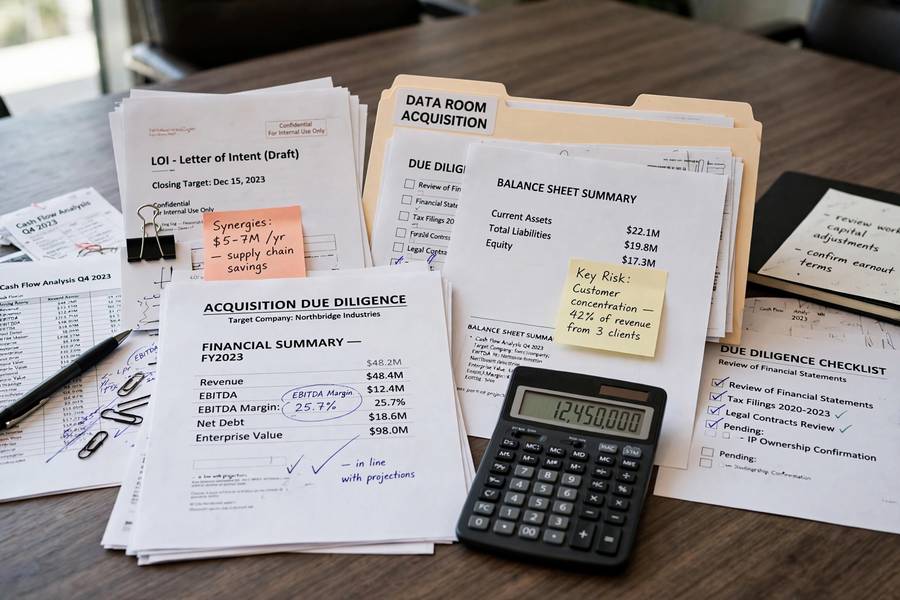
The 30–90 days after your offer is accepted are for verifying everything the seller claimed. Your checklist:
- Financial diligence: accountant reviews books, verifies revenue against bank deposits, checks for unrecorded liabilities.
- Legal diligence: attorney reviews contracts, leases, licenses, litigation, compliance, IP ownership.
- Operational diligence: you spend time in the business. Talk to employees (carefully — confidentiality still matters), observe operations, meet key customers and suppliers.
- The “walk away” list: define deal-breakers before diligence starts — undisclosed liabilities, customer concentration worse than represented, lease problems, regulatory issues. Emotional attachment grows during diligence; the pre-written list keeps you honest.
Most deals uncover something. The question is whether it’s a price adjustment, a restructured term, or a walk-away. Be prepared for all three outcomes.
Step 7: Close and Take Over
Closing involves final purchase agreements, fund transfers, and license/lease assignments. Then the real work begins:
- First 90 days: change nothing major. Learn the business, build employee trust, understand customers. New owners who “fix” everything in week one destroy value.
- Retain key employees. They’re the institutional knowledge. Retention bonuses tied to the transition period are cheap insurance.
- Use the seller’s transition support. Most deals include 3–12 months of seller availability. Use it — the seller knows things no document captures.
- Communicate carefully. Employees, customers, suppliers — each needs to hear the right message: stability, continuity, gradual improvement. Fear of change kills more acquisitions than bad numbers do.
- Track against your investment thesis. You bought for specific reasons — measure whether they’re materializing, and adjust.
Buying an existing business is the highest-probability path to business ownership: define your criteria, search broadly, evaluate skeptically, structure smart, verify everything, and transition patiently. The premium you pay over starting from scratch buys you the two things startups can’t: existing cash flow and proof the concept works. Do the diligence, and it’s money well spent.
Frequently Asked Questions
Buying offers immediate cash flow, proven concept, existing customers and staff, easier financing, and higher survival odds. Starting offers lower cost, full control, and no inherited problems. Buying suits operators who want established cash flow; starting suits inventors with a novel idea. Most first-time owners do better buying.
Small businesses typically sell for 2–4x seller’s discretionary earnings. With SBA financing, buyers put 10–25% down — so a $1M business might require $100K–$250K down plus working capital reserves. Keep 6–12 months of operating cash beyond the purchase price.
Online marketplaces (BizBuySell, BizQuest), business brokers in your target market, direct outreach to owners who might sell, and industry networks (trade associations, accountants, attorneys). The best deals often sell through broker relationships before hitting public listings.
The 30–90 day verification period after your offer is accepted: accountants verify financials against bank records, attorneys review contracts/leases/litigation, and you spend time in the business meeting employees, customers, and suppliers. Define your walk-away deal-breakers before diligence starts to stay objective.
Yes — SBA 7(a) loans are the most common path, requiring 10–25% down, good credit, and relevant experience, with 60–90 day closings. Seller financing (10–30% of price) is also common and signals seller confidence. Get pre-qualified before making offers so sellers take you seriously.