Here’s the dirty secret about getting into manga: the hardest part isn’t reading — it’s choosing. A wall of thousands of volumes, most of them volume 47 of something, all assuming you know the deal. And the standard advice (“just read One Piece!”) is terrible — 100+ volumes isn’t a starting point, it’s a mortgage.
The best manga for beginners are complete or short, with legible art, strong openings, and — crucially — they show what makes manga manga, not just comics from Japan. Twelve genuinely welcoming picks. No homework required.
Table of Contents
- Best Manga for Beginners: What “Beginner-Friendly” Actually Means
- Start Here: The Three Perfect First Manga
- Short and Complete: Stories You Can Actually Finish
- Genre Gateways: Action, Horror, Romance, and Slice of Life
- The Classics Worth Your Time (and the Ones to Skip for Now)
- How to Read Manga Without Feeling Lost
- Where to Go Next: Building Your Reading Life
- Frequently Asked Questions
Best Manga for Beginners: What “Beginner-Friendly” Actually Means
Most “beginner manga” lists are popularity contests. Here’s the actual definition:
Complete or nearly so. Nothing kills momentum like hitting the end of what’s available and waiting years for more. Beginners should read finished stories — beginning, middle, end — to experience the full arc of what manga can do.
Legible art. Some legendary manga has incredibly dense art (Berserk) that’s hard to parse until your eyes adjust. Beginner picks need clear panel flow, readable action, distinguishable characters. You’re learning a visual language; start with large print.
Strong openings. Manga is serialized — chapters compete weekly — so the good stuff hooks fast. But some classics take dozens of chapters to find themselves. Beginners don’t have that patience banked. Every pick here grabs you within the first volume.
Self-contained. No prior knowledge, no spin-off dependencies, no “read these 12 series first.” Each pick is its own complete experience.
Representative. A first manga should show what the medium does that nothing else does — pacing, paneling, visual metaphor. If you’ve studied how to write a screenplay, you’ll recognize story architecture — but manga’s visual grammar is its own education.
Start Here: The Three Perfect First Manga
If you read nothing else here, read one of these.
Death Note (12 volumes, complete). A bored genius finds a notebook that kills anyone whose name he writes in it, and decides to become god. A detective known only as “L” decides to stop him. The most addictive cat-and-mouse game in manga — psychological chess where every chapter ends on a revelation reframing the last. Clean, cinematic art; hooks in ten pages; twelve volumes you can actually finish. The manga I hand to skeptics. It converts them.
Fullmetal Alchemist (27 volumes, complete). Two brothers, a failed resurrection, a military conspiracy — the best-plotted long manga ever written. Every thread pays off, every character matters, the ending is perfect. Expressive, readable art; adventure balanced with genuine moral weight. If you read one long manga in your life, make it this one.
Yotsuba&! (ongoing, episodic). A strange little green-haired girl experiences the everyday world with total wonder — the most joyful thing in manga. Self-contained slice-of-life chapters: the park, cicadas, crayons. No continuity, no villains, no homework. Manga as pure delight — proof the medium’s range extends beyond the epic. Some of the best manga is just… lovely.
Short and Complete: Stories You Can Actually Finish
The beginner’s superpower is finishing things. Short complete series deliver the full manga experience — arc, payoff, satisfaction — in a weekend.
All You Need Is Kill (2 volumes, complete). The novel behind Edge of Tomorrow, in two lean volumes of military sci-fi. A soldier relives the same doomed battle, learning more each loop. Tight, propulsive, over before it can waste your time — proof manga does hard sci-fi with total efficiency.
Solanin (2 volumes, complete). Inio Asano’s story of twenty-somethings drifting after college — dead-end jobs, a band that might be something, the terror of ordinary adulthood. The most emotionally honest manga about being young and lost I’ve read. Photorealistic detail, devastating quiet moments. For anyone who thinks manga is all fantasy battles: the corrective.
Pluto (8 volumes, complete). Naoki Urasawa reimagines an Astro Boy arc as a murder mystery about robot rights, war, and grief. Manga at prestige-television level — dense, humane, meticulously plotted. Urasawa is the medium’s greatest living storyteller; this is his most accessible entry. Eight volumes that read like the best limited series you’ve binged.
A Silent Voice (7 volumes, complete). Before the beloved film: a former bully seeking redemption with the deaf girl he tormented. The manga goes deeper — more interiority, more supporting cast, harder questions about guilt. Genuinely moving, never manipulative. A masterclass in using the medium’s tools for empathy.

Genre Gateways: Action, Horror, Romance, and Slice of Life
Follow your taste. Each genre has a perfect ambassador.
Action: Demon Slayer (23 volumes, complete). Popular because it works. A kind-hearted boy becomes a demon slayer to save his sister — spectacular action with unusual emotional sincerity. Gorgeous sword techniques, villains with real backstories, complete. The anime is flashier; the manga’s pacing is tighter.
Horror: Uzumaki (3 volumes, complete). Junji Ito’s masterpiece: a town cursed by spirals. Three volumes of escalating dread — body horror, cosmic horror, imagery that lives in your head rent-free. Hyper-detailed, grotesque, impossible to look away from. (Read in daylight. Trust me.)
Romance: Your Lie in April (11 volumes, complete). A traumatized piano prodigy, a free-spirited violinist, and the lie structuring the story. Melodramatic in the best way — big emotions, earned honestly, classical music woven through every chapter. The ending destroys readers. You’ll cry. Worth it.
Slice of life: Barakamon (18 volumes, complete). A pretentious young calligrapher exiled to a rural island gets humbled by its residents — especially a precocious six-year-old. Warm, funny, genuinely wise about creativity and ego. Comforting and substantial: the perfect palate cleanser.
The Classics Worth Your Time (and the Ones to Skip for Now)
Some canonical manga is beginner-friendly. Some is a trap.
Read now: One-Punch Man. A hero so strong he’s bored — the premise is a joke, the execution increasingly epic. Yusuke Murata’s art is the most technically impressive in mainstream manga, and early volumes are self-contained enough to sample.
Read now: 20th Century Boys (22 volumes, complete). Urasawa again — a sprawling mystery of childhood friends, a cult, a decades-long conspiracy. Long but propulsive; the mystery pulls you forward. The rare long classic that respects a beginner’s time.
Skip for now: Berserk. A masterpiece and the worst possible first manga. Extraordinarily dense art, brutally dark content, unfinished (the creator’s death left it incomplete). Come back when fluent.
Skip for now: One Piece. Also a masterpiece, also a terrible start. 100+ volumes is a commitment you can’t evaluate until you love the medium. Graduate to epics later.
Skip for now: anything requiring lore. Skip the Fate franchise, mid-stream Jump series, anything whose wiki has a “reading order” page. Your first manga needs zero prerequisites.
The pattern: reputation isn’t accessibility. Read the welcoming masterpieces first. The intimidating ones will wait — and you’ll appreciate them more with trained eyes.
How to Read Manga Without Feeling Lost
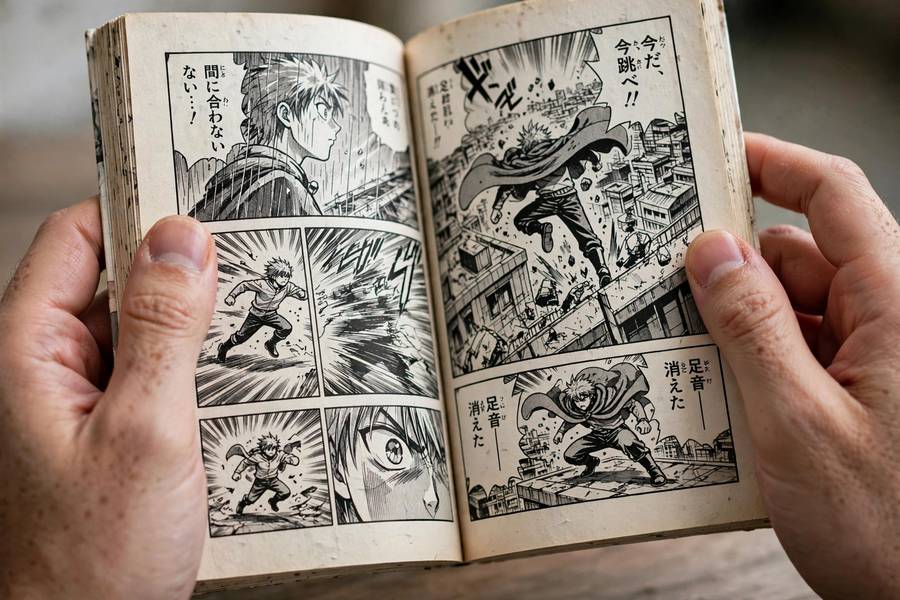
Right to left. Manga reads right-to-left, top-to-bottom — panels, pages, everything. Your eyes fight it for twenty pages, then it clicks. Don’t “practice” — just start; adaptation is automatic.
Savor the art. New readers rush dialogue and skim art. Slow down. Manga lives in the visuals — compositions, negative space, silent reaction shots. Some of the medium’s best moments have no words. The filmmaking tips on visual storytelling apply: composition is narrative.
Black and white is the point. Nearly all manga is monochrome — not a limitation, an aesthetic. Ink work, screentone, contrast: manga artists do with black and white what colorists do with palettes. Don’t wait for color; see what’s there.
Digital vs. physical. Physical volumes are lovely, but digital (official apps like Shonen Jump’s — huge library, few dollars a month) is the economical way to explore. Discover digitally; buy physical for the ones you love.
It’s okay to drop things. Not every acclaimed manga is for you. Three volumes without a hook? Move on. Dropping a series isn’t failure; it’s curation.
Where to Go Next: Building Your Reading Life
Month one: Death Note or Fullmetal Alchemist. Learn that manga can grip you like nothing else.
Month two: One short complete series in your genre (Uzumaki for horror, Solanin for realism, Pluto for mystery). Learn the medium’s range.
Month three: Yotsuba&! or Barakamon. Learn that quiet manga hits as hard as loud manga.
Month four: Follow your obsession. You’ll know what you crave — more Urasawa, more horror, the long epics (now you’re ready for One Piece and Berserk). Training wheels off.
Parting truths: manga rewards volume — visual literacy grows fast, and dense series become transparent. Your taste will evolve; what you love at month six will embarrass you at eighteen, and that’s growth. And the community is half the fun — forums, essayists, friends arguing about chapters at midnight.
One more: reading manga in Japanese is a shockingly effective language motivator — guides on how to learn a new language faster exist for exactly this. Plenty of readers started with “I want to read the raws” and ended up bilingual. It starts with one volume. It doesn’t end.

Frequently Asked Questions
Death Note (12 volumes) is the perfect first manga — addictive, complete, with clean art. Fullmetal Alchemist (27 volumes) is the best long starter, and Yotsuba&! is the most purely joyful entry point with zero continuity to track.
No — One Piece is 100+ volumes, which is an overwhelming starting point. Start with short complete series like Death Note, Pluto, or Solanin. Graduate to the long epics once you know you love the medium.
Manga reads right-to-left, top-to-bottom — panels and pages. It feels strange for about twenty pages, then becomes automatic. Just start reading; your eyes adapt without any special practice.
All You Need Is Kill (2 volumes), Solanin (2 volumes), and Uzumaki (3 volumes) are all complete in a weekend. Pluto (8 volumes) and A Silent Voice (7 volumes) offer deeper experiences that still respect your time.
Absolutely — manga spans every genre. Solanin (realistic drama about twenty-somethings), Barakamon (rural slice of life), and Pluto (sci-fi murder mystery) contain no fantasy tropes and work purely as great storytelling.
Official apps like Shonen Jump offer huge libraries for a few dollars a month. Bookstores and libraries carry physical volumes. Read digitally to explore widely, then buy physical copies of the series you love.