
The jump shot is basketball’s signature skill — and its most misunderstood. Most players learn by imitating what looks cool rather than what works, which is how you end up with side-spin bricks and a hitch that no coach can fix in one session.
Here’s the truth: great shooters aren’t born with touch. They’re built through thousands of reps of correct mechanics. Steph Curry’s form looks effortless because it’s been grooved into muscle memory over decades. The mechanics themselves are learnable by anyone, and they haven’t changed in fifty years.
Whether you’re picking up a ball for the first time or rebuilding a broken shot, this is the complete guide to shooting it right.
Table of Contents
- The Shooting Foundation: BEEF
- Footwork and Balance
- Hand Placement and the Shooting Pocket
- The Release and Follow-Through
- Arc: The Most Underrated Element
- Common Shooting Mistakes
- Drills That Build a Jumper
- Shooting Off the Dribble and Catch
- The Mental Side
- Frequently Asked Questions
The Shooting Foundation: BEEF
Coaches have taught shooting with the acronym BEEF for decades because it works. Memorize it:
B — Balance. Feet shoulder-width, knees bent, weight balanced. Every good shot starts from a stable base. If you’re falling sideways, nothing downstream works.
E — Eyes. Eyes on the target — specifically, the back of the rim. Where your eyes go, the ball follows. This is the simplest fix for most bad shooters and the most ignored.
E — Elbow. Shooting elbow tucked in, forming roughly a 90-degree angle, aligned under the ball. The classic flaw is the “chicken wing” — elbow flared out, which sends shots sideways.
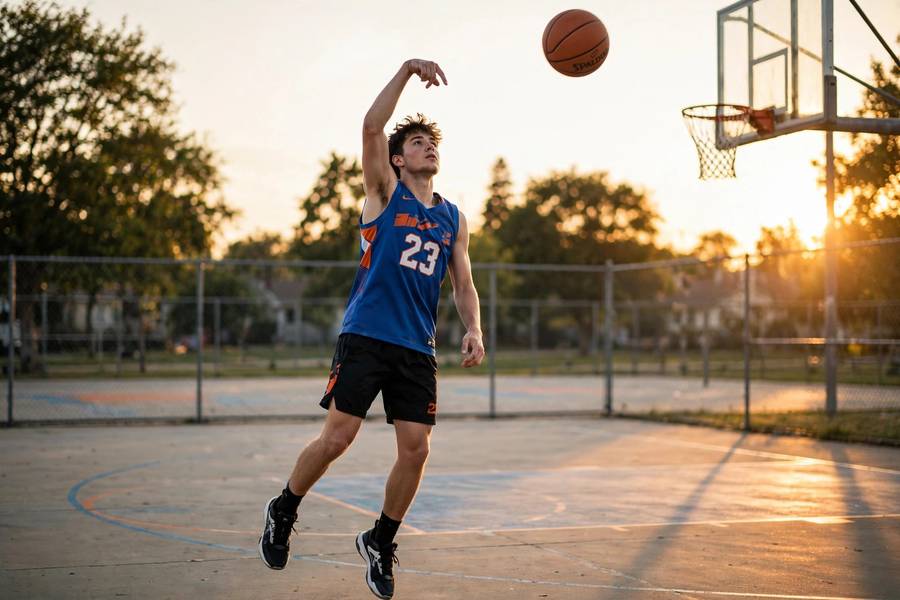
F — Follow-through. Snap the wrist, hold the follow-through until the ball hits the rim. Your hand should finish like you’re reaching into a cookie jar on a high shelf.
BEEF isn’t just for beginners. Pros revisit these fundamentals constantly — when a shot goes cold, the fix is almost always in one of these four letters.
Footwork and Balance
Before the ball moves, the feet set everything:
- Feet shoulder-width apart, shooting-foot slightly ahead (a few inches — the “turned” stance most pros use)
- Knees bent, weight on the balls of your feet — loaded like a spring
- Square to the basket — shoulders aligned, not twisted
- Rise straight up, not forward or sideways. Drift kills consistency.
The jump itself should be minimal for set shots — just enough lift to get rhythm. You’re shooting, not dunking. Excessive jumping adds variables; the best shooters barely leave the ground on open looks.
Hand Placement and the Shooting Pocket
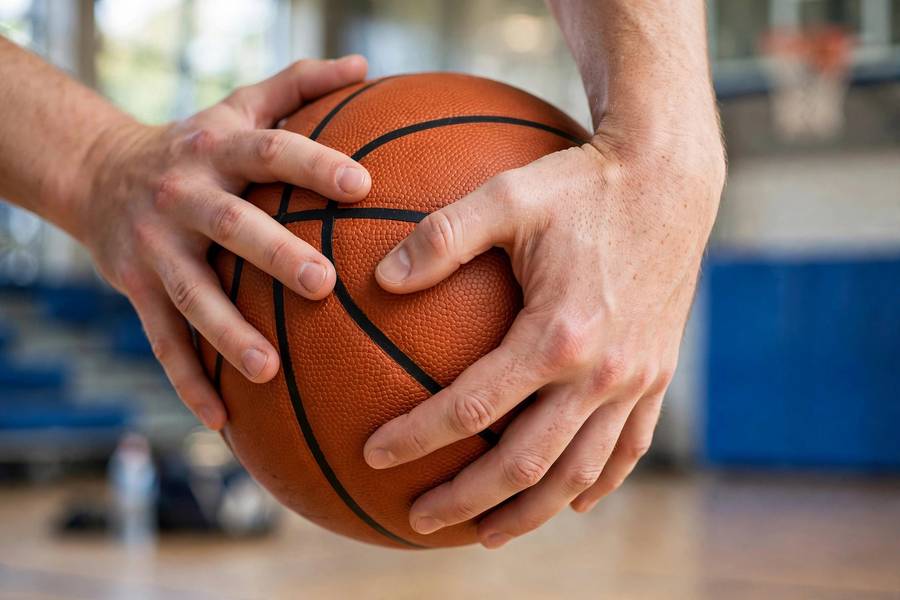
Shooting hand (dominant): under/behind the ball, fingers spread, ball resting on finger pads — not the palm. There should be a small gap between palm and ball; palming it kills touch and backspin.
Guide hand (non-dominant): on the side of the ball, thumb forming a “T” with the shooting hand’s thumb. Its only job is balance — it should fall away at release, never push. The classic tell of a bad shot: the guide hand thumb flicks, sending the ball sideways.
The shooting pocket: bring the ball to the same spot every time — roughly at your hip/waist on the shooting side, or chest for quicker releases. Consistency of the pocket creates consistency of the shot. Great shooters are metronomes from the pocket up.
The Release and Follow-Through
The release is one smooth motion, not two:
- From the pocket, the ball rises in a straight line — no looping around your body
- Elbow extends fully as you rise
- Wrist snaps forward at the top, imparting backspin
- Fingers point at the target on follow-through
- Hold the follow-through until the ball reaches the rim — this isn’t style, it’s feedback. Your hand tells you where the shot went.
Backspin is non-negotiable. It softens the bounce off the rim and backboard — the “shooter’s roll” that turns misses into makes. No backspin (flat shots, side spin) means hard rims and bricks.
Arc: The Most Underrated Element
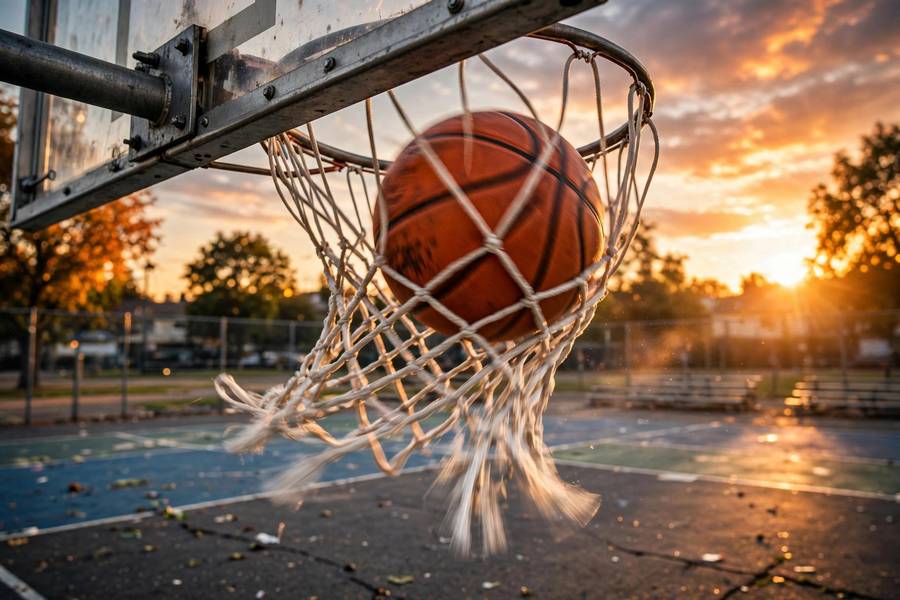
Most bad shooters shoot too flat. The optimal arc puts the ball entering the basket at roughly 45 degrees — which requires a higher release arc than feels natural.
Think “up, not out.” Aim to have the ball peak 1–2 feet above the rim’s height at its apex. Flat shots hit the front rim; proper arc drops the ball in from above, where the basket is effectively bigger.
A simple test: if your makes are mostly swishes and soft rim-rolls, your arc is good. If everything clangs hard off the back rim, shoot it higher.
Common Shooting Mistakes
- Guide-hand interference. The #1 mechanical flaw. If your misses go left-right (for righties, usually left), it’s almost always the guide hand pushing.
- Shooting on the way down. Release at or just before the top of your jump. Shooting on the descent is weak and inconsistent.
- Inconsistent pocket. Ball starts in a different place every time = different shot every time.
- No legs. All-arm shots have no range and no consistency. Power comes from the legs; arms direct it.
- Rushing. Game speed is fine; rushed mechanics are not. Even quick releases maintain form — watch how fast yet clean elite shooters are.
- Practicing bad reps. Ten thousand reps of bad form builds a bad shot permanently. Fix mechanics first, then volume.
Drills That Build a Jumper
Form shooting (daily): Start 3 feet from the basket. One hand, perfect BEEF, swish. Make 10, step back a foot. This boring drill is the foundation of every great shooter — don’t skip it, ever.
Spot shooting: Pick 5 spots around the court. Make 5 from each before moving. Tracks your percentages and builds game-like repetition.
Free throws: Shoot 25–50 daily with a full routine (dribbles, breath, BEEF). Free throws are pure mechanics — they’re your shooting laboratory.
Catch-and-shoot: Partner passes, you catch in stance and shoot. Focus on quick, clean transitions from catch to pocket to release.
Fatigue shooting: Shoot 10 free throws, sprint a court length, shoot 10 more. Games are played tired — practice the shot when your legs are heavy.
Track makes and attempts. What gets measured gets improved — even a notebook tally transforms practice from messing around to training. (The same principle applies across sports — whether you’re learning pickleball rules or perfecting a jumper, deliberate reps beat casual ones.)
Shooting Off the Dribble and Catch
Game shots rarely come standing still:
Off the catch: Land in stance as you catch (the “hop” catch). Ball goes straight to the pocket. The best shooters are already loaded before the ball arrives — preparation beats reaction.
Off the dribble: The pull-up requires stopping your momentum cleanly — a 1-2 step into balance, then the normal shot. Practice going both directions. The step-back creates space but demands excellent balance; master the basic pull-up first.
Off screens: Sprint, plant, catch, shoot — all in rhythm. The footwork (inside foot pivot) matters as much as the shot.
The Mental Side
Shooting is as mental as mechanical:
- Next-shot mentality. Great shooters forget misses instantly. The last shot has zero effect on the next one — unless you let it.
- Routine. Same dribbles, same breath, same rhythm every free throw. Routine is confidence you can manufacture.
- Visualization. See the ball going in before you shoot. It sounds mystical; it’s just mental rehearsal, and it works.
- Shoot through slumps. The answer to missing is correct reps, not fewer shots. Confidence comes from preparation, not results.
Like learning the offside rule in soccer or how the world cup works — understanding the game’s structure makes the skills within it click faster.
Frequently Asked Questions
BEEF: Balance (stable base), Eyes (on the back of the rim), Elbow (tucked, under the ball), Follow-through (wrist snap, hold it). Add proper arc and backspin, and you have the complete foundation.
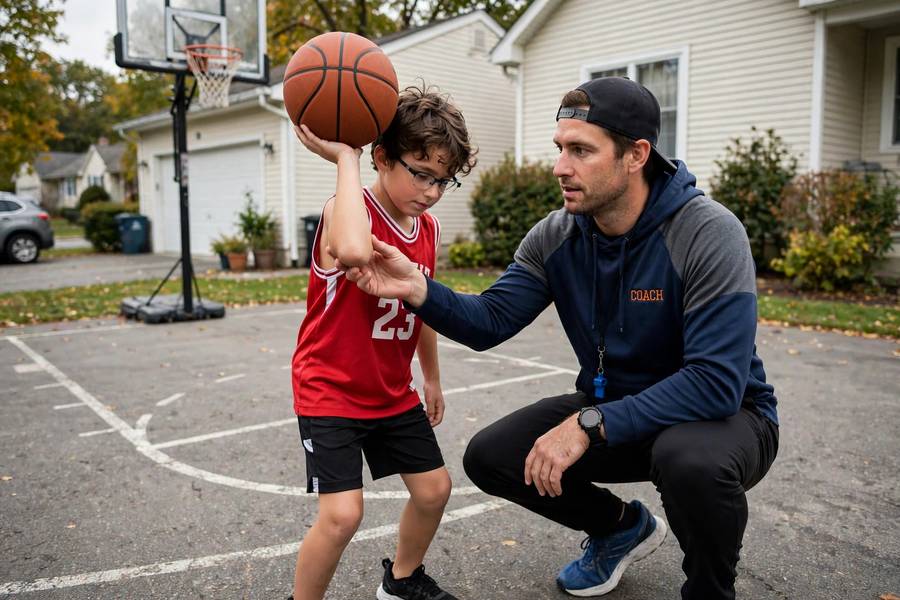
Almost always the guide hand pushing the ball sideways, or an elbow flared out (“chicken wing”). Film yourself from the front — you’ll see it immediately. Fix the guide hand first.
Leg strength and a higher arc, not arm strength. Power the shot from your legs, maintain form as you step back gradually, and never sacrifice mechanics for distance — range built on bad form doesn’t transfer.
Quality over quantity: 100–200 focused shots with correct form beats 500 sloppy ones. Start every session with form shooting close to the basket, then expand to game-speed work.
Same dribbles (2–3), same breath, same BEEF checklist, every time. The routine’s job is making the 100th free throw feel like the first — consistency of process creates consistency of result.
4–8 weeks of deliberate daily practice to groove new mechanics, longer to trust them in games. It gets worse before it gets better — that’s normal and means the old habits are actually changing.