What Is Business Casual for Women? Complete 2026 Guide


Business casual is the dress code everyone has heard of and almost no one agrees on. Ask around your office and you’ll get five different definitions — which is precisely the problem this guide solves. For women, business casual sits in a specific space: polished and intentional, relaxed enough to skip the full suit, structured enough that you never look like you’re running errands.
What follows is a definition you can rely on, the pieces that build it, and 15 concrete outfit formulas — plus the honest truth that “business casual” means something different in finance than it does in tech. If you want the broader definition angle first, the companion piece on the business casual dress code covers the concept across contexts.

What Business Casual Actually Means
There is no single universal definition of business casual — office culture writes the rules. The most useful way to think of it: business casual is professional clothing with the stiffness removed. You keep the structure (tailored trousers, a blazer, a proper dress) and drop the rigidity (the matching suit, the conservative tie-era formality that never applied to you anyway).
The anchor principle: you should look deliberate. Every piece looks chosen on purpose, fabrics have some quality to them, and the overall effect says “I’m here to work” rather than “I threw this on.” When in doubt, dress up rather than down — being slightly overdressed is always the safer error.
Business Casual vs Smart Casual vs Business Formal
These three terms get tangled, so here is the clean separation. Business formal is the full suit: matched jacket and trousers or a conservative dress, the most structured tier. Business casual is one notch down — tailored pieces worn more freely, no matching suit required.
Smart casual is a different animal entirely: it’s a social dress code, not an office one. Dark jeans, a nice top, and clean sneakers can be smart casual for dinner, but that doesn’t make them business casual for work. The line is intent: business casual serves the workplace; smart casual serves the evening. For the full distinction, see the breakdown of the smart casual dress code.
The Staples: What Every Business Casual Wardrobe Needs
Every business casual wardrobe is built from five staple groups: tops, bottoms, dresses, layers, and footwear. Get the right pieces in each group and the outfits assemble themselves.
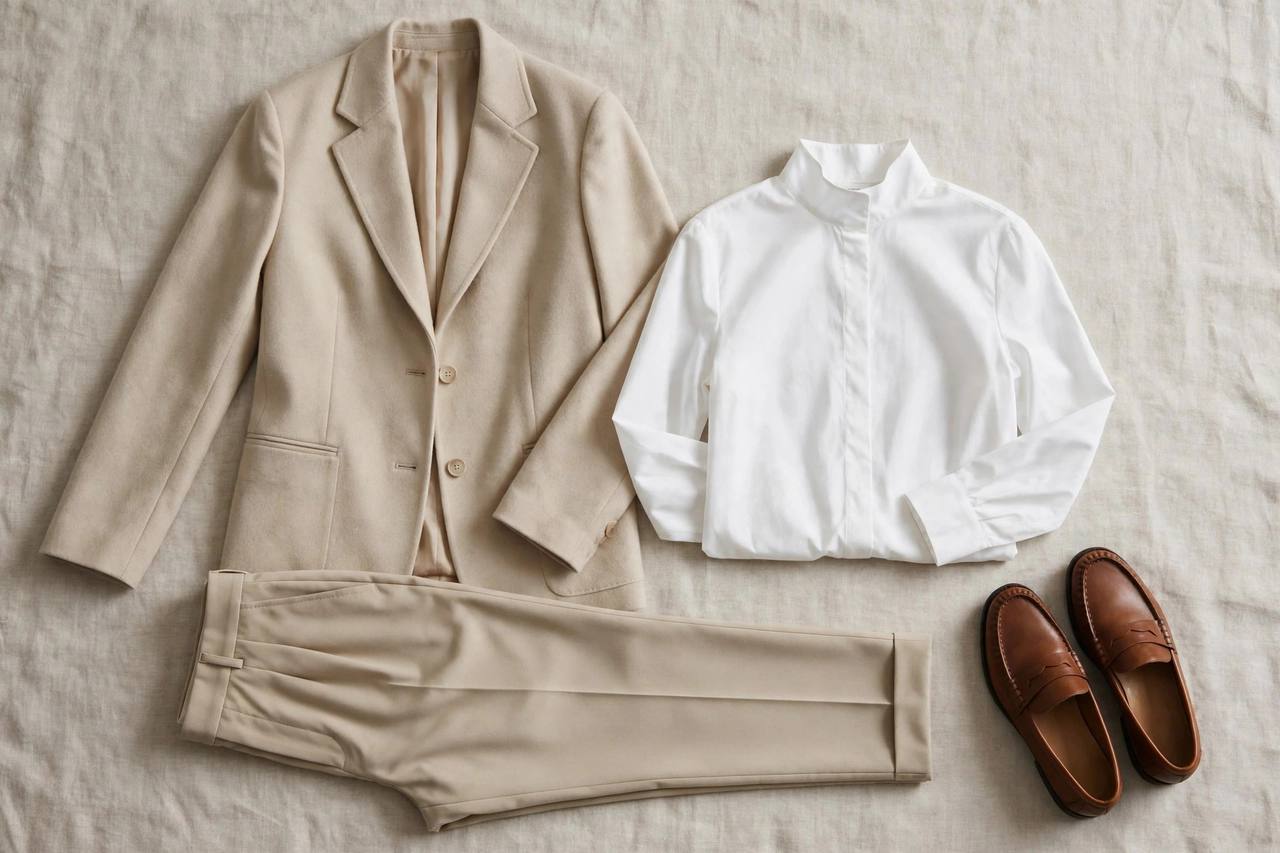
Tops: blouses, quality tees, knit tops, and a turtleneck for colder months. Bottoms: tailored trousers, dark jeans, and a midi skirt. Dresses: a midi wrap dress and a knit dress that works alone or under a blazer. Layers: a well-cut blazer above all, plus a cardigan or structured jacket. Footwear: loafers and ankle boots as the workhorses, with heels as an option when the day calls for them.
Nine pieces form the core of this wardrobe: wide-leg trousers, a midi wrap dress, a blazer, a tee or blouse, dark jeans, a midi skirt, a knit dress, a turtleneck, and ankle boots plus loafers. With those nine, mixed and matched, you have weeks of outfits before anything repeats.
15 Outfit Formulas That Always Work
The building blocks are sorted; here are the outfits. Each formula follows the same logic — one tailored piece, one quality top, the right shoes — so you can swap pieces freely.
- Blazer + white tee + wide-leg trousers + loafers. The foundation look.
- Midi wrap dress + ankle boots + a structured tote. One piece, done.
- Turtleneck + midi skirt + knee-high boots. Winter’s answer.
- Knit dress + blazer over the shoulders + loafers. Meeting-ready in seconds.
- Dark jeans + blouse + blazer + pointed flats. Friday without the sloppiness.
- Wide-leg trousers + silk-look blouse + heels. Client dinner territory.
- Midi skirt + fitted knit + ankle boots. Soft, still structured.
- Turtleneck + tailored trousers + loafers. The minimalist uniform.
- Dark jeans + turtleneck + blazer + boots. The relaxed-layer version.
- Knit dress + long cardigan + flats. Comfort days that still count.
- White tee + midi wrap skirt + blazer + loafers. Warm-weather polish.
- Blouse + wide-leg trousers + low heels. The classic boardroom-soft look.
- Midi wrap dress + blazer + ankle boots. The interview-adjacent formula.
- Fitted knit + dark jeans + structured jacket + boots. Creative-office gold.
- Turtleneck + midi skirt + blazer + pointed flats. Layered and deliberate.
Dressing by Office Type: Conservative vs Creative vs Tech
The same wardrobe reads differently in three office worlds. In corporate and finance, stay on the smarter side: blazer, tailored trousers, blouses, dresses. Dark jeans only if your office has explicitly blessed them. This is the sector where “when in doubt, dress up” matters most.
In creative and tech offices, the range widens: quality tees under blazers, dark jeans as a default, more personality in color and cut. The standard doesn’t disappear — it relaxes. Healthcare, education, and the public sector sit in the middle: polished and practical, with comfort that survives a long day on your feet. Read the room in your first week, then dress one notch above the median.
What to Avoid (Without Guessing)
The avoid list is refreshingly concrete: ripped jeans, gym wear, flip-flops, slogan tees, very short hemlines, low necklines, and see-through fabrics. None of these survive the “deliberate and professional” test. Notice what isn’t on the list — dark jeans, quality tees, and flats all have a place, done right.
The common thread: anything that draws attention to itself instead of to you is out. Your clothes should frame the work, not become the conversation.
Modest Coverage Rules: Hemlines, Necklines, Fit
Fit is the quiet superpower of business casual. Hemlines should sit at or below the knee when seated — the sitting test is the honest one. Necklines stay above anything that requires adjusting through the day; if you’re pulling it up at noon, it was the wrong choice at eight. Fabrics should be opaque under office lighting, not just in your bedroom mirror.
Tailoring matters more than labels. Trousers that break cleanly at the shoe, a blazer that closes without pulling, sleeves that end at the wrist — these details are what separate “business casual” from “casual that happens to be worn at business.” A 30-minute tailor visit does more for your wardrobe than a shopping spree.
Building a Budget Capsule Work Wardrobe
You don’t need fifteen outfits’ worth of clothes — you need the nine core pieces in a tight color palette. Neutral trousers, a neutral blazer, tops in black, white, and one or two colors you actually wear. Everything matches everything; that is the whole trick.
Buy the blazer and trousers first, in the best quality your budget allows, because they carry every outfit. Fill in tops and shoes after. The capsule method behind this is spelled out in the guide to building a capsule wardrobe — same logic, workwear edition.
What to Wear for a Business Casual Interview
An interview is the one occasion where you dress a full notch above the office norm. If the job is business casual, you show up closer to business formal: the blazer, the tailored trousers or midi dress, the polished shoes. The rule is simple — overdressed beats underdressed, because an interview is the one day where “trying too hard” doesn’t exist.
Keep colors restrained and the fit impeccable. You want the interviewer remembering your answers, not your outfit. For the interview-specific version of this advice, see how to dress business casual for an interview.
Shoes and Accessories That Finish the Look
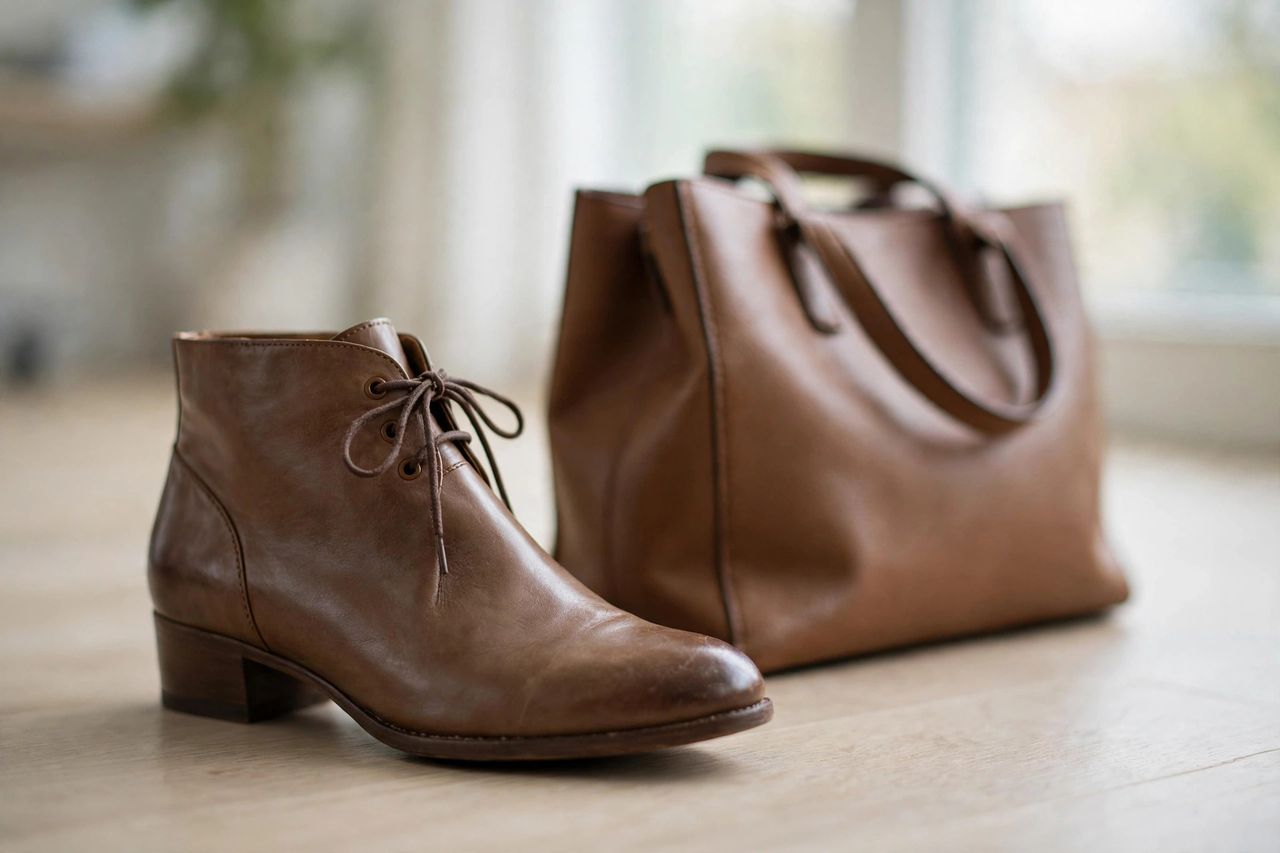
Shoes do more work than any other single item. Loafers and ankle boots cover almost every business casual day; low heels step in for presentations and client meetings. Keep them clean and in good repair — scuffed shoes undo an otherwise perfect outfit faster than anything else.
Accessories should be quiet: a structured bag, a watch, simple jewelry. One statement piece at most — the outfit is the message, and accessories are the punctuation. A tote that fits a laptop without looking like luggage is the single most useful accessory in a hybrid work life.
The One Mistake Almost Everyone Makes
The mistake: treating business casual as “casual.” Sneakers with a blazer, leggings as trousers, a hoodie under a jacket — the pieces might be individually fine, but the total reads as weekend. Business casual is not casual Friday’s older sibling; it is a professional standard with the tie removed.
The fix is one tailored piece per outfit. A blazer over jeans keeps it business casual; jeans without the blazer drifts toward plain casual. That single anchor piece is the difference, and it’s the easiest rule you’ll read in this whole guide.
Frequently Asked Questions
Are jeans business casual for women?
Dark, well-fitting jeans without rips can be business casual in many offices, especially creative and tech ones — paired with a blouse and blazer. In conservative corporate and finance offices, stay with tailored trousers unless jeans are explicitly accepted.
Can you wear sneakers or trainers with business casual?
Generally no. Loafers, ankle boots, flats, and low heels are the safe footwear. Clean, minimal sneakers might pass in the most relaxed tech offices, but they are not business casual by default.
Is business casual the same as smart casual?
No. Business casual is a workplace dress code built on tailored pieces like blazers and trousers. Smart casual is a social dress code — dark jeans and a nice top for dinner — and it sits a notch below business casual in formality.
What should a woman wear to a business casual interview?
Dress one notch above the office norm: a blazer, tailored trousers or a midi dress, and polished shoes, in restrained colors. Overdressed beats underdressed at an interview — there is no such thing as trying too hard on that day.
Can you wear a t-shirt for business casual?
A quality, well-fitting tee works under a blazer or with tailored trousers, especially in creative and tech offices. Avoid graphic prints, slogans, and anything faded or stretched — the tee must look intentional, not incidental.
What shoes go with business casual outfits?
Loafers and ankle boots are the everyday workhorses, flats are a solid middle ground, and low heels cover presentations and client meetings. Keep them clean and well-kept — scuffed shoes undo an otherwise polished outfit.