How to Stay Active at a Desk Job: Micro-Habits That Work


Here is the uncomfortable truth about how to stay active at a desk job: your body was not designed for eight hours of sitting, and no single workout fully cancels out a day spent motionless. I say this as a coach whose own clients include plenty of office workers — the ones who stay lean and pain-free are not the ones with the hardest gym sessions. They are the ones who move a little, all day long. This guide is about those micro-habits: the hourly breaks, the seated exercises, the desk setup, and the small structural changes that add hundreds of movement minutes to your week without asking you to find extra time.
A word on expectations: this is not a workout plan. If you can train two or three times a week on top of this, great — this guide makes that easier, not optional. What follows is the daily movement floor that keeps your joints, posture, and energy from quietly deteriorating.
Why Sitting All Day Is a Problem (and What Fixes It)
When you sit for hours, your hip flexors shorten, your glutes switch off, your shoulders roll forward, and your calorie burn drops to barely above sleeping. Research on sedentary behavior consistently links long uninterrupted sitting with worse metabolic and musculoskeletal outcomes — and the fix researchers keep landing on is breaking up sitting time, not just exercising harder later. The good news: the dose needed is small. Standing and walking for a few minutes every hour changes the equation dramatically.
How to Stay Active at a Desk Job: The Hourly Break Method
If you take one thing from this article, take this: never sit for more than 60 minutes without moving. Set a timer, a watch reminder, or an app nudge. Each break only needs two to three minutes:
- Stand up and walk — to the water cooler, around the office, down the hall and back.
- Do ten bodyweight squats or ten standing calf raises.
- Roll your shoulders and do five deep breaths with your chest open.
Eight breaks a day, three minutes each: that is 24 minutes of movement you did not have to schedule. Over a month, that adds up to roughly eight hours of extra activity.
Seated Exercises That Actually Work at Your Desk
Nobody wants to be the person doing jumping jacks in an open-plan office. These are invisible or close to it:
- Seated marches: sit tall, lift your knees alternately like marching. Sixty seconds gets your heart rate up without leaving the chair.
- Glute squeezes: squeeze your glutes hard for five seconds, release. Ten reps. Nobody can see this one.
- Seated leg extensions: straighten one leg at a time and hold for three seconds. Works the quads.
- Desk push-ups: hands on the desk edge, step back, ten slow push-ups. Great for the mid-afternoon slump.
- Neck and shoulder resets: chin tucks (pull your chin straight back, making a double chin — it looks silly and works brilliantly) and shoulder blade squeezes, ten reps each.
- Ankle circles and calf pumps: under the desk, invisible, and they keep blood moving in your lower legs.
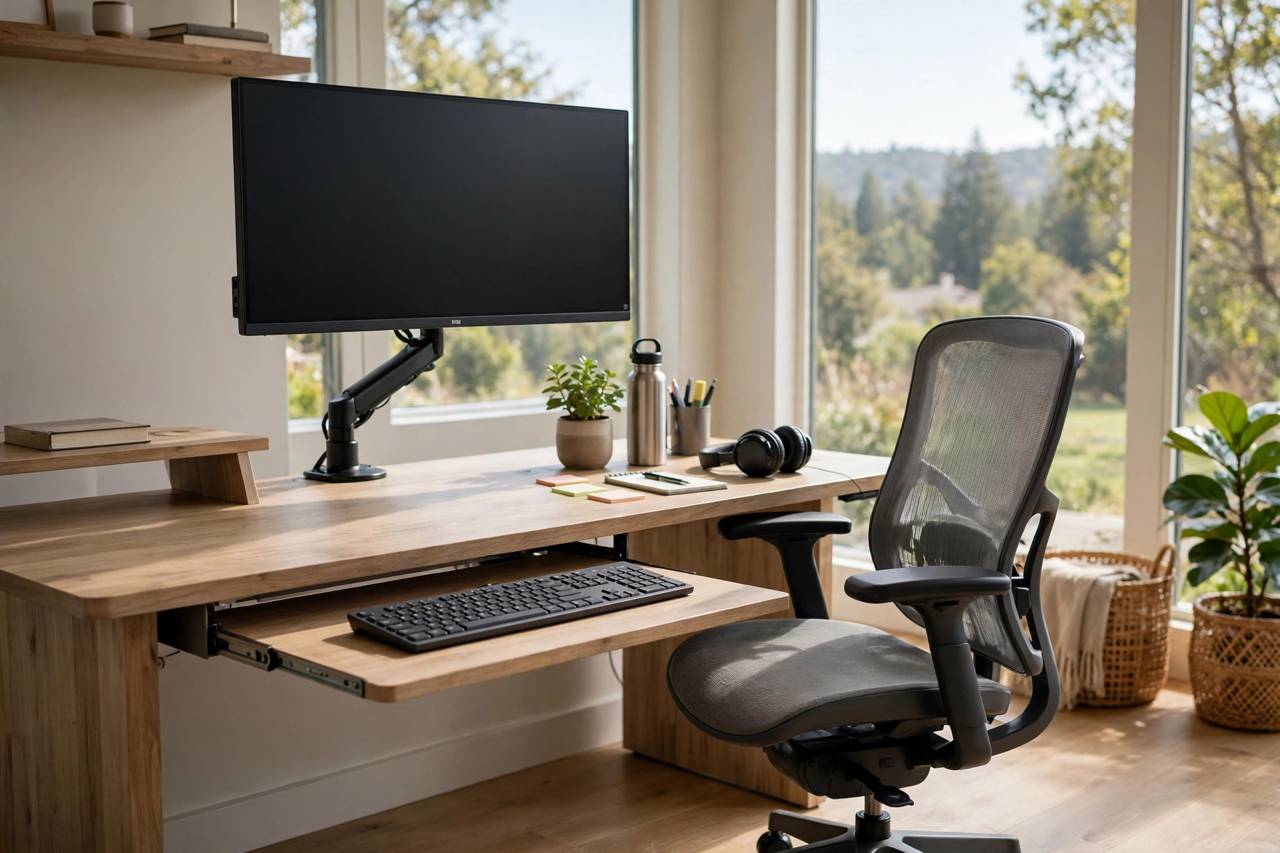
Set Up Your Desk So It Stops Hurting You
Exercise cannot outrun a terrible workstation. Fix the ergonomics once and benefit forever:
- Monitor at eye level: the top of the screen should be at or just below eye height. Stack it on books if you have to. Craning down at a laptop all day is the number one cause of desk-worker neck pain.
- Feet flat, knees at 90 degrees: adjust your chair height. If your feet dangle, get a footrest.
- Keyboard and mouse close: reaching forward for your mouse all day loads the shoulders. Keep elbows near your body.
- Stand up sometimes: a sit-stand desk is ideal, but even a countertop or ironing board works for standing calls. Aim to stand for part of each hour, not all day — full-time standing brings its own problems.
- The 20-20-20 rule for eyes: every 20 minutes, look at something 20 feet away for 20 seconds.
Build Movement Into Work You Already Do
The highest-leverage trick is attaching movement to existing habits:
- Walking meetings: any one-on-one call that does not need screen sharing becomes a walk. I know executives who take every call on foot.
- Park far, get off early: add five to ten minutes of walking to each end of your commute.
- Stairs by default: unless you are above the fifth floor, take the stairs. Every time.
- Lunch walks: fifteen minutes after lunch beats fifteen minutes of scrolling — for digestion, afternoon energy, and step count.
- Stand for the first five minutes of every hour: tie it to something automatic, like standing whenever your phone rings.
If you are trying to fit actual training around office hours, timing matters less than consistency — but my breakdown of the best time to exercise can help you pick the slot you will actually keep. And if desk life has left your shoulders stiff, a shoulder workout with no equipment is a perfect lunch-break reset.

The 2-Minute Hourly Reset Routine
Here is a concrete routine for those hourly breaks — memorize it once and repeat it all day:
- 0:00–0:30: stand up, roll your shoulders backward ten times, then forward ten times.
- 0:30–1:00: ten bodyweight squats or a walk to the farthest water source and back.
- 1:00–1:30: doorway or wall chest stretch, arms at ninety degrees, lean in gently.
- 1:30–2:00: ten chin tucks and ten standing calf raises. Sit back down.
Two minutes, no equipment, no sweat, no strange looks from colleagues. Done eight times a day, this routine alone delivers sixteen minutes of movement plus eight posture resets. It is the highest-return two minutes in an office worker’s day.
Track It So You Keep It
What gets measured gets done. A phone or cheap pedometer tracking daily steps is enough — most desk workers land between 3,000 and 5,000 steps without trying. Aim to push that toward 7,000–10,000 with the habits above. Do not obsess over the exact number; watch the trend. If your weekly average is climbing, the system is working. And track your hourly breaks too — a simple tally on a sticky note works. Most people are shocked to discover they sat for three straight hours on “busy” days, and that awareness alone usually fixes it within a week.
The Anti-Desk Workout: 10 Minutes, Twice a Week
Daily micro-movement keeps you from deteriorating; a short weekly strength session actually builds you back up. This is the minimum effective program I give desk workers — ten minutes, twice a week, no gym:
- Glute bridges: 2 sets of 12. Wakes up glutes that sitting switches off.
- Wall slides or band pull-aparts: 2 sets of 12. Directly reverses the hunched-desk posture.
- Bodyweight squats: 2 sets of 15. Keeps legs and hips functional.
- Dead bugs: 2 sets of 8 per side. Core stability without crunching a sore neck.
- Doorway chest stretch: 60 seconds. Opens everything the desk closed.
Do it Monday and Thursday, or whatever two days you will actually repeat. This is not about getting ripped — it is about giving your body the loading patterns that sitting steals.
Posture Myths Worth Dropping
- “Sit up straight all day.” Rigid upright posture held for eight hours is its own kind of strain. The research consensus has shifted: the best posture is your next posture. Change positions often.
- “Slouching will ruin your spine.” Comfortable, varied slouching is not the villain — uninterrupted static loading in any position is. A relaxed lean in a good chair, changed regularly, is fine.
- “You need a perfect ergonomic setup before you start.” A monitor riser made of books and a chair adjusted to the right height covers eighty percent of it. Do not let gear shopping delay the habits.
Standing Desks, Walking Pads, and Balance Boards: An Honest Take
Every year a new desk gadget promises to save office workers. Here is my honest ranking by value: a sit-stand desk is genuinely worth it if you alternate positions — it is the only gadget with solid evidence behind it. A walking pad under a standing desk is excellent if you will actually use it daily; most end up as expensive clothing racks, so be honest with yourself before buying. Balance boards and wobble cushions are fine for variety but change very little physiologically. And the under-desk elliptical? Better than nothing, but walking to the kitchen counts for more. Spend money on the sit-stand desk first; spend effort on the hourly breaks, which are free and matter more than all of it.
Frequently Asked Questions (FAQ)
How often should I get up from my desk?
At least once per hour. Two to three minutes of standing, walking, or light movement per hour is the minimum effective dose most sedentary-behavior research points to. More is better, but hourly is the habit that sticks.
Can short breaks really make a difference?
Yes. Studies on breaking up prolonged sitting show improvements in blood sugar regulation and musculoskeletal comfort from light activity breaks. You will also simply feel less stiff and more alert in the afternoon — most people notice that within a week.
Is a standing desk worth it?
It helps if you actually alternate between sitting and standing. A standing desk you stand at all day just trades one static posture for another. The value is in the switching, so set a reminder to change position every 30–60 minutes.
What is the best exercise for desk workers?
The one you will do daily: walking. Beyond that, prioritize the opposite of sitting — hip flexor stretches, glute activation, upper-back strengthening, and neck mobility. A few minutes of each daily beats an occasional intense session.
How do I remember to take breaks?
Automate it: phone alarms, smartwatch stand reminders, or a browser extension that locks your screen briefly each hour. Tying breaks to existing triggers — every phone call, every bathroom trip, every coffee refill — works even better than timers.
My back hurts from sitting. What should I do?
Start with the basics in this guide: hourly movement, better chair and monitor height, and hip flexor stretches. Persistent or sharp pain deserves a physiotherapist, not an article. General fitness guidance cannot diagnose your back.