How to Write a Research Paper Outline: Annotated Example Included


The students who struggle most with research papers usually skip the same step: the outline. They open a blank document, write an introduction, and then wander — paragraph by paragraph — hoping an argument assembles itself. It does not. An outline is where the thinking happens; the draft is just the thinking written out. If you want to know how to write a research paper outline that actually makes the paper easier, you need more than ‘make bullet points’ — you need a real structure with a real example.
This guide gives you exactly that: a complete annotated outline example from thesis statement to Roman-numeral hierarchy, the parallel-structure rule that keeps outlines clean, MLA and APA formatting variants, and the mistakes that turn outlines into useless lists. Build the outline right, and the paper practically writes itself.
How to Write a Research Paper Outline: Why Outline First
Writing without an outline is like building a house without a blueprint — you will discover the load-bearing problems when the walls are already up. An outline forces the three decisions that determine a paper’s quality: what is my thesis (the single claim everything supports), what is my evidence (and is there enough for each point), and what is my order (does the argument build logically).
The outline also exposes gaps early, when they are cheap to fix. (This is also why organized note-taking matters before you outline — structured notes become structured outlines.) If section III has one thin sub-point and section II has six, your paper is lopsided — better to discover that in a fifteen-minute outline than in a six-page draft. I tell students: if you cannot outline it, you cannot write it yet. Go back to the sources.
Practically, outlining converts a scary 2,000-word paper into eight small writing tasks. ‘Write section II.A’ is a manageable evening; ‘write the paper’ is paralysis. Every professional writer I know outlines in some form. Students should steal the habit early.
The Anatomy: Thesis, Roman Numerals, and Hierarchy
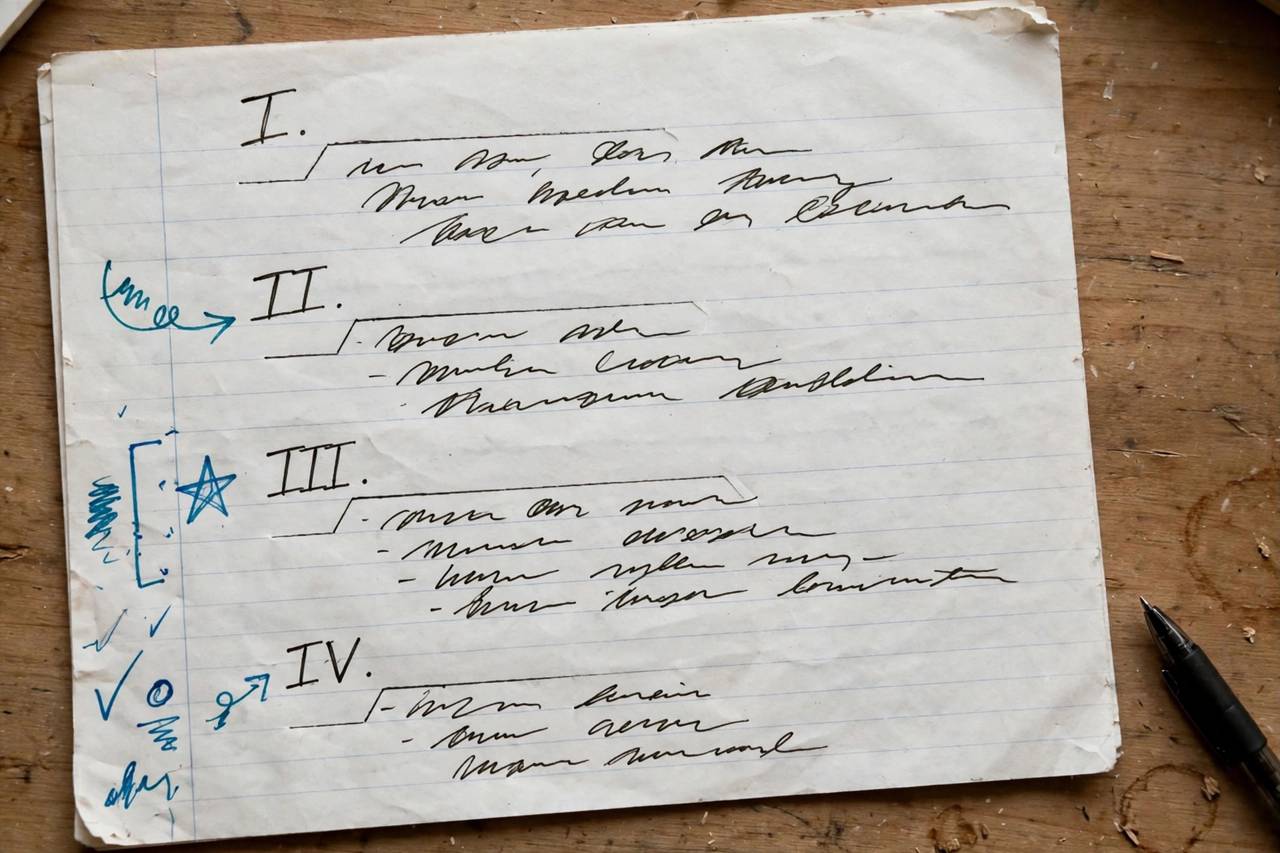
A formal outline has four levels, and each level has a job. Level one — Roman numerals (I, II, III) — marks your major sections or main arguments. Level two — capital letters (A, B, C) — marks the supporting points within each section. Level three — Arabic numerals (1, 2, 3) — marks specific evidence, examples, or sub-points. Level four — lowercase letters (a, b, c) — marks fine detail, used sparingly.
At the top sits the thesis statement: one to two sentences stating your paper’s central claim. Everything in the outline must connect to it — if a point does not support the thesis, it does not belong in the paper. Write the thesis first, in full sentences. Vague theses produce vague outlines produce vague papers; the chain starts here.
The parallel-structure rule: items at the same level must be grammatically parallel. If II.A is a noun phrase (‘Economic causes’), II.B must be a noun phrase (‘Social causes’), not a full sentence (‘Then society changed because…’). Parallel structure is not fussiness — it forces equal weight and clear logic at each level. Instructors can spot a non-parallel outline instantly, and it signals muddled thinking.
Formatting note: most high school and undergraduate outlines use either topic outlines (short phrases at each level) or sentence outlines (full sentences). Sentence outlines take longer but make drafting nearly mechanical — each sentence becomes a paragraph’s topic sentence. For papers over 1,500 words, sentence outlines repay the investment.
Full Annotated Example Outline
Here is a complete example for a paper with the thesis: ‘School districts should replace traditional homework with structured reading time, because current homework practices widen achievement gaps, harm student well-being, and lack strong evidence of effectiveness.’ Watch how every level serves the thesis.
- Thesis: School districts should replace traditional homework with structured reading time, because current homework practices widen achievement gaps, harm student well-being, and lack strong evidence of effectiveness.
- I. Introduction — A. Hook: the average high schooler now spends X hours weekly on homework (cite). B. Background: the homework debate’s history. C. Thesis statement (as above).
- II. Traditional homework widens achievement gaps — A. Students with educated parents and quiet homes complete more homework (cite study). B. Students with jobs or caregiving duties penalized for circumstances (cite). C. Grading homework thus measures home resources, not learning.
- III. Heavy homework loads harm student well-being — A. Correlation with student stress and sleep loss (cite surveys). B. Reduced time for exercise, family, and unstructured play. C. Counterpoint: moderate homework can build discipline — rebuttal: the benefits plateau early and accrue mainly to older students (cite).
- IV. Evidence for homework’s effectiveness is weak — A. Meta-analyses show minimal gains in elementary grades (cite). B. Gains in secondary grades are modest and subject-specific. C. Reading volume predicts achievement more strongly than homework completion (cite).
- V. Structured reading time as an alternative — A. Description: 30 minutes of self-selected reading during the school day. B. Evidence from districts that piloted it (cite). C. Addresses equity (equal access), well-being (no take-home burden), and effectiveness (reading gains).
- VI. Conclusion — A. Restate thesis in new words. B. Summarize the three lines of argument. C. Broader implication: education policy should follow evidence, not tradition.
Notice the architecture: sections II-IV each prove one clause of the thesis (gaps, well-being, evidence), section V proposes the solution, and the counterpoint lives inside section III where it belongs — acknowledged and rebutted, not ignored. Every section earns its place by serving the thesis. That is what a good outline looks like.
MLA vs. APA Outline Formatting
Content-wise, outlines are identical across styles — the differences are in the paper’s formatting, not the outline’s structure. Still, instructors may want the outline to match the paper’s style conventions, so here are the practical differences.
In MLA (common for humanities): the outline typically has no title page; your name, instructor, course, and date go in the upper left of the first page; the outline title is centered. If your paper will need in-text citations, plan them in the outline — note ‘(Smith 42)’ next to the evidence points where you will use them, so drafting does not stall on citation hunts. A standard APA citation cheat sheet covers the other major style if your course uses it.
In APA (common for sciences and social sciences): student papers include a title page with the paper title, your name, affiliation, course, instructor, and date. The outline itself follows the same Roman-numeral hierarchy. APA’s bigger impact is on the reference list you will build from the outline — keep full source details next to each evidence point as you outline, and the references page assembles itself.
Whichever style: number your outline pages, keep the hierarchy consistent, and never mix topic-phrase and full-sentence styles at the same level. Pick one and commit.
From Outline to Draft: The Conversion
Here is the part nobody explains: how the outline becomes prose. The conversion is mechanical. Your thesis becomes the last sentence of your introduction. Each Roman-numeral section becomes two to four paragraphs. Each capital-letter point becomes a paragraph led by a topic sentence. Each numbered evidence item becomes the supporting detail inside that paragraph — with its citation attached.
Draft in any order. The outline liberates you from writing front-to-back: stuck on the introduction? Write section III first. Introductions are easier once you know exactly what you are introducing, which is why many strong writers draft them last. The outline holds the structure while you work nonlinearly.
During drafting, the outline is a living document. If a section runs long, split it. If evidence contradicts your thesis, do not hide it — revise the thesis or add a counterpoint section. An outline that never changes during drafting was either perfect (rare) or ignored (common). Update it as you go; it doubles as your revision checklist. And when the research behind the outline needs organizing in the first place, studying with flashcards is a surprisingly good tool for memorizing key sources and quotes before you write.
Outline Mistakes That Doom Papers
Mistake one: the outline is just a list of topics with no argument. ‘I. Homework history. II. Homework pros. III. Homework cons.’ That is a table of contents, not an outline — it contains no thesis and no logic. Every Roman numeral should be a claim that supports the thesis.
Mistake two: uneven development. If section II has five sub-points and section IV has one, your paper will feel lopsided because it is. Either develop IV or merge it elsewhere. The outline’s visual structure makes imbalances obvious — that is its job.
Mistake three: evidence without sources. An outline point that says ‘studies show homework causes stress’ with no specific study named is a promise you may not keep. Attach at least a working citation to every evidence point during outlining. Future-you, drafting at midnight, will be grateful.
Mistake four: skipping the counterpoint. A paper that never acknowledges objections reads as naive. Build the strongest objection into the outline and rebut it — it is the single highest-leverage paragraph in most argumentative papers.
Frequently Asked Questions
How detailed should a research paper outline be?
Detailed enough that drafting is mechanical: thesis in full sentences, every major section as a claim, every claim with its evidence and working citations noted. For a 2,000-word paper, a good sentence outline runs 300-500 words. If your outline is under 100 words, it is probably a topic list, not an outline.
Should an outline be in full sentences or phrases?
Either is acceptable — check your instructor’s preference. Sentence outlines (full sentence per point) take longer but make drafting faster and expose logical gaps better. Topic outlines (phrases) are quicker for short papers. Never mix the two styles at the same level.
How do I write a thesis statement for the outline?
Make it a single arguable claim with a ‘because’ clause listing your main reasons: ‘X should happen because A, B, and C.’ Each reason becomes a major section. If you cannot list the reasons, your thesis is not ready — do more research or narrow the topic.
Can I change my outline while writing?
Absolutely — expect to. Outlines are planning tools, not contracts. If drafting reveals a better order, a stronger argument, or contradictory evidence, update the outline. Just keep it in sync; an outline that no longer matches the paper cannot guide revision.
Do I submit the outline with the paper?
Only if asked. Some instructors collect outlines as a separate checkpoint (which is a gift — free feedback before drafting). If submitted, make it clean and properly formatted; if it is just for you, prioritize usefulness over beauty.
The Bottom Line: The Outline Is the Paper, Unwritten
A research paper outline is not busywork — it is where the argument gets built. Thesis first, Roman-numeral claims that serve it, parallel structure at every level, evidence with working citations attached, and a counterpoint you rebut instead of ignore.
Write the outline until drafting feels like transcription. That feeling — ‘I just have to write out what I already decided’ — is the sign you did it right.