How to Keep Bananas From Ripening Too Fast

You buy a perfect bunch of bananas on Monday; by Wednesday they’re staging a full brown-spotted mutiny. If you’ve ever wondered how to keep bananas from ripening too fast, the answer starts with a gas you can’t see. Bananas produce ethylene — a natural plant hormone that triggers ripening — and here’s the kicker: once one banana starts producing it, the gas tells its neighbors to ripen faster too. It’s a chain reaction, and your fruit bowl is the venue. The good news? Every effective storage trick is just ethylene management. Here are the methods, ranked by how well they actually work, plus the science of why.
The Ethylene Science (60-Second Version)
Ethylene is a simple hydrocarbon gas that fruits release as they ripen — and bananas are enthusiastic producers. It works two ways: each banana ripens itself with its own ethylene (that’s why the process accelerates — riper fruit makes more gas), and the gas drifts to nearby fruit, syncing the whole bunch. This is also why “one bad apple spoils the barrel” is literal truth, and why putting a green banana in a paper bag with a ripe one speeds things up.
Every method below does one of three things: reduces ethylene production (cool temperatures), blocks ethylene exposure (wrapping, separating), or removes the fruit from the gas cloud (isolation). Knowing that, you can improvise your own solutions — and spot the folk remedies that can’t possibly work.
Method 1: Wrap the Stems (Easiest Win)
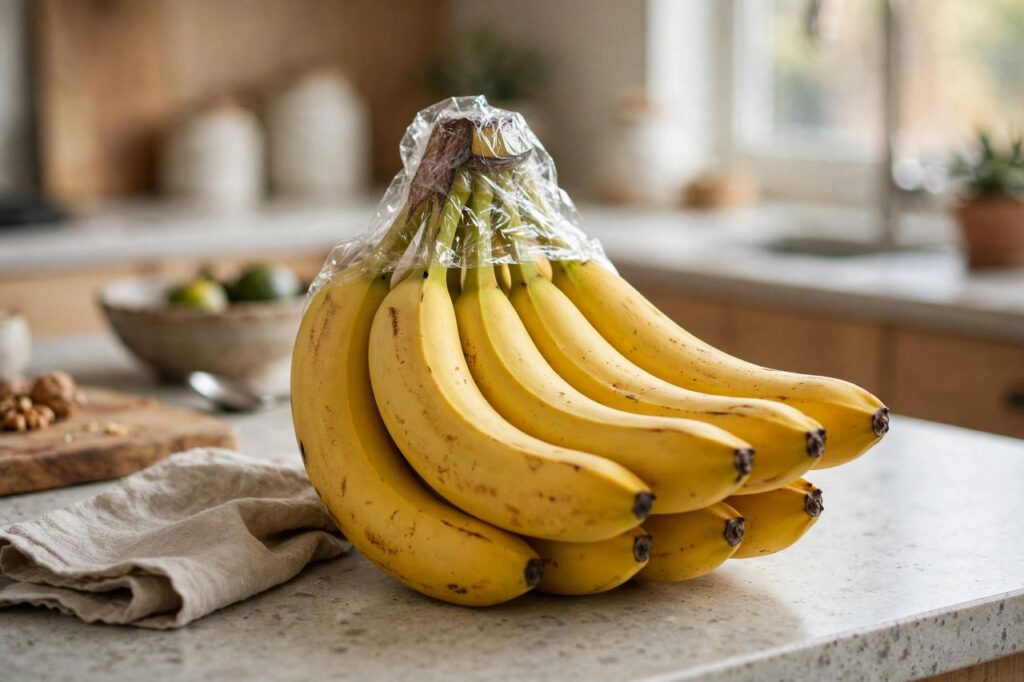
The stems are where bananas release the most ethylene. Wrapping them tightly with plastic wrap, foil, or even a damp paper towel under plastic slows the gas’s escape — and therefore slows the whole bunch.
How to do it: separate the plastic wrap, press it firmly around the crown where the bananas join. Re-wrap if you break bananas off the bunch. Effectiveness: solid — typically buys you an extra day or two of yellow. Cost: essentially zero. This is the highest ROI trick in the article; if you do nothing else, do this.
Method 2: Separate the Bunch
Remember the chain reaction: bananas ripen each other. Breaking the bunch into singles — or at least pairs — increases airflow and stops the ethylene cloud from concentrating. Combined with stem-wrapping, this is the best countertop strategy available.
Effectiveness: good, especially paired with Method 1. Trade-off: separated bananas are easier to knock around and bruise, and bruises ripen faster (damaged tissue releases more ethylene — the fruit’s distress signal). Handle gently.
Method 3: Cool, Dark Storage
Heat accelerates every chemical process including ripening, and light plays a supporting role. Store bananas at cool room temperature — around 60°F / 15°C is the sweet spot — away from sunny windows and warm appliances. That sunny spot on the counter that looks so picturesque in photos? It’s a ripening accelerator.
Effectiveness: moderate but free. A banana kept cool and dark easily outlasts one parked next to the stove. Also: keep bananas away from other ethylene producers — apples, avocados, tomatoes, and onions are the worst neighbors.
Method 4: Refrigerate (Yes, Really)
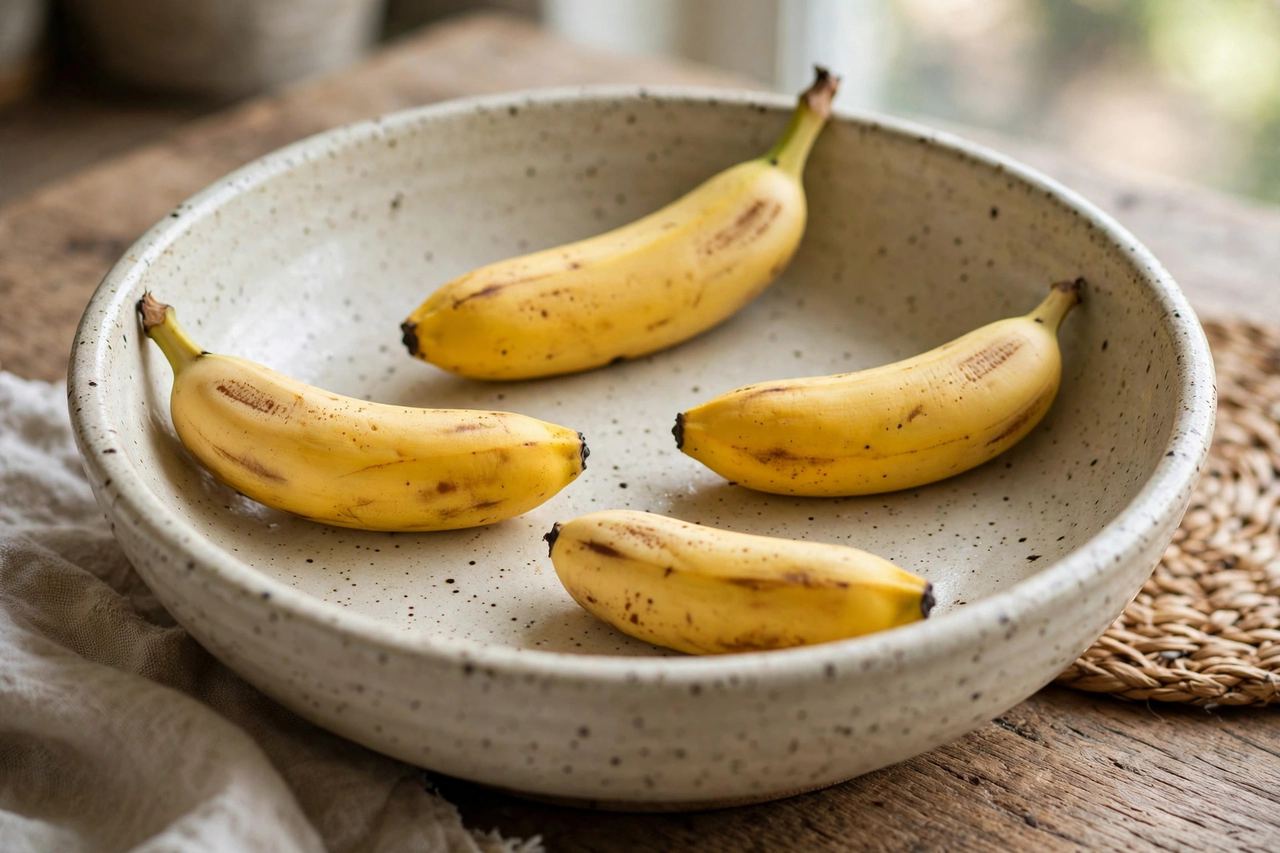
This one surprises people: you can refrigerate ripe bananas. The cold dramatically slows ethylene production and enzymatic ripening. The catch — and it’s purely cosmetic — is that the peel turns dark brown or black in the fridge. The flesh inside stays perfectly good for several more days.
The rules: only refrigerate bananas that are already at your preferred ripeness — the cold stops further ripening, so a green banana stays green. And never refrigerate unripe bananas expecting them to ripen later; chilling injury can leave them gray and unpleasant. Effectiveness: excellent for extending already-ripe bananas by 3–5 days. Ignore the peel; trust the fruit.
Method 5: Freeze for the Long Term
When bananas cross the line from ripe to overripe, stop fighting and freeze them. Peel, slice, flash-freeze on a tray, bag them — they keep for months and become smoothie gold. Freezing doesn’t preserve fresh-eating texture, but for blending and baking, overripe frozen banana is arguably better than fresh. Full method in my guide to freezing bananas for smoothies.
Methods Ranked: The Cheat Sheet
| Method | Extra time | Effort |
|---|---|---|
| Wrap stems + separate bunch | 1–3 days | Minimal |
| Cool, dark spot away from other fruit | 1–2 days | None |
| Refrigerate once ripe | 3–5 days | Minimal |
| Freeze when overripe | Months | 10 minutes |
| Buy greener + stagger purchases | Ongoing supply | Habit |
That last row deserves emphasis: the ultimate strategy is buying two bunches at different ripeness stages — one ready now, one green for later. No storage trick beats simply not having a week’s worth of bananas peak on the same day.
What Doesn’t Work (Folk Remedies, Tested by Logic)
- Hanging bananas on a hook. Looks charming; does nothing about ethylene. Bruise prevention at best.
- Lemon juice on the stems. The acid doesn’t meaningfully block gas release. Plastic wrap does the actual job.
- Storing in a sealed bag. Traps ethylene in with the fruit — the opposite of what you want. Ventilation beats sealing, always.
- Putting them next to other fruit “to absorb.” Other fruit doesn’t absorb ethylene; it responds to it. You’re ripening everything faster.
How to Keep Bananas From Ripening Too Fast When You Buy in Bulk
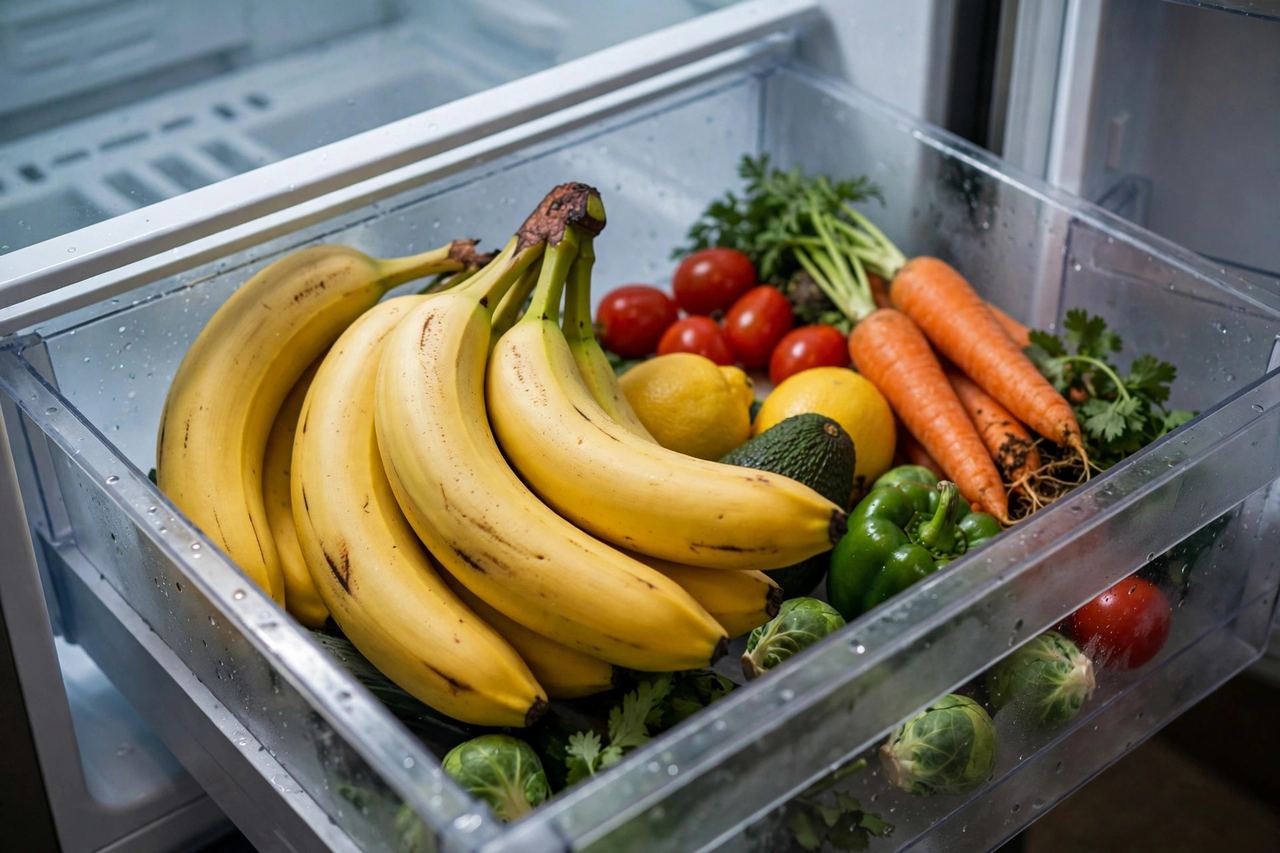
Warehouse-club shoppers and big families face the extreme version of this problem: fifteen bananas, all peaking simultaneously. The strategy shifts from preservation to pipeline management. Split the haul immediately: leave a few at room temperature for now, refrigerate the ripe ones (peel be damned), and freeze the rest in smoothie portions before they turn. Think of it as triage — you’re sorting bananas into \”eat this week,\” \”eat next week,\” and \”smoothie futures.\”
For genuinely large quantities, consider dehydrating: sliced bananas dried in a low oven or dehydrator become chewy banana chips that keep for months — a lunchbox staple that costs a fraction of store-bought. And banana bread freezes beautifully: bake a double batch from the overripe casualties, slice, wrap, and freeze. Future-you, facing a brown-banana emergency, will be grateful past-you planned ahead.
Ripening on Purpose: When You Want Them Faster
Sometimes the problem inverts — you bought green bananas for Friday’s baking and it’s already Thursday. Everything above, reversed: the paper bag trick. Place bananas in a paper bag (not plastic — you want some airflow) with an apple or a ripe banana, fold the top closed, and leave it at warm room temperature. The trapped ethylene concentrates and ripening accelerates dramatically — often cutting days off the timeline. Warmth helps: the top of the fridge or near (not on) a warm appliance speeds the chemistry. What doesn’t help: sunlight directly on the fruit (uneven ripening, cooked spots), microwaving (don’t — just don’t), or wishful thinking. Check twice daily; accelerated ripening can overshoot from green to overripe while you’re at work.
Banana Storage Myths, Busted
A few persistent myths, retired: \”Bananas ripen everything around them, so isolate them always.\” True in principle, but the effect is modest at normal kitchen distances — across the counter is fine; in the same bowl is not. \”Organic bananas ripen slower.\” No evidence for this; ripeness at purchase matters far more than farming method. \”The fridge ruins bananas.\” It ruins the peel’s appearance, which is where the myth comes from — the flesh is fine, and this misconception causes more banana waste than almost anything else. \”Brown spots mean they’re bad.\” Spots mean sugar development, not spoilage — speckled bananas are at peak sweetness. Actual spoilage signs: fermented smell, leaking liquid, or mold. \”You should never freeze bananas.\” Whoever started this never made nice cream. Freeze with confidence.
What to Do With Bananas at Every Ripeness Stage
Stop seeing ripeness as a countdown to garbage — each stage has a job. Green-tinged: too starchy to enjoy raw, but excellent cooked — try them pan-fried with a little butter and cinnamon, or in savory dishes where plantains would work. Fully yellow: peak eating stage; this is your lunchbox and cereal banana. Speckled: maximum sweetness — eat now, or freeze for smoothies and nice cream. Mostly brown: baking territory — banana bread, muffins, pancakes; the intense sweetness means less added sugar. Fully brown and soft: freeze immediately for future smoothies, or bake today. The only truly \”bad\” banana is one you throw away at a stage where it still had a job to do.
Worth repeating because it surprises people: the single highest-impact habit isn’t any storage trick — it’s buying cadence. A smaller bunch bought twice a week beats a heroic bunch nursed through ten days of ethylene warfare. Let the store’s produce section do the ripening; your job is just the last mile.
And remember the golden rule of banana math: every method here stacks. Wrap the stems and separate the bunch and keep them cool, and you’ll routinely get five or more good days from a single purchase — no waste, no 6am banana-bread emergencies.
Frequently Asked Questions
Do bananas ripen faster in the fridge or on the counter?
On the counter, by a wide margin. Refrigeration dramatically slows ripening — the peel darkens, but the flesh stays good for days longer. Only refrigerate bananas that are already as ripe as you like them.
Does separating bananas really slow ripening?
Yes. Bananas release ethylene gas that triggers ripening in neighboring fruit, so a tight bunch ripens itself as a unit. Separating them disperses the gas and typically adds a day or two.
Why do bananas turn brown in the refrigerator?
Cold damages the peel’s cell membranes, causing enzymatic browning — it’s a cosmetic reaction in the skin, not rot. The flesh inside is unaffected and stays fresh-tasting for several days.
Should you store bananas away from other fruit?
Yes — and vice versa. Bananas are heavy ethylene producers, so they speed up nearby fruit; and ethylene-producing fruits like apples and avocados speed up bananas. Give bananas their own space.
Can you slow down bananas that are already overripe?
Not really — ripening is a one-way process. Once they’re brown and soft, your options are: use them now (baking, smoothies), or freeze them for later. Refrigeration can buy a day, but the window is closing.
Does wrapping banana stems in foil work as well as plastic wrap?
Both work on the same principle — creating a barrier that slows ethylene release from the stem. Plastic wrap seals more tightly; foil is easier to reuse. Either beats nothing by a clear margin.