How to Get Rid of Fruit Flies Fast

If you want to know how to get rid of fruit flies fast, here is the good news first: you can genuinely clear an infestation in about 20 minutes of focused work, plus a few days of follow-through. I have battled these tiny invaders in my own kitchen more times than I care to admit — they appear out of nowhere, they multiply with alarming enthusiasm, and they seem to mock every half-hearted attempt to shoo them away. But fruit flies are predictable creatures with predictable weaknesses, and once you understand their lifecycle, beating them becomes a straightforward procedure, not a war of attrition.
This guide gives you the 20-minute kill routine — trap, drain, wipe — then the prevention checklist that keeps them from coming back. No exotic products required; everything here uses things you probably already own.
Why Fruit Flies Appear (and Why They Multiply So Fast)
Fruit flies do not spontaneously generate from your bananas, whatever it looks like. They ride in on produce from the store — microscopic eggs laid on the skin of fruit — and they are drawn to anything fermenting: overripe fruit, wine dregs, the film inside your drain, the bottom of the trash can. A single female can lay hundreds of eggs, and in warm kitchen conditions the full lifecycle from egg to breeding adult takes barely over a week. That is why three flies on Monday become thirty by Friday. You are not fighting the flies you see; you are racing their reproductive math.
This lifecycle fact dictates the entire strategy. Killing the visible adults feels satisfying but solves nothing if eggs are still hatching. The 20-minute routine below attacks all three fronts at once: trap the adults, eliminate the breeding sites, and remove the food sources. Miss any one of the three and the cycle restarts.
The 20-Minute Kill Routine
Set a timer. Work fast. Here is the sequence:
Minutes 0–5: Build the Vinegar Trap
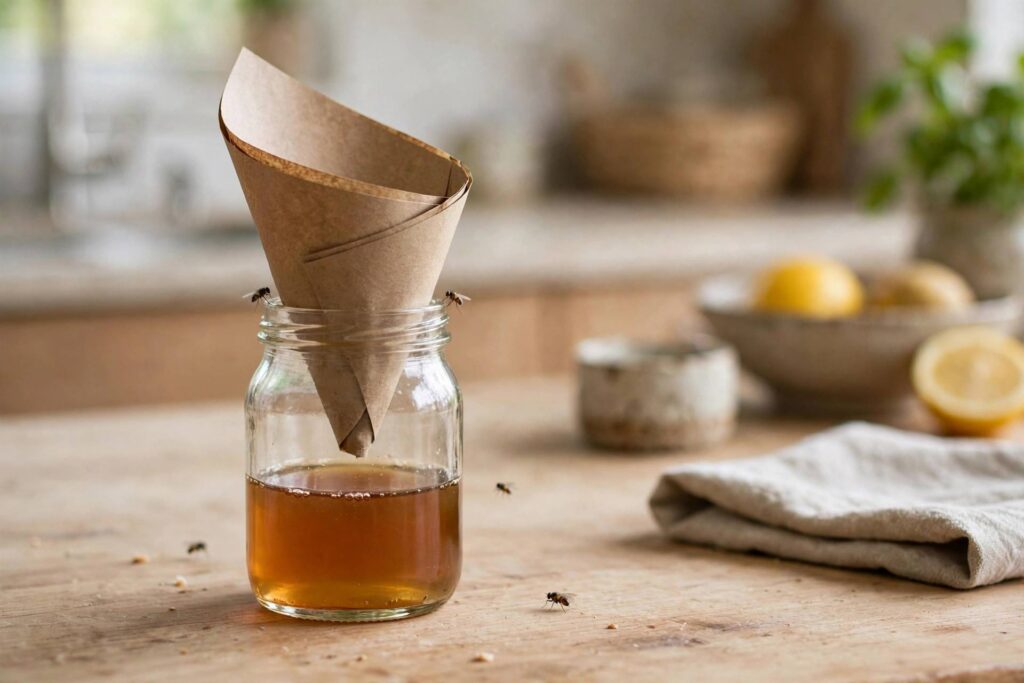
The classic apple cider vinegar trap works because it exploits exactly what attracts them. Pour a few tablespoons of apple cider vinegar into a small jar or glass, add a drop of dish soap, and stir. The soap is the critical ingredient most people skip — it breaks the liquid’s surface tension so flies that land sink instead of standing on the surface and flying away. Then make a paper funnel (roll a sheet of paper into a cone with a small opening) and set it in the jar’s mouth, or cover the jar with plastic wrap and poke a few small holes with a toothpick. Flies follow the vinegar scent in; the funnel geometry means almost none find their way out.
Place traps wherever you see activity — near the fruit bowl, by the trash, near the sink. In a bad infestation, deploy three or four. You will start catching flies within the hour, and the trap keeps working for days. Refresh the vinegar every two to three days.
Minutes 5–12: Attack the Drains
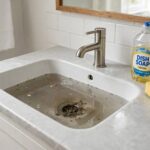
Kitchen drains are the breeding site everyone forgets. That slimy film coating the inside of your drain and garbage disposal is a five-star fruit fly nursery. Boiling water alone will not cut it — you need to physically and chemically break down the organic film.
Here is the method: pour a generous amount of baking soda down the drain, follow with white vinegar, and let it fizz for several minutes. Then flush with very hot (not necessarily boiling, which can damage some plumbing) water. For garbage disposals, toss in ice cubes and citrus peels and run it — the ice scours the grinding chamber walls. If you have a drain brush, use it; mechanical scrubbing of the drain interior removes the film that chemicals alone can miss. Do every drain in the kitchen, including the one you never use.
Minutes 12–20: Wipe Down and Remove Food Sources
Now eliminate everything they are eating. Wipe down counters, the stovetop, and especially under small appliances where crumbs and spills accumulate invisibly. Take out the trash and recycling — then clean the cans themselves, because the residue at the bottom is a buffet. Check under the sink for leaks or damp spots. Move ripe fruit into the refrigerator (cold stops the fermentation they love). Rinse empty bottles and cans before they go in recycling. Mop up any sticky spots on the floor — a dried drip of juice under the trash can sustains a colony.
Twenty minutes, three fronts. The visible swarm will thin dramatically within a day as the traps do their work and no new eggs get laid.

How to Get Rid of Fruit Flies Fast: The Follow-Through Days
The routine wins the battle; the next few days win the war. Eggs already laid will keep hatching for several days — this is normal and does not mean the routine failed. Keep the traps out and refreshed for at least a week. Repeat the drain treatment once more after three or four days to catch anything the first pass missed.
During this period, be strict about the prevention checklist below. Every new food source is a potential new nursery, and a single overlooked onion going soft in the pantry can restart the whole cycle. Think of it as a week of kitchen discipline that buys you months of peace.
If after ten days of consistent effort you still have significant activity, you have a hidden breeding site — the usual suspects are a slow leak under the sink, a forgotten potato in a dark cabinet, a trash can in another room, or buildup in a dishwasher filter. Play detective: check every room, not just the kitchen. Fruit flies will breed wherever fermentation happens, including bathrooms (drains) and home bars (spills).
The Prevention Checklist
Getting rid of fruit flies is easy. Keeping them gone is the actual skill. Make these habits:
- Refrigerate ripe produce. Fruit on the counter is a countdown timer. Once fruit ripens, it goes in the fridge. Bananas are the classic offender — buy them slightly green and refrigerate when spotted.
- Take trash out regularly. Kitchen trash should not sit for days in warm weather. Tie bags tightly, and keep the can itself clean — rinse it monthly at minimum.
- Rinse recyclables. That wine bottle with a tablespoon left in it? A fruit fly paradise. A quick rinse before the bin eliminates the attraction.
- Clean drains monthly. The baking soda and vinegar treatment is good maintenance, not just emergency medicine. Put it on a monthly rotation.
- Wipe spills immediately. Juice, wine, beer, soda — anything sugary or fermentable gets cleaned up the same day, not “later.”
- Check stored produce weekly. One rotting potato in the pantry will undo everything. A weekly five-second check of the onion bin and fruit bowl catches problems early.
- Keep compost sealed. If you compost indoors, use a sealed container with a tight lid and empty it frequently. An open compost crock in summer is essentially a fruit fly farm.
- Wash dish towels and sponges. Damp, food-soiled sponges and towels can harbor eggs. Replace sponges regularly and launder towels hot.
What About Store-Bought Traps and Sprays?
The DIY vinegar trap outperforms most commercial options on cost and matches them on effectiveness — the mechanism (attractant plus drowning solution) is identical. Commercial traps are essentially prettier, pre-mixed versions of the same thing; they are fine if you prefer the convenience, but they are not more powerful.
Insecticide sprays are the option I recommend against for kitchens. They kill the visible adults — the least important target — while leaving eggs and breeding sites untouched, and they introduce chemicals where you prepare food. Save the spray for the garage. In the kitchen, traps plus sanitation win every time, without the chemical trade-offs.
One product category worth knowing about: drain-specific enzyme cleaners, which use bacteria to digest the organic film in pipes. They are slower than the baking soda method but good for maintenance in problem drains. Use them as prevention, not as your primary attack.
Frequently Asked Questions
Where do fruit flies come from?
They almost always arrive as microscopic eggs on produce from the grocery store, then hatch in your kitchen when they find fermenting food. They can also fly in through windows and doors, attracted by the smell of ripening fruit. They do not come from the fruit itself spontaneously — the eggs were already there, invisible, waiting for the right conditions.
How long do fruit flies live?
Adult fruit flies live roughly two to four weeks in warm indoor conditions, but the relevant number is their reproductive speed: eggs hatch in about a day, and the new adults can breed within days of emerging. This is why infestations explode so fast and why eliminating breeding sites matters more than swatting adults.
Does the apple cider vinegar trap really work?
Yes — it is the most reliably effective DIY method because it targets the flies’ strongest instinct: the scent of fermentation. The critical details are the drop of dish soap (without it, flies land on the surface and escape) and the funnel or perforated cover (which turns entry into a one-way trip). Refresh the vinegar every few days to keep the scent strong.
Why do I still have fruit flies after cleaning everything?
Almost always a hidden breeding site: a slow leak under the sink, a forgotten item in the pantry, buildup in the dishwasher filter, a trash can in another room, or a drain you missed. Eggs already laid also keep hatching for several days after cleanup, which is normal. If activity persists beyond ten days of thorough effort, systematically check every room for moisture and forgotten food.
Are fruit flies harmful?
They do not bite and are not known to transmit diseases to humans the way some insects do, but they are a contamination risk — they travel between trash, drains, and your food, carrying bacteria on their bodies. The main harm is to your food (they accelerate spoilage and lay eggs in produce) and your sanity. They are a hygiene problem worth solving promptly, not a health emergency.
Will fruit flies go away on their own in winter?
Outdoor populations die off in cold weather, but indoor infestations persist year-round because your heated kitchen is their ideal habitat. Do not wait for winter — an indoor colony with food and warmth will happily breed through January. The routine in this guide works in any season.
Twenty Minutes, Then Done
Fruit flies feel like an invincible plague and are actually one of the easiest household pests to beat — because their needs are so specific. Take away fermentation, destroy the nurseries, trap the stragglers, and the math turns against them within days. Set your timer, run the routine, and enjoy your kitchen back.