How to Wake Up Without an Alarm: The Circadian Training Protocol


The idea of learning how to wake up without an alarm used to strike me as a superpower reserved for farmers and irritatingly disciplined people. Then I tried it — properly, over about two months — and discovered it is less a talent than a trainable rhythm. These days I wake up most mornings a few minutes before my target time, feeling oddly smug about it. This guide is the full protocol I used: the morning-light strategy, the strict-wake-time rule, the dawn simulator option, and one visualization technique I almost dismissed until it started working.
Why Waking Without an Alarm Is Trainable
Your body already knows how to end sleep on its own — it does it every morning you wake up a minute before the alarm screams. That ending is run by your circadian rhythm, an internal roughly-24-hour clock that schedules the release of hormones like cortisol (which rises before waking to lift you out of sleep) and melatonin (which falls as morning arrives). The problem isn’t that your clock is broken; it’s that modern life keeps feeding it confusing signals: bright screens at midnight, blackout darkness at 7 a.m., and a different wake time every day.
Think of your body clock like a muscle memory pattern. Every time you wake at the same time and get bright light soon after, you stamp that pattern a little deeper. Do it consistently and your brain starts preparing to wake before the alarm — many people find themselves stirring a few minutes early, which is exactly the signal the training is working. Nothing here requires supplements or gadgets to start; the core protocol is free.
One honest note: this trains your routine wake-up. It won’t fix chronic exhaustion — if you’re getting six hours and running on fumes, no protocol replaces sleep. Treat this as a rhythm project built on top of enough sleep, not a workaround for not getting it.
The 30-Day Circadian Training Protocol
Here’s the method, in the order that matters. Don’t skip ahead: step one does about half the work on its own.
Step 1: Lock in a Single Wake Time
Pick a wake time you can keep seven days a week — including weekends — for at least 30 days. This is the non-negotiable core of the whole system. Your body clock can’t calibrate to a moving target, and the famous “weekend catch-up sleep” actively undermines the training by shifting your rhythm later each week. Yes, this is the hard part. Choose a time you can actually keep: an ambitious 5 a.m. you abandon by day six teaches your clock nothing.
Set an alarm during the training period anyway — as a backup, not the goal. Put it across the room so you physically get up (more on why that helps in my piece on building a successful morning routine). The aim is to notice yourself waking before it rings, more and more often.
Step 2: Get Bright Light Within 30 Minutes
Light is the strongest signal your body clock reads, and morning light is the “start the day” stamp. Within 30 minutes of waking — ideally within minutes — get real light. Best: step outside, even on a cloudy day (clouds still deliver far more light than indoor bulbs). Next best: sit by a large bright window. Last resort: a bright light therapy lamp while you eat breakfast.
Five to twenty minutes is plenty. I take my coffee outside and check the garden; it’s the most pleasant part of the protocol and doubles as a screen-free start. Pair it with a glass of water — the benefits of drinking water in the morning after a night’s sleep are real and immediate, and the small ritual anchors the habit.
Step 3: Guard the Last Hour of the Day
Your clock also reads the evening: bright light late at night tells it “daytime is still happening” and delays your rhythm. You don’t need a perfect digital sunset — just dim the main lights for the last hour, keep screens at low brightness or in night mode, and make the bedroom genuinely dark. Consistency here matters as much as the morning half; the two ends of the day calibrate each other.
Step 4: Keep the Pattern Sacred for 30 Days
Here’s where most people bail: around week two or three, when the novelty fades and a late night beckons. Treat the wake time like medication — non-optional. One late night sets the training back several days, not because you’re weak but because the rhythm is still fragile. After roughly a month of consistency, most people report waking within minutes of their time, alarm-free, several days a week. That’s the green light to start trusting it — keep the backup alarm a while longer while confidence builds.
The Dawn Simulator Method
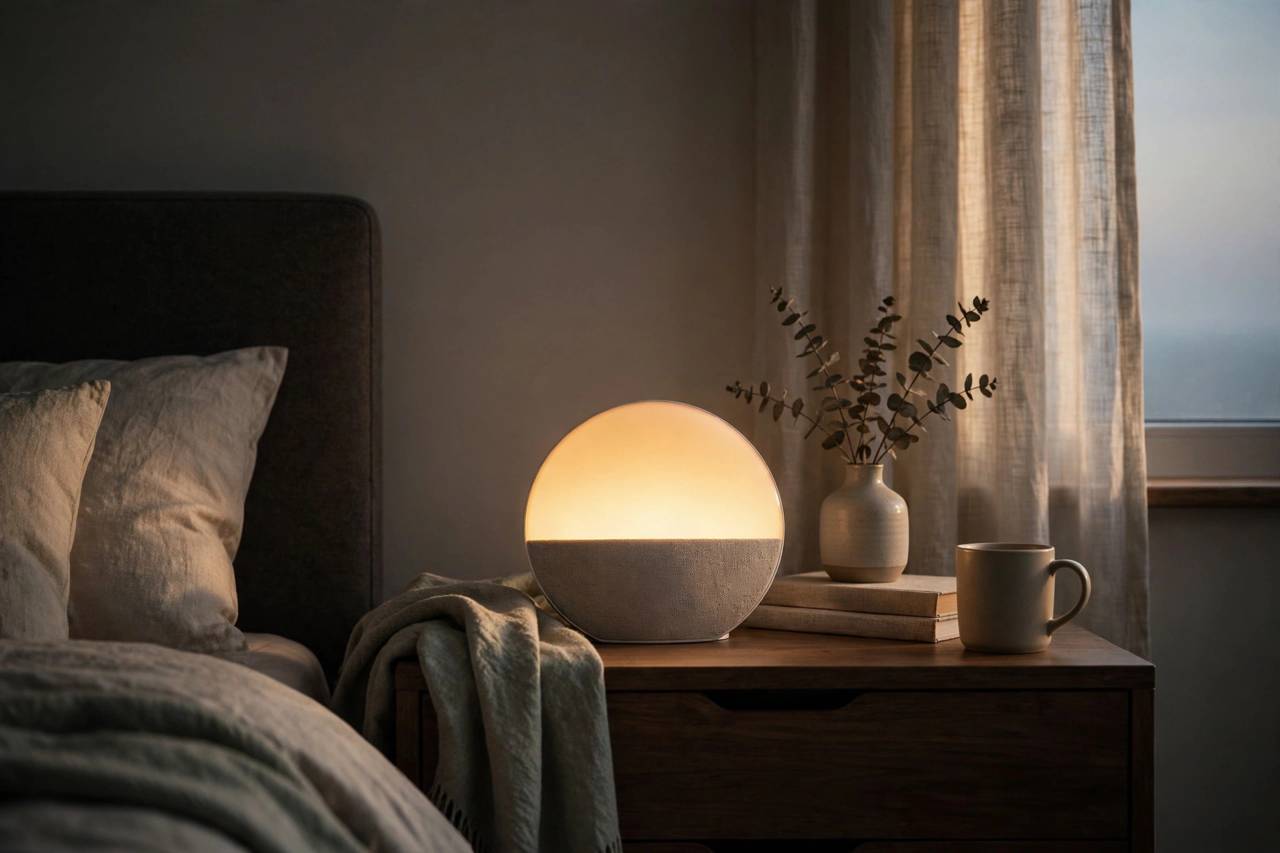
A dawn simulator is a lamp that gradually brightens over 20–40 minutes before your target wake time, mimicking sunrise. For people whose bedrooms are cave-dark (blackout curtains, north-facing windows, winter), it’s the single best upgrade to this protocol — it gives your body the light-ramp signal even when the real sun is absent.
Place it on the nightstand at face level, roughly an arm’s length away. Start the brightening cycle 30 minutes before your target time and set it to reach full brightness right at wake time. Use it in addition to the morning light step, not instead of it: the simulator handles the wake transition, and real daylight after getting up locks the rhythm in for the day. Keep your backup alarm set during training; the goal is to find yourself waking as the light reaches full, before any sound is needed.
The Visualization Technique Skeptics Skip
I nearly left this out because it sounds like wishful thinking. Before sleep, lie still and vividly picture yourself waking up at your target time — see the room’s light, imagine the feeling of being rested and alert, and mentally rehearse getting out of bed. Repeat the time to yourself calmly a few times. That’s it; the whole thing takes two minutes.
Why I kept it in: I tried it as an experiment, fully expecting nothing, and started hitting my target time noticeably more often within a week. The plausible mechanism is simple — you’re giving your brain a clear intention to anchor its internal wake planning around, rather than drifting to sleep with tomorrow left vague. It’s free, takes two minutes, and the worst case is that you fall asleep a little calmer. Do it every night of the training month and judge by results, not by how it feels.
What to Do When You Still Oversleep
It will happen — a late night, travel, a bad night’s sleep. When it does, the recovery rule is simple: get up at your normal time anyway the next day, even if you’re groggy, and protect the pattern going forward. One off day is noise; the rhythm re-locks in a couple of days if you don’t let it become two off days. Don’t try to “catch up” by sleeping in — that shifts the clock later and trades one groggy morning for a week of them.
If oversleeping becomes a pattern rather than an exception, that’s information: either your target time is earlier than your sleep allows (move bedtime earlier or the wake time later), or something is disrupting your sleep quality — and that’s a different problem to solve first. Once the rhythm is reliable, many people find it slots neatly into a fuller daily routine that runs on the clock their body already keeps.
How to Wake Up Without an Alarm When You Travel
Travel is where circadian training goes to die — new time zones, hotel blackout curtains, unfamiliar beds. But you can protect most of your progress with a travel protocol. Before the trip: if you’re crossing time zones, start shifting your wake time 30 minutes a day toward the destination time for three days before you leave. It’s gentler than arriving cold and it works shockingly well for shifts of up to three hours.
At the hotel: the blackout curtains are your enemy in the morning and your friend at night. Do a curtain check on arrival — open a gap you’ll actually use, or you’ll sleep through it in a pitch-black room and blame the method. Get outside within an hour of waking, even just for the walk to get coffee; new light in a new place is the fastest way to tell your clock where “morning” is now. Keep your home wake time (in destination time) as the anchor — consistency across the trip matters more than perfection on any single day.
For the return: expect 2–3 wobbly days. Don’t panic and don’t abandon the protocol — just re-lock the wake time, get the morning light, and let the rhythm re-settle. One useful trick: keep the backup alarm for the first three nights home, then drop it again once you’re waking before it. Travel doesn’t erase training; it just pauses it. The rhythm comes back faster each time because the pattern is already grooved in.
Frequent travelers sometimes carry a portable dawn simulator — the small ones weigh almost nothing and turn any blackout-curtained hotel room into a sunrise. It’s the one gadget in this whole system I’d actually call worth buying if you travel monthly or more.
Frequently Asked Questions
How long does it take to wake up without an alarm?
Most people need 3–6 weeks of a fixed wake time plus consistent morning light before they regularly wake near their target time on their own. Consistency matters more than speed.
Do I need a dawn simulator to make this work?
No — it’s a helpful upgrade, especially in dark winters, but the core protocol (fixed wake time, morning light, protected evenings) works without any device.
What if I have to wake at different times on weekdays and weekends?
Pick the earlier time as your anchor seven days a week. A shifting wake time is the single biggest thing that prevents the rhythm from locking in.
Does the visualization technique really work?
It costs two minutes and many people report it helps; the likely mechanism is simply setting a clear intention before sleep. Try it for a month and judge by your own results.
Will this work if I don’t get enough sleep?
No protocol replaces adequate sleep. Fix your sleep duration first — this method trains the timing of your wake-up, not a substitute for rest.
Can I still use an alarm during training?
Yes — keep a backup alarm the whole time. The goal is noticing yourself wake before it rings; drop the alarm only once that happens reliably.