How to Make Your Bed Like a Hotel: The Budget Method


I became mildly obsessed with how to make your bed like a hotel after a work trip where I slept better in three nights than I had in three months at home. I cornered the housekeeping supervisor (politely) and asked what the actual difference was. Her answer was not what I expected: it wasn’t expensive bedding. It was technique — tension, layers, and corners. I came home, spent a weekend testing her methods on my thoroughly ordinary bedding, and the difference was honestly startling. Here’s the full method, including the hospital-corner tutorial and the duvet-fold trick, with nothing to buy unless you want to.
Why Hotel Beds Feel Different (It’s Not the Mattress)
Three things make a hotel bed feel like a hotel bed, and only one of them involves money. First: tension — hotel sheets are pulled drum-tight, so nothing bunches or wrinkles under you. Second: layers in the right order — fitted sheet, flat sheet, then the duvet or coverlet, each doing a distinct job. Third: symmetry and finish — crisp corners, even folds, pillows placed with intent. Your brain reads all of this as “this space is cared for,” and your nervous system gets the message to stand down.
The good news: tension and corners are free. They just take five minutes and a bit of practice. Let’s build the bed the way housekeeping does it, layer by layer.
Step 1: The Foundation — Fitted Sheet Done Right
Start with a fitted sheet that actually fits — too big is worse than too small, because excess fabric is what wrinkles. Strip the bed completely (hotels always start from the bare mattress). Put the fitted sheet on with the tag or label at the bottom-right corner so you always orient it the same way.
Now the part everyone skips: lift each mattress corner and tuck the elastic deep under, pulling diagonally across the corner to create real tension. Then run your hands from the center outward, smoothing as you go. The sheet should feel almost trampoline-tight. If your sheet is older and the elastic is tired, this is the one place where a new fitted sheet genuinely pays off — budget sets are fine as long as the elastic is strong.
Step 2: The Flat Sheet and Hospital Corners Tutorial
Lay the flat sheet over the bed with the finished hem at the head, letting it overhang evenly on both sides and the foot. Smooth it flat, then do the famous hospital corners — the single technique that separates hotel beds from home beds:
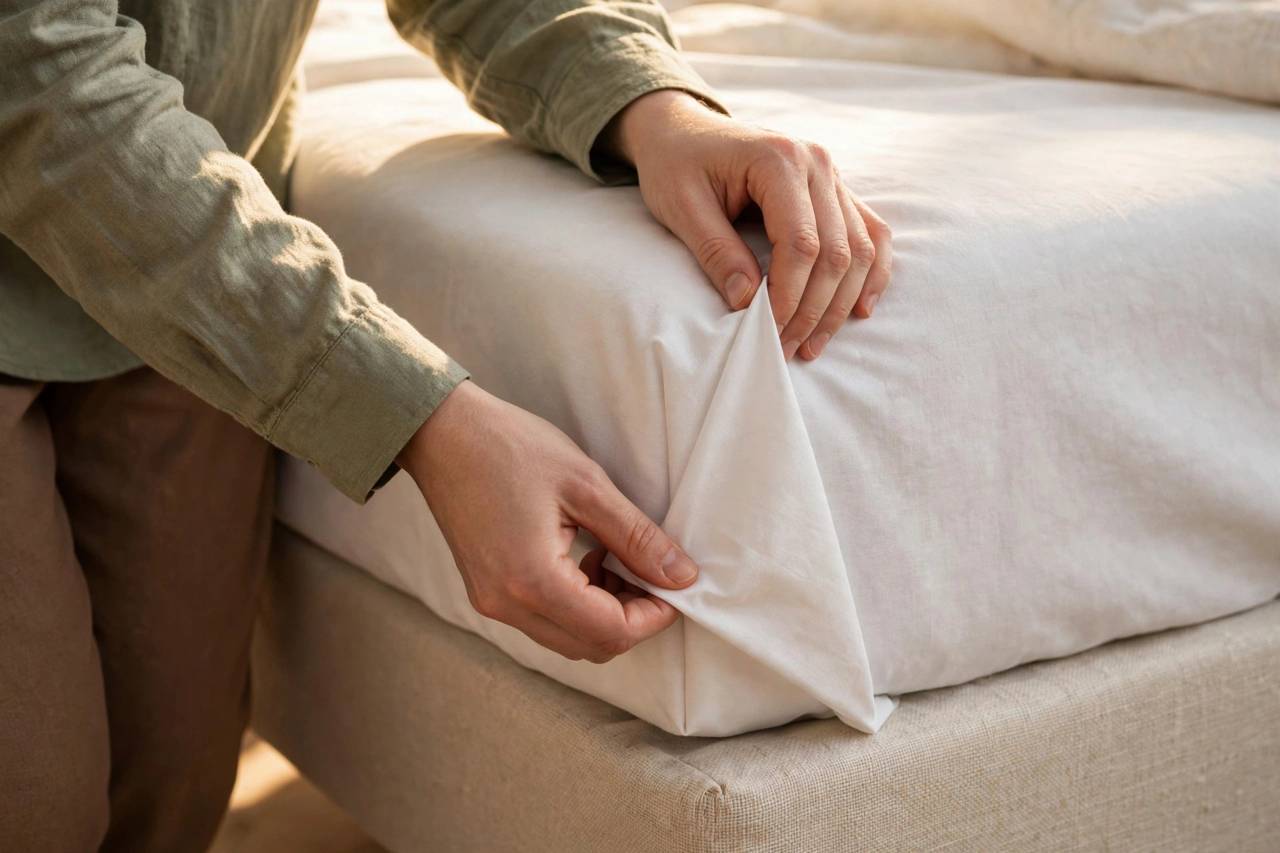
1. At the foot of the bed, tuck the hanging sheet straight under the mattress.
2. Move to one side near the foot. Grab the sheet about 30 cm up from the corner and lift it up onto the bed, creating a diagonal fold.
3. While holding that lifted fold, tuck the hanging part underneath the mattress with your other hand, working from the foot toward the head.
4. Drop the lifted fold back down over the tucked edge. Smooth it. You’ve just made a crisp 45-degree corner.
5. Repeat on the other side.
Do the same at the two head corners if you like the fully tucked look, or leave the head untucked for a more relaxed style. Either way, finish by smoothing the whole sheet with flat hands from center to edges — wrinkles are just air trapped under tension, and smoothing chases them out.
Step 3: The Duvet-Fold Trick
Here’s the housekeeping secret that makes the bed look professionally finished: the top third fold. Lay your duvet or comforter over the bed evenly. Then fold the top third of the duvet back on itself, toward the foot, creating a wide cuff about 30 cm deep. Smooth the fold.
That single fold does three things: it creates a clean horizontal line that reads as “finished,” it gives you a thicker layer exactly where your torso is (the part that needs the warmth), and it leaves the pillows sitting against a neat edge instead of sliding into a rumpled mess. If you use a flat sheet underneath, fold the sheet’s top hem back over the duvet cuff for the classic hotel contrast line — this also keeps the duvet cover cleaner for longer.
Step 4: Pillow Styling (The 2-Second Version and the Full One)
Hotels use a formula: sleeping pillows flat against the headboard (or standing, propped), then decorative shams in front, then a small accent cushion. You don’t need the full arsenal. The everyday version: two sleeping pillows propped upright against the headboard, two shams or pillowcases in front of them leaning slightly forward, and — this is the trick — give each pillow a firm karate chop down the center top. That little dent is the universal signal of a styled bed, and it takes one second.
For a guest-room wow factor, add a folded throw across the foot of the bed. It adds color and texture, and guests read it as luxury even though it’s just a blanket you already owned.
Styling Hacks That Cost Nothing
Once the technique is right, these free finishing touches sell the effect: symmetry — step back and make both sides mirror each other; no wrinkles on the visible third — nobody sees under the duvet, so spend your smoothing on the cuff and pillows; clear the nightstands — clutter next to a crisp bed undoes half the effect; and morning light — open the curtains, because hotel beds always live in bright rooms.
And zoom out: the bed is the visual anchor of the whole room. If you want the full effect, my guide on how to make your bedroom cozy covers lighting, textiles, and layout, and the hygge lifestyle approach to warm, low-stimulation spaces pairs perfectly with a bed that feels like a small nightly retreat.
How to Make Your Bed Like a Hotel With Just a Duvet
No top sheet? No problem — plenty of people (and plenty of European hotels) skip the flat sheet entirely. The duvet-only method just shifts the technique: shake and settle the duvet first, holding two corners and giving it three good shakes so the filling distributes evenly — lumpy filling ruins the look before you start. Lay it centered with equal overhang on both sides, then do the top-third fold-back exactly as described above. The cuff is even more important without a sheet, because it’s the only crisp horizontal line in the composition.
Tuck the duvet’s bottom corners under the mattress at the foot for a tailored look, or let it drape for a relaxed luxury-hotel feel — both read as intentional as long as the drape is even. Smooth the whole surface with flat hands, working from the center outward. Then the pillows: with no sheet, prop sleeping pillows directly against the headboard and layer shams in front. The karate-chop dent matters double here — it’s the detail that says “styled” instead of “slept in.”
One maintenance note for the duvet-only crowd: wash the duvet cover weekly, since it’s doing the sheet’s job against your skin. A second cover in rotation makes this painless — strip, replace, done, in the time it takes to make coffee.
The 90-Second Daily Version
The full hotel method is a weekend pleasure; weekday mornings need the express version. Here’s the 90-second routine that keeps 80% of the effect: 1. Pull the duvet up and shake it out (20 seconds). 2. Fold back the top third (15 seconds). 3. Plump each pillow and chop the dent (30 seconds). 4. Step back, smooth the visible cuff, straighten the throw (25 seconds). Done.
The secret is that the express version compounds: a bed made quickly every day looks better than a bed made perfectly once a week, because the wrinkles never get a chance to set. And the psychological payoff is the same — walking into a bedroom with a made bed at the end of the day feels like the room is looking after you. That’s not interior design; that’s self-respect with corners.
Choosing Bedding That Makes the Method Easier
Technique matters most, but the right bedding removes friction. Fabric: cotton percale (crisp, matte, cool) photographs and holds creases like hotel bedding; sateen (smooth, sheeny) wrinkles more visibly. If you love the hotel look, percale is the shortcut. Thread count: ignore the marketing — anything honest between 200 and 400 in quality cotton outperforms a dubious “1000 thread count” set. Feel matters more than numbers.
Color: white or ivory shows every wrinkle, which sounds like a downside — but it’s actually why hotels use it. White forces the technique: you smooth properly because you can see when you haven’t. Dark bedding hides wrinkles and quietly lets standards slide. Size: buy the duvet one size up from your bed (a king duvet on a queen bed) — the extra drape is half the luxury look, and it ends the blanket-tug-of-war for couples. And keep two sets in rotation: making the bed with fresh sheets is dramatically more motivating than wrestling a fitted sheet you just laundered and need back on tonight.
Frequently Asked Questions
Do I need expensive sheets to get the hotel look?
No. Technique matters far more than thread count — tight fitted sheets, hospital corners, and the duvet-fold trick work on budget bedding. Replace only a fitted sheet whose elastic has gone slack.
What are hospital corners and why do hotels use them?
Hospital corners are a 45-degree folding technique that tucks sheets tightly under the mattress. Hotels use them because they keep sheets wrinkle-free and in place all night.
Should I tuck the duvet in at the foot?
Hotels usually leave the duvet untucked at the foot for a relaxed drape, but tuck the flat sheet beneath it. Either way works — consistency and smoothness matter more than the choice.
How many pillows do hotels actually use?
Typically four to six: two sleeping pillows, two shams, and sometimes accent cushions. At home, two sleeping pillows plus two shams styled with the karate-chop dent give 90% of the effect.
How long does the hotel bed method take each morning?
About five minutes once you’ve practiced the corners a few times. The first week is slower; after that it’s muscle memory.