How Do Video Game Rankings Work? MMR and Ladders Explained


You win a match, your rank goes up. You lose, it drops. Simple — until you win five in a row and barely move, then lose once and plummet. If you’ve ever wondered how do video game rankings work under the hood, the answer is that the shiny badge you see (Gold III, Diamond, whatever) is just the costume. Underneath it, every serious competitive game runs a hidden number — usually called MMR, matchmaking rating — that represents the system’s best guess at your true skill. I’ve climbed ranked ladders in shooters, MOBAs, and fighting games for years, and once you understand the machinery, the weird rank movements stop feeling random and start feeling legible.
The whole system exists to solve one problem: how do you take millions of players of wildly different skill and sort them into fair matches in under a minute? The answer is statistics, iteration, and a visible rank designed to feel rewarding while the hidden number does the real work.
MMR and Elo: The Hidden Number Behind Your Rank
Almost every ranked system descends from the Elo rating system, invented for chess in the 1960s. The idea is elegant: every player has a rating number. When two players compete, the system predicts the outcome from the rating gap — if you’re rated much higher, you’re expected to win. After the match, your rating moves based on how reality compared to prediction. Beat someone stronger than you, gain a lot. Lose to someone weaker, drop a lot. Beat someone you were supposed to beat, gain a little.
MMR (matchmaking rating) is gaming’s version of this. It’s the hidden number the matchmaker actually uses to build fair lobbies. Your visible rank — Silver, Platinum, Immortal — is a translation of MMR into tiers and divisions, designed to give you milestones to chase. The two usually track together, but they can diverge: the system may hold your visible rank back (or push it forward) to keep the climb feeling earned.
Placement Matches: How the System First Sizes You Up
Every ranked season starts with placement matches — typically 5 to 10 games where the system has high uncertainty about you. During placements, each win or loss swings your hidden rating dramatically, because the algorithm is calibrating from scratch (or from last season’s ending point, which most games use as a soft starting guess).
This is why placements feel so volatile: the system is supposed to move you fast while it knows nothing. Once you’ve played enough games, your rating stabilizes — the system becomes confident — and individual matches move the needle less. New accounts and new seasons are the only times big swings are normal.
The Ranked Ladder: Tiers, Divisions, and LP
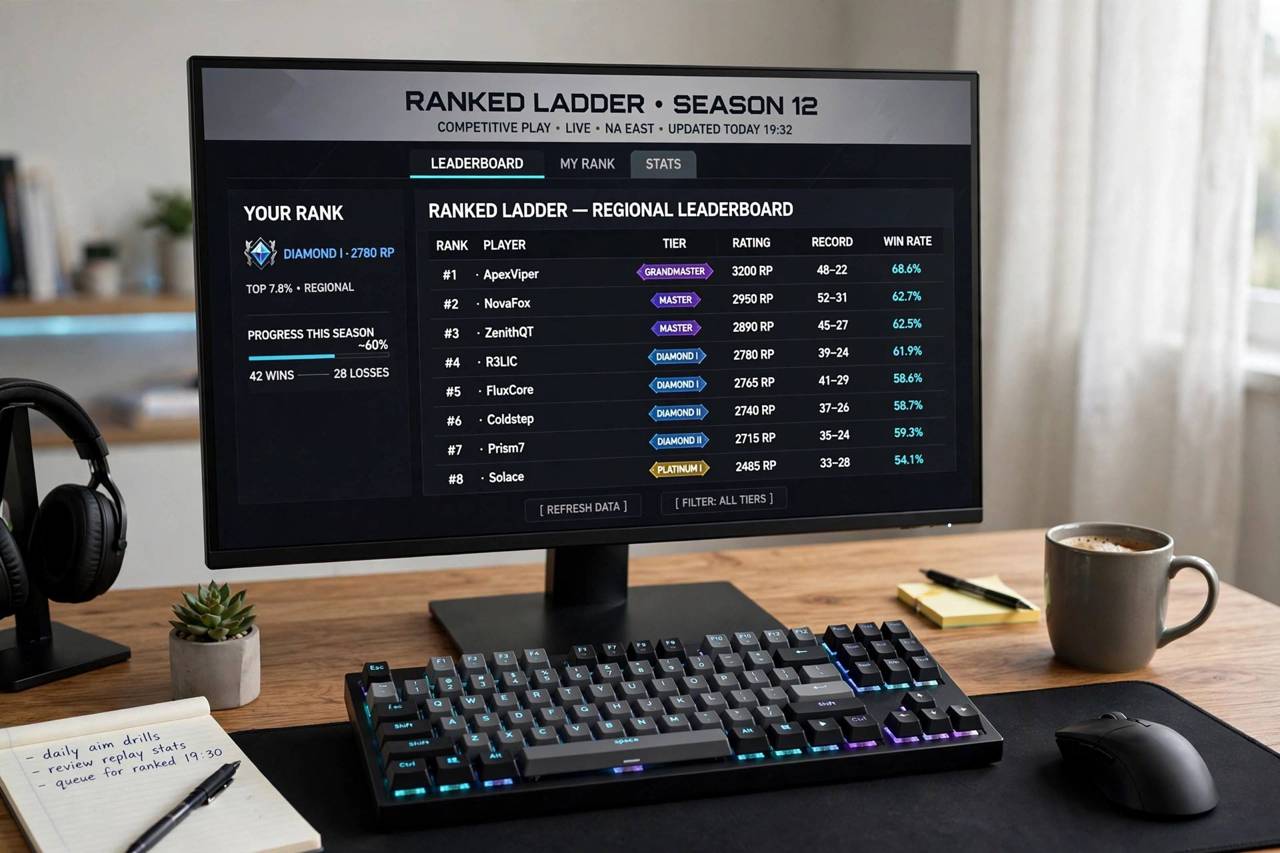
The visible ladder is psychology as much as mathematics. Most games structure it as tiers (Bronze through the highest rank, often with a special name like Radiant or Challenger for the top few hundred players) divided into divisions (usually I–IV or 1–3 within each tier). You earn LP (league points) or equivalent per win, lose them per loss, and promote when you cross thresholds — often through a promotion series of best-of matches at tier boundaries.
Two design details matter. Rank decay or demotion protection: many games shield you from dropping a full tier immediately (demotion protection), while some decay inactive high-ranked accounts to keep leaderboards honest. Season resets: at season’s end, ranks partially reset — usually a “soft reset” that compresses everyone slightly toward the middle rather than wiping the slate, so next season’s climb is faster for proven players.
Why Your Rank Sometimes Feels Wrong
The classic complaints all have systemic explanations. “I win more than I lose but I’m stuck”: your MMR may have you matched against stronger opponents, so wins gain less than losses cost — the system thinks you’re near your true level. “I lost one game and dropped a division”: at division boundaries with zero LP buffer, one loss demotes you; the underlying MMR barely moved. “My teammate was terrible, matchmaking is rigged”: over hundreds of games, teammates average out — the only constant in your matches is you. The system isn’t rigged; it’s just indifferent to your feelings about any single game.
And the big one: smurfs (high-skill players on new accounts) distort individual matches but the system corrects fast — a smurf’s MMR skyrockets within a dozen games because the algorithm detects the anomaly. It feels awful to face one; statistically, it’s noise.
Team Games vs. Solo Games: Different Math
In 1v1 games (fighting games, chess-like modes, StarCraft-style RTS), ranking math is clean: your result is entirely yours. Team games (5v5 shooters, MOBAs) have to solve a harder problem — how much of a win was you? Most systems adjust with performance modifiers: some games factor individual stats (kills, objectives, healing) into MMR changes, while purists argue only wins and losses should count, since stat-chasing corrupts teamwork. There’s no consensus, and different games choose differently — which is why climbing feels different across titles even when the ladders look similar. (Streaming is changing how we play too — see how cloud gaming works.)

How Do Video Game Rankings Work Across Different Genres?
The Elo skeleton adapts to each genre’s shape. FPS games (Valorant, CS-style): team-based MMR with performance modifiers — some titles weight individual combat score, others go pure win/loss. Rounds won/lost sometimes factor in, so a close 13–11 loss costs less than a 13–0 stomp. MOBAs (League, Dota): famously pure win/loss in most implementations, which is why MOBA climbing feels so teammate-dependent — the system refuses to reward good stats in a loss, on the theory that stat-chasing corrupts play.
Fighting games are the purest Elo environment: 1v1, no teammates, no excuses. Your rank is you. Many use visible points systems where beating higher-ranked players yields big gains — the closest to chess’s original formula. Battle royales (Apex-style ranked): placement-plus-kills hybrid — you earn points for finishing position and eliminations, so the system rewards both survival and aggression. Camping to placement without kills stalls your climb; hot-dropping every game tanks it. The math enforces balanced play.
Card and strategy games often use star or ladder systems with win streaks bonuses — simpler math, more volatility, designed for shorter session games. The common thread: every genre bends the Elo core around what “skill” means in its context.
Climbing Smarter: What the Math Actually Rewards
Understanding the system changes how you should approach the climb. Volume with consistency beats streaks: since the system converges on your true skill over many games, the fastest climbers aren’t the ones with miraculous win streaks — they’re the ones who play enough games for the math to work while gradually improving. Fifty games at a 55% win rate climbs further than ten games at 70%.
One-tricking vs. flexing: the math slightly favors specialization — deep mastery of one character or role reduces your performance variance, which means your MMR converges faster and more accurately. Flex players climb too, but slower, because the system needs more data across their wider variance. Stop-loss discipline: this isn’t superstition, it’s statistics — tilted play after losses measurably drops win rate, and the system doesn’t care why you lost. Two losses in a row? Take a break. The ladder will be there tomorrow, and your MMR doesn’t decay from a day off in most games.
Above all: the system is descriptive, not prescriptive. It measures the player you are, not the player you wish you were. Climbing is just the visible trail of getting better — focus on the improvement and the rank follows the math.
Ranked Anxiety Is Real: A Note on Mindset
A quick aside from the math, because it matters: ranked anxiety — the dread of queuing, the fear of losing hard-earned rank — is one of the most common experiences in competitive gaming, and the system’s design partly causes it. Visible ranks turn every game into a referendum on your worth; loss streaks feel like verdicts.
What helps, honestly: hide the number. Many games let you minimize rank display — do it. Focus on one improvable skill per week (map awareness, cooldown tracking, whatever) instead of the badge. And remember what the math says: your rank is a measurement with error bars, not a grade. It converges over hundreds of games; any single session is noise. The players who climb highest aren’t the least anxious — they’re the ones who kept queuing anyway. Treat ranked as practice with scorekeeping, not judgment with consequences, and the whole system gets lighter.
Frequently Asked Questions
How do video game rankings work?
Behind your visible rank, games track a hidden skill number (MMR, based on the Elo system). Wins against stronger opponents raise it more; losses to weaker ones drop it more. Your visible tier is a translation of that hidden number into milestones.
What is MMR in gaming?
MMR (matchmaking rating) is the hidden numerical estimate of your skill that the matchmaker uses to build fair games. Your displayed rank (Gold, Diamond, etc.) is derived from it but may lag behind or be cushioned by design features like demotion protection.
Why did my rank drop after one loss?
At division boundaries with no LP buffer, a single loss can demote you visibly even though your hidden MMR barely changed. It’s a display threshold effect, not a massive skill reassessment.
Do placement matches matter more than regular games?
Yes — during placements the system has high uncertainty about your skill, so each result swings your hidden rating much more than a mid-season game. That’s intentional: it’s calibrating from scratch.
Why am I stuck at the same rank despite winning?
Your MMR likely has you facing stronger opponents, so wins earn less than losses cost — the system believes you’re near your true level. Breaking through usually requires improving fundamentals, not just grinding more games.
What is a soft reset in ranked seasons?
At season’s end, most games compress ratings slightly toward the middle rather than wiping them. Proven players climb back quickly through new placements, while the reset gives everyone fresh milestones to chase.
How do video game rankings work? A hidden number guesses your skill, every match refines the guess, and the shiny badge is just the user interface. Play enough games and the system will find your level with unnerving accuracy — the ladder doesn’t lie, it just takes a while to finish its sentence.