What Is a Unique Selling Proposition? Definition, Worksheet & Examples


Ask ten small business owners what makes them different, and nine will say “quality” or “great service.” Here is the problem: if everyone claims it, it is not unique, and if it is not specific, it is not a proposition. So what is a unique selling proposition? A unique selling proposition (USP) is a clear, specific statement of the distinct benefit your business offers that competitors do not, the reason a customer should choose you instead of anyone else. It is not a slogan and not a mission statement. It is a competitive claim you can actually deliver on.
I have helped dozens of small businesses sharpen their positioning, and the pattern is always the same: the USP was there all along, buried under generic language. This guide gives you a fill-in-the-blank worksheet to extract yours, worked examples from realistic small businesses, and a clear explanation of how a USP differs from the mission statements, visions, and slogans people confuse it with.
What Is a Unique Selling Proposition? Definition and the Specificity Test
A strong USP has three qualities. It is specific: it names a concrete benefit, not a vague virtue. It is unique: competitors cannot credibly say the same thing. And it is valuable: the benefit matters to the customer enough to influence a purchase.
Test any candidate USP against this question: could your two closest competitors put this sentence on their website without lying? If yes, it is not a USP; it is table stakes. “High-quality products” fails. “Hand-poured soy candles with 60-hour burn times, made in small batches of 50” passes, because it is specific, verifiable, and hard for a mass-market competitor to match.
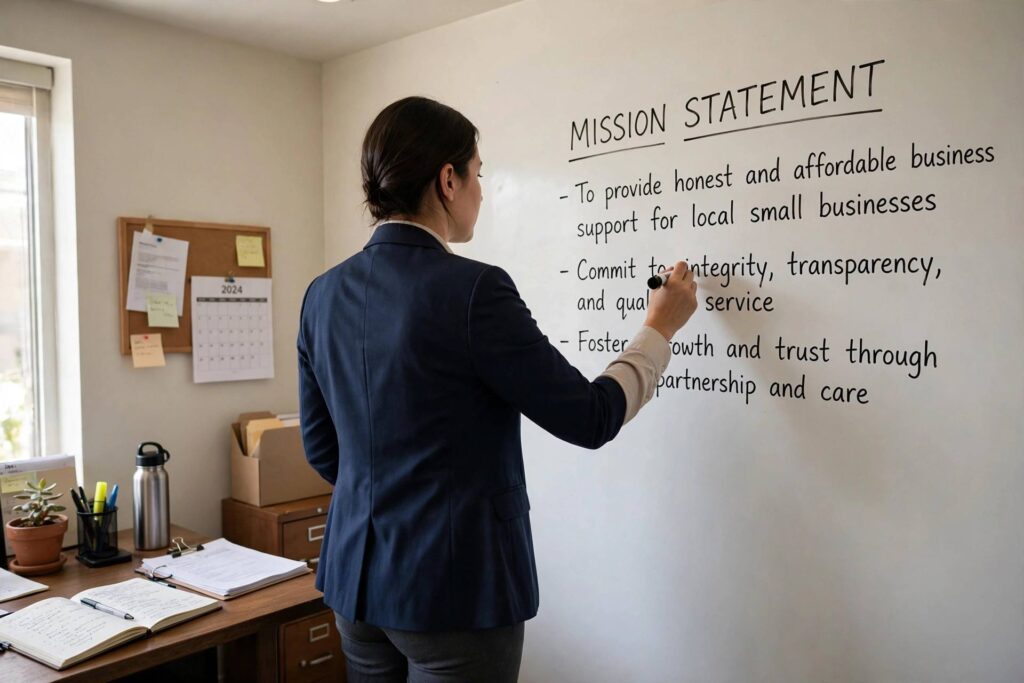
What a USP is not: a slogan (slogans are memorable phrases; USPs are substantive claims), a mission statement (missions describe your purpose; USPs describe your customer advantage), or a list of features (features describe what you have; a USP describes why it matters to the buyer).
The USP Worksheet: Fill in the Blanks
Work through these five prompts in order. Write actual sentences, not bullet fragments; the discipline of complete sentences exposes vague thinking.
1. Who exactly do you serve? “We help ___.” Be narrow. “Busy parents” beats “families.” “Independent coffee shops” beats “businesses.” Specificity here powers everything downstream.
2. What problem do you solve for them? “Who struggle with ___.” Name the pain in the customer’s words, not yours. Customers do not buy “synergistic solutions”; they buy relief from specific frustrations.
3. What do you do differently? “Unlike ___, we ___.” Name the alternative (competitors, DIY, doing nothing) and your concrete difference. This is the “unique” in USP; if you cannot fill this blank, you do not have one yet, which is valuable information.
4. What proof do you have? “We have ___.” Numbers, years, customers served, guarantees, certifications. A claim without proof is a wish. Even modest proof (“200+ five-star reviews,” “same-day service guaranteed”) transforms a USP from assertion to evidence.
5. Assemble it. Combine the answers into one or two sentences: “We help [who] [solve what], unlike [alternative], we [difference], backed by [proof].” Then cut it in half. Then cut it in half again. Your final USP should be statable in one breath.
Worked Examples: Three Small Businesses
Example 1: A residential cleaning service. Draft: “We help busy dual-income families keep a clean home without spending weekends on chores. Unlike national franchises that send a different stranger each visit, we assign one dedicated cleaner who learns your home, backed by our 24-hour re-clean guarantee.” Final USP: “One dedicated cleaner for your home, every visit, guaranteed, or we re-clean free within 24 hours.” Specific, unique (franchises cannot match the dedicated-cleaner model easily), valuable (trust and consistency are the top anxieties in this category).
Example 2: A specialty coffee roaster. Draft: “We help home brewers who are tired of stale supermarket coffee taste cafe-quality cups. Unlike big roasters with months-old beans, we roast every Tuesday and ship within 24 hours, with the roast date printed on every bag.” Final USP: “Roasted every Tuesday, shipped within 24 hours, roast date on every bag.” The specificity does the selling; no adjectives needed.
Example 3: A bookkeeping service for freelancers. Draft: “We help solo freelancers who dread tax season stay organized year-round. Unlike generic accounting firms that bill hourly and speak jargon, we charge one flat monthly fee and explain everything in plain English, with 500+ freelancers served.” Final USP: “Flat-fee bookkeeping for freelancers, in plain English, no hourly billing, no jargon.” It names the audience, the pain, and the difference in twelve words.
Notice what none of these say: “quality,” “passion,” “excellent service.” The USP lives in specifics.

USP vs Mission vs Vision vs Slogan
These four get mixed up constantly, so here is the clean separation:
USP: Why should a customer choose you over competitors? Customer-facing, competitive, specific. Example: “Roasted every Tuesday, shipped within 24 hours.”
Mission statement: Why does your business exist? Purpose-facing, internal and external. Example: “To make great coffee accessible to home brewers.” A mission explains your reason; a USP explains your advantage.
Vision statement: Where is the business going? Future-facing, aspirational. Example: “A world where no one drinks stale coffee.” Visions inspire teams; they do not close sales.
Slogan/tagline: What is the memorable phrase? Marketing-facing, catchy. Example: “Freshness you can taste.” Slogans are built from USPs, not instead of them; the slogan is the jingle, the USP is the reason to believe it.
If you want to go deeper on how these fit into your overall brand, our guide on what branding really is connects the dots, and the piece on business name vs brand name clears up another common confusion.
Where Your USP Should Appear
A USP only works if customers see it. Put the full version on your homepage hero section, above the fold, where it answers the visitor’s first question (“why should I stay?”). Use shortened versions in ad headlines, social media bios, email signatures, packaging, and anywhere you have ten seconds of a prospect’s attention. Train your team to say it; if your staff cannot state the USP in one sentence, customers will never hear it.
Testing and Refining Your USP
A USP is a hypothesis until customers confirm it. Test yours three ways. Ask customers why they chose you over alternatives; if their answers match your USP, you nailed it, and if they consistently name something else, your real USP is what they said, not what you wrote. A/B test the USP as a homepage headline against your current headline and measure conversion. Check competitors quarterly; a USP is only unique until someone copies it, and the best response to imitation is to deepen the proof, not to change the claim.
Revisit the worksheet annually. Businesses evolve, markets shift, and the difference that mattered three years ago may be table stakes today. The worksheet takes an hour; running on an outdated USP costs far more.
USP Mistakes That Kill Conversions
Most bad USPs fail in predictable ways. The most common is the generic claim: “quality,” “service,” “passion.” These are not differentiators; they are the entry fee for being in business, and customers filter them out as noise. Next is the feature list disguised as a USP: “we offer X, Y, and Z” describes inventory, not advantage. Translate every feature into the customer’s benefit before it earns a place in your USP.
Another killer is the unprovable superlative: “the best,” “the leading,” “number one.” Without proof, superlatives trigger skepticism instead of trust; with proof (“rated 4.9 from 2,000+ reviews”), they become assets. Finally, the USP nobody can find: a brilliant positioning statement buried on the about page while the homepage says something vague. Your USP belongs above the fold on your homepage, in your ads, and in your team’s vocabulary. A USP customers never see is a USP you do not have. Audit yours quarterly: read it aloud, ask whether competitors could honestly say it, and check that every claim still has proof behind it. Positioning decays as markets move; maintenance is part of the job. The businesses that win are rarely the best; they are the best positioned.
Frequently Asked Questions
What is a unique selling proposition in simple terms?
A USP is a clear statement of what makes your business different and better for customers than competitors. It answers: “Why should I buy from you instead of someone else?” in one or two specific, provable sentences.
What is an example of a unique selling proposition?
“Roasted every Tuesday, shipped within 24 hours, roast date on every bag” (a coffee roaster). Good USPs are specific, hard for competitors to copy, and meaningful to buyers, unlike generic claims like “high quality” or “great service.”
What is the difference between a USP and a slogan?
A USP is a substantive competitive claim (what makes you different and why it matters); a slogan is a memorable phrase. Slogans are often built from USPs, but a catchy slogan without a real USP behind it is just decoration.
How long should a USP be?
One to two sentences, statable in one breath. If it takes a paragraph to explain, keep refining. Brevity forces the specificity that makes USPs work.
Can a business have more than one USP?
You can have supporting differentiators, but lead with one primary USP. Multiple “unique” claims dilute each other; customers remember one sharp difference far better than five mild ones.
How do I find my USP if my business seems identical to competitors?
Look harder at specifics: process differences, guarantees, speed, specialization, customer experience details, or proof points. Ask customers why they chose you; their answers often reveal a USP you did not know you had. If truly nothing differs, that is a strategy problem to solve, not a wording problem.
Final Thoughts
Your USP is not a creative writing exercise; it is a business decision expressed in a sentence. Do the worksheet honestly, cut ruthlessly, prove specifically, and put it everywhere. In a market where everyone shouts “quality,” the business with one sharp, true sentence wins. Write yours this week, test it against real customers, and refine it until it sells.