What Is a Business License and Do I Need One? The Founder’s Guide


When I started my first business, I spent weeks obsessing over the logo and about eleven minutes thinking about paperwork — which is exactly backwards, as I learned when a city inspector asked for a document I did not have. So let us answer the question properly: what is a business license and do I need one? A business license is simply the government’s permission slip to operate — a registration, usually with your city or county (sometimes your state), that says you exist, you are known to the authorities, and you have agreed to follow the local rules. It is less intimidating than it sounds, more important than most founders think, and in many cases legally required before you make your first sale.
Here is the mental model that clears up most confusion: a business license is not one thing. It is a category of permissions issued at different levels of government for different purposes. Your city wants its general business license. Your state may want a seller’s permit if you sell physical goods. Your industry may need a professional license on top. You do not need “a business license” — you need to figure out which licenses your business, in your location, actually requires. That detective work is what this guide is for.
What Is a Business License and Do I Need One? Who Actually Needs One
The honest answer: most businesses need at least one license or permit, but “most” hides a lot of variation. Here is how it breaks down in practice.
Almost certainly yes: any business with a physical location open to the public (retail, restaurant, salon), any business in a regulated industry (food service, childcare, construction, health and beauty, transportation, financial services, alcohol), and any business selling taxable goods (which triggers seller’s permit requirements in most states). Home-based businesses are the surprise category — many cities require home occupation permits even for a desk and a laptop, mainly to enforce zoning rules.
Probably yes, check locally: freelancers, consultants and online sellers. Requirements vary wildly by jurisdiction. Some cities exempt small home-based service businesses; others want everyone registered. Selling on marketplaces does not exempt you — the platform collects sales tax for you in many states now, but your local business license obligation is separate and still yours.
The gray zone: hobby income, occasional gig work, and side projects below local revenue thresholds. Many jurisdictions have minimum thresholds or casual-sale exemptions, but “my friend said I don’t need one” is not a legal strategy. A ten-minute check of your city’s business license page — or one phone call — settles it definitively.
My rule from experience: when in doubt, get the license. The cost is usually modest ($50–$400 annually in most cities), the process is usually simple, and operating without a required license exposes you to fines, forced closure, and — the one nobody thinks about — problems with business insurance claims and payment processors, both of which may ask for license documentation.

The Types: What “Business License” Can Mean
General business license (city/county). The baseline — registers your business with the local government, usually renewed annually. This is what most people mean by “business license,” and it is the one almost every physical business needs.
State business license. A handful of states (Alaska, Hawaii, Nevada, Washington, among others) require a state-level license in addition to local ones. Most states do not have a single general state license — instead they regulate by industry.
Seller’s permit / sales tax permit. Required if you sell taxable goods (and in many states now, certain services). This is what lets you collect sales tax legally — and obligates you to remit it. Get this before your first sale; collecting tax without the permit, or failing to collect when required, creates liabilities that compound fast.
Professional and occupational licenses. Doctors, lawyers, contractors, electricians, cosmetologists, real estate agents, food handlers — licensed professions need their credential plus usually the general business license. The professional license says you are qualified; the business license says the business exists.
Home occupation permit. The home-business special: confirms your business complies with residential zoning (no retail traffic, no signage, no employees in some zones). Cheap, fast, and the one home-based founders skip most often.
DBA (Doing Business As). Not technically a license, but closely related: if you operate under a name other than your legal name, most jurisdictions require registering the fictitious name. Banks usually require the DBA filing before opening a business account under that name.
How to Get One: The Actual Process
The process is refreshingly bureaucratic — meaning it is predictable. Step 1: determine your requirements. Start with your city’s website (search “[your city] business license”) — most have a wizard or checklist. Then check your state’s business portal for state-level requirements. This research takes an hour and prevents 90% of problems.
Step 2: choose your business structure first, because the license application asks for it. Sole proprietorship, LLC, corporation — the license does not care much, but the application needs the answer. If you have not formed your entity yet, that comes first; comparing LLC formation services can speed up that step considerably.
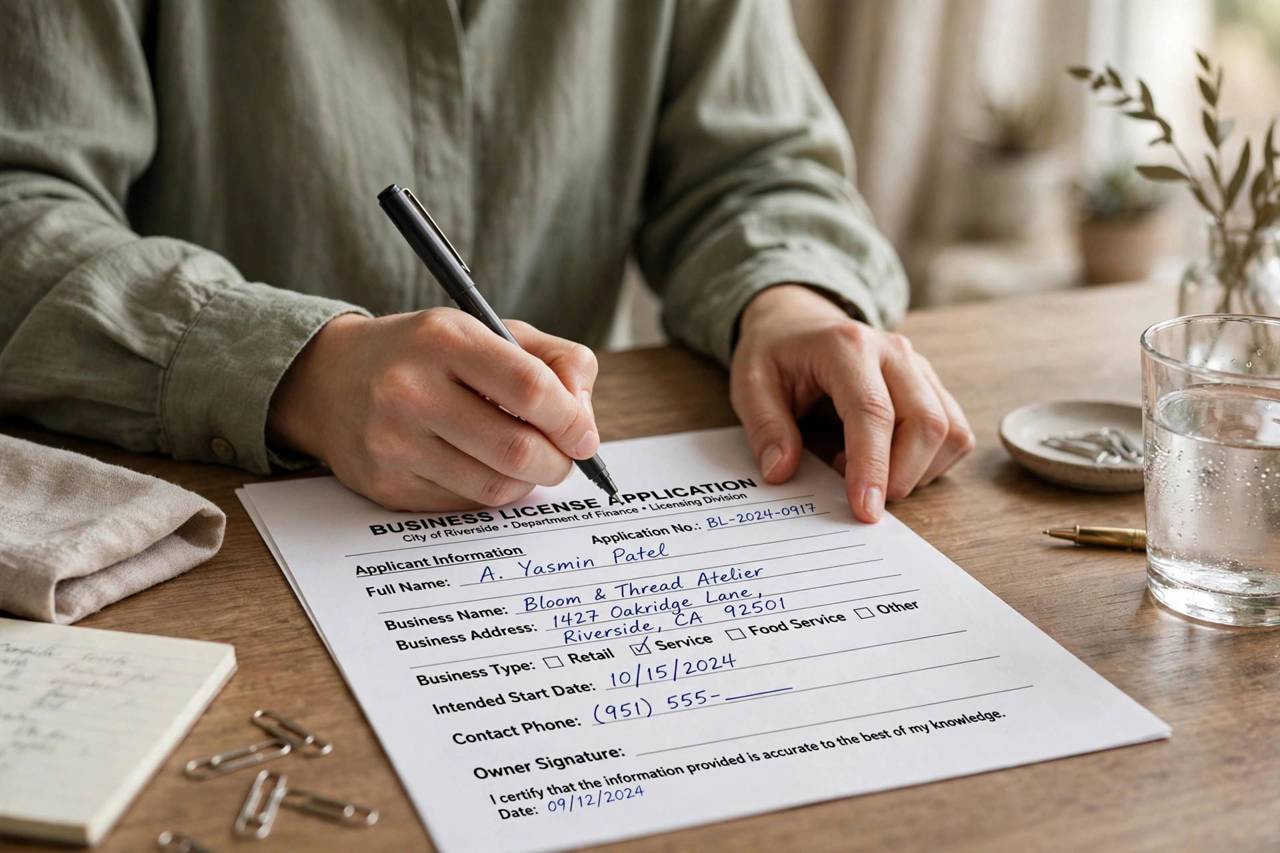
Step 3: gather the basics — legal business name, DBA if applicable, business address, ownership structure, EIN (Employer Identification Number from the IRS — free, takes minutes online), and a description of business activities. Step 4: apply — most cities now offer online applications; walk-in still exists where it does not. Step 5: pay the fee and wait — anywhere from instant approval to a few weeks, depending on the jurisdiction and whether inspections are involved (food businesses: expect inspections).
Step 6: display and renew. Many licenses must be visibly displayed at the business location. And calendar the renewal — licenses lapse quietly and fines for operating on an expired license are a completely avoidable own-goal. I keep every renewal date in one spreadsheet with 60-day reminders. Boring. Effective.
Typical Costs (and the Costs of Skipping)
General business licenses typically run $50–$400 per year depending on city and business type — some charge flat fees, others scale with revenue or employee count. Seller’s permits are often free or under $100. Professional licenses vary widely ($100–$1,000+, plus exam and continuing education costs). DBA filings: $10–$100. None of these numbers should surprise a serious business; if licensing costs break your budget, the business model needs work, not the paperwork.
The costs of not licensing are asymmetric: fines ($100–$1,000+ per violation, sometimes per day), stop-work orders, back taxes and penalties if you should have been collecting sales tax, voided insurance coverage (policies often require legal operation), and lease or loan complications — landlords and lenders routinely ask for license documentation. The license is cheap. Operating without it is expensive.
Common Mistakes First-Time Founders Make
Assuming online means exempt. E-commerce businesses need licenses based on where they operate, not where their customers are. Your home office city wants its license regardless of where you ship.
Confusing the license with the entity. Forming an LLC does not license you to operate — it creates the legal entity. The business license is separate permission to do business. You need both, and founders constantly assume one covers the other.
Forgetting renewals. The number one compliance failure I see. Set reminders. The city will not chase you politely — it will fine you.
One license, multiple locations. Each physical location typically needs its own local license. Expanding to a second city means a second application. Plan for it in expansion budgets.
Special Cases: When Licensing Gets Complicated
A few business types deserve special mention because their licensing stacks higher than normal. Food businesses (restaurants, food trucks, home bakeries under cottage food laws) layer health department permits, food handler certifications and inspections on top of the general license — start with the health department, not the city clerk, because their requirements drive the timeline. Contractors and trades need state contractor licenses (with exams, bonding and insurance minimums) before the local business license means anything. Home daycares face some of the heaviest regulation of any small business — background checks, home inspections, capacity limits — and operating informally is the fastest route to serious penalties. Businesses selling age-restricted goods need specialized permits with their own long timelines; apply months before you plan to open. The pattern: the more a business touches public health, safety or regulated substances, the earlier licensing needs to start — treat permits as part of the launch timeline, not an afterthought.
Frequently Asked Questions
What is a business license in simple terms?
It is the local government’s permission to operate a business in its jurisdiction — a registration, usually renewed annually, confirming your business exists and agrees to follow local rules. Most physical businesses and many home-based ones require it.
Do I need a business license to sell online?
Usually yes — based on where you operate, not where customers are. Your city/county typically requires a general business license for your home office or warehouse, and you will likely need a seller’s permit for sales tax. Marketplace platforms handle some tax collection, but not your local license obligation.
How much does a business license cost?
Typically $50–$400 per year for a general city/county license, varying by location and business type. Seller’s permits are often free or under $100. Professional licenses cost more. Renewal is usually annual.
What happens if I operate without a business license?
Fines (sometimes per day), stop-work orders, back-tax liability, potential voiding of business insurance, and complications with leases and loans. The penalties consistently exceed the license cost by orders of magnitude.
Is a business license the same as an LLC?
No. An LLC is a legal business structure (liability protection, tax treatment); a business license is permission to operate. They are separate filings serving separate purposes, and most businesses need both.
The Bottom Line
What is a business license: the government’s permission slip to operate, usually from your city or county, often layered with state and industry permits. Do you need one: almost certainly yes in some form — check your city’s requirements, get the license before your first sale, and calendar the renewal. It is the least glamorous part of starting a business and one of the most consequential to get right. I learned that from an inspector. Learn it from this article instead.