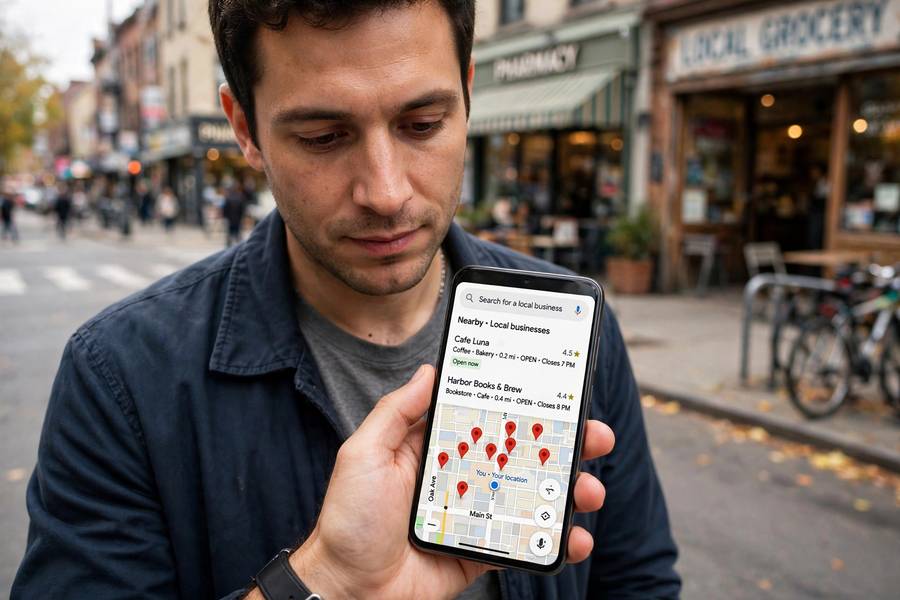
When someone nearby searches “plumber near me” or “best coffee shop downtown,” Google decides which businesses appear — and most small businesses leave that decision to chance. Local SEO is the work of making Google’s choice easy: proving you’re real, relevant, and trusted by actual customers.
I’ve watched local businesses double their inbound calls with a few weeks of focused local SEO work — no ad spend, no agency retainer. It’s the highest-ROI marketing available to location-based businesses, and most of your competitors are neglecting it. Here’s the complete playbook, in priority order. For the broader marketing picture, see how to write a marketing plan — part of the complete playbook for how to grow a small business.
Contents
- What Local SEO Actually Is
- Your Google Business Profile the Foundation
- Reviews the Ranking Fuel
- NAP Consistency the Boring Essential
- Local Keywords on Your Website
- Citations and Local Links
- Website Fixes That Matter Locally
- Tracking Local Performance
- Local SEO Mistakes to Avoid
What Local SEO Actually Is
Local SEO is the practice of optimizing your online presence so nearby customers find you when they search with local intent — “near me” searches, “[service] in [city],” or map searches. It’s distinct from general SEO: you’re not competing with the whole internet, just with businesses in your area.
Google’s local results come in two main forms: the map pack (the 3 businesses with map pins shown prominently) and local organic results below. The map pack gets the overwhelming majority of clicks — appearing there is the entire game for most local businesses.
Google decides map pack rankings on three factors: relevance (does your business match the search?), distance (how close are you to the searcher?), and prominence (how well-known and trusted does your business appear online?). You can’t change distance, but relevance and prominence are within your control.
The honest framing: local SEO isn’t tricks or hacks. It’s systematically proving to Google what your customers already know — that you’re a real, active, well-regarded local business. Businesses that do this consistently win; businesses that don’t, don’t.
Your Google Business Profile the Foundation
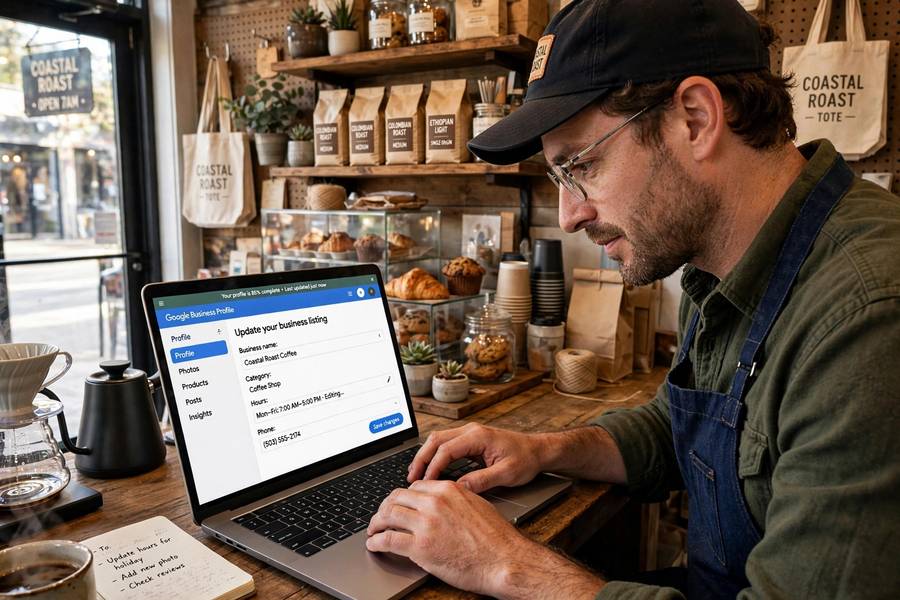
Your Google Business Profile (GBP) is the single most important local SEO asset you have. It’s free, it powers the map pack, and it’s what customers see first. Treat it like your digital storefront — because it is.
Claim and verify. If you haven’t claimed your profile, do it today. Google needs to verify you’re the legitimate owner (usually by postcard, phone, or video). Unclaimed profiles can be edited by anyone — including competitors and pranksters.
Complete every field. Business name (your real name — no keyword stuffing), correct categories (primary category matters most — choose the one matching your main revenue), full address, phone, website, hours (including holiday hours — wrong hours during holidays generate brutal reviews), services/products list, and business description. Completeness is a relevance signal; empty fields are missed opportunities.
Add photos — lots of them. Businesses with plenty of photos get dramatically more engagement. Upload exterior, interior, team, and products — real photos outperform stock. Update seasonally.
Use Posts. GBP Posts (updates, offers, events) keep the profile active and give searchers fresh reasons to engage. One post per week minimum — a special, a new product, a behind-the-scenes update. Active profiles signal an active business.
Answer questions. The Q&A section lets anyone ask questions — and anyone answer them. Monitor it and answer promptly, because wrong answers from strangers sit there permanently if you don’t.
Enable messaging and booking where relevant. Every friction point you remove between “found you” and “contacted you” increases conversion. If customers can message or book directly from the profile, let them.
Reviews the Ranking Fuel
Reviews are the heaviest-weighted prominence factor in local search. More reviews, better ratings, recent reviews, and review responses all feed the algorithm — and they convert searchers at least as powerfully as they rank.
The quantity game. Businesses in the map pack typically have significantly more reviews than those below. This isn’t a finish line — it’s an ongoing race against local competitors. Check monthly: how many reviews do the top 3 in your category have? That’s your target to exceed.
Ask systematically. The number-one reason businesses lack reviews isn’t unhappy customers — it’s never asking happy ones. Build the ask into your process: at checkout (“would you mind leaving us a Google review? It helps”), in follow-up emails (direct link — every click of friction halves response), on receipts, with a QR code at the counter. Make it a habit, not a campaign.
Timing matters. Ask when satisfaction peaks — right after a great meal, upon project completion, at pickup. The ask feels natural in the moment and awkward a week later.
Respond to every review. Every single one — positive and negative, within 24–48 hours. Thank positive reviewers specifically (mention what they praised). Address negative reviews professionally: acknowledge, apologize where warranted, take it offline (“please call us at…”). Never argue publicly — future customers judge you by how you handle complaints, not by whether you get them.
Never buy fake reviews. Google detects patterns, penalizes businesses, and removes reviews in waves. One penalty wipes out years of legitimate work. The risk-reward is absurd — don’t.
NAP Consistency the Boring Essential
NAP = Name, Address, Phone number. Google cross-references these across the web to confirm your business is real and located where you claim. Inconsistent NAP data confuses the algorithm and suppresses rankings.
Audit your listings. Search your business name and check every directory, social profile, and mention: Google, Yelp, Facebook, Apple Maps, Bing Places, industry directories, your own website footer. The name, address, and phone must match exactly — “Street” vs “St.”, suite numbers, formatting. Pick one canonical version and use it everywhere.
Fix the big ones first. Google Business Profile, your website, Facebook, Yelp, Apple Maps, Bing — these carry the most weight. Then work through industry-specific directories (Avvo for lawyers, Healthgrades for medical, TripAdvisor for hospitality, etc.).
Watch for duplicates. Duplicate listings (old addresses, slightly different names) split your ranking power and confuse customers. Claim and merge or remove duplicates wherever you find them.
Keep it updated. Moved? Changed numbers? Update everywhere — not just Google. Stale data across directories is one of the most common local SEO problems I find in audits, and it’s preventable with a 30-minute quarterly check.
Boring? Completely. Effective? Enormously. NAP consistency is table stakes — without it, everything else underperforms.

Local Keywords on Your Website
Your website needs to tell Google clearly what you do and where you do it:
Location pages. If you serve multiple areas, create a dedicated page per primary service area — not thin duplicates with swapped city names, but genuinely useful pages mentioning local landmarks, neighborhoods served, and area-specific details. One strong location page beats five thin ones.
Natural local language. Include your city/neighborhood in titles, headings, and body copy where natural: “Plumbing Services in Austin” as a page title, neighborhood names in service descriptions, local landmarks in testimonials. Write for humans first; the location signals follow.
Embed a map. An embedded Google Map on your contact/location page reinforces the geographic association. Simple, effective, often overlooked.
Local schema markup. Add LocalBusiness structured data to your site (your SEO plugin likely handles this). It explicitly tells Google your business type, address, hours, and geo-coordinates — removing all ambiguity.
Content with local relevance. Blog about local topics: neighborhood guides, local event participation, area-specific advice (“preparing Austin homes for summer heat” for an HVAC company). This content attracts local links and local searches simultaneously.
Citations and Local Links
Citations are mentions of your NAP on other websites — directories, review sites, local publications. They validate your existence and location. Build them on: major data aggregators, top general directories (Yelp, Yellow Pages, BBB), industry-specific directories, and local directories (chamber of commerce, neighborhood sites, city guides).
Quality over quantity — 30 accurate citations on relevant sites beat 300 on spammy directories.
Local links — links from other local websites to yours — are prominence gold. Earn them through: chamber of commerce membership (usually includes a directory link), sponsoring local teams or events (sponsors get linked), local press (newsworthy business stories get covered), partnerships with complementary local businesses (cross-linking resource pages), and community involvement (event pages link participants).
One strong local link (newspaper, university, city site) outweighs dozens of directory citations. Invest relationship effort accordingly — the link is a byproduct of genuine community presence, which is valuable in itself.
Website Fixes That Matter Locally
Beyond keywords, these technical basics affect local performance:
Mobile experience. Most local searches happen on phones, often with immediate intent (“need a plumber now”). If your site loads slowly or displays poorly on mobile, you lose the customer regardless of ranking. Test on an actual phone, not just responsive previews.
Click-to-call. Your phone number should be tappable on mobile, visible without scrolling, on every page. Local searchers call — make it frictionless. Track calls as conversions; they’re your primary local metric.
Clear service + area statement. Above the fold on your homepage: what you do, where you do it, how to contact you. “Emergency Plumbing in Denver — Call (555) 123-4567.” No cleverness, no scrolling required.
Speed. Local searchers are impatient — many are standing in a parking lot or dealing with an urgent problem. Every second of load time costs conversions. Compress images, minimize plugins, and test with PageSpeed Insights.
HTTPS and basics. Secure site, no broken links, working contact forms. Table stakes, but I still find local business sites failing them regularly.
Tracking Local Performance
Measure what matters:
Map pack visibility. Search your primary keywords (in incognito, or better, with a rank tracking tool) and note your map pack position monthly. This is your headline metric.
GBP insights. Google provides free data: how many people found you via search vs maps, what actions they took (calls, directions, website visits), and photo views. Review monthly — trends tell you what’s working.
Calls and direction requests. These are the conversions that matter locally. Track them as your primary KPIs. A ranking improvement that doesn’t increase calls is vanity; a call increase is revenue.
Review velocity. Are you gaining reviews steadily? Track count and average rating monthly. Stagnant review counts while competitors grow is a warning sign.
The quarterly audit. Every 90 days: check map pack positions, review GBP completeness, audit NAP consistency, and fix whatever slipped. Local SEO is maintenance, not a one-time project.
Local SEO Mistakes to Avoid
Keyword-stuffing your business name. “Joe’s Plumbing | Best Plumber Austin TX Emergency” violates Google’s guidelines and risks suspension. Your real business name, nothing more.
Creating fake locations. Virtual offices, PO boxes, and fake addresses for service areas you don’t serve — Google suspends for this, and reinstatement is painful. List your real location; use service-area settings for areas you travel to.
Ignoring the profile after setup. An optimized-then-abandoned profile decays: hours go stale, Q&A goes unanswered, posts stop, competitors pass you. Local SEO rewards the consistent, not just the correct.
Review gating. Selectively asking only happy customers for reviews (or worse, filtering) violates platform policies. Ask everyone; respond to everything.
Hiring cheap SEO spammers. The “$99/month local SEO” services build spammy links and fake citations that eventually trigger penalties. Legitimate local SEO is mostly work you can do yourself following this guide — save the agency budget for when you’ve maxed the fundamentals.
Local SEO rewards the diligent, not the clever. Complete profile, steady reviews, consistent NAP, clear website, community presence — maintained quarterly. That’s the entire formula, and it works in every market I’ve seen it applied consistently.
Frequently Asked Questions
Local SEO optimizes your online presence so nearby customers find you in local searches and the Google map pack. It focuses on your Google Business Profile, reviews, consistent business information across directories, and location-relevant website content.
Complete your Google Business Profile fully, gather reviews steadily and respond to all of them, keep your name/address/phone consistent everywhere online, add photos regularly, and use Posts. Google ranks on relevance, distance, and prominence — you control the first and third.
Critically important — reviews are among the heaviest-weighted local ranking factors. Ask systematically at the moment of satisfaction, respond to every review within 48 hours, and track your review count against local competitors monthly.
NAP (Name, Address, Phone) citations are mentions of your business details on directories and websites across the web. Google cross-references them to verify your business is real and correctly located — inconsistent information suppresses your local rankings.
Yes — most effective local SEO is work you can do yourself: claiming and completing your Google Business Profile, asking for reviews, fixing directory listings, and adding location content to your website. Save agency budgets for after you’ve maxed these fundamentals.