What Is Smart Casual Dress Code for Men? The Practical Decoder


What is smart casual dress code for men? If you have ever stared at an invitation that says “smart casual” and felt a small wave of panic, welcome — you are in excellent company. It is the most misunderstood dress code in menswear, precisely because it sits in the uncomfortable middle: sharper than casual, easier than business. After years of decoding dress codes for clients, here is my definition: smart casual means polished pieces worn with relaxed attitude. A blazer, but no tie. Good shoes, but not necessarily Oxfords. You look intentional, never stiff.
The confusion is understandable because smart casual is not a fixed uniform — it is a range, and where you land in that range depends on the occasion. A smart casual wedding guest and a smart casual Friday at a startup are not wearing the same thing. So instead of one outfit, I am going to give you the decoder: how smart casual differs from its neighbors, the formulas for each occasion, and the mistakes that mark a man as someone who guessed.
What Is Smart Casual Dress Code for Men? The Decoder
These three get tangled constantly, so let us untangle them with one comparison.
Casual is your off-duty uniform: jeans, t-shirts, sneakers, hoodies. Comfort first, no performance of polish. Nobody is judging, and nothing is tailored.
Business casual is workplace polish without a suit: collared shirts, chinos or dress trousers, blazers, leather shoes. It is still office-coded — the pieces say “professional,” even without the tie. Think client meetings and interviews.
Smart casual borrows polish from business casual but drops the office. Dark jeans are welcome. Knit polos, clean minimal sneakers, and unstructured blazers all belong. The pieces say “I made an effort” rather than “I am at work.” Dinners, dates, parties, events — smart casual is social polish, not professional polish.
The one-line test: if you would wear it to close a deal, it is business casual. If you would wear it to a nice dinner, it is smart casual. If you would wear it to walk the dog, it is casual. Most men’s smart casual mistakes are really category errors — wearing business casual to a party (too stiff) or casual to a nice restaurant (too sloppy).

The Smart Casual Formula: Building Blocks
Every good smart casual outfit is built from the same kit. Own these pieces and you can dress for anything in the category.
Tops: Oxford shirts (white, light blue), knit polos, henleys, fine-gauge crewneck sweaters, and well-fitting plain t-shirts in heavyweight cotton for the casual end. Collar optional; structure preferred. A shirt with a collar instantly reads smarter than one without — that single choice moves an outfit half a category.
Bottoms: dark indigo or black jeans with no distressing, chinos in navy/olive/stone/charcoal, and tailored trousers for the dressy end. Fit is everything: slim or straight, hemmed to a single break, no pooling. The jeans must look deliberate — dark, clean, fitted — not like you grabbed whatever was on the floor.
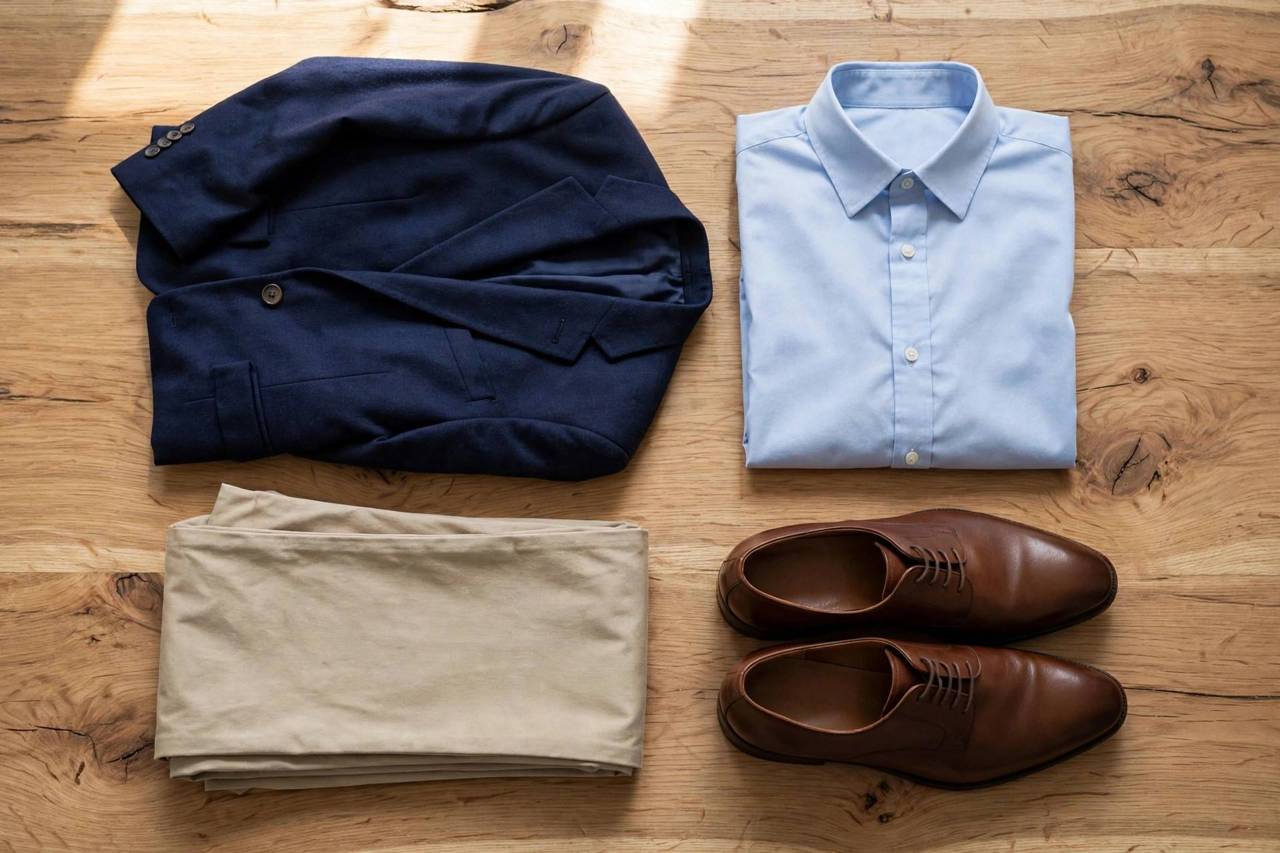
Layers: an unstructured blazer is the single highest-leverage smart casual purchase you can make. It elevates jeans and a t-shirt into a real outfit in ten seconds. Add a Harrington or bomber jacket, a merino quarter-zip, and a sharp overshirt for variety across seasons.
Shoes: this is where most men fail. Clean minimal leather sneakers, loafers, suede Chelsea boots, desert boots, or brogues. Athletic running shoes — the ones with neon soles and mesh — are the fastest way to sink a smart casual outfit. Your shoes should look like a choice, not an afterthought.
Outfit Formulas by Occasion
Dinner at a nice restaurant: unstructured navy blazer + white Oxford shirt + dark jeans + brown loafers. The canonical smart casual outfit. It works because every piece is doing its job: the blazer says effort, the jeans say ease.
Date night: black crewneck sweater + charcoal chinos + suede Chelsea boots. Understated, confident, and comfortable enough that you are not fidgeting. Add a watch — the one accessory that always earns its place.
Smart casual wedding guest: move to the dressy end: light grey or navy suit separates (blazer + contrasting trousers, not a matched suit), a shirt with no tie, and proper dress shoes. When an invitation says smart casual for a wedding, “casual” is doing very little work — err formal.
Evening event or party: dark jeans + knit polo or henley + bomber or overshirt + clean minimal sneakers or desert boots. Relaxed but composed. You look like you belong in the photos.
Smart casual office (no client meetings): chinos + Oxford shirt + quarter-zip or blazer + loafers. This overlaps with business casual, and that is fine — the categories share a border, and offices live on it.
Common Mistakes That Give You Away
The tie with no jacket. A tie without a blazer reads as a waiter, a schoolboy, or a man who lost his jacket. In smart casual, skip the tie entirely — the absence of a tie is part of the code.
Gym shoes with good clothes. I said it above and I will say it again because it is the most common failure: performance sneakers destroy an otherwise perfect outfit. Own one pair of clean minimal sneakers for social wear and keep the running shoes for running.
Distressed denim. Rips, fading and whiskering push jeans firmly into casual territory. Smart casual denim is dark, clean and plain. There is no version of ripped jeans that reads “smart.”
Logos and graphics. A giant brand logo or a joke graphic tee caps how smart an outfit can look, no matter what is layered over it. Keep tops plain or subtly textured.
Ignoring fit. Smart casual lives or dies on fit because there is no suit structure hiding anything. A blazer with shoulders two inches too wide, jeans pooling at the ankle, a shirt blousing at the waist — each one quietly downgrades the whole outfit. Tailoring is cheaper than new clothes and matters more.
Dressing for the wrong end of the range. Showing up to a smart casual wedding in sneakers, or to a house party in a tie-less suit, are both category errors. When the invitation is vague, ask the host or match the venue: the nicer the venue, the dressier your end of smart casual should be.
Seasonal Adjustments
Summer: linen shirts, lightweight unstructured blazers, chinos or tailored shorts only if the occasion is truly relaxed (never for dinners or weddings), loafers without socks or with no-show socks. Breathable fabrics keep you composed — sweat is the enemy of “smart.”
Winter: layer with intent: turtleneck or merino crewneck under a blazer, wool overcoat on top, dark denim or flannel trousers, Chelsea or chukka boots. Winter is actually the easiest season for smart casual because layers do the work of looking deliberate.
The Smart Casual Capsule: 12 Pieces, Endless Outfits
You do not need a big wardrobe — you need the right twelve pieces in the right colors. Tops (4): white Oxford shirt, light blue Oxford shirt, navy knit polo, charcoal crewneck sweater. Bottoms (3): dark indigo jeans, navy chinos, charcoal chinos. Layers (2): unstructured navy blazer, olive overshirt or Harrington jacket. Shoes (3): white minimal leather sneakers, brown loafers, suede Chelsea boots. Every top works with every bottom; both layers work over everything; the shoes cover the full range from relaxed to dressy. That is dozens of distinct combinations before you repeat — months of outfits from one shopping trip.
The discipline is in the colors: navy, white, charcoal, olive, brown. They all coordinate because the palette is restrained, which means getting dressed takes thirty seconds and always works. Add pieces only in these color families and the capsule grows without ever clashing. And maintain it: resole the loafers, replace the sneakers when the soles wear, tailor the blazer once. A twelve-piece wardrobe in good condition outperforms a forty-piece wardrobe of maybes every single time — this is the quiet-luxury version of smart casual, and it costs less than the alternative.
The one upgrade that matters most: if your budget allows a single splurge, make it the blazer. It is the hardest-working piece in the capsule — the difference between jeans-and-shirt and an actual outfit — and quality shows most in structured garments. A well-cut blazer in a good wool blend elevates everything beneath it, including a twenty-dollar t-shirt. Everything else in the capsule can be mid-range; the blazer earns the investment. Get that one piece right and the other eleven practically style themselves.
Frequently Asked Questions
Can you wear jeans for smart casual?
Yes — dark, clean, well-fitting jeans with no distressing are a smart casual staple. They are arguably the defining garment of the dress code. Light wash, ripped or baggy jeans are not.
Are sneakers OK for smart casual men?
Clean, minimal leather or suede sneakers in neutral colors: yes. Athletic running shoes with bright colors and mesh: no. The shoe should look like a style choice, not exercise equipment.
Do you wear a tie with smart casual?
No. The absence of a tie is part of what makes it smart casual rather than business attire. If you feel the urge to add a tie, you have probably crossed into business casual territory.
What is the difference between smart casual and business casual for men?
Business casual is office polish without a suit (collared shirts, chinos, blazers, leather shoes). Smart casual is social polish — it allows dark jeans, knit polos and clean sneakers, and drops the workplace formality. One is for work; the other is for life.
Can smart casual include a full suit?
A matched suit is overdressed for most smart casual occasions — it reads as business or formal. The exception is the dressy end (like some weddings), where suit separates — blazer with contrasting trousers — hit the right note.
The Bottom Line
Smart casual dress code for men is not a mystery once you see it clearly: polished pieces, relaxed attitude, fit doing the heavy lifting. Own the building blocks, match the occasion’s end of the range, keep the sneakers clean and the denim dark — and you will never panic at those two words on an invitation again.