How Do News Anchors Use a Teleprompter Without Looking at It?

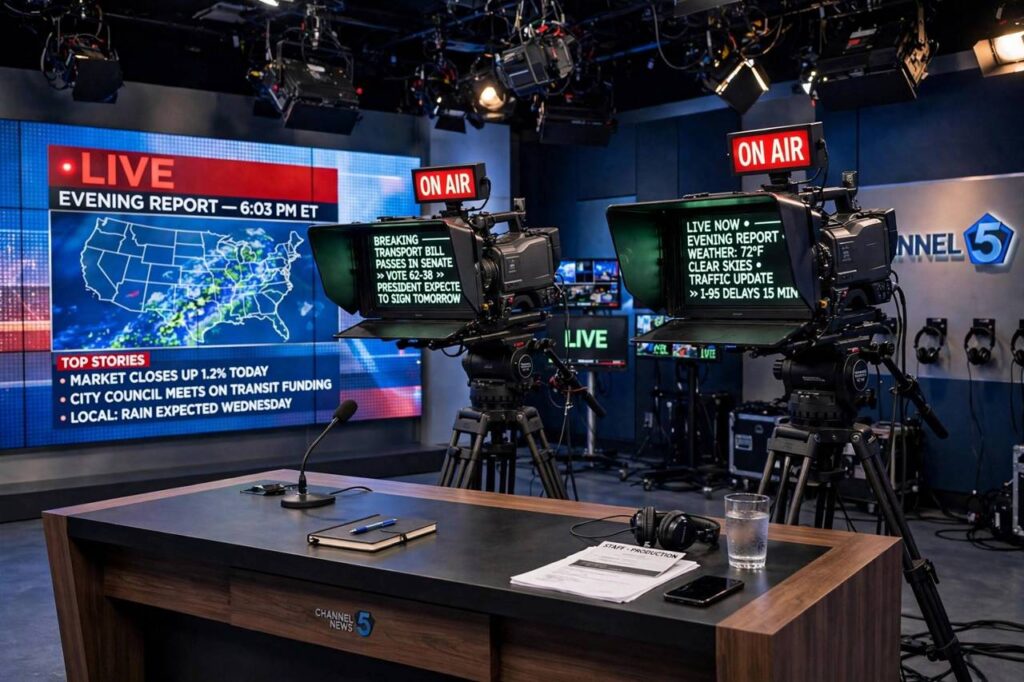
If you have ever wondered how do news anchors use a teleprompter without it looking like they are reading, you are noticing a genuine piece of stagecraft. The trick is not what most people think. Anchors are not speed-reading, they are not memorizing, and the text is not flying past at some impossible pace. The real secret is a two-person operation and a piece of glass angled at 45 degrees.
I have toured enough studios to demystify this for you. Once you understand the mechanics — the mirror, the operator, the eye-line geometry — you will never watch the evening news the same way again. And the best part is what happens when the whole thing breaks down live, because it does, and the recovery is where you see who the real professionals are.
The Anchor–Operator Team
The teleprompter is a two-person job. The anchor reads; a prompter operator controls the scroll. This matters more than people realize, because the operator is matching the scroll speed to the anchor’s delivery in real time — slowing down for emphasis, pausing for a graphic, speeding up when the anchor is racing the clock.
The operator sits in the control room watching the same program feed you see at home, with a foot pedal or a scroll wheel controlling the text speed. A good operator reads the anchor’s rhythm the way a musician reads a conductor. When the anchor ad-libs a sentence or stumbles over a name, the operator adjusts. When a breaking-news script gets rewritten mid-broadcast, the operator loads the new copy and finds the anchor’s place without missing a beat.
Anchors and operators develop a feel for each other over months and years. A new pairing is noticeably clunkier — the scroll lags or races, the anchor’s eyes dart. Watch a new anchor’s first weeks on air and you can sometimes spot the adjustment period in real time.
Why the Eye Contact Still Looks Real
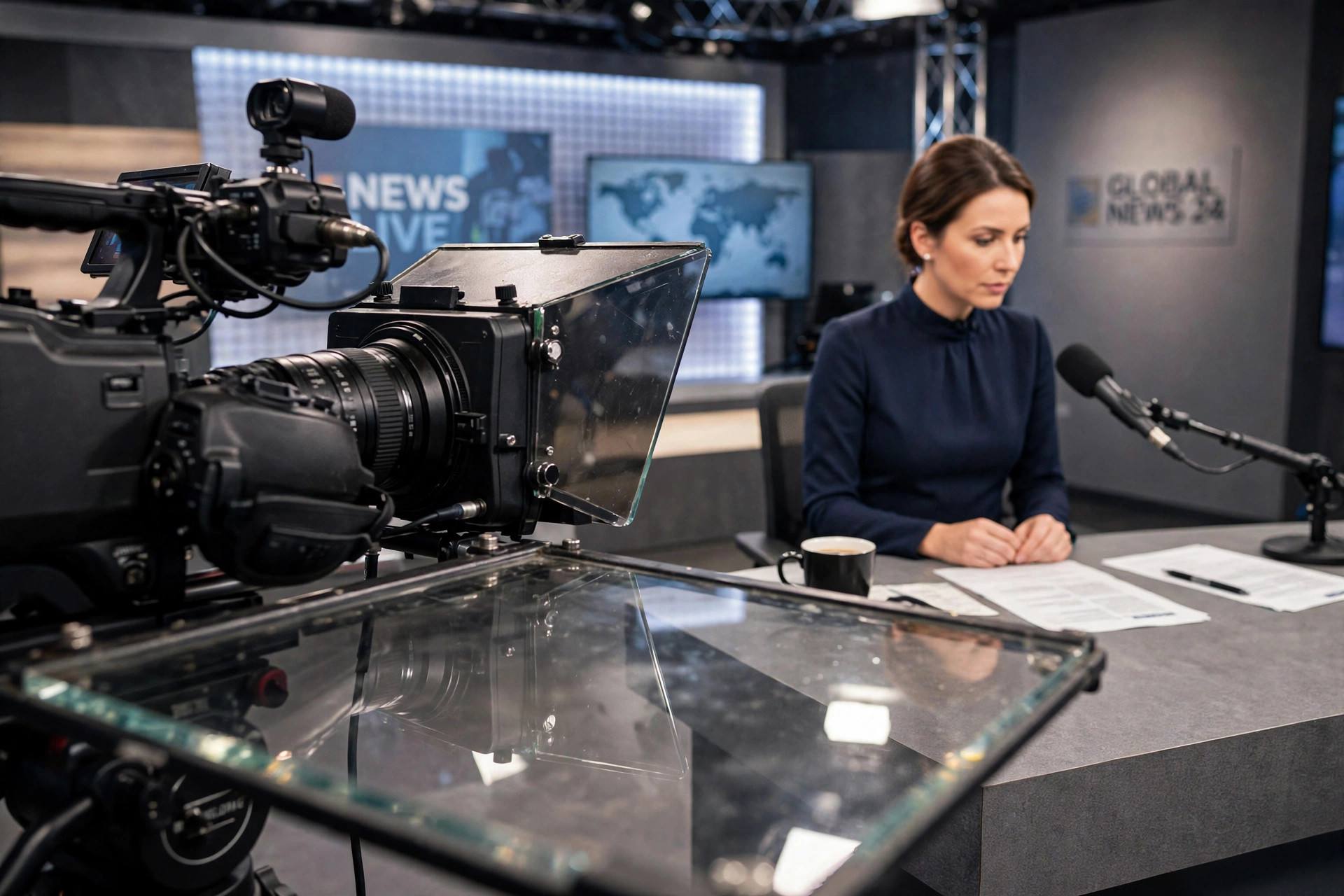
Here is the geometry that makes the whole illusion work. The camera lens sits directly behind a piece of specially coated glass — a beam-splitter mirror — angled at 45 degrees. The script is displayed on a monitor below the glass, and the mirror reflects the text up so the anchor sees it floating right in front of the lens.
Because the text appears exactly where the lens is, the anchor looking at the words is simultaneously looking directly into the camera. That is the entire trick. From your couch, it looks like unbroken eye contact. From the anchor’s chair, it looks like reading words off a floating screen.
Several details make it convincing:
- Font size and line length. The text is large — much larger than you would expect — and lines are short, so the anchor’s eyes barely move side to side. That is why you do not see the eyes scanning like someone reading a book.
- Eye-line markers. Scripts include cues like “look up” or camera numbers, and experienced anchors glance at notes or graphics at scripted moments, which actually enhances the natural feel.
- The words are theirs. Anchors usually write or heavily rewrite their own scripts. Reading your own words aloud is dramatically easier and more natural than reading someone else’s — the phrasing matches your speech patterns, so it sounds like talking, not reciting.
- Rehearsal. Before air, anchors read through the show. Familiarity with the copy means they are half-recalling and half-reading, which smooths out the delivery enormously.
Presidential teleprompters work on the same principle — two glass panels flanking the podium, text reflected so the speaker appears to address the audience directly. News studios just put the glass in front of the camera instead.
What Happens When the Teleprompter Breaks
It happens more often than stations admit: the scroll freezes, the screen goes black, or the wrong script loads. This is the moment that separates anchors from readers, and it is genuinely fun to watch.
First, the anchor usually has paper scripts on the desk as backup — yes, still, in the digital age. A quick glance down, a smooth pickup, and most viewers never notice. Second, experienced anchors know the top of every story. They have rehearsed, they wrote the words, and they can summarize from memory while the operator fixes the problem.
The worst-case scenario is a total prompter failure during a long segment. Then you see the real skill: the anchor vamps — asks the co-anchor a question, throws to a reporter, goes to a graphic — buying the thirty seconds the control room needs. Watch for the subtle signs: the anchor’s eyes drop to the desk more often, the pace gets slightly more conversational, there is a touch more ad-lib. That slightly looser, more human broadcast you occasionally see? Sometimes that is a prompter outage, and it is often the best television of the night.
There is also the famous opposite problem: the operator scrolls too fast or loads the wrong story, and the anchor reads it deadpan before realizing. Those clips live forever on blooper reels, and they are a reminder that the system has a human at both ends.
Do Anchors Memorize Anything?
Less than you would think, more than it looks like. The prompter carries the exact wording — names, numbers, quotes that must be precise. But anchors internalize the structure: they know story one is the fire, story two is city hall, story three is the weather tease. That scaffolding is what lets them recover when the text disappears.
Field reporters are a different story. A reporter doing a live shot has no prompter — they work from notes, memory, and an earpiece with the producer feeding cues. The polished “live from downtown” segment that looks effortless is usually built on three or four bullet points and a lot of practice. If you ever wondered why anchors seem smoother than field reporters, now you know: one of them has a floating script and a dedicated operator.
How Do News Anchors Use a Teleprompter During Breaking News
The rehearsed evening broadcast is the teleprompter’s comfort zone. Breaking news is where the system gets stress-tested — and where you can see most clearly how anchors really use it. When a major story breaks mid-show, the whole workflow changes.
The script is being written live. During breaking news, producers are typing copy into the prompter system in real time — sometimes sentences ahead of the anchor, sometimes barely that. The anchor is reading text they have never seen, about events still unfolding, while the operator scrolls copy that is literally being finished as it appears. There is no rehearsal, no familiar phrasing, no muscle memory. This is cold reading under maximum pressure, and it is the hardest thing a news anchor does.
The operator becomes a co-pilot. In normal broadcasts the operator paces the scroll; in breaking news they are also triaging — loading new pages, deleting outdated ones, and flagging which paragraphs are confirmed versus developing. Anchors and operators develop shorthand for this chaos: the operator might flash a graphic or change text color to signal “this just updated.” Watch a breaking-news broadcast closely and you can sometimes see the anchor pause a beat before a sentence — that is them reading ahead, processing, and deciding how to deliver information they learned three seconds ago.
Ad-libbing takes over. The dirty secret of breaking news: much of it is not on the prompter at all. Anchors fill gaps by talking — summarizing what is known, interviewing reporters live, narrating live pictures — while the desk writes the next block of copy. The best breaking-news anchors are the ones who can speak coherently about incomplete information without speculating, a skill that looks easy and is brutally hard. The prompter becomes a safety net rather than the script: key names, numbers, and confirmed facts appear there so the anchor does not have to hold them in memory while thinking aloud.
Mistakes happen, and handling them is the job. Wrong names, outdated casualty figures, locations that turn out to be wrong — breaking news means correcting yourself on air, sometimes within minutes. Professional anchors correct quickly, plainly, and without drama: “We want to correct something we reported a few minutes ago.” Viewers forgive errors in breaking news far more readily than they forgive evasiveness about them. The prompter helps here too — corrected copy loads in, and the anchor reads the fix with the same steady delivery.
So the next time you watch breaking coverage, notice the rhythm: read, pause, ad-lib, read. That staccato delivery is not bad anchoring — it is a human being processing the news at the exact speed it arrives, with a scrolling safety net and a control room racing to keep up.
Frequently Asked Questions
Can the audience see the teleprompter text?
No. The beam-splitter glass is coated to reflect the script toward the anchor while remaining transparent from the camera’s side. The camera shoots straight through the glass. Studio guests sitting across the desk sometimes catch a reversed glimpse, but viewers at home see nothing.
Who controls the scrolling speed?
A dedicated prompter operator in the control room, using a foot pedal, scroll wheel, or similar controller. The operator watches the broadcast and adjusts speed to match the anchor’s delivery in real time — it is a manual, human-driven process, not an automatic timer.
Do news anchors write their own scripts?
Usually they write or substantially rewrite them. Producers draft the rundown and reporters write their packages, but anchors typically put the intros and transitions into their own voice. Reading your own phrasing is a big part of why the delivery sounds natural.
What is the text size on a teleprompter?
Much larger than normal reading text — anchors can adjust it to their preference, but it is typically sized so that only a few words appear per line. Short lines and big type minimize visible eye movement, which is why anchors do not look like they are reading.
How long have teleprompters been used in news?
The teleprompter was invented in the 1950s for soap opera actors, and news adopted it soon after. Before that, anchors read from paper scripts on the desk, glancing down constantly — watch very old broadcasts and you will see the difference immediately. The angled-glass design that creates the eye-contact illusion became the standard decades ago.
The Illusion, Explained
So how do news anchors use a teleprompter? They read large text reflected on glass positioned exactly over the camera lens, while a human operator paces the scroll to their delivery — and they make it look like conversation by writing their own words, rehearsing the rundown, and knowing the stories cold enough to survive a blackout. Next time you watch the news, look for the tells: the barely-there eye movement, the glance down at the desk, the suspiciously smooth recovery. Now you know what you are seeing.