What Is the Dewey Decimal System? A Plain-English Guide

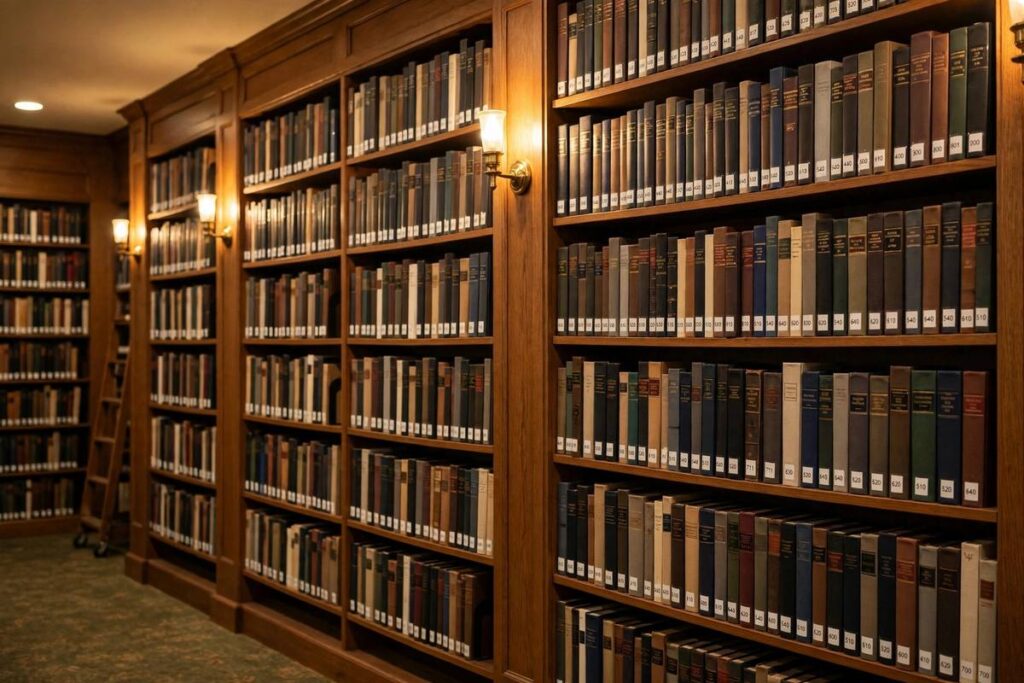
Walk into almost any public or school library in America, glance at the spine of a book, and you will see a number — 641.5, 973.2, 500. What is the Dewey Decimal System, and what do those numbers actually mean? It is the library classification system that organizes books by subject, invented by Melvil Dewey in 1876, and it is still the reason the cookbook sits nowhere near the history section. This guide explains the whole system in plain language: the ten main classes, how to read a call number, and how to use it to find exactly the book you want. (This is general information about how libraries organize books, not professional cataloging advice.)
What Is the Dewey Decimal System? The Basics
The Dewey Decimal Classification — DDC for short — is a system for organizing library materials by subject. Before Dewey, most libraries shelved books by acquisition order, size, or the whim of whoever was in charge, which meant finding a book on a specific topic required asking the librarian or wandering. Dewey’s insight was simple: assign every subject a number, shelve books in numerical order, and anyone who understands the numbers can browse by topic without help.
The system divides all human knowledge into ten main classes, each covering a hundredth of the number line from 000 to 999:
000 — Computer science, information, and general works. Encyclopedias, journalism, and books about books themselves. The class for knowledge about knowledge.
100 — Philosophy and psychology. Ethics, logic, and the workings of the mind. Self-help books often land here, which surprises people.
200 — Religion. Sacred texts, theology, and religious history across all faiths — though critics note the system gives disproportionate space to Christianity, a legacy of its 19th-century origins.
300 — Social sciences. Politics, economics, law, education, and sociology. One of the busiest sections in any public library.
400 — Language. Dictionaries, grammar guides, and books about specific languages. Your Spanish textbook lives here.
500 — Science. Mathematics, physics, chemistry, biology, and the natural world. The 500s are where curious kids tend to camp out.
600 — Technology and applied science. Medicine, engineering, cooking, gardening, and business. Note that cookbooks (641.5) live here, not in some separate “food” area — the system classifies by subject, and cooking is applied science.
700 — Arts and recreation. Painting, music, photography, and sports. A book about basketball strategy and a book about oil painting are neighbors here.
800 — Literature. Novels, poetry, plays, and literary criticism, organized largely by the language of origin.
900 — History and geography. History books, travel guides, and biographies. The single most browsed section in many libraries.
Each class divides into ten divisions (the tens digit) and each division into ten sections (the ones digit), so 500 is science, 510 is mathematics, and 516 is geometry. The decimal point then allows infinite refinement: 516.3, 516.37, and so on, each step narrowing the subject.
How to Read a Dewey Call Number
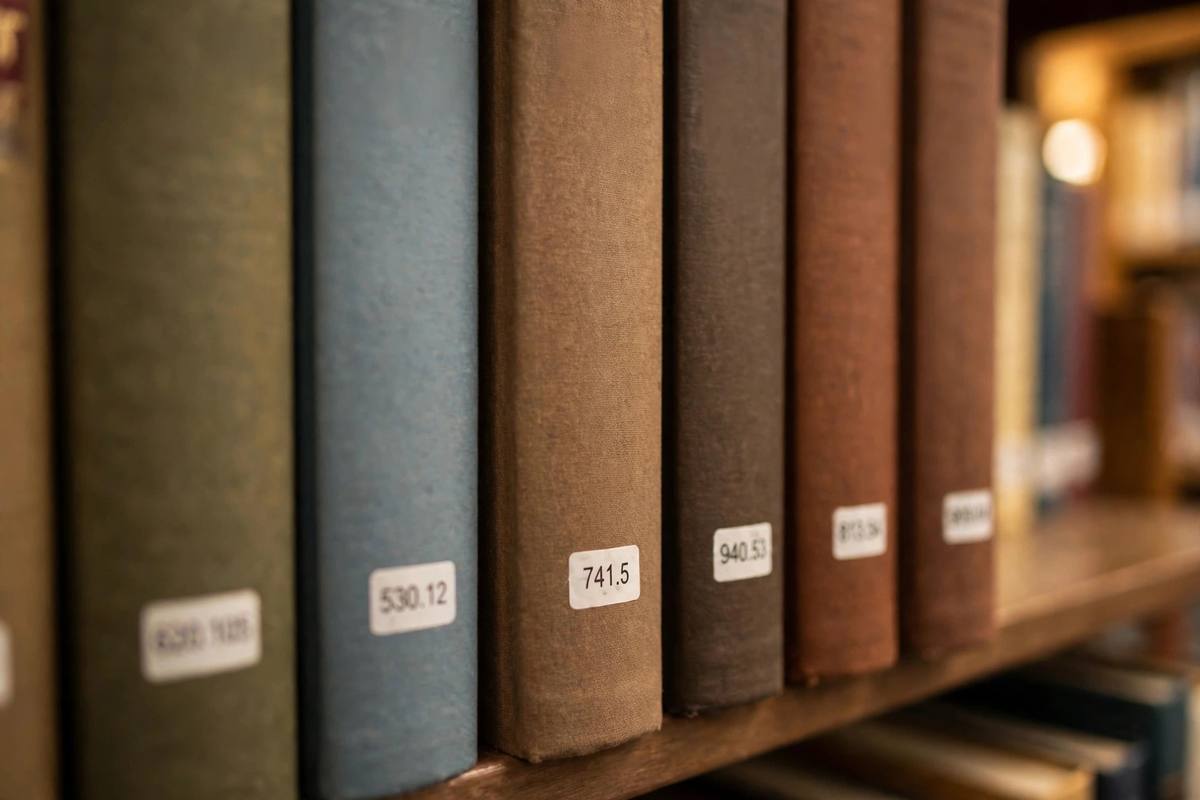
The number on a book’s spine is its call number, and it has two parts. The first line is the Dewey classification number — the subject address. The second line is usually the first few letters of the author’s last name (sometimes called the “cutter” or book number), which alphabetizes books that share the same subject number.
Take 641.5 JON. The 641.5 says: 600s (technology), 640 (home management), 641 (food and drink), 641.5 (cooking). So this is a cookbook. The JON says the author’s surname starts with those letters, shelving it among the other cookbooks in alphabetical order. Two cookbooks on the same shelf might read 641.5 JON and 641.5 SMY — same subject, different authors, alphabetical within the number.
Reading left to right, each digit narrows the topic. 973 is the history of the United States; 973.7 is the Civil War period specifically; 973.73 narrows further to Civil War military history. A longer number always means a more specific subject — never a “bigger” or “more important” one. And the numbers sort as decimals, not whole numbers: 641.5 comes before 641.55, which comes before 641.6.
One practical tip: when you are browsing the shelves, the numbers do the navigating for you. If you found a useful book at 305.8 (social groups) and want more on the same theme, just look left and right — the neighboring books are the system’s suggestions, chosen by subject rather than by an algorithm. It is a browsing habit that pairs naturally with improving your reading comprehension, since both reward slowing down and following connections.
How to Find a Book Using the Dewey System
Using Dewey in practice is a short, repeatable process. It works the same way in a small town library and a big city branch, because the numbers are standardized.
Step one: search the catalog first. Every modern library has an online catalog. Search for your topic or title, and the record will show the call number — something like 796.332 BRO. Write it down or screenshot it. The catalog may also show a floor map or section name.
Step two: find the right number range. Libraries post range signs at the end of each shelving row (“500–599,” “600–649,” and so on). Walk to the range containing your number. Remember that the shelves run in increasing order, left to right, top to bottom, and the decimal portion matters: 796.33 comes before 796.332.
Step three: match the author letters. Within the right number, books shelve alphabetically by the author letters on the second line. If the exact book is checked out, the books on either side are on closely related subjects — often a better discovery method than the catalog search that brought you there. Bring a notebook: the Cornell note-taking method is ideal for capturing what you find while browsing the stacks.
Step four: ask when stuck. Libraries shelve fiction separately (usually alphabetical by author, no Dewey numbers), and children’s sections, reference collections, and media often use modified systems. If the number on the catalog record does not match what you see on the shelf, the reference desk can tell you in seconds whether the item is in a special collection.
Dewey vs. the Library of Congress System
Dewey is not the only system. University and research libraries in the United States mostly use the Library of Congress Classification (LCC), which organizes by letters instead of numbers — Q for science, D for history, and so on. LCC was designed for very large collections and handles specialized academic subjects with finer granularity than Dewey.
The practical difference for you: if you learned Dewey in school and then walk into a university library, the spines will look unfamiliar, but the underlying idea is identical — subjects grouped together, specific addresses within each subject. Public libraries, school libraries, and small college libraries overwhelmingly stick with Dewey because it is simpler to learn and perfectly adequate for general collections. Neither system is “better” in the abstract; they are tools sized for different jobs.
Outside the United States, you will also encounter the Universal Decimal Classification (a Dewey derivative used widely in Europe) and various national systems. The good news is that the skill transfers: once you understand that a call number is a subject address, you can navigate any classified collection.
Dewey Numbers You Will Actually Encounter
A few call numbers come up so often that recognizing them makes library browsing dramatically easier. 641.5 is the cookbook neighborhood — nearly every general cookbook lives here, which is why the cooking section feels like its own little world within the 600s. 973 is American history; add decimals and you time-travel (973.9 is the 21st century). 796 covers sports and games — 796.3 is ball sports, so basketball strategy and soccer coaching manuals sit side by side.
In the 800s, literature organizes by language of origin rather than topic: 813 is American fiction, 823 is English fiction. That is why novels are not shelved by genre the way a bookstore does it — Dewey cares about the language first, and many libraries pull fiction out of Dewey entirely, shelving it alphabetically by author instead. If you have ever wondered why the library’s novels ignore the number system, that is why: for fiction, readers browse by author, not by subject. And if all this browsing gets you in the mood, reading more books regularly is the natural next step.
And 030 is where encyclopedias live — the general-knowledge section. It is shrinking in the internet age, but it remains a good reminder of what Dewey was built for: a time when the library was the search engine, and the numbers were the algorithm.
Criticisms and Limits of the System
No 150-year-old system escapes criticism, and Dewey has collected its share — most of it fair. The religion section is the famous example: Christianity gets seven of the ten divisions under 200 (220–280), while all other world religions share 290. That allocation reflected the worldview of an American librarian in 1876, and although revisions have improved it, the structure still shows its origins.
Similar biases appear elsewhere. The history section historically centered Western civilization, with other regions compressed into smaller ranges. The language section gives English and major European languages far more room than the thousands of other world languages. And rapidly evolving fields — computer science crammed into 000, for instance — strain a framework designed before they existed.
Librarians have responded in two ways: through the system’s own revision process (Dewey is now maintained by OCLC and updated continuously in its online edition), and through local adaptations, where individual libraries adjust classifications to serve their communities better. The criticisms are worth knowing because they remind you of something useful: a classification system is a map of knowledge drawn by particular people at a particular time, not knowledge itself.

Frequently Asked Questions
What is the Dewey Decimal System in simple terms?
It is a library system that assigns every subject a number from 000 to 999, so books on the same topic sit together on the shelf. Invented by Melvil Dewey in 1876, it is still used by most public and school libraries in the United States.
What are the 10 main Dewey Decimal classes?
000 (general works), 100 (philosophy), 200 (religion), 300 (social sciences), 400 (language), 500 (science), 600 (technology), 700 (arts), 800 (literature), and 900 (history and geography).
How do I find a book’s Dewey number?
Search the library’s online catalog for the title or topic — the record lists the call number. Then follow the range signs on the shelves to the matching number, and look alphabetically by author within that number.
Why do cookbooks have numbers like 641.5?
Because Dewey classifies by subject: 600 is technology and applied science, 640 is home management, 641 is food and drink, and 641.5 is cooking specifically. The decimal digits narrow the topic step by step.
Do all libraries use the Dewey Decimal System?
No. Most public and school libraries do, but university and research libraries typically use the Library of Congress Classification system, which uses letters instead of numbers. Fiction is usually shelved separately by author in both systems.