The Biggest Volcanic Eruption in History: Tambora, and the Giants Before Records

“Biggest eruption in history” turns out to be two questions, and honest answers have to keep them separate. There is the biggest eruption humans witnessed and wrote down — that one has a clear winner. And there is the biggest eruption geologists have found evidence of, from long before records — that one makes the witnessed winner look modest, and its own winner depends on which list you read.
This article does both, in that order, but first it has to hand you the ruler both answers are measured with — because in volcanology, half the arguments about “biggest” are really arguments about units, and the other half are arguments about which century, or which eon, the arguer has quietly chosen as the arena.
First, the Ruler: VEI
Eruptions are graded on the Volcanic Explosivity Index (VEI), a scale from 0 to 8. The most common criteria, in the USGS’s own description, are the volume of ejecta — ash, pumice, and lava — and the height of the eruption column. The top of the scale is reserved for events of a different order entirely: an eruption is classed VEI 8 when the measured volume of its deposits exceeds 1,000 cubic kilometers, and such eruptions carry their own name, supereruptions. Every VEI 8 happened tens of thousands to millions of years ago, which is why, for the giants, deposits are the evidence — nobody was there with a notebook.
Now the unit warning, and it matters for every number below. Eruption sizes get reported in two different currencies. Bulk volume counts the deposits as they lie — loose, airy, full of pore space. DRE — dense-rock equivalent — converts the same material back into the volume of solid rock (and magma) it came from, and DRE figures are therefore always smaller than bulk figures for the same eruption. Both currencies are legitimate; mixing them without labels is how false records are manufactured.
So in this article, every figure wears its label: DRE figures are marked DRE, and the prehistoric giants, whose list uses bulk volumes, are marked as such. If you take only one study habit from this page, take that one.
The Biggest in Recorded History: Tambora, 1815
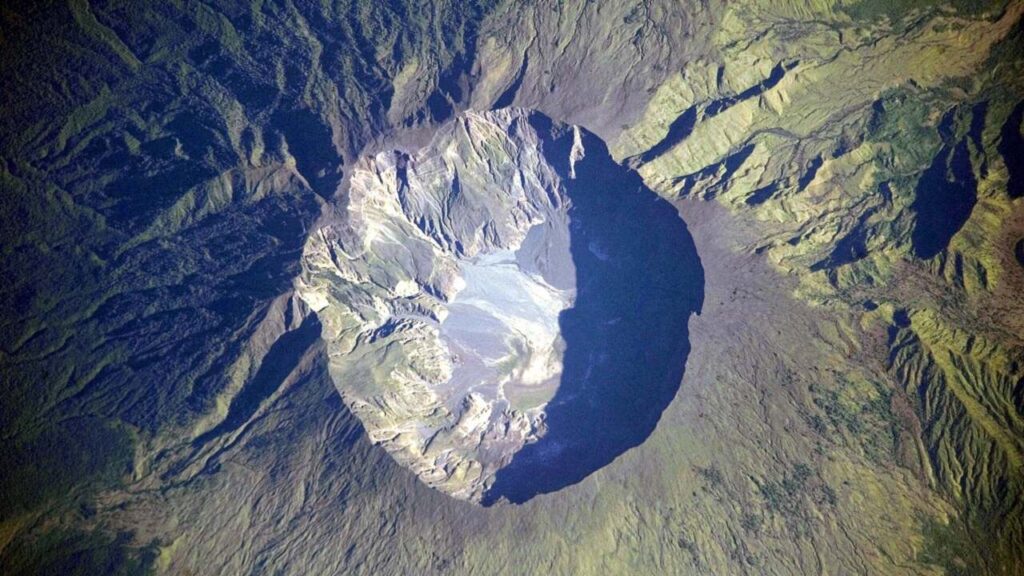
The biggest volcanic eruption in recorded human history is the 1815 eruption of Mount Tambora, on the Indonesian island of Sumbawa: a VEI 7, with a dense-rock equivalent of 35–50 km³. The eruption reduced the height of the volcano itself by a third — the mountain was substantially consumed by its own event.
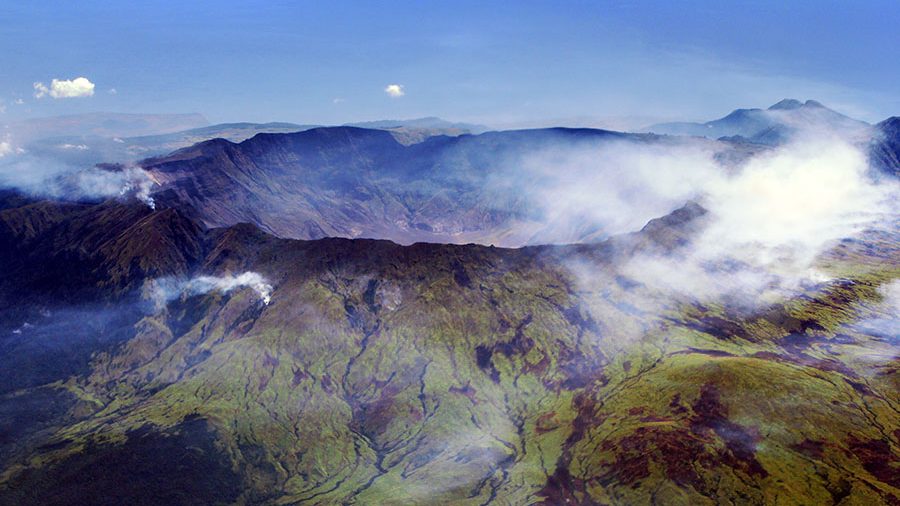
Tambora had been dormant for centuries before it woke; the first of many eruptions began on 5 April 1815, and the sequence ran on for months, raining large stones on the surrounding area and generating whirlwinds that destroyed nearby villages. In total, the events lasted for over four months — a detail worth absorbing, because the popular picture of a great eruption is a single blast on a single day. Tambora was a season of eruptions, and the record it holds was accumulated across all of them.
The human cost requires two figures, printed together, because our sources give two. BBC Science Focus puts the deaths at an estimated at least 71,000, largely through starvation as ash and climate effects destroyed food supplies. The USGS’s table of the deadliest eruptions lists 92,000 in total. Neither figure is exact — counting famine deaths across a region, two centuries ago, is estimation by nature — and both are recorded here rather than one being silently preferred.
What is not in dispute is the global echo: ash and gases blocked out the Sun’s warmth so effectively that 1816 became known as the “Year Without a Summer,” with massive food shortages following around the world. No other recorded eruption reaches Tambora on the scale and on the toll together. It is the recorded-history record-holder by both rulers this article uses. (And if your question was actually about mountains rather than eruptions — the biggest volcano is a different question, answered in its own guide.)
The Recorded Runners-Up
| Eruption | Year | VEI | Volume (DRE) | Deaths |
|---|---|---|---|---|
| Krakatoa (Indonesia) | 1883 | 6 | ~9 km³ | 36,600 (est.) |
| Novarupta (Alaska, USA) | 1912 | 6 | 13–14 km³ | 0 |
| Pinatubo (Philippines) | 1991 | 6 | 4.8 km³ | 1,202 |
| Hunga Tonga (Tonga) | 2022 | ~5.7 | 7.1 km³ | 6 |
| Mount St. Helens (USA) | 1980 | 5 | 0.5 km³ | 57 |
Each row teaches something different, which is why the table is worth reading slowly. Krakatoa is the famous one: its explosions were heard in Perth, Australia, over 3,000 km away — a sound often calculated as the loudest in recorded history — and its death toll, an estimated 36,600, came mostly through tsunamis.
Novarupta is the corrective to Krakatau’s fame: the largest eruption of the 20th century by volume, expelling about 15 km³ of magma in just 60 hours — roughly 30 times the volume of Mount St. Helens — and it killed nobody, because of where it happened; the USGS and BBC figures for Novarupta are given in slightly different currencies (magma volume versus DRE), which is precisely why both are labeled in this article rather than merged.
Pinatubo shows the modern pattern: a VEI 6 with 1,202 deaths, in an eruption where early warnings and evacuations saved many lives — the death toll reflects the typhoon that arrived as the eruption peaked, compounding ash and mudflows across a wide area, as much as the eruption itself.
Hunga Tonga shows that the table is still being written — an underwater volcano whose 2022 eruption ripped its visible island apart, raised a plume 20 km into the sky, and sent a tsunami across the Pacific that cost six lives; its VEI of about 5.7 came with a DRE of 7.1 km³ exceeding Pinatubo’s.
And St. Helens anchors the bottom of the table as the scale reference most readers know: a VEI 5, 0.5 km³ DRE — the event Americans treat as the eruption is, by volume, between a seventieth and a hundredth of Tambora.
Before Records: The Geologic Giants
Now step past the edge of written history, where the currency changes to bulk volume and the numbers change by orders of magnitude. These are eruptions so big they collapse into calderas, and the honest way to present them is with their uncertainty attached.
The largest figures on the standard list of largest eruptions belong to North America’s ancient caldera eruptions. The Wah Wah Springs eruption, about 30 million years ago, is listed at 5,500–5,900 km³ (bulk) — which, you should notice, is more than the 5,000 km³ of La Garita’s Fish Canyon Tuff eruption, about 27.8 million years ago, the eruption most often crowned “the largest.” Both figures stand in the same list, and this article declines to pick between them by stealth: which giant is “biggest” genuinely depends on the estimates a source adopts, and estimates of volumes this old can carry, as the list itself warns, considerable uncertainty.
What can be said firmly is the class: single eruptions of thousands of cubic kilometers, against Tambora’s recorded-history best of 35–50 km³ DRE.
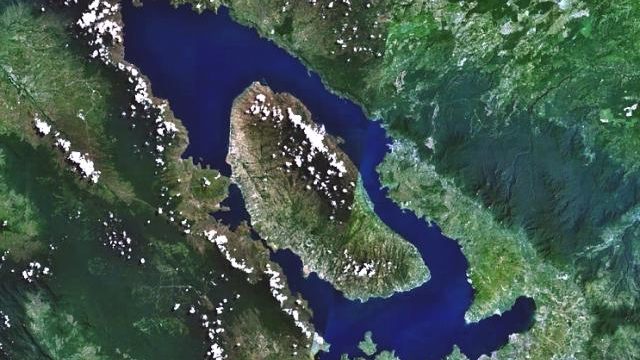
The remaining giants each hold a more specific title. Toba, in Indonesia, erupted about 74,000 years ago; its volume is given as a wide range, 2,000–13,200 km³, with most estimates placing it at 2,800 km³ — and it is described as the largest-known eruption on Earth in at least the last million years. Yellowstone’s Huckleberry Ridge eruption, 2.1 million years ago, produced 2,450–2,500 km³, and Yellowstone appears in this story a second time as well: its Lava Creek eruption, about 640,000 years ago, produced around 1,000 km³ — right at the VEI 8 threshold — making Yellowstone the rare system with more than one entry in the giants’ register.
And the most recent of the VEI 8 class is Taupō’s Oruanui eruption in New Zealand, about 27,000 years ago, at 1,170 km³ — recent enough that the world it erupted into was recognizably ours. How often does the planet do this? Eruptions of this size occur worldwide, on the evidence, every 50,000 to 100,000 years.
One caution belongs with this whole section, and the list itself states it: evidence for the oldest giants is incomplete — erosion and plate tectonics have destroyed the deposits of many eruptions entirely, and even for the eruptions that are listed, the volume estimates carry considerable uncertainty. The geologic table is a table of survivors, not a census. That frequency, plus the dates, is why scientists treat supereruptions as a real category of natural event and simultaneously as nothing anyone alive needs to schedule around.
The Quiet Record-Holder: Laki, 1783–84
One record-holder remains, and it breaks the pattern of this entire article, so it gets its own section. The Laki eruption in Iceland, in 1783–84, was not an explosion at all: it was an effusive eruption, an outpouring of about 15 km³ of lava. No VEI headline, no column in the stratosphere of the kind the scale rewards. And it killed about one fifth of Iceland’s population — through the gases, the contaminated grazing land, and the famine that followed, with the ensuing climate disruptions believed to have killed many more elsewhere. Laki is the standing proof that “biggest” and “deadliest” and “loudest” are three different rankings, and that the quietest eruption on this page out-killed most of the famous explosions.
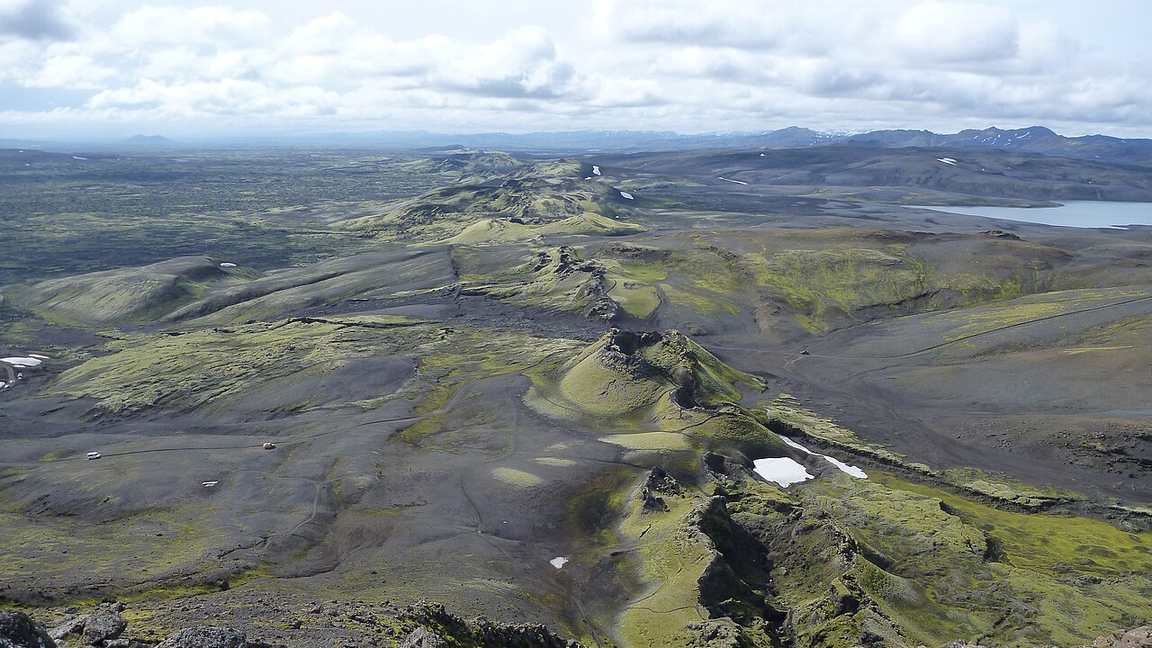
When students ask me why volcanologists resist superlatives, Laki is the eruption I make them study: the ruler you choose decides the record you find.
Frequently Asked Questions
Tambora, 1815 — a VEI 7 eruption in Indonesia with a dense-rock equivalent of 35–50 km³, the largest of recorded history. It reduced the volcano’s own height by a third, killed at least an estimated 71,000 people (the USGS total is 92,000), and made 1816 the “Year Without a Summer.”
There is no single settled answer, and any source that gives one without a range is tidying the data. On the standard list, Wah Wah Springs stands at 5,500–5,900 km³ (bulk volume) and La Garita’s Fish Canyon eruption at 5,000 km³; Toba, about 74,000 years ago, is the largest known of the last million years at a commonly estimated 2,800 km³, within a wide range of 2,000–13,200 km³.
The Volcanic Explosivity Index — a scale from 0 to 8 grading eruptions mainly by the volume of material ejected and the height of the eruption column. VEI 8, a supereruption, requires deposits of more than 1,000 cubic kilometers; the most recent one was Taupō’s Oruanui eruption about 27,000 years ago.
No. Krakatoa (1883) was a VEI 6 with a dense-rock equivalent of about 9 km³; Tambora was a VEI 7 at 35–50 km³ DRE — roughly four to five-and-a-half times Krakatoa’s dense-rock volume. Krakatoa is more famous, largely because its sound was heard over 3,000 km away and its tsunamis killed an estimated 36,600 people. Fame and size are different tables, and both articles’ worth of confusion comes from mixing them — much like mixing up how eruptions unfold, step by step, which is its own subject.
Novarupta, in Alaska, in 1912 — the century’s largest volcanic event, a VEI 6 that expelled about 15 km³ of magma in 60 hours, some 30 times the volume of Mount St. Helens in 1980. It also killed no one, which is why the more famous answer people give — St. Helens — is wrong on size and right only on memory.