What Is the Difference Between a Reboot and a Remake?

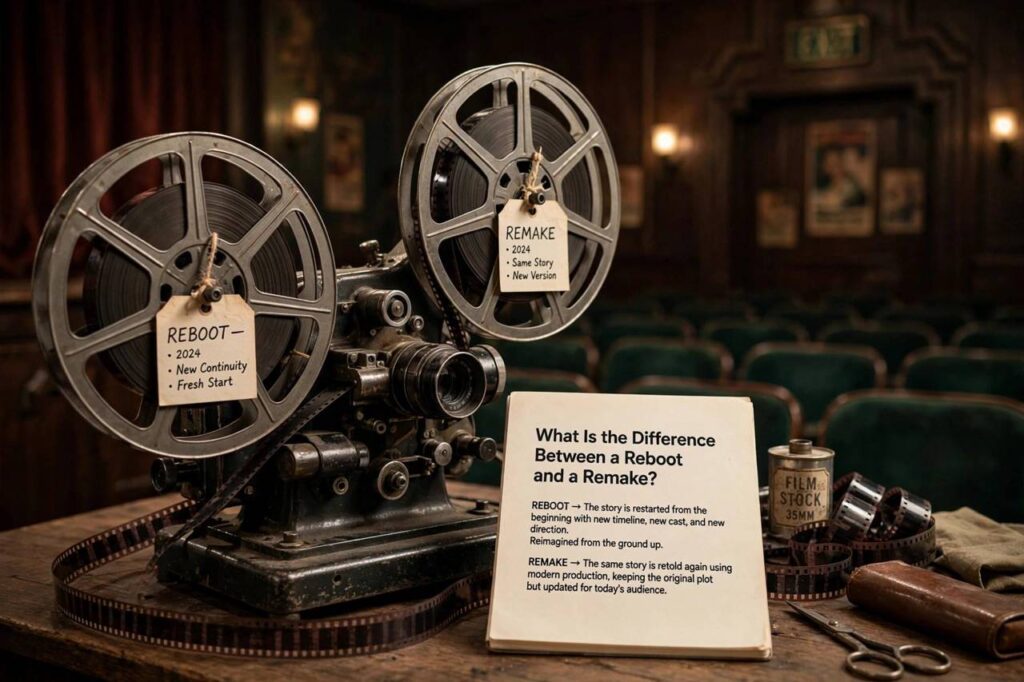
Hollywood has a vocabulary problem, and it’s contagious. Every other announcement is a “reboot” or a “remake,” the terms get swapped freely, and most of us nod along while privately unsure which is which. So let’s settle it: what is the difference between a reboot and a remake? The short version is that a remake retells one specific story, while a reboot restarts an entire franchise. The long version — the one that explains why the distinction actually matters — is more interesting.
Think of it this way. A remake is a cover song: same tune, new performance. A reboot is a band getting back together with a new lineup and a new sound. Both revisit the past, but they’re doing fundamentally different things with it.
What Is the Difference Between a Reboot and a Remake? Start With the Remake
A remake takes one specific earlier film and makes it again. Same basic story, same characters, new cast, new production. Gus Van Sant’s Psycho (1998) is the textbook case — a nearly shot-for-shot redo of Hitchcock’s 1960 original. Disney’s run of live-action versions of its animated classics (The Lion King, Aladdin, Beauty and the Beast) are remakes: one film, re-told, usually with updated visuals and occasionally tweaked details.
Remakes are usually motivated by one of three things. Technology is the big one — a story that deserves modern effects, or an animated film that can now be “live action.” Cultural updating is another: the bones of the story are strong, but the attitudes, casting, or setting need a refresh for a new audience. And then there’s the simplest motive of all: the original made money, and studios like money.
The remake lives or dies on a single question: does the new version justify its existence? The good ones find something the original couldn’t do — a new perspective, a new cultural context, a new visual language. The bad ones feel like expensive photocopies. Audiences can smell the difference within about ten minutes.
The Reboot: Same Universe, Fresh Start
A reboot doesn’t retell one film — it restarts a whole franchise, usually by discarding continuity and beginning the story over. Batman Begins (2005) is the canonical example: it didn’t remake Batman (1989), it threw out that entire continuity and started Batman’s story from scratch for a new generation. Casino Royale (2006) did the same for James Bond. Star Trek (2009) rebooted the timeline itself.
Reboots happen when a franchise has run out of road. The continuity has gotten tangled, the audience has aged out, the tone feels dated — but the underlying property still has value. Rather than continuing a story nobody’s following anymore, the studio wipes the slate and reintroduces the characters to people who never saw the originals. It’s a bigger swing than a remake, and the stakes are higher: a failed remake wastes one film, but a failed reboot can shelve a franchise for a decade.
Notice the pattern: reboots almost always skew younger, grittier, or more “grounded” than what came before — at least until the pendulum swings back. Every generation gets the version of the hero it supposedly needs, which is a polite way of saying every generation gets the version that tests best with its demographics.
The Extended Family: Reimagining, Sequel-Reboot, and Legacy Sequel
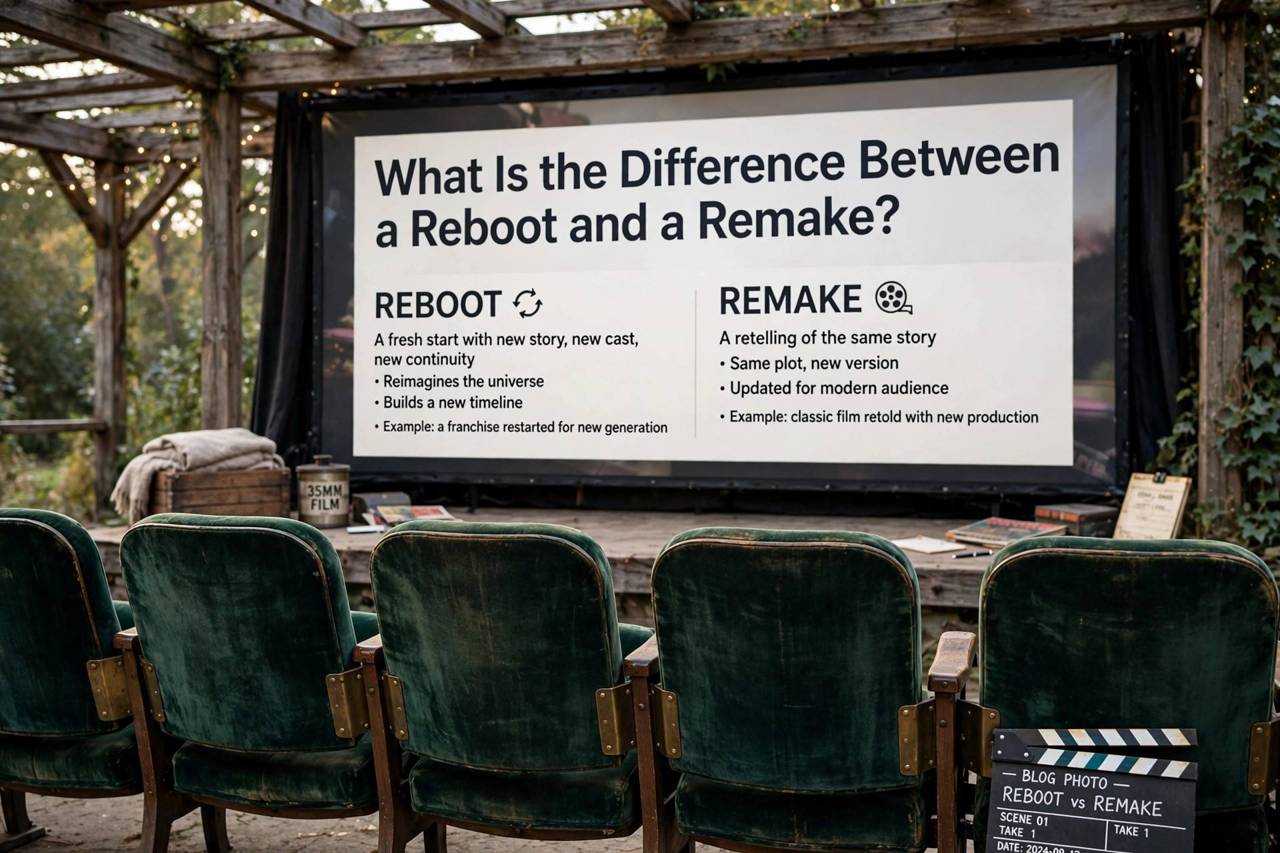
Hollywood’s terminology has mutated beyond the basic pair, and the newer terms describe real distinctions. A reimagining keeps the premise but changes the genre, tone, or setting dramatically — same seed, different plant. A soft reboot (or “requel”) keeps the old continuity technically intact while handing the story to new characters, usually with the original stars showing up to pass the torch. Think the newer Star Wars trilogy or Jurassic World.
The legacy sequel is the soft reboot’s more respectful cousin: it directly continues the original story, often decades later, with the original cast returning as mentors. Top Gun: Maverick is the gold standard — it honored the original without being trapped by it, and audiences rewarded it enormously. The spiritual successor isn’t a reboot at all, just a new thing by the same creators in the same vein, trading on association rather than continuity.
Why does any of this matter to you, the person buying the ticket? Because the label is a promise about what you’re going to see. A remake promises familiarity with a fresh coat of paint. A reboot promises a new beginning. A legacy sequel promises a reunion. When a studio uses the wrong word — calling a remake a “reimagining” to dodge comparisons, say — it’s usually telling you something about its own confidence in the film.
Why Hollywood Can’t Stop Recycling
The economics are brutally simple. Original films are gambles; familiar properties are investments with a track record. A reboot or remake comes with built-in awareness — millions of people already know the title, the characters, the theme music. Marketing a known quantity costs less and fails less often than launching something from zero. In an era when how long it takes to film a movie keeps stretching and budgets keep ballooning, studios cling to anything that reduces risk.
There’s also a demographic logic. Every fifteen to twenty years, a new generation of moviegoers arrives with no attachment to the originals. To them, a reboot isn’t a recycling — it’s an introduction. The 2009 Star Trek wasn’t for the fans who’d watched every episode; it was for everyone who hadn’t. That’s not cynical, exactly. Stories get retold in every era; film just does it with hundred-million-dollar budgets.
And sometimes — this is the part the cynics miss — the retelling is genuinely better. The Fly (1986), Ocean’s Eleven (2001), True Grit (2010): all remakes, all arguably superior to their originals. The source material is a starting point, not a ceiling. If you want to understand the machine that keeps greenlighting these, it helps to know what Hollywood is and how its incentives actually work.
How to Tell Which One You’re Watching
Here’s the practical test. Ask: does this film expect me to know the earlier films? If it retells one specific story with a new cast — remake. If it starts the whole saga over with new actors and a new continuity — reboot. If the old heroes show up to hand things to the new kids — legacy sequel or soft reboot. If it just feels spiritually similar with no shared continuity — original film wearing a familiar costume.
The marketing will try to confuse you, because “reboot” sounds bolder than “remake” and “reimagining” sounds more artistic than either. Ignore the label and watch the film’s relationship to its predecessors. The terminology is just Hollywood’s way of managing your expectations — and now you know how to read it.
One final wrinkle: studios sometimes avoid all these words entirely, calling a reboot a “new chapter” or a “fresh take” to dodge the baggage. When the press materials strain to avoid the R-words, that’s usually a sign the filmmakers know the project invites unflattering comparisons. Confidence looks like Batman Begins owning the restart; anxiety looks like euphemism. The vocabulary around a film is marketing data — treat it that way. Next time a trailer drops, listen to which words the studio chose; they’re telling you what they’re afraid you’ll think. That awareness alone puts you ahead of most opening-weekend audiences.
The Remake Spectrum: Great, Pointless, and Everything Between
Not all remakes are created equal, and the interesting question isn’t whether remaking is legitimate — it’s what separates the ones that work from the ones that feel like a tax write-off with catering. The pattern, across decades of examples, is fairly consistent.
The great remakes almost always change the meaning, not just the surface. John Carpenter’s The Thing (1982) took a 1950s B-movie and turned it into a paranoid masterpiece about trust — same premise, completely different film. David Cronenberg’s The Fly (1986) turned a campy original into a tragedy about decay and love. In both cases, the filmmakers had something to say that the original couldn’t have said, in an era the original couldn’t have imagined. The remake was the vehicle, not the point.
The pointless remakes do the opposite: they reproduce the original’s beats with better effects and less soul. The tell is when the marketing leans entirely on nostalgia — “remember this? now it’s shinier!” — rather than on any new idea. Shot-for-shot remakes are the extreme case: technically impressive, artistically inert, answering a question nobody asked. Audiences can feel the difference between a retelling with a purpose and a retelling with a budget.
Then there’s the fascinating middle category: remakes that fail interestingly. Sometimes a bold reimagining doesn’t land but still reveals something — about the source material, about the era, about what audiences actually valued in the original. Even the misfires contribute to the conversation, which is more than can be said for the competent, forgettable ones that vanish without a trace.
Frequently Asked Questions
What is the difference between a reboot and a remake?
A remake retells one specific earlier film with a new cast and production — same story, new version. A reboot restarts an entire franchise from scratch, discarding previous continuity to reintroduce the characters to a new generation.
Is Batman Begins a reboot or a remake?
A reboot. It didn’t retell 1989’s Batman; it discarded that continuity entirely and started Batman’s story over with a new tone, cast, and origin approach.
What is a legacy sequel?
A legacy sequel directly continues the original story years later, usually with original cast members returning as mentors to new characters. Top Gun: Maverick and Creed are classic examples.
Why does Hollywood make so many remakes and reboots?
Economics: familiar properties come with built-in audience awareness, which lowers marketing costs and financial risk compared to original films. Each new generation of moviegoers also arrives unfamiliar with the originals, creating fresh demand.
Can a remake be better than the original?
Absolutely. The Fly (1986), Ocean’s Eleven (2001), and True Grit (2010) are widely considered improvements on their originals. A remake succeeds when it finds something new to say, not just a new way to say the same thing.