What Is the Difference Between Rugby and American Football?


To the casual observer, rugby and American football look like close cousins — big athletes, an odd-shaped ball, lots of tackling. And honestly? The confusion is completely understandable. But once you know what to look for, these are two gloriously different sports with different rhythms, different rules, and different kinds of toughness. Whether you’re trying to follow a match, settle a debate, or decide which one to get into, here’s the full breakdown. If you’re wondering what is the difference between rugby and American football, this guide compares rules, gear, scoring, and gameplay side by side.
What Is the Difference Between Rugby and American Football? The One-Minute Version
If you only remember three differences, make them these: (1) Rugby is continuous — the clock rarely stops and there’s no break between plays; American football is stop-start, with a huddle and a planned play before every snap. (2) Rugby players wear minimal padding (basically just a mouthguard); American football players wear helmets and full pads. (3) In rugby, the ball can only be passed backward or sideways — never forward; in American football, the forward pass is the heart of the offense.
Everything else flows from those three facts. Now let’s dig into the details, because the details are where it gets fun.
Origins: Same Family Tree, Different Branches
Both sports descend from the chaotic mob-football games played in 19th-century England. Rugby formalized first, with the Rugby Football Union founded in London in 1871. American football evolved from rugby-style play at American colleges in the late 1800s, with figures like Walter Camp introducing the line of scrimmage, downs, and the forward pass — innovations that turned it into a distinct sport.
Rugby then split into two codes — rugby union (15 players) and rugby league (13 players) — with union being the globally dominant form. American football became, well, America’s game: the NFL is the richest sports league on Earth. So while they share DNA, they’ve been evolving separately for well over a century.
The Ball and the Field
The balls look similar but aren’t identical. A rugby ball is slightly larger and more rounded; an American football is a bit smaller with more pointed ends — optimized for the spiral forward pass that defines the American game. Close enough to confuse, different enough that players notice immediately.
The fields differ more than you’d think. A rugby field is larger — up to 100 meters long between the goal lines (plus in-goal areas), and about 70 meters wide. An American football field is 100 yards long with 10-yard end zones, and narrower. Rugby’s bigger pitch suits its free-flowing nature; football’s precise yardage suits its territorial chess match.
Scoring areas: Rugby has an in-goal area (like an end zone) where tries are scored by grounding the ball. American football has end zones where touchdowns are scored by carrying or catching the ball across the line. Similar concept, different execution — in rugby you must physically touch the ball to the ground; in football, crossing the plane is enough.
How Play Works: Continuous vs. Stop-Start
This is the fundamental difference, and it shapes everything about how each sport feels.
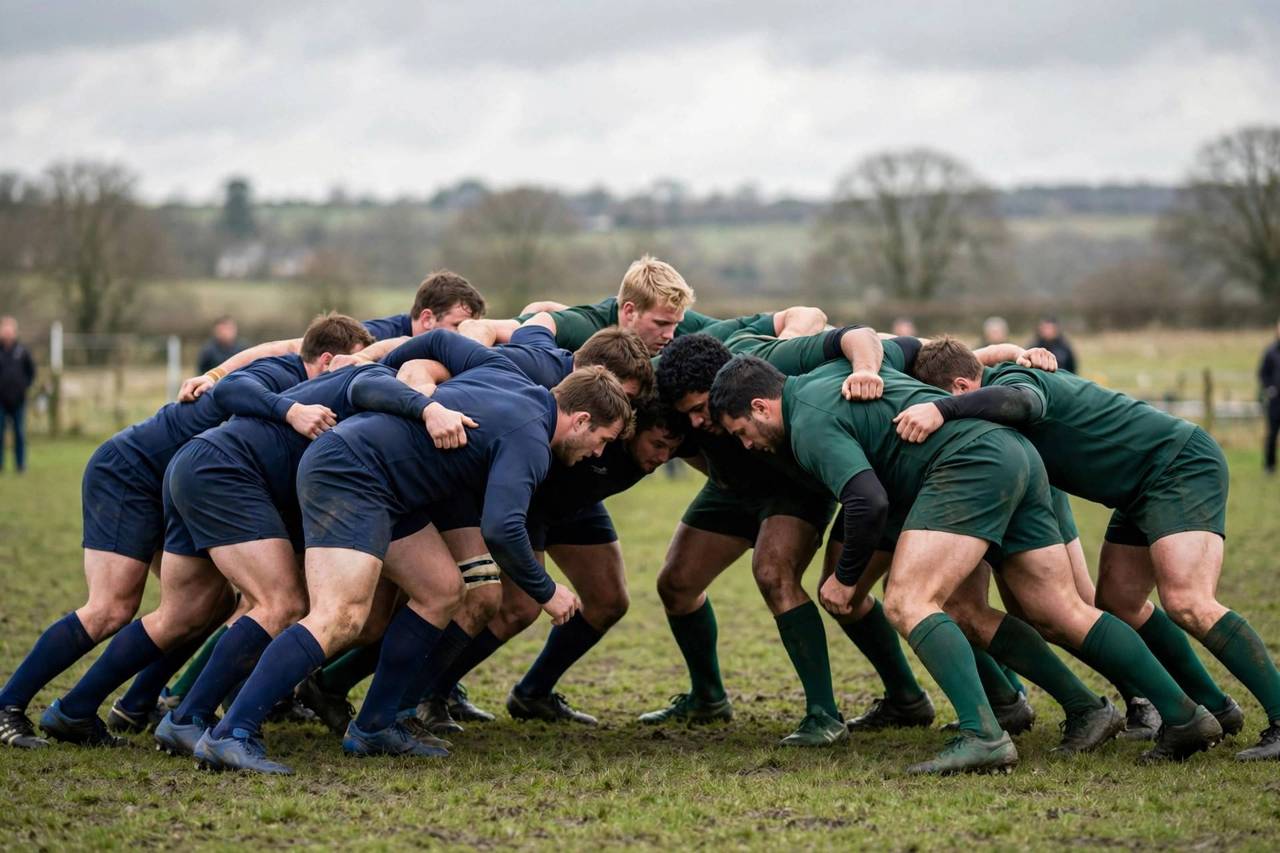
Rugby is continuous. When a player is tackled, play doesn’t stop — the tackled player releases the ball, teammates pile in to secure it (forming a ruck), and the game flows on. There are no huddles, no play clocks, no reset between phases. The ball stays live for long stretches, and players must constantly readjust. It’s exhausting, improvisational, and beautiful — more like jazz than classical music.
American football is episodic. Each play is a discrete event: the teams line up, the ball is snapped, the play unfolds over a few seconds, then everything stops. Coaches send in the next play, players huddle, and it all resets. This structure allows for extraordinary tactical complexity — every play is designed, rehearsed, and executed like a military operation. It’s chess with collisions.
Neither is better; they’re different entertainment experiences. Rugby gives you sustained tension and athletic improvisation. Football gives you strategic depth and explosive set-piece drama.
Passing Rules: The Great Divide
In rugby, you can only pass backward or laterally. Never forward. This single rule defines the sport’s entire geometry — teams advance by running with the ball or kicking it forward and chasing. It means every player on the field must be able to run, pass, catch, and tackle, because the ball can end up with anyone at any time.
In American football, the forward pass is legal (one per play, from behind the line of scrimmage) — and it’s the sport’s signature weapon. This creates extreme specialization: quarterbacks who throw, receivers who catch, linemen who block. Each player is a specialist in a way rugby players simply aren’t.
If you’re new to rugby and want to understand how all of this fits together on the field, my explainer on rugby rules walks through the laws of the game step by step.

Tackling and Protective Gear
Here’s the paradox that surprises everyone: rugby players tackle with almost no protection, while football players wear armor.
Rugby players typically wear just a mouthguard — maybe a soft scrum cap and light shoulder padding, but nothing like a helmet. Tackles must be below the shoulders (high tackles are penalized severely), and the technique emphasizes wrapping with the arms. The lack of armor actually changes tackling behavior: without a helmet as a weapon, players tackle more carefully.
American football players wear helmets, shoulder pads, thigh and knee pads — full battle gear. The collisions are correspondingly more violent, with players launching themselves at full speed. Modern football has tightened rules around helmet-to-helmet contact and defenseless players, but the impacts remain the sport’s defining physical feature.
Which is tougher? It’s the wrong question — they’re tough in different ways. Rugby demands enduring continuous physical punishment for 80 minutes with minimal protection. Football demands absorbing and delivering maximum-force collisions in short, intense bursts. Both require extraordinary courage; neither has a monopoly on it.
Scoring: How Points Work
Rugby union scoring: Try (grounding the ball in the in-goal area) = 5 points, conversion kick after a try = 2 points, penalty kick = 3 points, drop goal = 3 points. Games often finish with scores like 24-17 or 31-28.
American football scoring: Touchdown = 6 points, extra point kick = 1 (or 2-point conversion attempt), field goal = 3 points, safety = 2 points. Typical scores like 27-24 or 31-17.
The numbers look similar, but the rhythm differs enormously. Rugby scores accumulate through sustained pressure and broken-field brilliance; football scores come from executed drives and big plays. A 14-point swing means different things in each sport.
Players and Positions
Rugby union fields 15 players per side, and they’re on the field for the full 80 minutes (with limited substitutions — typically 8). Players are broadly divided into forwards (the bigger, scrummaging pack) and backs (the faster, ball-handling runners), but everyone tackles, everyone runs, everyone passes. Versatility is mandatory.
American football fields 11 players per side, but with unlimited substitution and completely separate offensive, defensive, and special-teams units. A quarterback never plays defense; a linebacker never throws a pass. Rosters run 50+ players deep. Specialization is absolute.
This is why the sports produce different body types: rugby favors all-around athletes in the 200-250 pound range who can run all day; football has 350-pound linemen who play in short bursts and 180-pound speedsters who touch the ball a handful of times per game.

Game Length and Structure
- Rugby union: Two 40-minute halves, clock rarely stops. Total real time: about 1 hour 40 minutes. Done.
- American football (NFL): Four 15-minute quarters, but the clock stops constantly — for incomplete passes, timeouts, injuries, quarter breaks, halftime. Total real time: over 3 hours.
Football packs roughly 11 minutes of actual ball-in-play action into those three-plus hours — the rest is strategy, replays, and commercials. Rugby gives you about 35-40 minutes of live action in under two hours. Different pacing philosophies, and fans of each will tell you theirs is superior with complete sincerity.
Global Reach
Rugby is genuinely global: massive in New Zealand, South Africa, England, France, Ireland, Wales, Australia, Argentina, and growing in Japan, the USA, and the Pacific Islands. The Rugby World Cup is one of the world’s biggest sporting events.
American football is overwhelmingly American — the NFL dominates US sports culture and the Super Bowl is a de facto national holiday, but the sport’s international footprint is modest by comparison (though growing, with NFL games in London and beyond). If you enjoy decoding the tactical side of field sports, you might also like my breakdown of the offside rule in soccer — another sport where one law shapes everything.
Which Should You Watch (or Play)?
Watch rugby if you love continuous action, improvisation, and athletic versatility — and you want a full match experience in under two hours.
Watch American football if you love strategy, tactical chess matches, explosive athletic plays, and the spectacle of a full Sunday production.
Play rugby if you want to develop all-around athleticism and you like the idea of a sport where everyone does everything.
Play football if you’re drawn to specialized roles and the intellectual challenge of executing complex schemes.
So what is the difference between rugby and American football in one sentence? Continuous, minimal-pad, backward-passing rugby versus stop-start, full-armor, forward-passing football. Honestly? Try both. They’re different enough that loving one doesn’t preclude loving the other — and understanding both makes you a sharper sports fan overall. The next time someone says “it’s just like rugby,” you’ll know exactly why it isn’t, and you’ll be able to explain why that difference is the whole point.
FAQ
Is rugby more dangerous than American football?
Both carry significant injury risk in different ways. Football’s armored, high-speed collisions produce more concussions and acute traumatic injuries; rugby’s continuous play produces more cumulative wear, and concussion is a serious concern there too. The sports’ governing bodies both continue tightening safety protocols. Neither is “safe” — they’re contact sports.
Why can’t you pass forward in rugby?
It’s one of the sport’s foundational laws, dating to its origins. The backward-pass rule forces teams to advance through running and kicking, which creates rugby’s distinctive flowing, improvisational style. Lifting that rule would essentially turn rugby into a different sport.
Which sport is older, rugby or American football?
Rugby is older. Rugby’s rules were codified in England in 1871, while American football evolved from rugby-style play at American colleges in the late 1800s, becoming a distinct sport around the turn of the 20th century.
Do rugby players wear any protection?
Minimal: mouthguards are standard, and some players wear soft scrum caps (for ear protection in scrums) or light shoulder padding. No helmets, no hard-shell pads — a stark contrast to American football’s full armor.
How long is a rugby match vs. an American football game?
A rugby union match is 80 minutes of play (two 40-minute halves) and takes about 1 hour 40 minutes in real time. An NFL game is 60 minutes of game clock (four 15-minute quarters) but takes over 3 hours in real time due to constant clock stoppages.