

A stunt double is a trained performer who stands in for an actor during dangerous, physically demanding, or specialized sequences — fight scenes, car chases, falls, fire, horseback riding, and anything else the insurance company won’t let the star do.
They’re the most invisible essential workers in Hollywood. When the action looks incredible, it’s usually not the famous face doing it — it’s someone whose name you’ll never know, taking real risks for a fraction of the pay, in a craft the Oscars still don’t recognize with a category. That last fact tells you a lot about how this industry values risk versus fame.
Table of Contents
- The Job, Precisely Defined
- How Doubles Match Their Stars
- What Stunt Doubles Actually Do (It’s Not Just Falling)
- The Hierarchy: Double, Coordinator, Second Unit
- Famous Doubles and Legendary Stunts
- Pay, Risk, and the Injury Reality
- The Oscar Fight: Why There’s No Stunt Category
- Frequently Asked Questions

The Job, Precisely Defined
A stunt double performs the physical action sequences that are too dangerous, too skilled, or too time-consuming for the principal actor.
The key word is double — they’re cast to match a specific actor: similar height, build, hair, skin tone, and movement style. In wide shots and fast action, the audience should never notice the switch. In close-ups, it’s the star (or clever editing sells the illusion).
Important distinction: a stunt double is assigned to one actor. A stunt performer is the general term — doubles are a subset. And a stunt coordinator designs the action; they rarely double anyone themselves anymore.
The job exists because of a collision between art and insurance. Studios insure their stars for millions; letting a $20-million actor do a 40-foot fall is financial insanity. So the risk gets transferred to someone paid thousands, not millions. Remember that asymmetry — it explains most of the industry’s labor politics.
How Doubles Match Their Stars
Casting a double is a physical puzzle:
- Body match: height within an inch or two, similar build and weight. Costume and camera angles hide small differences.
- Hair and coloring: wigs and dye handle most of it. For long-running franchises, doubles sometimes grow/maintain hair to match.
- Movement: the subtle one. A double studies how their actor walks, runs, holds themselves — because audiences feel wrongness in movement even when they can’t name it.
- Skill match: the double needs the actual skills the sequence demands — driving, martial arts, horseback, swimming, parkour. Many doubles are former athletes or military.
The matching goes deep on big franchises: some stars work with the same double for a decade. The double learns the actor’s physical tics so well they can be them in motion. It’s an intimate, strange craft — professional invisibility as an art form.
Fun detail: for nude or revealing scenes, a different specialist — the body double — is used. Different job, different casting, same principle of invisible substitution.
What Stunt Doubles Actually Do (It’s Not Just Falling)
The public image is car crashes and explosions. The reality is broader and more technical:
- Fight choreography. Weeks of rehearsal for a 90-second fight. Every punch, throw, and reaction is mapped like dance — because it basically is, at full speed, with contact.
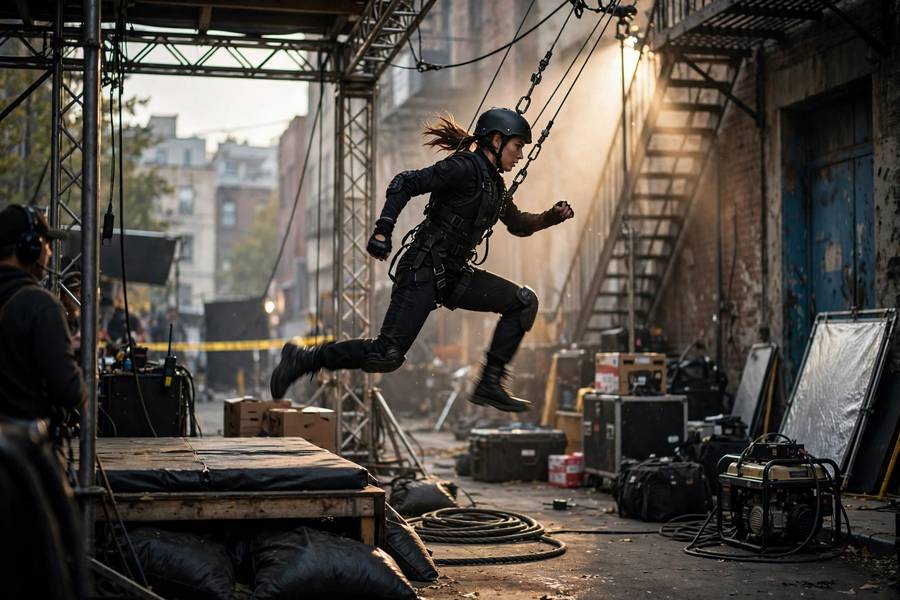
- Wire work. Flying, superhuman jumps, “yanked backward by explosion” — all wires, all rehearsed, all terrifying the first dozen times.
- Vehicle work. Precision driving, near-misses, rollovers (with reinforced cages and choreography down to the inch).
- Fire burns. Full-body fireproof gel, fireproof underlayers, and burns timed in seconds. The most dangerous common stunt — there’s no faking being on fire.
- Falls. High falls onto airbags or cardboard boxes (“the box rig”), stair falls, fight knockdowns. Technique makes the unsurvivable look routine.
- Water work. Underwater fights, boat transfers, flood sequences — water multiplies every risk.
- Specialty skills. Skiing, skating, gymnastics, horseback — productions hire doubles who are genuinely elite at the specific skill.
And the unglamorous majority: rehearsal. Stunt performers rehearse action the way dancers rehearse routines — until it’s muscle memory. The danger you see on screen is managed by preparation you don’t.
The Hierarchy: Double, Coordinator, Second Unit
Understanding who does what:
Stunt performer/double — executes the action. Hired per production, sometimes per week.
Stunt coordinator — designs all action, hires the team, runs safety. The coordinator is the department head, equivalent to a cinematographer for action. The best ones (think the teams behind major action franchises) are auteurs in their own right.
Second unit director — shoots the action sequences, often while the main unit shoots dialogue scenes. On action-heavy films, the second unit shoots a huge portion of the movie. Some of the best action directors working today came up through second unit.
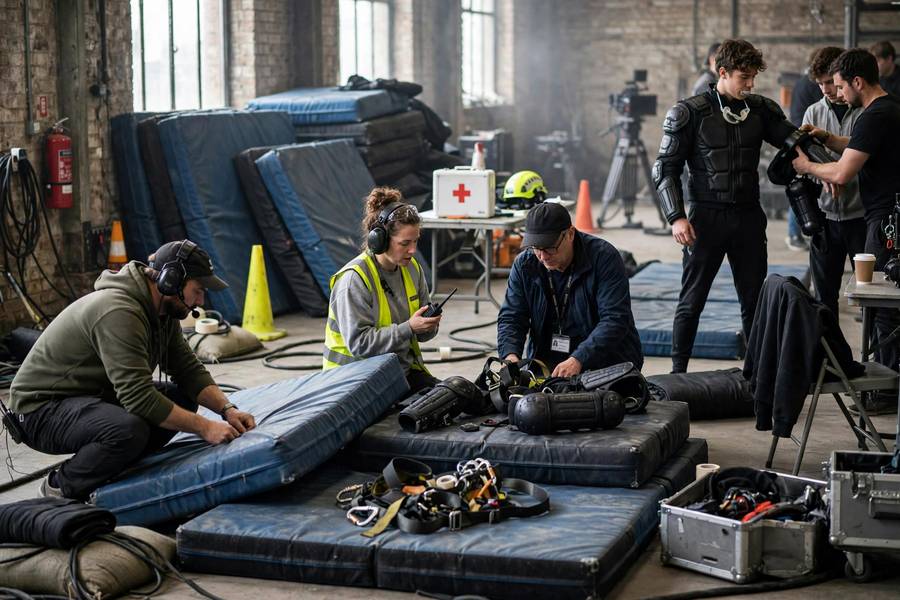
Stunt rigger — the engineers: wires, pulleys, car rigs, air ramps. Invisible when perfect; the reason everyone’s alive.
The pipeline: coordinator designs → riggers build → performers rehearse → second unit shoots → editors assemble. The star’s contribution to the action sequence is often limited to close-ups and the occasional wide shot. The movie’s action belongs to the stunt team.
For how all these units fit into production, see how movies are really made.
Famous Doubles and Legendary Stunts
A few who deserve names:
- Vic Armstrong — doubled Harrison Ford (Indiana Jones), among many. Later became a second-unit director. The archetypal career path.
- Zoë Bell — Uma Thurman’s double in Kill Bill, later a star in her own right (Death Proof). Proof that doubles can break through.
- The Mad Max: Fury Road team — the film’s action is essentially a stunt symphony; the performers did things that look impossible because they nearly were.
- The John Wick team (87Eleven) — former stunt performers who became directors, bringing stunt-coordinator sensibilities to the director’s chair. The franchise’s action revolution came from stunt people, not film schools.
Legendary stunt lore: the truck flip in The Dark Knight (a real 18-wheeler, really flipped), the building rappel descents, the Mission: Impossible HALO jump (Cruise did his own, famously — he’s the exception that proves the insurance rule, and even he uses doubles for plenty).
Pay, Risk, and the Injury Reality
Let’s talk numbers honestly:
Pay: union stunt performers (SAG-AFTRA) earn daily/weekly rates roughly $1,000-$3,500+/day depending on the stunt’s danger classification, plus adjustments for specific hazards (fire, water, heights each add premiums). Coordinators earn far more. Non-union work pays less with fewer protections. Good money per day — but work is gig-based and seasonal.
Risk: this is genuinely dangerous work. Injuries — broken bones, concussions, burns, spinal damage — are occupational realities, not freak accidents. Deaths, while rare, happen: the industry has lost performers on major productions in recent years, each one sparking safety reckonings.
The asymmetry: the double takes the physical risk; the star gets the credit and the close-up; the studio gets the insurance discount. The system works — films get made, people get paid — but the risk-reward distribution is stark. Stunt performers know this going in; it’s a calling as much as a job.
Safety evolution: the industry has professionalized enormously — safety meetings, rehearsal requirements, on-set medics, CGI replacing the most lethal gags. The direction is right. The residual risk is real.
The Oscar Fight: Why There’s No Stunt Category
Here’s the industry’s open embarrassment: the Academy Awards have no category for stunt work. Cinematography, editing, sound, VFX — all recognized. The people who set themselves on fire for the shot? Nothing.
The campaign for a stunt Oscar has run for decades. The Academy’s resistance is a mix of institutional inertia and an uncomfortable truth: recognizing stunts would force acknowledging how much of “the star’s” iconic moments belong to someone else. The illusion of the star doing everything is commercially useful.
Stunt professionals have their own awards (the Taurus World Stunt Awards), and the industry increasingly acknowledges coordinators publicly. But the Oscar gap remains the starkest measure of the fame-risk asymmetry: maximum risk, minimum recognition.
It’s worth sitting with that the next time an action sequence leaves you breathless. Someone did that. Their name was in the crawl, eighth screen down, in small type.
More behind-the-scenes industry coverage in our Celebrity section.
Frequently Asked Questions
A stunt double is a trained performer who stands in for an actor during dangerous or physically demanding scenes — fights, falls, car chases, fire stunts. They’re cast to physically match the star so audiences can’t tell the switch.
Related: a supporting actor.
Sometimes for simpler action, but insurance and safety rules mean most dangerous work goes to doubles. Tom Cruise is a famous exception who does many of his own stunts — most stars do not, and studios generally forbid it for insured leads.
Union (SAG-AFTRA) stunt performers earn roughly $1,000-$3,500+ per day depending on danger classification, with premiums for fire, water, and height work. Coordinators earn significantly more. Work is gig-based and seasonal.
A stunt double performs dangerous or skilled action sequences matching a specific actor. A body double stands in for nude, revealing, or specific body-part shots. Different specializations, same principle of invisible substitution.
The Academy has resisted adding a stunt category for decades despite industry campaigns. Reasons cited include institutional inertia — and the uncomfortable fact that recognizing stunts highlights how much of stars’ iconic action belongs to doubles. Stunt professionals have their own Taurus World Stunt Awards.