
Of all the wedding details that cause disproportionate stress, addressing invitations might be number one. It’s fiddly, rule-heavy, and — unlike centerpieces — mistakes are visible to the exact people you’re trying to impress. I’ve watched couples spend three weeks agonizing over whether to write “Mr. and Mrs. John Smith” or “John and Jane Smith,” and honestly? Most of the anxiety is unnecessary.
Here’s the practical truth: invitation addressing has real rules, but only a handful actually matter. This guide covers the ones that do — titles, married and unmarried couples, plus-ones, kids, outer vs. inner envelopes — with exact formats you can copy. Follow these and nobody will notice your envelopes. Which is exactly the point.
Table of Contents
- The Golden Rule of Addressing
- Outer vs. Inner Envelopes
- Married Couples: The Formats
- Unmarried Couples Living Together
- Single Guests and Plus-Ones
- Children and Families
- Titles, Divorce, and Tricky Situations
- Handwriting vs. Printing
- Common Mistakes That Cause Real Problems
- Frequently Asked Questions
The Golden Rule of Addressing
Everything in invitation etiquette flows from one principle: the envelope tells the guest exactly who is invited. No guessing, no assumptions. If someone’s name is on the envelope, they’re invited. If it’s not, they’re not. This is how you control plus-ones and kids without awkward conversations.
That means addressing is not decoration — it’s communication. Get the names right and half your guest-list headaches disappear. This is also why your guest list must be final before you address a single envelope. Addressing 150 invitations and then cutting 12 people is a special kind of pain.
Outer vs. Inner Envelopes
Traditional formal invitations use two envelopes:
- Outer envelope: The mailing envelope. Formal, full names and titles, full address. No abbreviations (write “Street,” not “St.”).
- Inner envelope: The smaller envelope inside holding the invitation. Less formal — first names are fine. This is where you clarify exactly who’s invited (“John, Jane, and Emma”).
For semi-formal and casual weddings, one envelope is completely fine — just use the outer-envelope format. Nobody under 40 expects an inner envelope, and honestly, most guests throw both away. Match the formality to your wedding, not to a rulebook from 1950.
Married Couples: The Formats
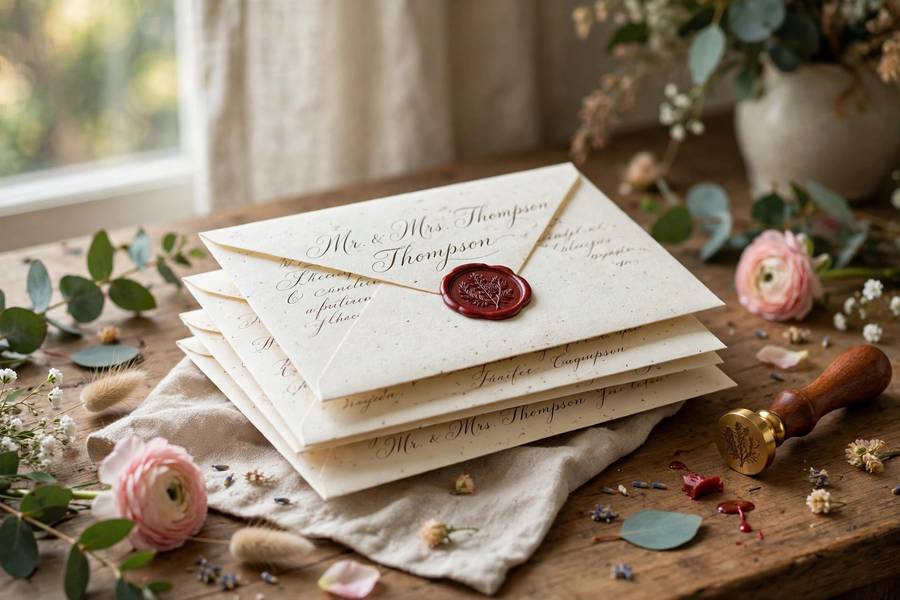
Traditional formal (outer envelope): Mr. and Mrs. John Smith
Modern formal (my recommendation for most couples): Mr. John Smith and Mrs. Jane Smith — or simply — John and Jane Smith
Same last name, wife kept her name: Mr. John Smith and Ms. Jane Doe (List alphabetically by last name if you’re unsure of order — or the person you know better first.)
Different last names: Ms. Jane Doe and Mr. John Smith
Inner envelope: John and Jane — or The Smiths.
My honest advice: use the format the couple themselves uses. If Jane introduces herself as “Dr. Jane Smith,” don’t demote her to “Mrs. John Smith” on your envelope. When in doubt, ask. A quick text — “hey, how do you two like to be addressed formally?” — takes ten seconds and prevents genuine offense.
Unmarried Couples Living Together
Outer envelope: Ms. Jane Doe Mr. John Smith (On separate lines, same address. Names in alphabetical order by last name.)
Inner envelope: Jane and John.
Do not combine them into “Mr. and Mrs.” — they’re not married, and assuming otherwise is the kind of thing people remember. Also: if they’re engaged, you still use the unmarried format until the wedding happens.
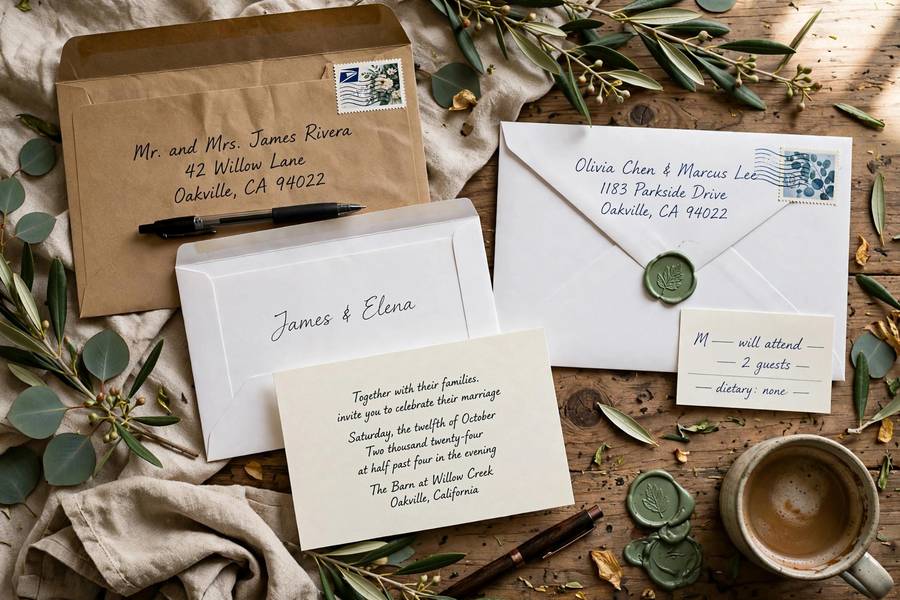
Single Guests and Plus-Ones
This is where the golden rule does its work.
Single guest, no plus-one: Ms. Jane Doe (just her name — the absence of “and Guest” is the message)
Single guest with a named plus-one: Ms. Jane Doe and Mr. John Smith (if you know the partner’s name, use it — it’s warmer)
Single guest with an unnamed plus-one: Ms. Jane Doe and Guest
Be deliberate here. “And Guest” on every single person’s invitation is how a 120-person wedding becomes a 160-person wedding. My rule of thumb for clients: offer plus-ones to guests who won’t know anyone else, anyone in a long-term relationship, and wedding party members. Everyone else? It’s okay to invite them solo. Truly.
If someone asks for a plus-one they weren’t given, a warm “we’re keeping the wedding intimate and weren’t able to extend plus-ones to everyone — we hope you can still make it!” works. Most people understand.
Children and Families
Children invited (outer envelope): Mr. and Mrs. John Smith (Children’s names go on the inner envelope: John, Jane, Emma, and Liam. On a single envelope, add a second line: “and family” — or list the kids’ names.)
Children NOT invited: Address only to the parents. Then put “Adults-only celebration” or “We love your kids, but our venue can’t accommodate them — enjoy a parents’ night out!” on the details card or wedding website. Do not write “no kids” on the invitation itself.
The kids question causes more family drama than any other addressing issue. Decide your policy once, apply it evenly (no exceptions for your sister’s kids but not your cousin’s — that’s how feuds start), and communicate it clearly on the website. Uneven application is what people actually get angry about, not the policy itself.
Titles, Doctors, Divorce, and Tricky Situations
Doctors: Always use the professional title — it’s earned. “Dr. Jane Smith and Mr. John Smith.” If both are doctors: “Drs. Jane and John Smith” (formal) or “Dr. Jane Smith and Dr. John Smith.”
Other titles: Judge, Reverend, Captain, Professor — use them. Military titles include rank: “Captain John Smith, U.S. Navy.”
Divorced women: Use “Ms.” with her current last name (whichever she uses now): “Ms. Jane Doe.” Never use “Mrs.” with a divorced woman’s ex-husband’s name unless she specifically does.
Widowed women: “Mrs. John Smith” is still traditional, but many prefer “Ms. Jane Smith.” When in doubt, ask — this one is genuinely personal.
Gender-neutral: “Mx.” is the standard gender-neutral honorific: “Mx. Alex Rivera.” If you’re unsure, just use full names without a title — that’s always safe.
Estranged family / sensitive situations: Send separate invitations to divorced parents at separate addresses even if you’re inviting both. Don’t make your addressing the place where family tension plays out.
Handwriting vs. Printing
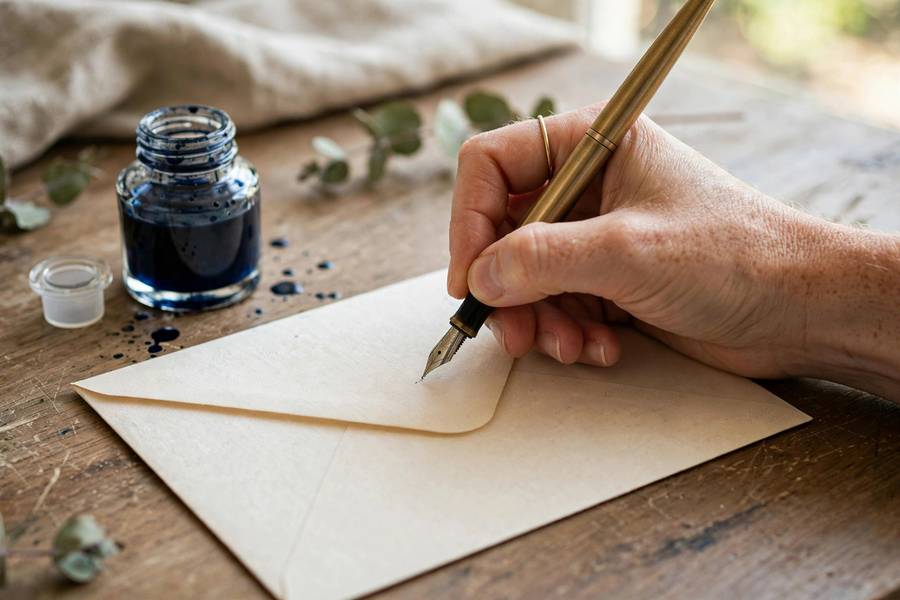
Hand calligraphy: Beautiful, traditional, expensive ($2–$5+ per envelope), and slow. Worth it for formal weddings under 100 guests if the budget allows.
Your own handwriting: Perfectly fine for casual and semi-formal weddings — if it’s legible. Illegible handwriting on 150 envelopes is not “charming,” it’s a mail-delivery problem.
Printed (digital calligraphy fonts): The modern standard. A good script font, printed in a dark ink, looks excellent and costs a fraction of hand calligraphy. Most of my couples do this now, and no guest has ever complained.
Labels: Don’t. I know they’re tempting. But a printed label on a wedding invitation reads as “bulk mail,” and it undermines everything the invitation is trying to say. Print directly on the envelope instead — every home printer can do it with a template.
Whatever you choose, do a test envelope first. Check the ink color, the alignment, and — critically — that the address is complete and correct. One wrong zip code on a batch run is a painful lesson.
Common Mistakes That Cause Real Problems
These aren’t etiquette nitpicks — they cause actual issues:
- Abbreviating on formal invitations. “St.” instead of “Street,” “Apt.” instead of “Apartment.” Spell it out on the outer envelope.
- Forgetting the return address. On the back flap of the outer envelope. Undeliverable invitations without a return address just vanish.
- Not ordering extra envelopes. Order 15–20% extra. You will make mistakes, your hand will cramp, and reordering takes weeks.
- Mailing too late. Invitations go out 6–8 weeks before the wedding (8–10 for destination). Addressing takes longer than you think — start 2–3 weeks before your mail date.
- Using pencil or light ink. It smudges and it’s hard to read. Dark ink, always.
- Forgetting postage for the RSVP envelope. If you include a paper RSVP card, the return envelope needs a stamp. Unstamped RSVP envelopes are the number one reason response rates crater.
- Addressing before the list is final. I said it before: final list first. Every re-addressed envelope is wasted money and time — and if you’re also finalizing wedding seating chart ideas later, a clean guest list now saves you twice.

Frequently Asked Questions
Traditionally “Mr. and Mrs. John Smith” on the outer envelope. The modern approach most couples prefer: “Mr. John Smith and Mrs. Jane Smith” or simply “John and Jane Smith.” Use whatever format the couple themselves uses — when in doubt, ask them.
Only for formal weddings. The inner envelope traditionally clarifies exactly who is invited (“John, Jane, and Emma”). For semi-formal and casual weddings, a single envelope is completely fine and what most couples do now.
Write “and Guest” after the invitee’s name if the plus-one is unnamed, or include the partner’s actual name if you know it. If no plus-one is offered, address the invitation to the guest only — the absence of “and Guest” is the message.
Address the envelope only to the parents’ names. Communicate the adults-only policy on a details card or your wedding website (“We love your little ones, but our venue can’t accommodate children”). Apply the rule evenly to avoid family drama.
Hand calligraphy is beautiful but costly ($2–$5+ per envelope). Printed addresses in a good script font look excellent and are the modern standard. Avoid stick-on labels — they read as bulk mail. Always do a test envelope first.
6–8 weeks before the wedding, or 8–10 weeks for destination weddings. Start addressing 2–3 weeks before your mail date, order 15–20% extra envelopes for mistakes, and include a stamped return envelope if you’re using paper RSVP cards.
Get the names right, communicate clearly, and move on — your energy is better spent on things guests will actually remember. For more planning help, browse our latest guides.