Walk into any bridal salon and you’ll hear the same script: “this silhouette is for pear shapes, that one’s for apples.” Here’s what I tell my brides after years of appointments — body-type rules are a starting point, not a verdict. The dress that makes you gasp in the mirror is the right dress, whatever the charts say.
That said, understanding how silhouettes work saves you hours of frustrating try-ons. Here’s the real guide — no body-shaming, no rigid rules, just what actually flatters and why.
Table of Contents
- Forget the Fruit System
- The Silhouettes, Honestly Explained
- What to Try First by Shape
- Fabric Matters More Than You Think
- The Fitting Room Strategy
- Myths to Ignore
- For Tall Brides
- For Athletic Builds
- For Full-Busted Brides
- The Undergarment Secret
- Real Bride Transformations
- The Fitting Room Checklist
- What to Tell Your Consultant
Forget the Fruit System
Are you a pear, an apple, an hourglass, a rectangle? Honestly — most women are a mix, and reducing yourself to a fruit is the fastest way to feel bad in a fitting room. Instead, think in terms of what you want to highlight and what you want to skim over. That’s it. That’s the whole system.
Want to show off your waist? Look at defined waists. Love your shoulders? Consider strapless or off-shoulder. Want to glide rather than cling? A-line and ball gowns are your friends. Start from what you love about yourself, not from a chart telling you what’s “wrong.”
The Silhouettes, Honestly Explained
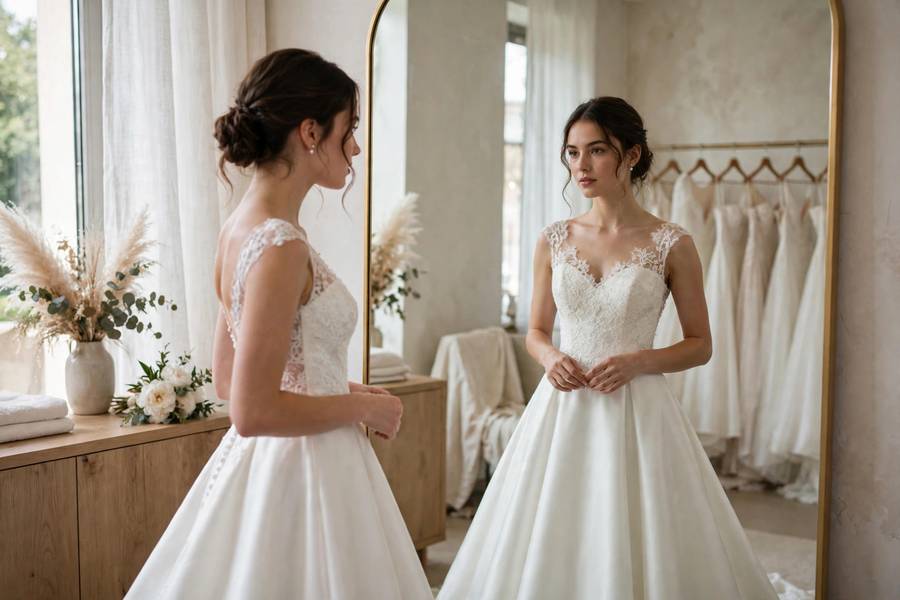
A-line: Fitted bodice, skirt that gradually flares — like a capital A. The universal crowd-pleaser. It defines the waist and skims everything below. If you’re overwhelmed, start here. It works on almost everyone, which is why consultants reach for it first.
Ball gown: Fitted bodice, very full skirt. Drama, princess energy, incredible for formal venues. It creates a waist by contrast and hides everything below the bodice. Petite brides: try it, but watch the volume doesn’t swallow you — proportion is everything.
Mermaid/trumpet: Fitted through hips and thighs, flares at or below the knee. Shows off curves unapologetically. You need to be comfortable with a fitted look all day — sitting, dancing, hugging. Try sitting down in the salon before you commit.
Sheath/column: Straight, narrow, follows the body’s line. Minimalist, modern, gorgeous. Least forgiving of undergarments — what you wear underneath matters enormously. Best with structured fabrics that skim rather than cling.
Empire waist: High waistline just under the bust, flowing skirt. Comfortable, romantic, great if you want zero restriction at the waist. A favorite for outdoor and destination weddings.
https://www.wedlockcross.com/wp-content/uploads/2026/10/wedding-dress-for-your-body-type-2.jpgWhat to Try First by Shape
Curvy with a defined waist: Start with mermaid or fit-and-flare to celebrate it, plus A-line as the safe bet. Avoid empire waists — they hide the waist you’re trying to show off.
Fuller bust: Look for structured bodices with boning — they support without a wrestling match. V-necks and scoop necks elongate. Be cautious with strapless if you’ll be tugging it up all day; a good corset back solves this.
Petite: Sheath, A-line, and trumpet in proportionate volume. Avoid overwhelming ball gowns and heavy fabrics. A higher waistline elongates your legs. And hem — budget for it, almost every petite bride needs it.
Tall: You can carry drama — ball gowns, long trains, bold details. Mermaid styles look incredible with length. The main caution: sample sizes run small, so don’t judge a style by a too-short sample.
Plus size: A-line and ball gowns are consistently winners — structured bodices, defined waists, skirts with movement. Look for ruching (very forgiving), thicker fabrics with structure, and illusion necklines. And demand to see the plus-size samples — any good salon has them.
Fabric Matters More Than You Think
Two dresses in the same silhouette can look completely different in different fabrics. Mikado and duchess satin are structured — they hold shape and smooth. Chiffon and tulle are soft — they float and drape. Crepe skims the body and shows every line (gorgeous but honest). Lace adds texture that disguises a multitude of fitting sins.
If you’re between sizes or worried about clinging, choose structure over softness. A structured fabric does the work for you all day long.
https://www.wedlockcross.com/wp-content/uploads/2026/10/wedding-dress-for-your-body-type-3.jpgThe Fitting Room Strategy
Try one of each silhouette first — even the ones you’re sure you’ll hate. I can’t count the brides who swore they’d never wear a ball gown and then cried happy tears in one. The “no” list is just as valuable as the “yes” list; it sharpens what you actually want.
Bring the undergarments and shoe height you’ll wear on the day. A dress tried on with the wrong bra is a different dress. Take photos from every angle, including sitting. And limit opinions to one or two trusted people — a committee of six will talk you out of the dress you love.
For the complete shopping journey, see how to choose a wedding dress without the meltdown, and my wedding planning checklist to keep everything on schedule.
Myths to Ignore
“You need to lose weight first.” No. Buy the dress for the body you have. Alterations take dresses in far more easily than they let them out, but crash dieting for a dress is a miserable foundation for a marriage celebration.
“White is the only option.” Ivory, champagne, blush, even black accents — wear what makes your skin glow. Pure white washes out many skin tones; ivory is universally kinder.
“Trends don’t matter.” They do a little — you’ll look at these photos for decades. But the “timeless” dress is the one you love, not the one a magazine calls classic. Trust your gut over the zeitgeist.
For Tall Brides
Tall brides (5’9″+): you can wear what others can’t — dramatic trains, big ballgowns, bold details. Your challenges are different: sample sizes run short (budget extra for length), and some silhouettes can make you feel “too much.” Mermaid and sheath dresses look statuesque on tall frames. Avoid: empire waists (they can make tall brides look pregnant rather than elegant) and overly delicate details that get lost on a larger canvas. Go bold — big flowers, dramatic backs, cathedral trains. Your height carries drama beautifully.
For Athletic Builds
Athletic brides with strong shoulders and minimal waist definition: create curves with the dress. Fit-and-flare and ballgown silhouettes add lower-body volume that balances strong shoulders. Ruched bodices create the illusion of curves. Sweetheart necklines soften. Avoid: sheath dresses (they’ll hang straight and hide your shape) and halter necklines (they emphasize shoulder width). A belt or defined waistline is your best friend — it manufactures the hourglass.
For Full-Busted Brides
Support is everything. Look for: structured bodices with boning, wider straps or sleeves, V-necks or scoop necks (they break up the chest visually), and corset backs (adjustable = forgiving). Avoid: high necklines (they create a wall of fabric), strapless sweethearts without structure (you’ll spend the day hiking it up), and flimsy fabrics with no support. Tell the salon your bra size upfront — they’ll pull dresses with appropriate construction. And budget for a great strapless bra or built-in cups; the right foundation changes everything.
The Undergarment Secret
Here’s what bridal salons won’t always tell you: the undergarments make or break the dress. Wear the right shapewear to every fitting — the dress is altered to fit WITH it. For most gowns: a longline bra or bustier, smoothing shorts (not full body shapers — you’ll need the bathroom), and no-show underwear. Get professionally fitted for the bra; most women wear the wrong size. Bring your wedding shoes to every fitting too — hem length depends on heel height. These unglamorous details are the difference between a dress that looks good and a dress that looks incredible.
Real Bride Transformations
Theory is nice; real brides are better. Here are three transformations I’ve witnessed:
The pear-shaped bride who came in wanting a sheath dress (because that’s what Instagram told her). The consultant gently suggested an A-line. She cried — not because it was the dress, but because for the first time, a dress made her feel like the best version of herself instead of a compromise. She still talks about that moment.
The plus-size bride who’d been told by a previous salon to “just get a bigger size” of a dress designed for straight bodies. At a salon with true plus samples, she tried a structured ballgown with a corset bodice. The structure did what no amount of “flattering” advice could — it made her feel powerful. The dress didn’t hide her body; it celebrated it.
The athletic bride convinced she needed to “soften” her shoulders. Her consultant showed her a V-neck fit-and-flare that worked WITH her strong frame instead of against it. She stopped trying to look delicate and started looking like herself — strong, confident, radiant.
The lesson: the right dress doesn’t change your body type. It changes your relationship with it. That’s worth more than any silhouette rule.
The Fitting Room Checklist
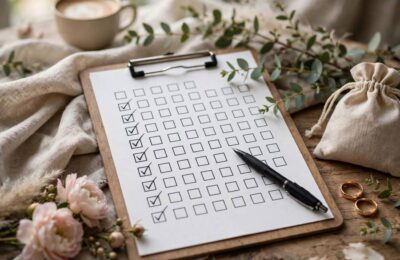
Bring this mental checklist to every appointment:
☐ The sit test: Can you sit comfortably? You’ll sit during dinner, the ceremony (sometimes), and photos. ☐ The hug test: Can you hug people? Stiff bodices restrict; make sure you can embrace. ☐ The dance test: Move like you’ll dance. If the dress fights you in the fitting room, it’ll fight you on the dance floor. ☐ The bathroom test: Can you manage it alone (or with one helper)? Elaborate dresses need a plan. ☐ The 2-hour test: How do you feel after wearing it 10 minutes? Multiply by 12. Discomfort amplifies. ☐ The photo test: Photograph front, back, side. The camera sees what the mirror doesn’t.
Bring to every fitting: your shoes, your undergarments, and a trusted opinion. And pack fashion tape and emergency essentials — even the best-fitting dress benefits from a safety net on the wedding day.
What to Tell Your Consultant
Your bridal consultant is your ally — but only if you communicate. Here’s exactly what to say:
At the start: “My budget is [X] including alterations. I’m interested in [silhouettes], but I’m open to suggestions. I love [neckline/details] and I don’t like [dealbreakers]. My wedding is [venue/vibe/season].” This 30-second brief saves 30 minutes of wrong dresses.
During: Be specific about what you like AND don’t like. “I don’t like this” is useful. “I don’t like this BECAUSE the waist feels too high” is gold — it tells her what to pull next. Don’t be polite about dresses you hate; politeness wastes your appointment.
About your body: You don’t need to announce insecurities, but do mention fit priorities: “I need good bust support,” “I want to be able to dance,” “I don’t want anything too tight in the hips.” Consultants hear this all day — it’s not embarrassing, it’s information.
The magic phrase: “Pull something you think I’d love but I wouldn’t pick myself.” Consultants have seen thousands of brides. Their wildcard picks are legendary. Trust the expertise you’re paying for (even though the appointment is free, their knowledge isn’t).
https://www.wedlockcross.com/wp-content/uploads/2026/10/wedding-dress-for-your-body-type-4.jpgStart with A-line — it flatters almost everyone. Then try one of each silhouette to learn what you love. Focus on what you want to highlight rather than rigid body-type rules.
No. Buy for the body you have now. Dresses can be taken in easily, and feeling good during shopping matters more than chasing a number.
A-line and ball gowns with structured bodices are consistently flattering. Look for ruching, thicker structured fabrics, and defined waists. Always ask to see plus-size samples.
Enormously. The same silhouette in structured mikado versus soft chiffon looks like two different dresses. Structured fabrics smooth and hold shape; soft fabrics drape and flow.
Try one of each major silhouette first (5–6 dresses), then narrow to 3–4 in your favorite shapes. More than 10–12 in a day leads to decision fatigue.