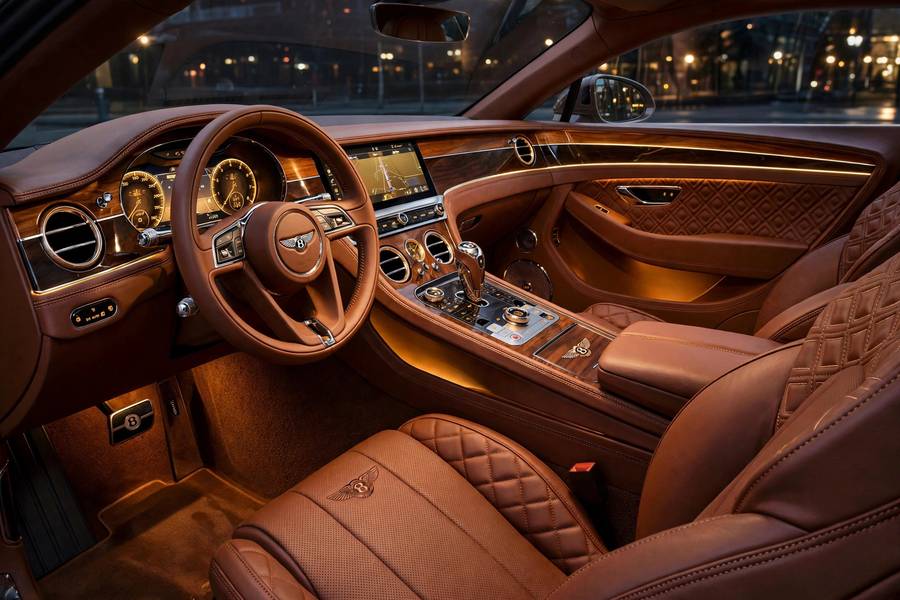
Luxury cars with the best interiors aren’t decided by spec sheets — they’re decided by sitting in them. I’ve sat in all of these (some on the job, some at shows, a few during test drives), run my hands over the materials, worked the controls, and noted which ones feel genuinely special versus which ones just photograph well.
Here’s my honest top 10, ranked on craftsmanship, material honesty, design, comfort, and that hard-to-define sense that the cabin was designed by people who care.
Contents
- What Makes an Interior Great
- 1 Rolls-Royce Phantom
- 2 Bentley Flying Spur and Continental GT
- 3 Mercedes-Benz S-Class
- 4 Range Rover SV
- 5 Porsche Panamera and Taycan
- 6 Genesis G90
- 7 Audi A8 and S8
- 8 BMW 7 Series
- 9 Lexus LS 500
- 10 Lucid Air
- The Fakes: What to Watch Out For
- Best Interior for the Money
What Makes an Interior Great
Before the list, my criteria — because “best interior” is subjective unless you define it:
- Material honesty: Real wood, real metal, real leather. Not plastic with a convincing grain, not “vegan leather” marketed as a virtue when it’s a cost cut (sometimes it is a genuine choice; often it’s not).
- Craftsmanship: Tight panel gaps, consistent stitching, controls that feel expensive. The details you touch a hundred times a day matter more than the ones you photograph once.
- Design coherence: Everything belongs. No parts-bin switchgear that clashes, no screens slapped on as afterthoughts.
- Comfort: Seats, space, quietness, climate. The fundamentals.
- Restraint: Knowing what to leave out. The best interiors aren’t the busiest — they’re the most considered.
1 Rolls-Royce Phantom
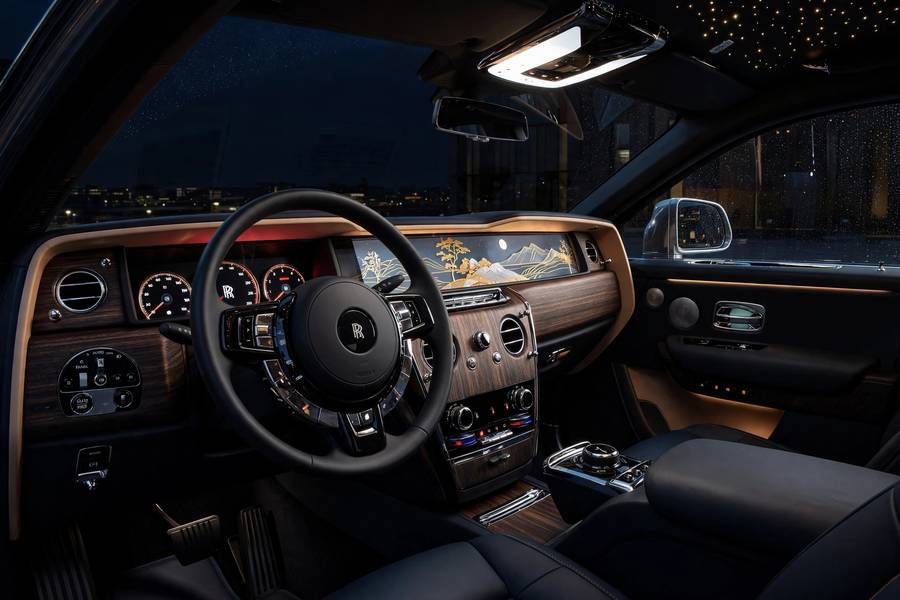
The Phantom’s cabin isn’t an interior — it’s architecture. The Gallery (a glass-enclosed art space spanning the dashboard, commissioned per buyer), the starlight headliner (1,600 fiber-optic stars, customizable to constellations), the hand-stitched leather, the book-matched veneers — everything is bespoke, everything is real, and everything is finished to a standard no other manufacturer attempts.
What strikes you sitting in it: the quiet. The materials don’t just look expensive; the whole cabin feels carved from silence. The doors close with a power-assisted whisper. Even the umbrellas in the doors feel considered.
No other cabin on this list — on earth — matches it. It’s #1 by a distance.
2 Bentley Flying Spur and Continental GT
Bentley’s interiors are the craftsman’s answer to Rolls-Royce’s artistry. Where the Phantom is architectural, the Bentley is tactile: diamond-quilted leather you want to touch, knurled metal controls (the organ-stop vents, the gear selector) that feel like precision instruments, and wood veneers finished by people who’ve done it for decades.
The rotating display — center screen that flips to reveal analog gauges or a clean veneer panel — is the best party trick in the industry, and it makes a philosophical point: technology should disappear when you don’t want it.
The driver’s environment is the best here — better than the Phantom’s, because Bentley designs for the person holding the wheel. If interiors were judged on the driver’s seat alone, Bentley might take #1.
3 Mercedes-Benz S-Class
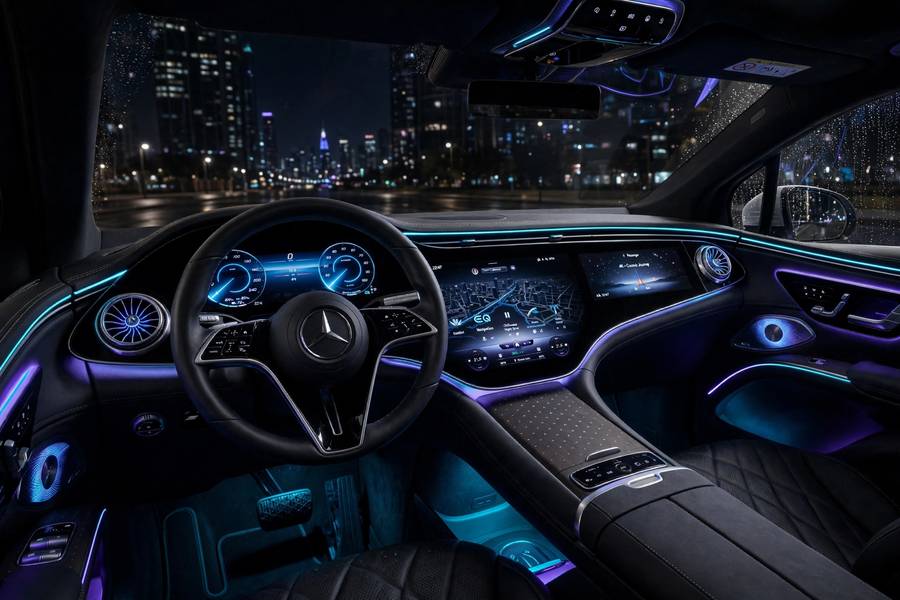
The S-Class invented the modern luxury interior template that everyone copies: the tech-forward cabin with screens integrated (not bolted on), ambient lighting as a design element, and seats that are engineering marvels (the Executive Rear Seat package offers recline, massage, heating, ventilation, and calf rests).
The current S-Class interior is slightly less warm than its predecessor — more screen, less wood — but the execution is flawless. The MBUX system is the best infotainment in the business, the Burmester 4D audio makes music physical, and the material quality is a half-step above every non-British competitor.
It’s the rational #1 — the best interior you can buy without entering the bespoke stratosphere.
4 Range Rover SV
The Range Rover SV’s interior is where British craftsmanship meets modern minimalism. The SV Signature Suite offers mosaic marquetry (tiny pieces of wood forming patterns), semi-aniline leather in colors you won’t find elsewhere, and a powered deployable table. The design language — clean horizontal lines, hidden-until-needed technology — feels more modern than Bentley without being cold.
What I love: the sense of space. The Range Rover’s tall cabin and huge glass area make it feel airier than any sedan here. And the materials are honest — you can tell what’s real by touching it, and it’s all real.
5 Porsche Panamera and Taycan
Porsche interiors don’t shout luxury — they whisper precision. Everything is exactly where your hand expects it, every control has the same weighted, mechanical feel, and the build quality is the tightest in the industry below Rolls-Royce. The Taycan’s curved digital instrument cluster and the Panamera’s clean center console show how to do screens without making the cabin feel like an electronics store.
It’s not the most opulent cabin here, but it might be the best made. Panel gaps, switch feel, material consistency — Porsche’s manufacturing discipline shows in every touchpoint. For the driver who values precision over pampering, it’s perfect.
6 Genesis G90
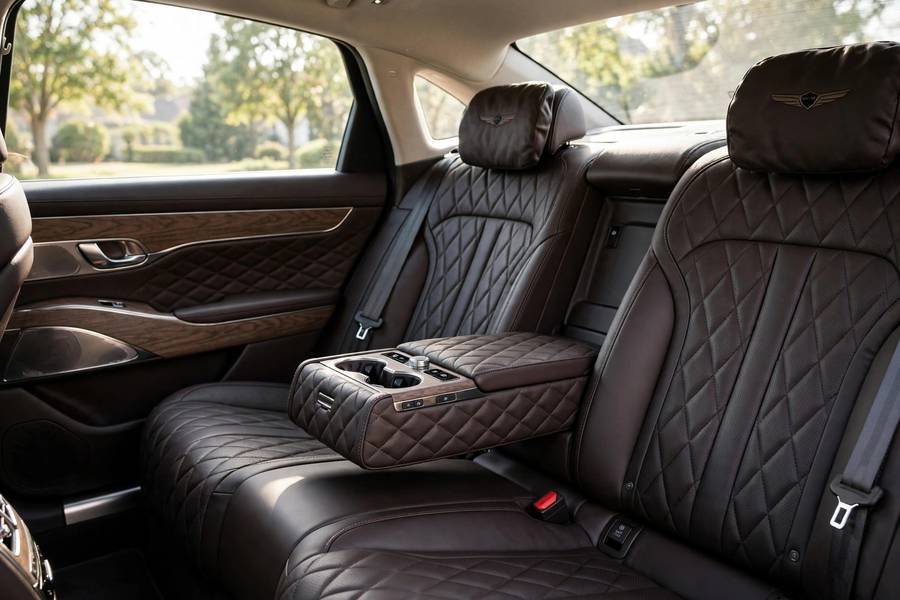
The G90 is the giant-killer. Quilted Nappa leather, real wood, a 26-speaker Bang & Olufsen system, rear executive seating with massage — at a price that undercuts the S-Class by $30,000+. Sitting in it blind, you’d guess it costs twice what it does.
Genesis understands something the Germans forgot: luxury is about how the cabin makes you feel, not the badge on the steering wheel. The G90’s interior feels warm, considered, and genuinely premium. The materials are real, the design is coherent, and the rear seat rivals cars costing twice as much.
If this list were ranked by interior-per-dollar, the G90 wins outright.
7 Audi A8 and S8
Audi’s interior philosophy: technology as luxury. The A8’s cabin is a masterclass in integrated tech — dual touchscreens with haptic feedback, the virtual cockpit, matrix LED reading lights, and a foot-massage rear seat option (yes, really — the A8L offers heated foot massage for the rear passenger).
The design is more restrained than Mercedes — darker, more architectural, very “German boardroom.” Material quality is excellent, build precision is Audi’s trademark. It lacks the warmth of Bentley or the theater of Rolls, but for the tech-minded luxury buyer, it’s deeply satisfying.
8 BMW 7 Series
The current 7 Series interior is BMW’s boldest — the 31-inch theater screen that drops from the headliner for rear passengers, the crystal iDrive controller, the sweeping ambient light bar across the dash. It’s dramatic, futuristic, and polarizing.
The front cabin is excellent — great seats, good materials, best-in-class driving position. The rear with the theater screen is a genuine event. But the design tries almost too hard; where the S-Class feels inevitable, the 7 Series feels designed — impressive, but you notice the effort. Still, on features-per-dollar and sheer spectacle, it earns its spot.
9 Lexus LS 500
The LS 500’s interior is the most Japanese cabin here — and I mean that as high praise. The Kiriko cut-glass trim, the hand-pleated door panels (inspired by origami), the Shimamoku wood — these are craft traditions applied to cars, not car-industry approximations of craft. The attention to detail is obsessive in a way only Lexus attempts.
It’s quieter in design than the Germans — less screen, more material — which feels refreshing. The seats are superb, the Mark Levinson audio is reference-grade. It doesn’t have the rear-seat theater of the S-Class or the bespoke options of the British, but the craftsmanship-per-dollar is outstanding.
10 Lucid Air
The Lucid Air earns the last spot as the future’s representative. The interior — especially in Santa Monica trim — is a revelation of space efficiency: EV packaging gives it S-Class rear legroom in a car the size of a 5 Series. The materials are genuinely premium (real wood, excellent leather), the 34-inch curved display is elegantly integrated, and the glass canopy roof makes the cabin feel extraordinary.
It’s less proven than everything else here — Lucid’s long-term durability is an open question, and the brand’s future isn’t certain. But as a pure interior achievement, it deserves recognition. This is what happens when you design a luxury cabin without an engine in the way.
The Fakes: What to Watch Out For
Since I’m being honest, here are the interior red flags I see in the shop:
- Piano black plastic everywhere. Shows every fingerprint, scratches if you look at it wrong, and it’s just plastic. Manufacturers love it because it’s cheap and photographs well.
- “Carbon fiber” trim that’s printed plastic. Real carbon has texture and depth; the fake stuff is a photograph under clearcoat.
- Touchscreen climate controls. Slower, more distracting, and less reliable than knobs. A cost cut dressed as innovation.
- Stitching that’s molded, not sewn. Run your finger along it — real stitching has thread you can feel; fake stitching is a molded ridge.
- Thin, hard “leatherette” on touchpoints. If the steering wheel and armrests feel like a basketball, the luxury is skin-deep.
The best interiors use real materials where your hands actually land. Check the touchpoints, not the brochure.
Best Interior for the Money
- Under $60,000: Genesis G70/G80 — 80% of the G90’s cabin feel at half the price.
- $60,000–$100,000: Genesis G90 or Lexus LS 500 (used) — genuine flagship cabins without flagship pricing.
- $100,000–$200,000: Mercedes S-Class or Range Rover Autobiography — the rational peak.
- $200,000+: Bentley Flying Spur — the driver’s ultimate cabin.
- Money no object: Phantom. There’s no debate.
And the used-market secret: interiors age better than powertrains. A 5-year-old S-Class or LS with a pristine cabin delivers 90% of the new-car interior experience at 40% of the price. Leather and wood don’t depreciate like electronics do.
For the broader luxury picture, see most luxurious cars — and for the two brands that define interior craftsmanship, my Rolls Royce vs Bentley comparison goes deeper. The mechanicals matter too: AWD vs 4WD explained covers what’s underneath all that leather.
Frequently Asked Questions
The Rolls-Royce Phantom — bespoke everything, the Gallery dashboard, starlight headliner, and unmatched quiet. The Bentley Flying Spur is the best driver’s interior; the Mercedes S-Class is the best rational choice below the bespoke tier.
The Genesis G90 — quilted Nappa leather, real wood, executive rear seating, and Bang & Olufsen audio at $30,000+ less than an S-Class. Used Lexus LS 500s are also outstanding interior value.
Rolls-Royce for the passenger — more theatrical, more bespoke, quieter. Bentley for the driver — more tactile, with knurled metal controls and a cockpit feel. Both use real materials throughout; the difference is philosophy, not quality.
Touch the touchpoints: real stitching you can feel (not molded ridges), real wood and metal (not printed plastic), consistent panel gaps, and weighted controls. Watch for piano-black plastic, fake carbon fiber, and touchscreen-only climate controls as red flags.
Interiors age better than powertrains — quality leather and wood hold up well with basic care, which is why 5-year-old flagship sedans are such good used values. Electronics and screens age fastest; prioritize cars with physical controls for longevity.