There is a specific moment in every conversation about self-driving cars where someone asks, “So can I buy one yet?” And the honest answer is a strange one: sort of, barely, and probably not where you live. Level 3 autonomy cars exist. They are real, certified, and on sale. But the list of them is so short you could memorize it during one red light, and the conditions under which they actually drive themselves are so narrow that most owners will use the feature a handful of times a year.
Table of Contents
- What Level 3 Actually Promises
- The Complete List: Cars With Real Level 3
- Mercedes Drive Pilot: The Flagship
- The Handoff: Waking Up a Checked-Out Driver
- Why So Few? The Certification Wall
- What Level 3 Feels Like From the Driver’s Seat
- Level 3 vs the “Almost” Systems
- Where Level 3 Goes From Here
- Frequently Asked Questions
What Level 3 Actually Promises
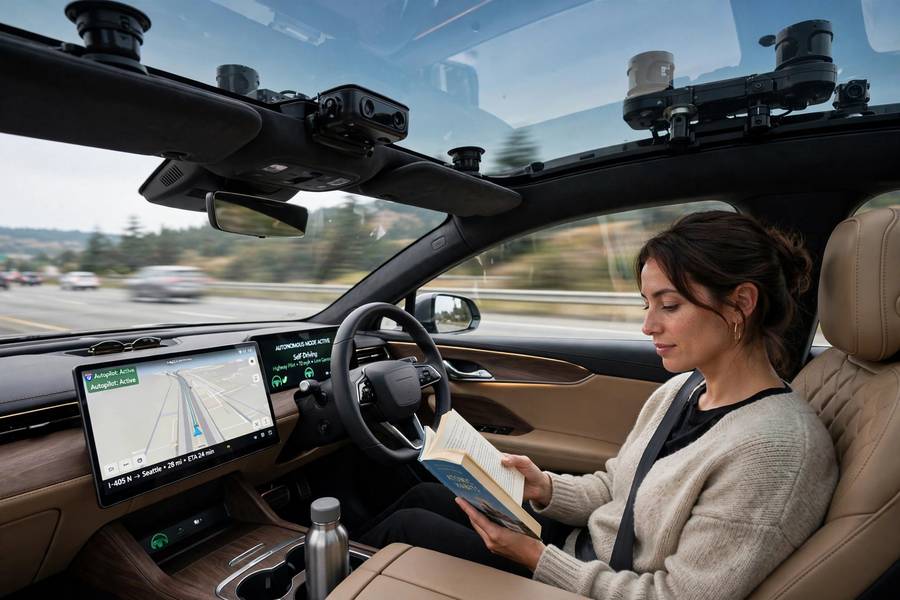
Let me strip away the jargon, because Level 3 is simple at its core. The car drives. You don’t. You are allowed — legally, explicitly — to take your eyes off the road and do something else. When the car reaches the edge of what it can handle, it tells you to take over, and you must be ready to do so.
That “allowed to look away” is the entire revolution. Every system below Level 3 demands your eyes on the road at all times, which means every system below Level 3 is, practically speaking, just fancy cruise control. Level 3 is the first level where the car takes the driving task and hands you the far more pleasant task of being a passenger who might get a phone call from the car.
But notice the shape of the promise: it’s conditional. Conditional on speed, on road type, on traffic density, on weather, on the car being in a place where regulators have approved the system. Level 3 doesn’t mean the car drives everywhere. It means the car drives in a very specific, carefully certified envelope — and inside that envelope, it is genuinely in charge.
The Complete List: Cars With Real Level 3
I’ve been tracking this for a while, and the list remains almost comically short:
Mercedes-Benz Drive Pilot. The only Level 3 system widely available to consumers, certified in Germany and in select US states (Nevada and California). Available on the S-Class and EQS. Operates at up to 60 km/h (about 37 mph) in heavy traffic on suitable highways.
Honda Traffic Jam Pilot. Certified Level 3 in Japan, offered on a limited run of the Legend sedan — a hundred or so cars. Essentially a technology demonstrator sold to the public, but it counts: it’s certified Level 3.
BMW’s Personal Pilot L3. BMW has received certification in Germany for Level 3 operation and planned rollout on the 7 Series. Availability is limited and region-specific, and it’s worth checking current status before assuming anything.
That’s it. That’s the list. Three automakers, tiny production numbers, geographically restricted. If someone shows you a list of “Level 3 cars” with twenty entries, they’re counting Level 2 systems with ambitious marketing — which is to say, they’re wrong.
Mercedes Drive Pilot: The Flagship
Drive Pilot deserves a close look because it’s the only Level 3 system most people could theoretically buy, and it reveals what Level 3 costs in engineering.
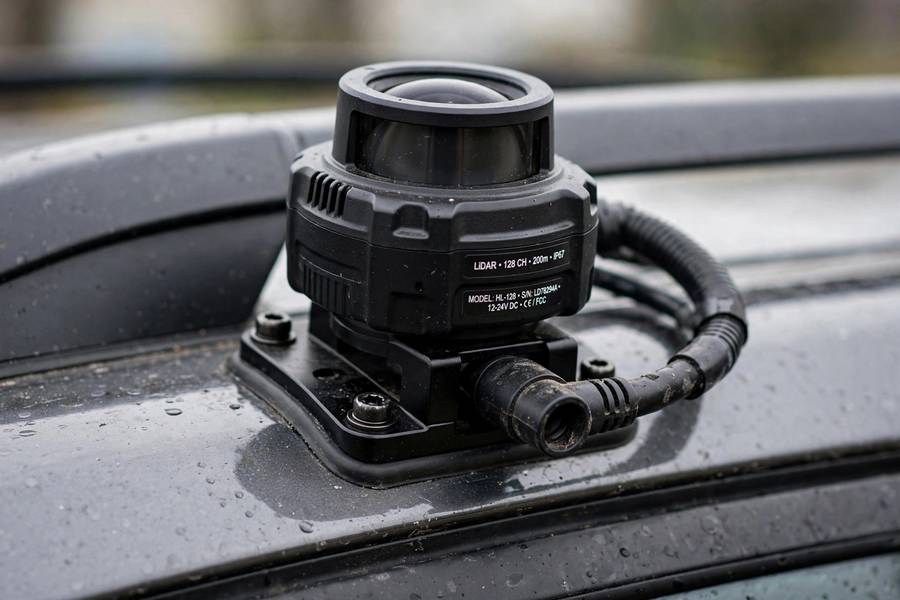
The system is geofenced to suitable highway sections, works only up to 60 km/h, requires heavy traffic (it follows a vehicle ahead), won’t work at night in some conditions, won’t work in rain, and needs clear lane markings. The car is loaded with redundant sensors — lidar, radar, cameras, ultrasonic, plus moisture sensors and precise positioning — because Level 3 certification demands redundancy that Level 2 systems skip.
The headline feature, though, isn’t the sensors. It’s the liability commitment. Mercedes has said it will accept legal responsibility for the vehicle while Drive Pilot is engaged. Read that again: the automaker, not you, is the responsible party while the system drives. That is the practical meaning of the jump from Level 2 to Level 3, and it’s why certification is so hard to earn. Mercedes isn’t just proving the car can drive — it’s putting its legal department on the line that it can.
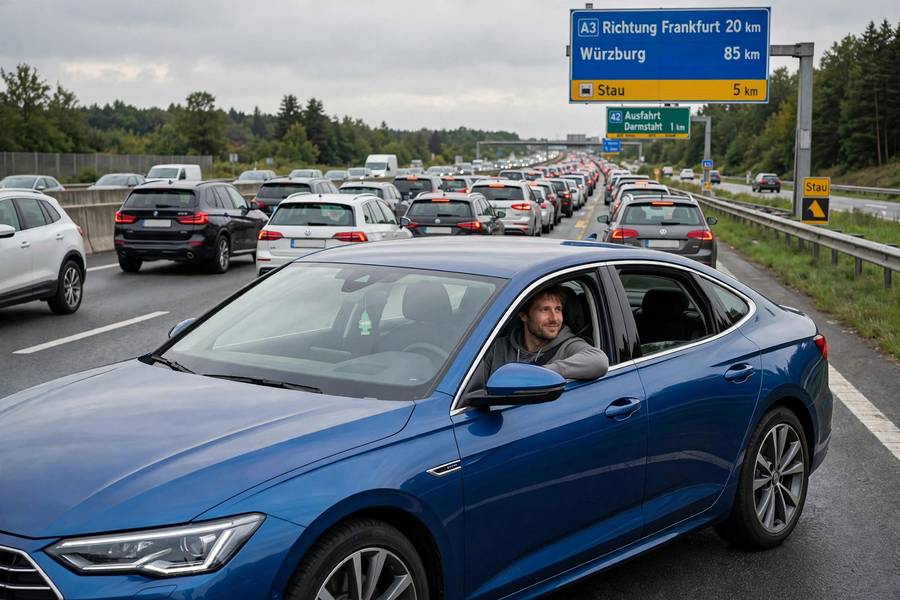
The tradeoff is the envelope: traffic-jam highway driving at low speed. That’s the scenario where the handoff problem is most manageable (you’re going slowly, in a lane, following a car) and where the value is most obvious (nobody enjoys stop-and-go traffic). It’s a deliberately modest ambition, executed to certification standards.
The Handoff: Waking Up a Checked-Out Driver
The handoff is the reason Level 3 is so hard, so let me explain it properly. At Level 2, you’re watching the road, so taking over means grabbing the wheel — your brain is already in the loop. At Level 3, you’ve been reading email for fifteen minutes. Your situational awareness is zero. Your hands aren’t on the wheel, your eyes aren’t on the road, and your mind is somewhere else entirely.
Now the car encounters something it can’t handle — the lane markings vanish, traffic clears and speeds rise, weather changes. It must bring you back into the loop. Research on this transition suggests it takes a human several seconds to regain meaningful awareness, and “several seconds” at highway speed is an eternity.
So Level 3 systems are designed around generous, escalating handoff sequences: visual alerts, audio alerts, seat vibrations, and long lead times. If the driver doesn’t respond, the system must execute a “minimum risk maneuver” — typically slowing down, pulling to the shoulder, turning on hazard lights, and calling for help. The system has to be competent enough to handle its own failure to hand over. That redundancy — the car needing a backup plan for the backup human — is a huge part of what makes Level 3 certification so demanding.
This is also why Level 3 envelopes are so narrow. Every expansion of the envelope multiplies the handoff scenarios that must be engineered and certified. Low-speed traffic jams are the easy case, and even that took years.
Why So Few? The Certification Wall
If you’re wondering why every automaker hasn’t shipped Level 3, the answer is a wall made of three bricks:
Regulatory approval. Level 3 systems need certification in each jurisdiction, and the rules differ wildly. Germany created a legal framework for it early; the US handles it state by state; many countries have no framework at all. An automaker can’t just ship the software — it has to navigate every regulator separately.
Liability. As I mentioned with Mercedes, someone has to accept responsibility while the system drives. Automakers are cautious about this for obvious reasons. The legal frameworks for apportioning blame in a Level 3 crash are still being written, case by case.
Validation. Proving a Level 3 system is safe enough requires staggering amounts of testing — billions of simulated miles plus millions of real ones, covering every scenario in the operational envelope. Only the largest automakers can afford this, and even they are selective about where they spend it.
The result: Level 3 is a technology that exists but barely ships. It’s the difference between “we built it” and “we’ll sell it to you and defend it in court.” That gap is where most autonomous driving hype goes to die.
What Level 3 Feels Like From the Driver’s Seat
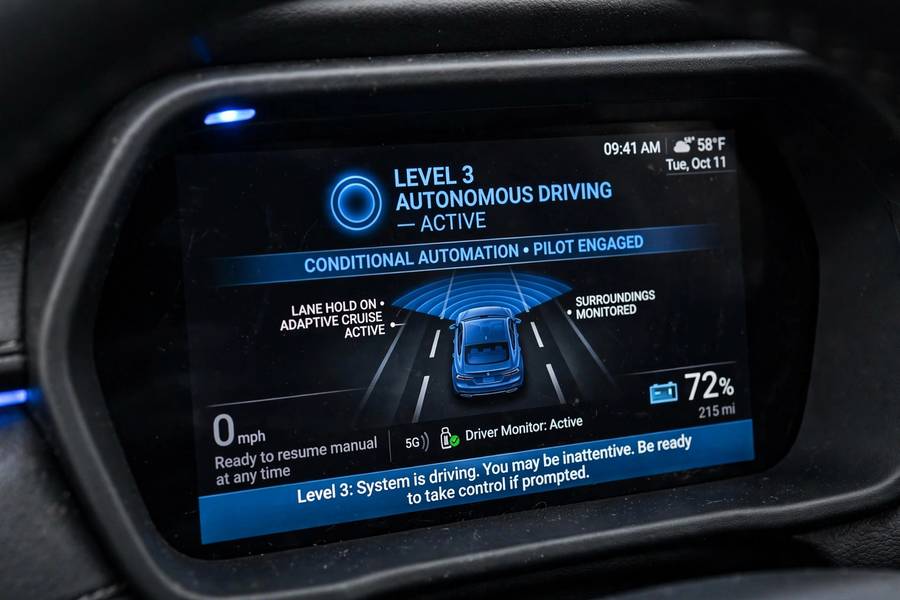
The system’s presence is signaled clearly — turquoise marker lights are the emerging standard for indicating an automated vehicle is in charge, and interior displays show the system’s status constantly. Drivers report that the strangest part isn’t looking away; it’s the discipline of staying ready to take over while doing nothing. Humans are bad at sustained vigilance without engagement. It’s the same problem air traffic controllers and power plant operators have always had, now installed in a sedan.
There’s a dry irony here: Level 3 gives you your attention back, then demands you keep a slice of it on retainer.
Level 3 vs the “Almost” Systems
This is where I get to be the annoying pedant, because the distinction matters and the industry keeps blurring it.
Tesla’s Full Self-Driving (Supervised), GM’s Super Cruise, Ford’s BlueCruise — all Level 2. Excellent Level 2, increasingly capable Level 2, but Level 2. The proof is simple: the manufacturer requires you to watch the road, and the manufacturer does not accept liability. Those two facts are the entire test. If the company won’t take the wheel legally, the car isn’t Level 3.
Some systems are sometimes described as “Level 2+” — a term that has no standing in the SAE standard and means, roughly, “Level 2 but we feel good about it.” Treat it as marketing. The SAE scale has no plus signs.
The honest way to evaluate any system: check whether the owner’s manual permits eyes-off driving, and check who the company says is responsible during operation. Everything else is decoration.
Where Level 3 Goes From Here
Level 3’s future is probably not a sudden explosion — it’s a slow widening of the envelope. Higher speeds (Mercedes has talked about extending toward 95 km/h), more road types, more regions as regulators catch up. Each expansion requires re-certification, so progress will be measured in years and jurisdictions, not software updates.
My take: Level 3 matters less as a product and more as a proof. It’s the first time automakers have had to stand behind an autonomous system with their legal liability, not just their marketing. That accountability shift — which I’ve written about in the context of AI accountability — is the real milestone. Everything after this is just widening the circle.
To understand the technology making all of this possible, read how self-driving cars use AI to perceive and decide, and the full overview of how self-driving cars work.
Frequently Asked Questions
A Level 3 autonomy car can drive itself within defined conditions, and the driver is legally allowed to take their eyes off the road. The driver must be ready to take over when the system requests it. It is the first level where the car, not the human, is considered the driver while active.
Very few: Mercedes-Benz Drive Pilot (S-Class and EQS, in Germany and select US states), Honda Traffic Jam Pilot (limited run in Japan), and BMW’s Personal Pilot L3 (certified in Germany, limited rollout). Tesla, GM Super Cruise, and Ford BlueCruise are Level 2, not Level 3.
No. Level 3 allows you to look away from the road, but you must remain able to take over when the system requests it — typically within several seconds. Sleeping is not permitted; the driver must stay in the driver’s seat and responsive.
While the Level 3 system is engaged, the manufacturer generally accepts liability — Mercedes has explicitly committed to this for Drive Pilot. If the driver was asked to take over and failed to do so, or was misusing the system, liability can shift back to the driver.
Level 3 requires regulatory certification in each jurisdiction, manufacturer acceptance of liability, and an extremely hard engineering problem: safely handing control back to a driver who has been disengaged. The testing and validation costs are enormous.
No. Tesla’s Full Self-Driving (Supervised) is a Level 2 system: the driver must supervise constantly with eyes on the road, and Tesla does not accept liability during operation. The name does not reflect the SAE autonomy level.