


Last month I did something slightly unhinged: every time I used AI search for anything factual — a date, a statistic, a how-it-works explanation, a recommendation — I wrote down the answer, then checked it against a real source. Sixty-two questions, sixty-two verifications, one spreadsheet that slowly became the most depressing and most interesting document on my laptop.
The headline result: AI search got the substance right about four times out of five. The rest of the time it was wrong in ways ranging from “slightly off date” to “confidently invented a person who does not exist.” And here’s the part that actually matters: I almost never would have caught the errors if I hadn’t been checking. The wrong answers looked exactly like the right ones.
So is AI search accurate? The honest answer is the one nobody puts in a headline: it’s accurate enough to be genuinely useful and wrong often enough that trusting it blindly is a bad habit. If you want to understand what AI search is first, start there. This guide is about the accuracy question specifically — how often it errs, why it errs, and the verification routine that takes about ninety seconds.
Table of Contents
- What “Accurate” Even Means for AI Search
- My Month of Fact-Checking: The Numbers
- Why AI Search Gets Things Wrong
- The Confidence Problem
- What AI Search Is Actually Good At
- The 90-Second Verification Routine
- When to Trust It and When to Dig Deeper
- Frequently Asked Questions
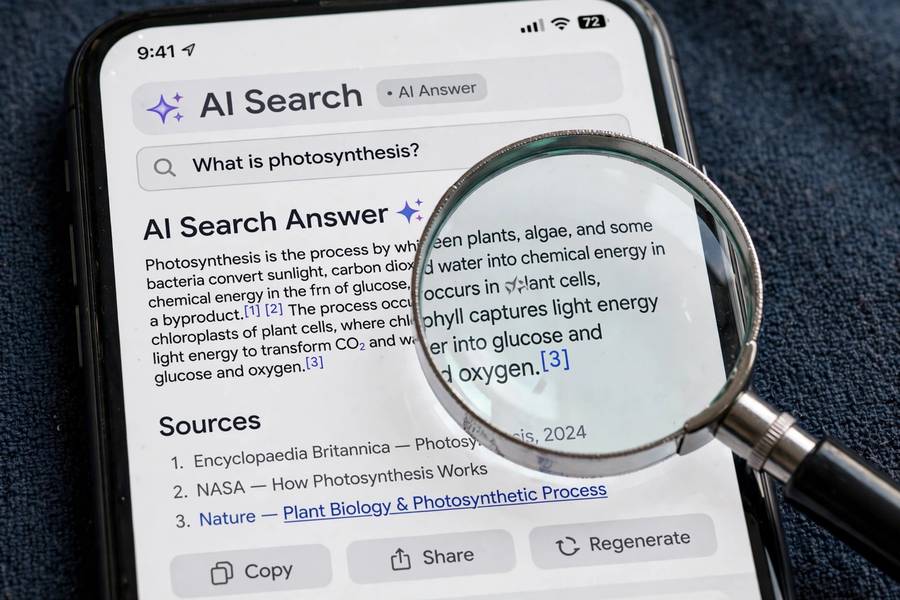
What “Accurate” Even Means for AI Search
Here’s the first trap: “accurate” sounds like one thing but AI search answers have several layers, and each layer can fail independently.
The facts. Names, dates, numbers, definitions. This is the layer people usually mean by accuracy, and it’s the one AI search is best at — mostly.
The reasoning. The answer’s facts can all be correct while the conclusion drawn from them is shaky. I once asked about two competing technical standards and got a flawless description of both followed by a recommendation that contradicted its own evidence. Every brick was fine; the house leaned.
The currency. Is the answer current? AI search tools that browse the web usually are. Ones running on a training cutoff sometimes answer 2026 questions with 2024 confidence. The answer can be “accurate” for a world that no longer exists.
The completeness. An answer that mentions three causes of a problem when there are five isn’t wrong, exactly. But if you act on it, you act on a partial picture. This is the failure mode nobody tests for and everyone suffers from.
When people argue about AI search accuracy online, they’re usually arguing about different layers without realizing it. Keep the layers separate in your head and the whole topic gets much clearer.
My Month of Fact-Checking: The Numbers
Let me be transparent about my completely unscientific experiment, because the categories are more interesting than the score.
Out of 62 factual questions across history, science, technology, current events, and practical how-tos:
- 48 were fully correct (77%). Every verifiable claim checked out against a primary or high-quality secondary source.
- 9 had minor errors (15%). A wrong year by one or two, a slightly inflated statistic, a misspelled name, a detail that was true for the US but presented as universal. Annoying but not dangerous.
- 5 were seriously wrong (8%). One invented a study. One merged two different historical events into one. One gave advice based on a product feature that had been discontinued. Two presented contested claims as settled fact.
Eight percent seriously wrong. That’s the number that should calibrate your trust. If you ask AI search ten factual questions a day — and plenty of people do — you’re absorbing roughly one serious falsehood daily. Most won’t matter. Some will.
Two patterns stood out. First, the errors clustered in questions where I lacked enough knowledge to smell-check the answer — which is, of course, exactly when I’m asking. Second, errors spiked on questions about recent events and niche topics, where the model’s training data is thin and the web results it retrieves are lower quality.
Why AI Search Gets Things Wrong
Understanding the machinery explains the mistakes. AI search isn’t a database that looks things up; it’s a language model that reads retrieved pages and composes an answer. Every step can introduce error.
Bad retrieval. The model can only synthesize what it finds. If the top results for your query are SEO sludge, outdated pages, or confidently wrong forum posts, the answer inherits their flaws. The model doesn’t have a librarian’s judgment about source quality — it has statistical patterns about what sources tend to be cited.
Bad synthesis. Even with good sources, combining them is genuinely hard. The model might merge details from two different articles about two different things, especially when topics are similar. The “two historical events merged into one” error from my experiment was exactly this.
Hallucination. Sometimes the model just makes things up — a citation that doesn’t exist, a statistic with no source, a person who never lived. This happens more when the question is specific and the real information is sparse. The model would rather complete the pattern than admit it doesn’t know.
Stale training data. For tools that mix browsing with built-in knowledge, the built-in knowledge can be old. A feature that changed in 2025 might still be described the 2023 way if the retrieval step doesn’t surface the update.
None of this is a bug in the moral sense. It’s the technology working as designed — generating the most plausible continuation, not consulting a vault of truth. Once you internalize that, the 8% serious-error rate stops being surprising and starts being obviously expected.
The Confidence Problem
Here’s what actually makes AI search accuracy a practical problem rather than an academic one: the answers never sound uncertain.
Human experts hedge. “As far as we know.” “The evidence suggests.” “There’s some debate here.” AI search writes with the serene confidence of a textbook, whether it’s reporting a well-established fact or inventing a study out of whole cloth. My invented-study answer was, stylistically, one of the most authoritative-sounding responses in the whole month.
This matters because humans are terrible at calibrating trust when confidence cues are stripped away. We use tone as a proxy for reliability — it’s how we navigate conversations all day. AI search exploits that proxy by sounding certain about everything.
The practical takeaway is blunt: never use the answer’s tone as evidence for the answer’s truth. It isn’t.
What AI Search Is Actually Good At
Fairness requires the other side. AI search is genuinely excellent at several things, and dismissing it entirely would be as foolish as trusting it entirely.
Orientation. “What is this thing and how does it broadly work?” AI search answers these beautifully. For getting your bearings on an unfamiliar topic — the vocabulary, the main players, the shape of the debate — it’s faster and often clearer than any alternative. It pairs well with understanding how a search engine works in the traditional sense, so you know what each tool is for.
Synthesis across sources. Need the consensus view from twelve articles you don’t have time to read? That’s the core strength. The 77% fully-correct rate in my experiment was mostly this category.
Brainstorming and drafting. When the output is a starting point rather than a final answer — ideas, outlines, first drafts — accuracy demands are lower and AI search shines. And if you’re using a chatbot for the thinking part, how to get better answers from ChatGPT is worth reading first.
Low-stakes facts. The capital of a country, the year a movie came out, the formula for a common calculation. Boring, well-documented, and the model has seen them ten thousand times. Error rates here are tiny.
The pattern: AI search is best when the cost of an error is low and the value of speed is high. It’s worst when the cost of an error is high and you can’t easily check. Calibrate accordingly.
The 90-Second Verification Routine
I promised a practical routine. Here’s the one I actually use now, born from that spreadsheet:
1. Check the citations (30 seconds). Click one or two. Do they exist? Do they say what the answer claims? In my experiment, roughly half the errors would have been caught here — the cited page either didn’t exist or didn’t support the claim.
2. Cross-check the key claim (30 seconds). Take the single most important assertion in the answer and search it in a traditional search engine. If the top results agree, you’re probably fine. If they don’t, you’ve found something.
3. Ask “what would change my mind?” (30 seconds). This is the one people skip and shouldn’t. Before accepting an answer, identify what evidence would make it wrong, and glance at whether that evidence exists. It fights confirmation bias, which is the real reason most of us accept wrong answers — we asked hoping for a particular one.
Ninety seconds. That’s the price of going from 77% to something like 97%. For anything that affects a decision, a purchase, your health-adjacent choices, or something you’ll repeat to another person — pay it.
When to Trust It and When to Dig Deeper
A simple framework I now use, borrowed from risk management:
Trust with a glance: low-stakes orientation, brainstorming, well-established facts, anything where being slightly wrong costs you nothing. Enjoy the speed.
Verify with the routine: anything you’ll act on — purchases, travel plans, technical decisions, arguments you’ll make at dinner. Ninety seconds.
Go to primary sources: medical-adjacent questions (and note this site doesn’t cover those — go to actual medical sources), legal questions, financial decisions, academic citations, anything where the error cost is high. AI search is a starting point here, never the destination.
Never trust: single-source statistics you’ll quote publicly, claims about living people, breaking news in the first hours, and anything where the answer conveniently matches exactly what you wanted to hear. That last one is the hardest and most important.
The technology will get more accurate. Retrieval will improve, models will hedge better, citations will get more reliable. But the core dynamic won’t change: a system that generates plausible text will always occasionally generate plausible falsehoods. The verification habit is the durable skill, not any particular tool’s accuracy score.
Frequently Asked Questions
Mostly. In a month of fact-checking 62 AI search answers, I found 77% fully correct, 15% with minor errors, and 8% seriously wrong. It’s reliable for orientation and well-established facts, but wrong often enough that important claims deserve a 90-second verification.
AI search composes answers from retrieved pages rather than looking up facts in a database. Errors come from poor-quality retrieved sources, bad synthesis of multiple sources, hallucinated details when information is sparse, and stale training data. Wrong answers also sound just as confident as right ones.
Use the 90-second routine: click one or two citations to confirm they exist and support the claim, cross-check the key assertion in a traditional search engine, and ask what evidence would prove the answer wrong. This catches roughly half of all errors.
They’re different tools. Traditional search shows you sources and lets you judge them; AI search synthesizes an answer but hides the judgment step. AI search is faster for orientation, while traditional search gives you more control over source quality for important questions.
Use it as a starting point, not the final word. For purchases, technical decisions, or anything you’ll repeat to others, verify the key claims with the 90-second routine. For high-stakes topics like health, legal, or financial matters, go to primary or professional sources.