How to Write a Lab Report: Section-by-Section With Examples


The lab report is where science students discover that doing the experiment was the easy part. You pipetted, you measured, you watched the solution turn an extremely satisfying shade of blue — and now you have to turn all of that into a formal document with an abstract, a methods section in past tense, and error analysis that does not just say ‘human error.’ If you have ever wondered how to write a lab report that actually earns its marks, this guide is the annotated walkthrough I wish someone had given me in my first chemistry class.
We will go section by section — abstract, introduction, methods, results, discussion, conclusion, references — with example text for each, a clear explanation of what instructors are really grading, and the classic mistakes (like smuggling results into the methods section) that quietly cost points. The examples use a simple pendulum experiment, so the science stays out of the way of the writing lessons.
How to Write a Lab Report: The Standard Structure
A lab report follows the same skeleton in almost every science course, because it mirrors the scientific method itself. The standard order is: Title, Abstract, Introduction, Methods (or Materials and Methods), Results, Discussion, Conclusion, References. Some instructors add appendices for raw data. Memorize this order — a surprising number of lost marks come from putting discussion content in the results section or conclusions in the abstract.
Two style rules govern everything. First, the methods section is written in past tense and passive voice: ‘The pendulum was released from 30 degrees,’ not ‘We released the pendulum.’ You are describing what was done, as a recipe someone else could follow. Second, the report is formal and impersonal — no ‘I thought it was cool when…’ and no contractions. You are writing as a scientist, not texting a friend.
Length varies by course, but a typical undergraduate lab report runs 1,500 to 3,000 words plus figures. Your instructor’s rubric is the real specification — read it before you write a word. If the rubric says the discussion is worth 30 percent, that is where your time goes.
Abstract and Introduction: Setting Up the Story
The abstract is a 150-250 word summary of the entire report, written last but placed first. It must answer four questions in miniature: what was the question, what did you do, what did you find, and what does it mean. Example: ‘This experiment investigated the relationship between pendulum length and oscillation period. A simple pendulum was tested at five lengths (0.2-1.0 m), with period measured over 20 oscillations per trial. Results showed period increasing with the square root of length, consistent with theoretical predictions (T = 2π√(L/g)). The measured value of g was 9.71 m/s², within 1% of the accepted value. Discrepancies are attributed to air resistance and measurement timing.’ Notice: no citations, no undefined jargon, every section of the report represented in one or two sentences.
The introduction is where you show you understand the science behind the lab. It has three jobs: state the purpose or research question, summarize the relevant background theory (with citations), and state your hypothesis or expected outcome. For the pendulum: explain the theory of simple harmonic motion, present the period equation, cite your textbook or lab manual, and hypothesize that period will increase with length but remain independent of mass.
The classic introduction mistake is writing a history of pendulums since Galileo. Instructors want focused background — only the theory needed to understand your experiment and interpret your results. Two to four paragraphs is usually right. If a concept does not help explain your results, cut it.
Methods: The Recipe Someone Else Could Follow
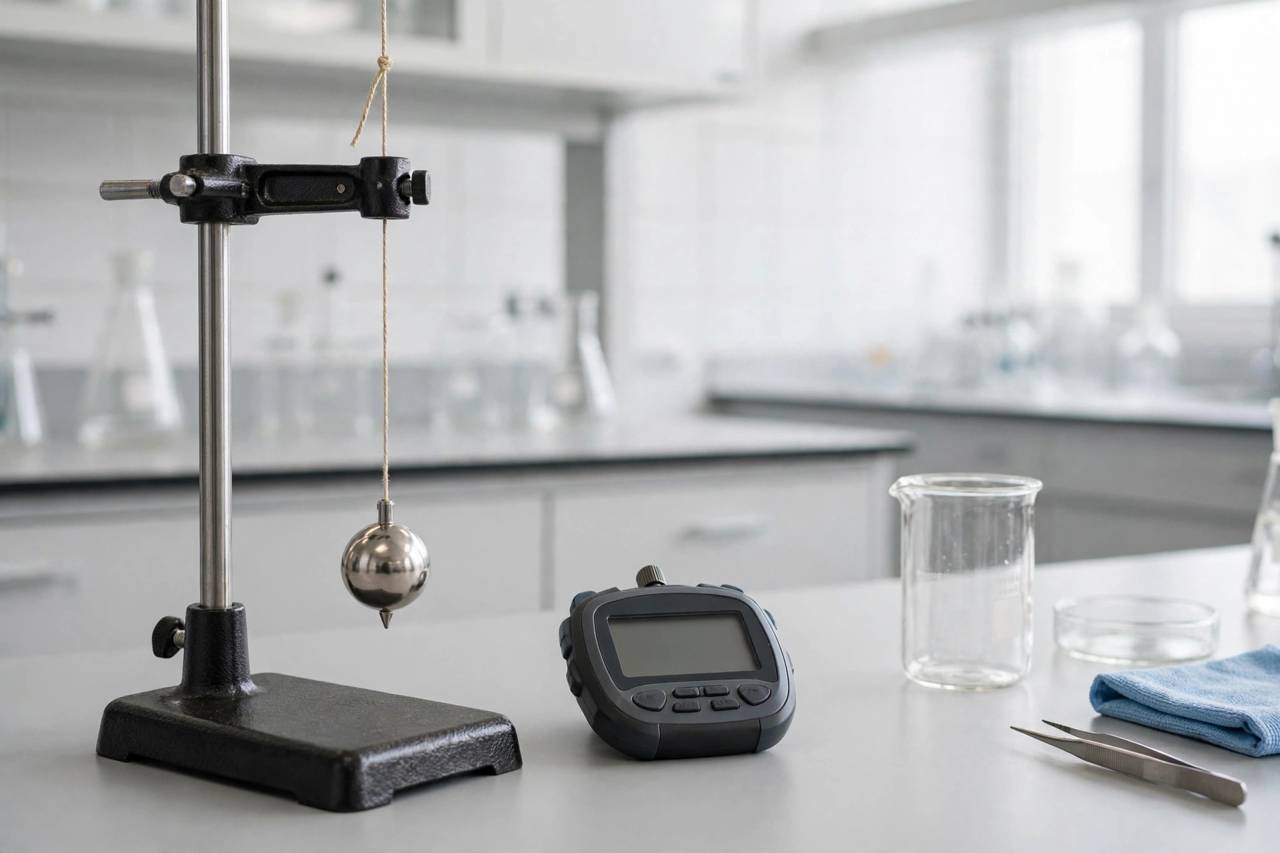
The methods section describes exactly what you did, in enough detail that a competent peer could replicate the experiment. For the pendulum: ‘A metal bob (mass 0.10 kg) was suspended from a fixed support by a light string. The string length was adjusted to five values between 0.20 m and 1.00 m, measured from pivot to the bob’s center. For each length, the bob was displaced 30° from vertical and released; the time for 20 complete oscillations was measured with a digital stopwatch (±0.01 s). Three trials were conducted at each length.’
Include: equipment with relevant specifications, quantities and settings, the procedure in chronological order, and how measurements were taken (including instrument precision). Do not include: results (‘the period was 1.42 s’ belongs in results), justifications (‘we chose 30° because…’ — brief rationale is fine, but save analysis for the discussion), or narrative filler about what you were thinking.
The number-one methods mistake is mixing in results or observations. ‘The solution turned blue, indicating the reaction completed’ — the color change is a result; the methods should only say the reagents were mixed and observed at timed intervals. Keep a bright line: methods = what was done, results = what happened. When you are studying for the exam on this material, rewriting your methods from memory is also an excellent test of whether you actually understood the procedure.
Results: Show the Data, Save the Interpretation
The results section presents your findings without interpreting them. That means: tables of processed data, graphs with labeled axes and captions, and text that walks the reader through what the figures show. Every figure needs a number, a descriptive caption, and a mention in the text: ‘As shown in Figure 1, period increased with string length.’ A graph nobody refers to might as well not exist.
Present processed data, not raw chaos. Your pendulum timing trials get averaged; the table shows mean period per length with uncertainties, not all fifteen stopwatch readings (those go in an appendix if required). Include uncertainties or error bars — a measurement without an uncertainty is, strictly speaking, incomplete. ‘T = 1.42 ± 0.03 s’ tells the reader how much to trust the number.
Example results text: ‘Mean period increased from 0.90 ± 0.02 s at 0.20 m to 2.01 ± 0.03 s at 1.00 m (Table 1). A plot of T² against length yielded a straight line (Figure 1) with gradient 4.02 ± 0.05 s²/m, from which g was calculated as 9.71 ± 0.12 m/s².’ Notice what is missing: no explanation of why, no ‘this proves the theory’ — that is the discussion’s job. Results describe; discussion interprets. Students who learn to take organized notes during labs find this section dramatically easier, because the data is already structured when writing starts.
Discussion and Conclusion: Where the Marks Live
The discussion is typically the most heavily weighted section, and it is where most students underperform. Its job: interpret the results, compare with theory and literature, explain discrepancies honestly, and evaluate the experiment. Start by restating the key finding and whether it supported your hypothesis. Then the crucial part — error analysis. Not ‘human error’ (which explains nothing and irritates every instructor on earth), but specific, quantified sources: ‘Timing reactions introduce an estimated ±0.2 s per measurement; air resistance systematically reduces the measured period at larger amplitudes; the string’s mass was neglected in the theoretical model.’
For each error source, say whether it is random or systematic and which direction it pushes the result. Then propose concrete improvements: ‘Using photogate timing would eliminate reaction-time error; conducting trials in a vacuum chamber is impractical, but restricting analysis to small amplitudes would reduce air-resistance effects.’ Specific beats vague every time.
The conclusion is short — one paragraph. Restate what was investigated, the main finding with its uncertainty, and whether the hypothesis held. No new data, no new analysis, no ‘in conclusion, science is important.’ End cleanly. Then the references: every source you cited in the introduction or discussion, formatted in whatever style your course requires — many science courses use APA, so a standard APA citation guide has you covered.

What Instructors Actually Grade (The Rubric Decoded)
If your instructor provides a rubric, it usually distributes marks something like this: abstract 10%, introduction 15%, methods 15%, results 20%, discussion 25%, conclusion and presentation 15%. The exact split varies, but the pattern is consistent — discussion and results together are nearly half the marks. Budget your writing time accordingly; do not spend three hours perfecting the introduction and forty-five minutes on the discussion.
Beyond the sections, instructors grade four cross-cutting qualities. Clarity: can a peer follow your logic? Precision: are quantities reported with units and uncertainties? Honesty: do you report the weird data point instead of quietly dropping it? (Dropping outliers without justification is a serious academic sin — discuss them instead.) And formatting: numbered figures, captioned tables, consistent units, tidy references.
- Do: label every axis with quantity and unit; report uncertainties; discuss limitations specifically; cite background theory; proofread for tense consistency.
- Do not: write ‘human error’ as an error source; include results in methods; present a figure you never mention; round intermediate calculations aggressively; submit without checking the rubric one final time.
Frequently Asked Questions
How long should a lab report be?
Follow your instructor’s specification first. Typical undergraduate reports run 1,500-3,000 words plus figures and tables. Quality matters more than length — a concise, well-analyzed 1,800-word report beats a padded 3,000-word one. Never pad with irrelevant background.
Can I use ‘I’ or ‘we’ in a lab report?
Most science courses prefer passive voice and third person in the methods (‘the solution was heated’), though some instructors now accept ‘we.’ Check your course guidelines. The abstract, results, and discussion are usually fine in impersonal style throughout — when in doubt, avoid first person.
What tense should each section be in?
Methods: past tense (what you did). Results: past tense (what you found). Introduction: present tense for established facts (‘the period of a pendulum depends on length’), past tense for specific cited studies. Discussion: mix — past for your findings, present for general interpretations.
How do I handle data that does not match the theory?
Report it honestly and discuss it — this is often where the best marks are. Explain possible reasons with specific error analysis, quantify where possible, and suggest improvements. Instructors respect honest analysis of messy data far more than suspiciously perfect results.
Do I put raw data in the report?
Usually in an appendix, not the main text. The results section shows processed data — means, graphs, calculated values. Raw trial-by-trial readings go in an appendix if your instructor requires them, or in your lab notebook. Never clutter results with unprocessed numbers.
The Bottom Line: Describe Honestly, Analyze Specifically
A strong lab report is not about perfect data — it is about honest description and specific analysis. Methods that someone could replicate, results presented cleanly with uncertainties, and a discussion that names real error sources and proposes real improvements. That is what instructors reward.
Write the sections in this order for sanity: methods first (while the procedure is fresh), then results, then discussion, then introduction, and the abstract dead last. Your future lab reports will thank you.