How to Reduce Screen Time Before Bed: 8 Simple Ways

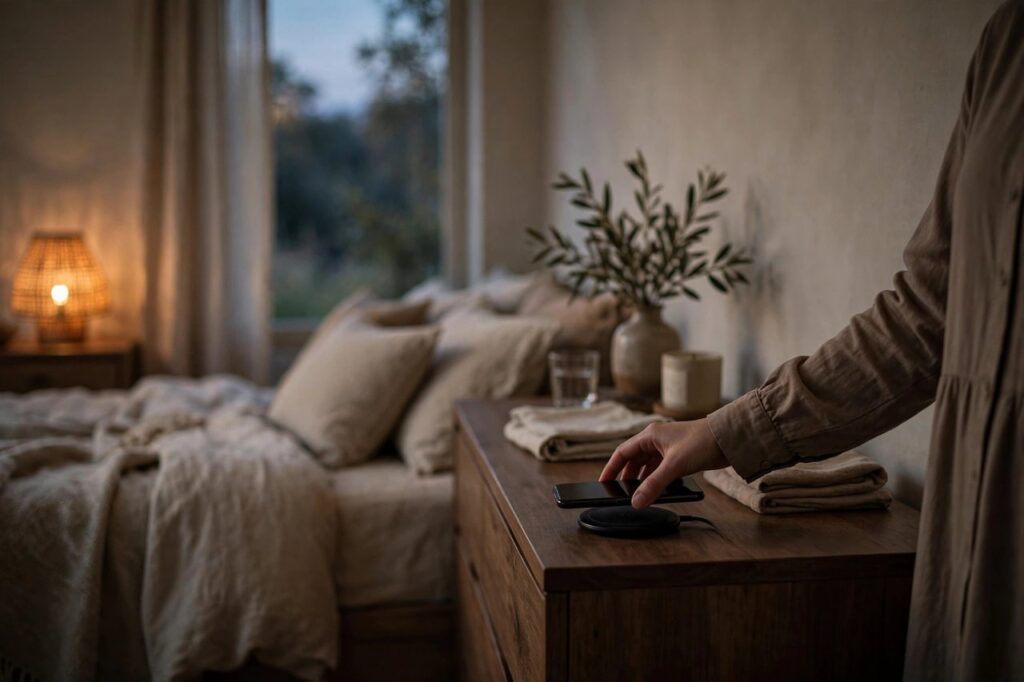
You already know the scroll is costing you sleep. What you might not know is how precisely researchers have now measured it — and that the fix is less about willpower than about systems. This guide gives you both: the science of why screens wreck sleep, and eight practical, low-effort ways to build a calmer wind-down.
No guilt, no digital-detox extremes. Just a set of small environmental changes that make the right choice the easy choice.
Why Screens Wreck Sleep: Melatonin and Mental Stimulation
Two mechanisms, both working against you. First, the light: screen light — especially the blue wavelengths — suppresses melatonin, the hormone that signals to your body that it’s nighttime. Less melatonin means your internal clock shifts later, so you feel alert when you should feel drowsy. It’s not just brightness; it’s a chemical message telling your brain the sun hasn’t set.
Second, and just as important: stimulation. As one sleep physician puts it, screens stimulate more than they relax. The content is engineered to hold your attention — the next video, the next thread, the next notification. Your brain can’t wind down while it’s processing novelty, outrage, or even just the low-grade decision-making of choosing what to watch next. Light delays the sleep signal; stimulation keeps the mind running past it. Together, they’re why “just five more minutes” reliably becomes forty.
The 2025 Norway Study: 59% More Insomnia, 24 Minutes Less Sleep Per Hour
This is the freshest data on the question, and it’s striking. A 2025 Norwegian study surveyed more than 45,000 adults aged 18–28 about their in-bed screen habits — one of the largest samples ever collected on this topic.
The finding: each additional hour of screen time in bed was associated with a 59% higher risk of insomnia symptoms — and 24 minutes less sleep per night. Not per week. Per night, per extra hour. Two hours of scrolling doesn’t just feel bad the next morning; the data says it costs you nearly fifty minutes of sleep and pushes your insomnia risk up sharply.
What makes this study hard to dismiss is the design: it measured screen time specifically in bed, not total daily screen time, and the dose-response pattern held. More scrolling, worse sleep, in a clean staircase. If you’ve been telling yourself your bedtime scrolling is harmless because you’re “just relaxing,” this is the number to sit with: 59%.
The Hidden Trap: Phone as Alarm Clock and Mid-Night Scrolling
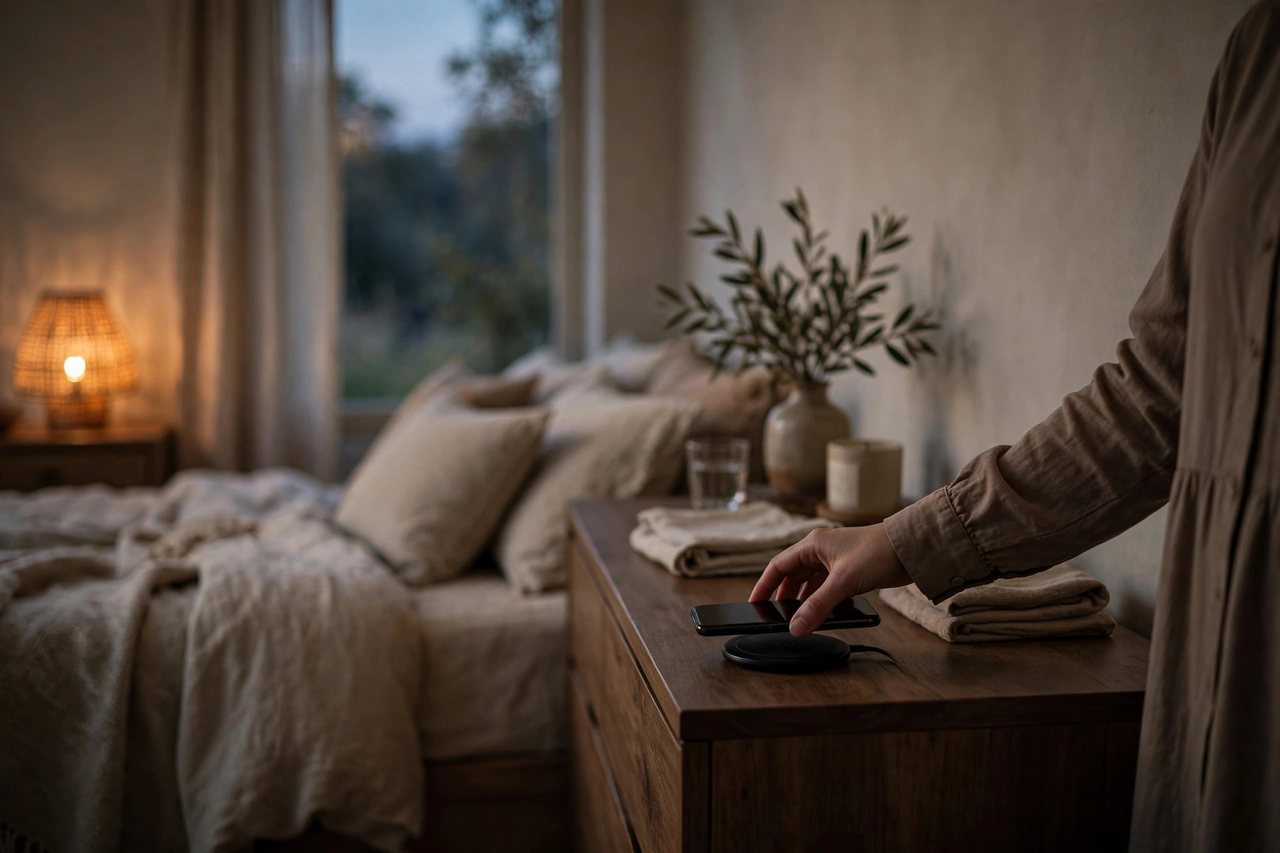
Here’s the trap most sleep advice misses: the phone isn’t just a bedtime problem, it’s a bedroom problem. If your phone is your alarm clock, it lives on your nightstand — inches from your hand, all night, glowing with every notification. The last thing you touch before sleep and the first thing you touch on waking is the single most stimulating object you own.
The mid-night version is worse. Waking briefly during the night is completely normal — most people surface for 10–15 minutes and drift back off without ever fully waking. But if you grab your phone in that window, the light and stimulation reset your arousal completely. What would have been a 10–15 minute half-waking stretches into 30–45 minutes of full alertness. You’ve turned a normal sleep cycle into an hour-long detour, and you’ll blame “bad sleep” in the morning instead of the phone.
The fix for both is the same, and it’s structural: the phone charges outside the bedroom. Not on silent — outside. More on that below.
The Digital Curfew: 30–60 Minutes, and How to Enforce It
The expert guidance converges on a clear window: avoid screens for 30 to 60 minutes before bed. One sleep specialist recommends a full 30–60 minutes of screen-free wind-down; another sets the minimum at 30 minutes with no devices. Pick the end of the range you can actually sustain — 60 minutes is ideal, 30 is the floor.
A curfew only works if it’s automatic, so don’t rely on willpower at 10:45 PM when your willpower is gone. Set a daily alarm labeled “screens off” for 60 minutes before your target bedtime. When it rings, the phone goes to its charger — outside the bedroom — and the evening’s replacement ritual begins. Tell the people who text you late that you’re offline after that hour; most will respect it, and the rest can wait until morning.
If 60 minutes feels impossible, start at 20 and add ten each week. The habit matters more than the starting line. And pair it with our ideal night routine guide to fill the new screen-free time with something better.
Charge the Phone Outside the Bedroom (the “Real Silent Mode”)
This is the single highest-leverage change on this list. Not Do Not Disturb. Not grayscale. Not the phone face-down on the nightstand. The phone, charging, in another room.
Why it works: it removes the decision. Every other strategy requires you to resist the phone while it’s within arm’s reach at your weakest moment. Charging outside the bedroom makes scrolling require getting up, walking to another room, and standing there — which nobody does at 2 AM. It kills the bedtime scroll, the alarm-clock trap, and the mid-night grab in one move.
“But it’s my alarm!” Buy an alarm clock. A basic one costs less than a takeout meal, it’s more reliable than a phone (no dead battery, no update restarting at 3 AM), and it can’t show you notifications. This is the move that makes all the other moves easy. If you do nothing else from this guide, do this — and if phone habits run deeper than bedtime, our phone addiction guide tackles the daytime side.
Replacement Rituals: Book, Warm Shower, Stretching, Journaling, Tea
You can’t just remove the scroll; you have to replace it. An empty hour before bed will fill itself with the phone unless you give it something better. Pick two or three of these and rotate:
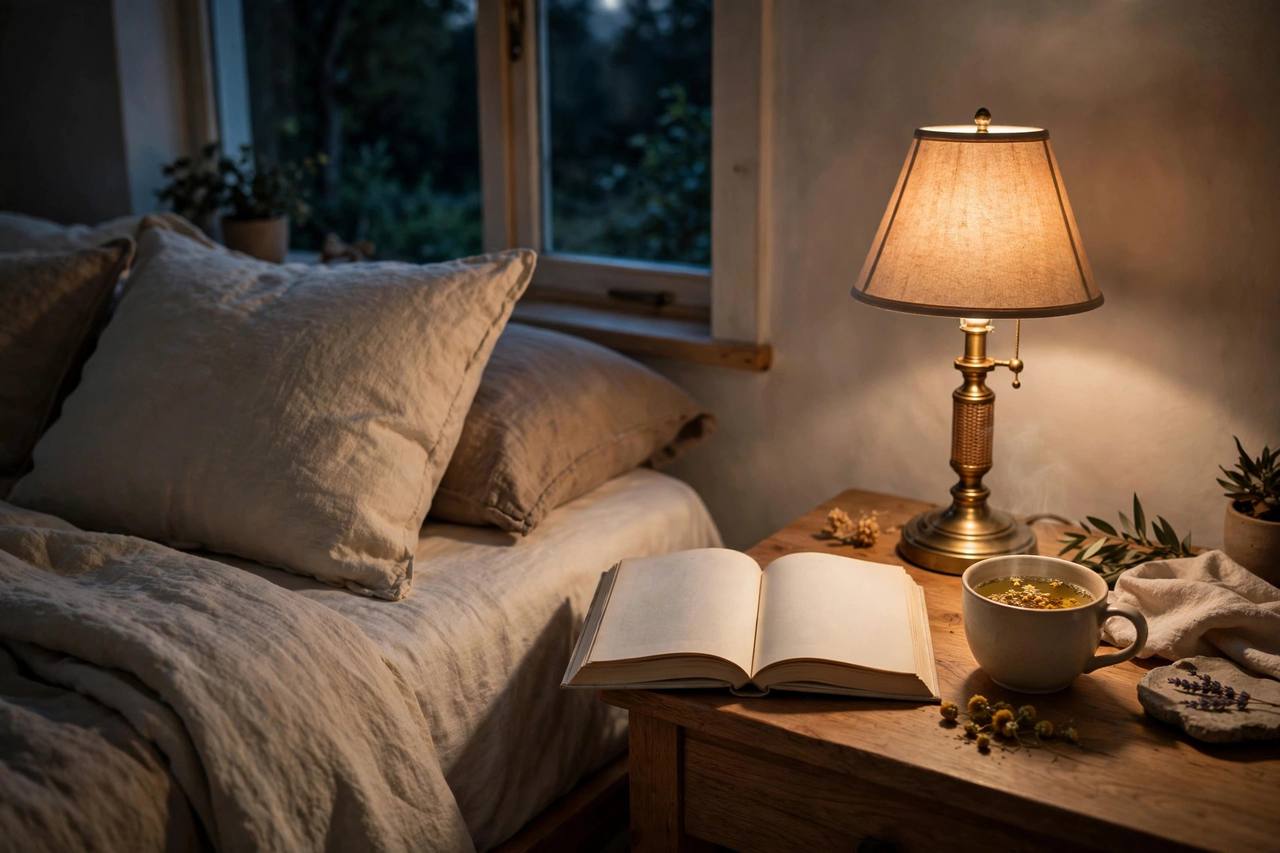
A physical book. Not an e-reader with notifications — paper, or a dedicated e-ink reader with Wi-Fi off. Reading is the classic wind-down because it’s absorbing without being stimulating; it gives the mind something to do while the body powers down.
A warm shower. The drop in body temperature afterward mimics the natural cooling that triggers sleepiness. Ten minutes, warm not scalding, about an hour before bed.
Gentle stretching. Five to ten minutes of slow stretches — neck rolls, hamstrings, child’s pose. Nothing vigorous; you’re signaling safety to your nervous system, not training.
Journaling. A brain dump of tomorrow’s worries onto paper. The research logic is simple: your mind loops on unfinished business, and writing it down tells it the business is captured. Three lines are enough.
Herbal tea. Chamomile, valerian, or just something warm and caffeine-free. The ritual matters more than the herb — it’s a sensory signal that the day is over.
The key: same rituals, same order, most nights. Repetition turns them into sleep cues — after a few weeks, the tea-and-book sequence starts making you drowsy on its own.
Room Setup: Cool, Dark, and Warm Lighting
Your bedroom should feel like a cave: cool, dark, and quiet. The screen-free hour works best when the environment backs it up.
Cool: Aim for a slightly cool room — your core body temperature needs to drop for sleep onset, and a warm room fights that. If you can’t control the thermostat precisely, lighter bedding and a fan do most of the work.
Dark: Blackout curtains or a sleep mask. Even small light sources — the LED on a charger, hallway light under the door — fragment sleep more than people expect. Do a lights-out audit: lie in bed and count every glowing dot, then kill them.
Warm lighting: For the wind-down hour itself, switch to warm, dim lamps instead of overhead brights. Bright white light in the evening is a weaker version of the screen problem — it tells your brain it’s still daytime. A bedside lamp with a warm bulb sets the right signal while you read or journal.
None of this requires a renovation. A sleep mask, a ten-dollar warm bulb, and moving the chargers out of the room covers most of it. Small bedroom? Our cozy bedroom guide has more ideas that work in tight spaces.
Night Shift and Blue-Light Filters: Helpful But Not a Free Pass
Phone makers now ship night modes that warm your screen’s color temperature after sunset. Do they help? A little — reducing blue light does reduce melatonin suppression compared to a full-brightness white screen. If you’re going to look at a screen in the evening, warmer is genuinely better than cooler.
But here’s the honest caveat: it’s not a free pass. Remember the two mechanisms — light is only half the problem. Night Shift does nothing about stimulation: the content is still engineered to hook you, the decisions still keep your brain busy, and the “just one more video” loop doesn’t care what color temperature it’s rendered in. A warm-tinted doomscroll at midnight is still a doomscroll.
Use the filter — set it to run automatically from sunset — but treat it as harm reduction, not permission. The curfew and the out-of-bedroom charger are doing the real work; Night Shift is just the seatbelt.
Do Not Disturb and Notification Hygiene
Even with the phone outside the bedroom, evening notifications deserve a system — because every buzz during your wind-down hour is a tug back toward the screen.
Do Not Disturb on schedule: Set it to activate automatically at your curfew time every night. Allow calls from favorites only (the genuine-emergency channel), and silence everything else. Scheduled DND means you never have to remember.
Notification hygiene: Go through your apps once and turn off every non-essential notification — the shopping apps, the social “someone liked” pings, the news alerts. Ask of each one: “Would I want this waking my wind-down?” If not, it goes. Most people can delete two-thirds of their notifications without missing anything that mattered.
The home screen: Move social and news apps off your home screen into a folder on page two. Out of sight genuinely reduces pickup frequency — it’s a tiny friction, but tiny frictions compound across dozens of evening decision points.
A Sample 60-Minute Wind-Down Protocol
Put it all together. Here’s what the full hour looks like — adjust the times to your schedule, but keep the sequence:
T-60 (screens off): The alarm rings. Phone goes to its charger outside the bedroom. DND is already on by schedule. Lamps switch to warm and dim.
T-50 (warm shower): Ten minutes, warm water. Let the day wash off literally and mentally.
T-40 (tea + journal): Make the herbal tea. While it cools, brain-dump tomorrow: three lines, whatever’s looping.
T-30 (stretch): Ten slow minutes. Neck, shoulders, hamstrings, child’s pose. Breathe slowly.
T-20 (read): Physical book in bed, warm lamplight. No “one more chapter” guilt — but notice when your eyes get heavy.
T-0 (lights out): Lamp off. Room cool, dark, quiet. Phone still in the other room, where it belongs.
The first week feels deliberate. By week three, it’s just what evenings are. And the mornings — waking up without reaching for a screen, without the 2 AM scroll hangover — are the reward that keeps the system running. For the other end of the night, our wake up early consistently guide picks up where this one leaves off.

Frequently Asked Questions
How long before bed should I stop using my phone?
Avoid screens for 30 to 60 minutes before bed — 60 minutes is ideal, 30 is the floor. Set a daily “screens off” alarm, and when it rings, put the phone on its charger outside the bedroom. Don’t rely on willpower at 10:45 PM.
Does Night Shift really protect your sleep?
Partly. Warming your screen reduces blue-light melatonin suppression, but it does nothing about mental stimulation — the content still keeps your brain busy. Treat Night Shift as harm reduction, not a free pass; the curfew and out-of-bedroom charging do the real work.
Why do I sleep worse after scrolling in bed?
Two mechanisms: screen light suppresses melatonin (delaying your sleep signal), and the content stimulates your brain when it should be winding down. A 2025 Norwegian study of 45,000+ adults found each extra hour of in-bed scrolling linked to 59% higher insomnia risk and 24 minutes less sleep.
What should I do instead of scrolling before bed?
Replace the scroll with a ritual: a physical book, a warm shower, 10 minutes of gentle stretching, journaling tomorrow’s worries, or herbal tea. Pick two or three, do them in the same order nightly, and they become sleep cues within a few weeks.
Is it bad to use my phone as an alarm clock?
Yes — it keeps the most stimulating object you own inches from your hand all night. Charge the phone outside the bedroom and buy a basic alarm clock instead. It removes the bedtime scroll, the mid-night grab, and the morning notification avalanche in one move.
What if I wake up in the middle of the night — can I check my phone?
Don’t. Brief mid-night waking (10–15 minutes) is normal and you’ll drift back off. Grabbing your phone resets your arousal and stretches it to 30–45 minutes of full alertness. Keep the phone in another room so the choice is made for you.