How to Play Checkers for Beginners: Rules, Moves & Easy Wins

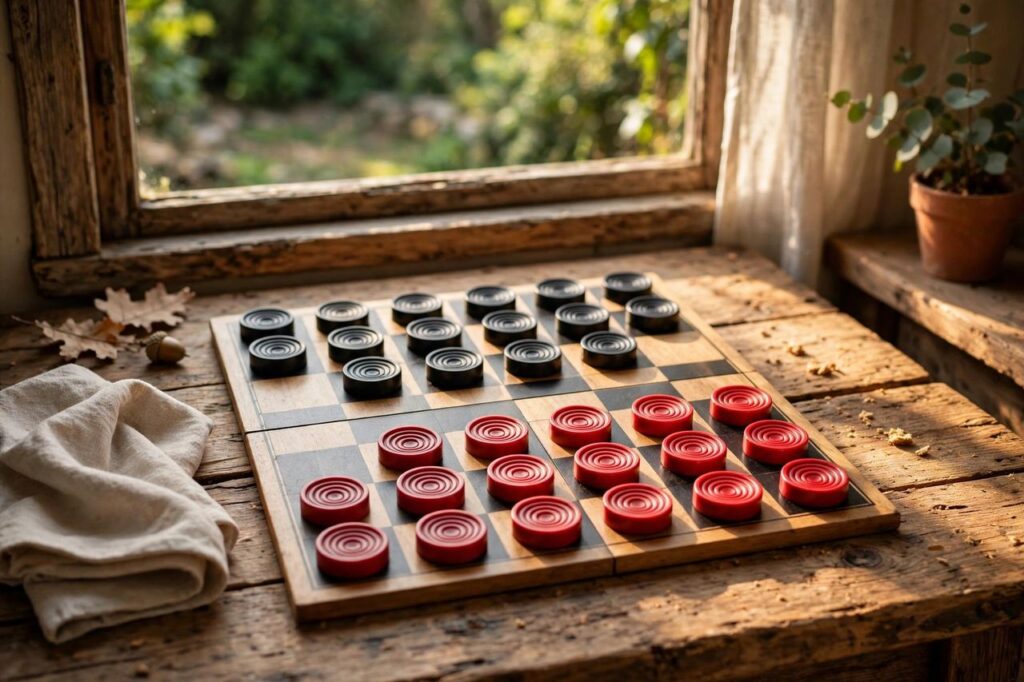
Learning how to play checkers for beginners takes about five minutes, but don’t let the simplicity fool you: underneath those red and black pieces is a real strategy game with traps, sacrifices, and endgames that have been studied for centuries. Checkers (called draughts in much of the world) is one of the oldest board games still played, and it’s the perfect first strategy game because the rules fit on an index card.
This guide covers the board setup, every legal move, how capturing works, what happens when you get a king, and the beginner strategies that will have you beating casual players fast.
Checkers Setup: The Board and Pieces
Checkers is played on an 8×8 board, the same grid as chess, but only the dark squares are used. Each player gets 12 pieces, and they start on the three rows closest to them, placed only on dark squares. One player uses the dark pieces, the other the light pieces (traditionally black and red).
One setup detail beginners always ask about: the board must be oriented so that each player has a dark square in their near-right corner. Remember “dark on the right” and you’ll never set it up wrong.
How to Play Checkers: The Basic Rules
The player with the dark pieces moves first. On your turn, you move one piece. That’s the whole turn structure, but the movement rules have important details:
- Regular pieces move diagonally forward only, one dark square at a time. They cannot move backward or sideways.
- Only move to empty squares. You can’t stack pieces or share a square.
- If you can capture, you must capture. This is the rule beginners miss most. Capturing is not optional in standard checkers rules.
- The game ends when one player captures all opposing pieces, or when the opponent has no legal moves left.
How to Play Checkers for Beginners: Capturing (Jumping) Rules
To capture, your piece jumps diagonally over an adjacent enemy piece into the empty square directly behind it. The jumped piece is removed from the board immediately. If your piece lands in a position to jump again, you must keep jumping in the same turn, this is called a multi-jump, and it can clear half the board in one spectacular move.
Here’s the critical part: captures are mandatory. If any of your pieces can capture on your turn, you must make a capture. If multiple captures are available, most casual rule sets let you choose which one, but tournament rules (and many digital versions) require you to take the capture that jumps the most pieces. Agree on this with your opponent before the game starts.
How to Get a King in Checkers
When one of your pieces reaches the farthest row of the board (your opponent’s back rank), it becomes a king. Mark it by stacking a second captured piece on top of it. Kings are the power pieces of checkers: unlike regular pieces, kings can move and capture both forward and backward diagonally.
Your turn ends immediately when a piece is crowned, even if it lands in a position where it could keep jumping. The new king starts capturing on your next turn. Because kings are so strong, the midgame of checkers is largely a race to king your pieces while stopping your opponent from kinging theirs.
Beginner Strategy: How to Win at Checkers
Checkers rewards a few simple principles that beginners can apply immediately:
- Control the center. Pieces in the middle of the board have more movement options and more jumping opportunities than pieces stuck on the edges.
- Keep pieces in pairs. Two pieces supporting each other diagonally can’t both be jumped safely. Lone pieces are targets.
- Don’t rush to the king row. Advancing a single piece deep into enemy territory usually gets it trapped and captured. Advance with support.
- Count before you jump. Since captures are mandatory, opponents will bait you: they offer a piece so your forced jump lands you in a double-jump trap. Always check where your piece lands.
- Sacrifice deliberately. Sometimes giving up a piece to open a multi-jump that takes two or three enemy pieces is the winning move. Forced captures make sacrifices powerful.
- Protect your back rank. In the endgame, an empty back rank is an invitation. Keep a piece or two home to block cheap kingings.
Common Beginner Mistakes
The classic beginner error is forgetting that captures are mandatory and moving a different piece instead; in casual play your opponent will (correctly) call you on it. The second is moving pieces to the board’s edge “for safety,” which actually limits their mobility. The third is trading pieces evenly when ahead: if you’re up in material, trades favor you, so force them.
Checkers Variations Worth Knowing
International draughts is played on a 10×10 board with 20 pieces per side and flying kings that move any distance diagonally; it’s the competitive standard in much of Europe. Suicide checkers (also called giveaway) flips the goal: you win by losing all your pieces first. And Chinese checkers, despite the name, is an entirely different game with no relation to standard checkers.
Checkers Openings and Tactics Every Beginner Should Know
Checkers has studied openings just like chess. The most famous is the “Old Faithful” opening (11-15 for Black), a solid, flexible start that beginners should learn first. A few tactical ideas carry you far: the two-for-one shot, where you sacrifice one piece to capture two on the return jump, is the most common winning tactic in casual games. The “bridge”, keeping two pieces side by side so neither can be jumped safely, is your defensive backbone. And in the endgame, the opposition: with kings, controlling the squares your opponent’s king wants decides everything. You don’t need to memorize lines; understanding these three ideas puts you ahead of 90% of casual players.
Checkers vs. Chess: Which Should You Learn?
Beginners often ask, and the honest answer is both, for different reasons. Checkers teaches tactical calculation: forced captures mean you must think several moves ahead, every turn. Chess teaches strategic planning: long-term structure with more piece variety. Checkers games take 15-30 minutes; chess games can run hours. Checkers is solved (a perfect game is a draw, proven by computer analysis in 2007); chess remains gloriously unsolved. Start with checkers for the fundamentals of thinking ahead, then try chess when you want deeper waters. Neither is “better”, they’re different workouts for the same brain.
Legendary Checkers Players and the Machine That Solved the Game
Checkers has its own legends. Marion Tinsley, a mathematics professor, was the greatest checkers player in history: across a 45-year career he lost a mere handful of tournament games, and went nearly a decade at his peak without a single loss. His 1992 match against the Chinook computer program was a landmark in AI history; Tinsley led when illness forced him to withdraw, and Chinook later went on to prove in 2007 that perfect checkers play leads to a draw. Checkers is officially “solved”, one of the most complex games ever to earn that distinction.
The lesson for beginners: the game you’re learning has genuine depth. Tinsley’s dominance came from endgame precision and tactical vision, the same skills you’re building when you practice counting jumps and protecting your back rank.
Where to Play Checkers Online
Track your progress, not just your wins. Most platforms show your rating over time; watching it climb from beginner to intermediate is the most motivating feedback loop in gaming. And when you lose, use the analysis board: step through the game, find the move where it went wrong, and you’ll rarely make that mistake twice. That’s how casual players become strong ones.
The best way to improve fast is volume, and online play gives you instant opponents. Lidraughts is the free, open-source home of serious draughts with strong players and analysis tools. Checkers apps on mobile offer quick casual games with adjustable AI difficulty, perfect for practicing tactics on the bus. Board Game Arena includes checkers variants with a friendly community. Start against the AI at a level where you win about half your games; that’s the sweet spot where every game teaches you something.
Two Checkers Puzzles to Sharpen Your Tactics
Try these classic positions against a friend or app. Puzzle 1, the sacrifice: you have two pieces that can each capture one enemy piece, but one capture lands your piece where it will be jumped next turn. The solution: take the capture that looks worse, because it opens a double jump on the following move. Forced captures mean your opponent can’t decline the bait. Puzzle 2, the blockade: in a king endgame, position your king so the enemy king has only two squares, then mirror its moves until it runs out. These little exercises train the core checkers skill: thinking not about this jump, but about where the jump leaves you.
Frequently Asked Questions
Can you jump more than once in checkers?
Yes. If your piece lands from a jump in a position to make another jump, you must continue jumping in the same turn. These multi-jumps are mandatory and can capture several pieces at once.
Can a regular piece jump a king?
Yes. Kings capture and are captured by the same jumping rules as regular pieces. A king’s advantage is movement (forward and backward), not immunity.
Do you have to jump if you can in checkers?
In standard rules, yes: captures are mandatory. If you have a legal capture available, you must take it. Always agree on the exact variant with your opponent before playing.
What happens when a checker reaches the other side?
It becomes a king. Crown it by stacking another piece on top, and it gains the ability to move and capture diagonally in both directions. Your turn ends immediately upon crowning.
Can checkers end in a draw?
Yes, though it’s rare in casual play. Draws happen when neither player can force a win, such as two lone kings chasing each other forever. Tournament rules have specific draw conditions; casual players usually just agree to call it.
Is checkers good for kids?
It’s one of the best first strategy games for kids. The rules are simple enough for a six-year-old to learn, but the game teaches planning, consequences, and patience. Games are short, usually 15 to 30 minutes.