How to Improve Handwriting for Adults: A 10-Minute Daily System

Nobody teaches adults how to write by hand. You learned in elementary school, your handwriting froze somewhere around age fourteen, and then keyboards took over — until the day you had to write something by hand in front of other people and realized your signature looks like a seismograph reading. If you want to know how to improve handwriting for adults, the good news is that it is entirely trainable. Your hand did not forget how to write neatly; it just never got a second round of coaching.
This guide gives you that coaching: a 10-minute daily drill system built on basic strokes, guidance on worksheets made for adult hands, the slow-down rule that fixes most problems by itself, and practical advice on pens and paper. Ten focused minutes a day, and most adults see real change in three to four weeks. If you are starting from even earlier — a child learning letter formation — the same stroke-first principles apply, and our guide to improving handwriting covers the foundations.
Why Adult Handwriting Gets Worse (and Why It Is Fixable)
Adult handwriting deteriorates for boring, fixable reasons. First, disuse: most adults write by hand for minutes a day, so the fine motor patterns go rusty. Second, speed: we write fast and carelessly — notes, signatures, forms — and speed without form practice just rehearses bad habits. Third, grip and posture: the death-grip most adults use creates tension that makes smooth letterforms physically impossible.
The encouraging part: handwriting is a motor skill, and motor skills respond to deliberate practice at any age. Studies of motor learning consistently show that short, focused, daily practice outperforms occasional long sessions — which is exactly why this system is ten minutes, not an hour. You are not trying to become a calligrapher. You are rebuilding clean, legible, comfortable everyday writing.
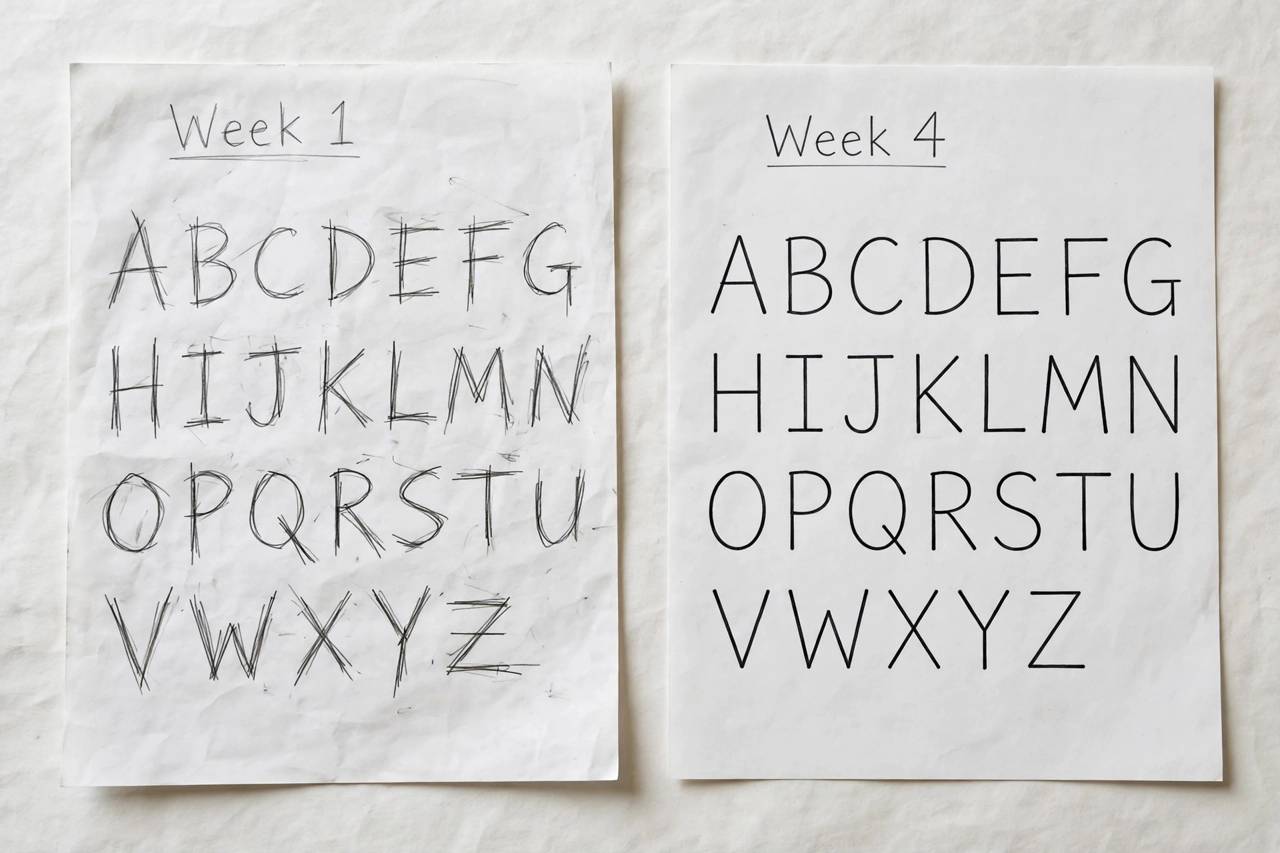
Set a realistic target before you start. ‘Beautiful copperplate script’ is a months-long project; ‘clear, consistent, professional-looking everyday handwriting’ is a weeks-long one. Aim for the second. Write a baseline sample today — the alphabet, a few sentences — date it, and put it away. In a month, the comparison will be your best motivation.
The 10-Minute Daily Drill System
Every session follows the same structure: 3 minutes of basic strokes, 5 minutes of letter practice, 2 minutes of real writing. Same order, every day. The routine matters as much as the content — you want your hand to warm up the way an athlete warms up.
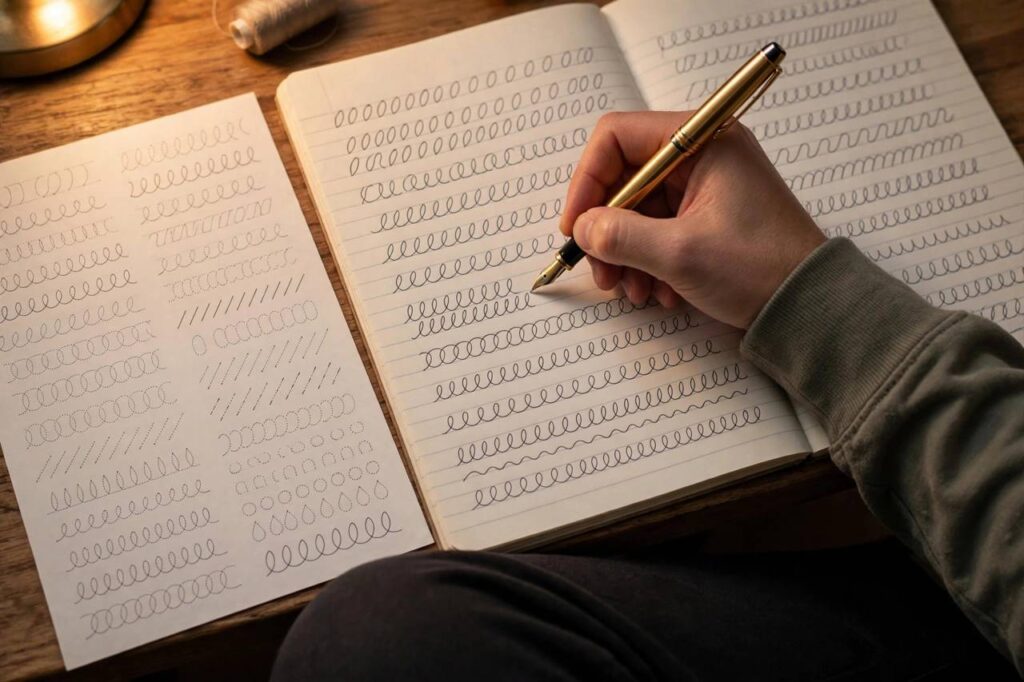
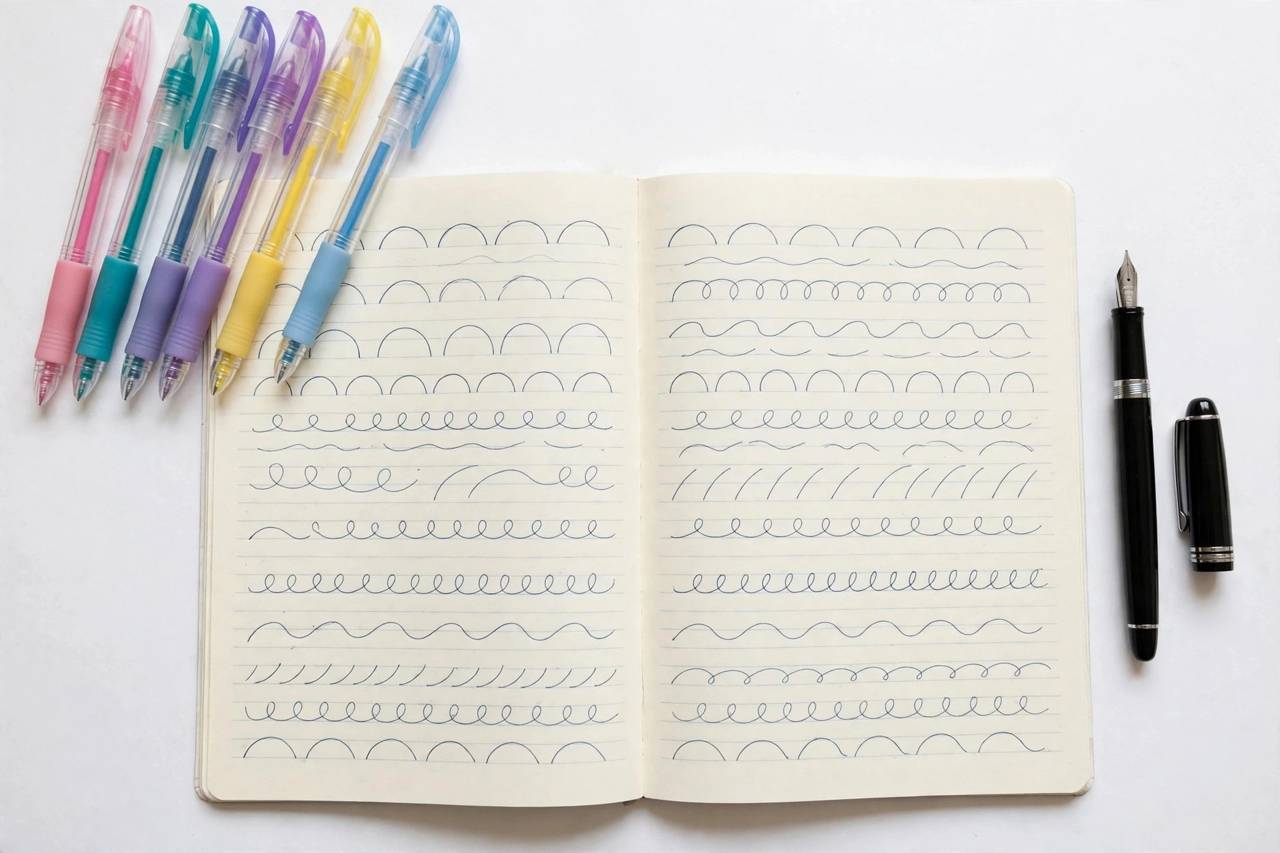
Minutes 1-3 — basic strokes. All handwriting is built from a handful of shapes: vertical lines, horizontal lines, circles, curves, and slanted connectors. Fill lines with each: rows of ‘lllll’, rows of ‘ooooo’, rows of connected humps ‘mmmmm’, rows of ‘eeeee’. Focus on consistency — same height, same slant, same spacing. Boring? Extremely. Effective? Completely. These strokes are the scales before the sonata.
Minutes 4-8 — letter practice. Work through the alphabet in groups by shape family, not A-to-Z order. Tall letters (b, d, f, h, k, l, t), short letters (a, c, e, m, n, o, r, s, u, v, w, x, z), and descenders (g, j, p, q, y). Practice one family per day, writing each letter slowly five to ten times, watching for your personal problem letters. Everyone has three or four letters that fall apart — usually r, s, k, or the a/o/e family. Those get extra reps.
Minutes 9-10 — real writing. Copy a paragraph from a book, or write tomorrow’s to-do list, applying what you practiced at normal speed. This transfer step is critical: drills without application stay in the drill. End each session by circling your best letter and your worst — awareness is the mechanism of improvement.
How to Improve Handwriting for Adults: The Slow-Down Rule
If you take one thing from this guide, take this: slow down. The vast majority of illegible adult handwriting is just fast handwriting. When you write at speed, your brain abbreviates — loops collapse, letters merge, spacing vanishes. Most adults can produce perfectly legible writing simply by reducing speed by about a third. Try it right now: write a sentence at your normal speed, then rewrite it deliberately slower. The difference is usually dramatic.
The drill version: practice everything at ‘teaching speed’ — the speed at which you could explain each stroke as you make it. Speed returns naturally as the forms become automatic, usually within a few weeks. Rushing the process just rehearses the old sloppy patterns faster. There is an old martial arts saying that applies perfectly: slow is smooth, smooth is fast.
Apply the rule strategically in real life. You do not need teaching speed for grocery lists. But for anything another human reads — meeting notes you will share, cards, forms, whiteboard writing — consciously drop a gear. Legibility is a courtesy, and people notice.
Worksheets for Adults: What to Look For
Adult learners need different worksheets than children. Kids’ worksheets have huge lines, cartoon characters, and letter-tracing that feels patronizing at thirty. Look for worksheets with standard ruled spacing (or slightly wider), minimal decoration, and practice content that is actually words and sentences — not just letter repetition.
Good sources: printable practice sheets from handwriting improvement books, Spencerian-style drill sheets (the stroke exercises transfer even if you do not learn the full script), and simple lined paper used deliberately. Honestly, a quality notebook and a printed alphabet exemplar taped inside the cover beats most commercial workbooks. The exemplar — a model of the letterforms you are aiming for — is the key tool. Print one in a style you like, and keep it visible during every session.
Structure your worksheet time by weakness, not by alphabet. After a week of drills, you will know your problem letters. Spend 70 percent of practice time on your worst 30 percent of letters. Practicing letters you already write well feels productive and accomplishes nothing. The ugly letters are where the points are.
Pens and Paper: Equipment Matters More Than You Think
You cannot evaluate your handwriting with a dying ballpoint on printer paper. Equipment will not fix bad form, but bad equipment hides good form — scratchy pens create tension, and slick paper makes ink blob.
Pens: switch to something smooth. Gel pens (0.5mm or 0.7mm) are the easiest upgrade — they glide with minimal pressure, which reduces the death-grip automatically. Fountain pens are the classic handwriting-improvement tool because they punish pressing hard (the nib digs in) and reward light, consistent pressure; an inexpensive starter fountain pen is a revelation for heavy-handed writers. Avoid cheap ballpoints that require pressure — they are handwriting’s worst enemy.
Paper: use paper with some tooth — standard notebook or printer paper is fine, glossy paper is not. Lined or grid paper helps enormously while retraining: lines enforce consistent letter height, which is half the battle. French-ruled (Séyès) paper, with its extra horizontal lines, is beloved by handwriting improvers for training x-height consistency. And write at a proper desk when practicing — hunched over a coffee table with the paper sliding around is not practice, it is suffering.
Posture, Grip, and the Physical Side
Quick physical audit, because no drill overcomes bad mechanics. Sit with both feet flat, paper angled slightly (right-handers: top tilted left; left-handers: top tilted right), and your non-writing hand anchoring the page. Your writing arm should move from the shoulder for long strokes, not just the fingers — finger-only writing is cramped by design.
Grip: hold the pen about an inch from the tip, with a relaxed tripod grip (thumb and index finger pinching, middle finger supporting). If your knuckles are white, you are pressing too hard — consciously relax every few minutes during practice until a light grip becomes the default. Tension is the enemy of smooth lines; most adults press three times harder than necessary.
Left-handers: you have extra challenges (smudging, hooked wrist), but the same system works. Angle the paper more steeply, position your hand below the writing line to avoid dragging through wet ink, and consider faster-drying gel or ballpoint inks. Left-handed handwriting improvers often benefit most from the slow-down rule, since smudge-avoidance rewards deliberate pacing.
Frequently Asked Questions
How long does it take to improve handwriting as an adult?
With 10 focused minutes daily, most adults see noticeable improvement in 3-4 weeks and substantial change in 2-3 months. Consistency matters far more than session length — ten minutes daily beats an hour on Sundays. Your baseline sample will prove it to you.
Is it better to learn cursive or improve print handwriting?
Improve whichever you actually use. For most adults, that is print (manuscript). Cursive is worth learning only if you want it for its own sake — it is not inherently faster or better once print is well-formed. Do not try to fix both simultaneously.
Can bad handwriting be a sign of something medical?
Occasionally. A sudden deterioration in handwriting in adulthood can rarely signal neurological issues, and persistent difficulty may relate to dysgraphia or motor conditions. If your handwriting changed abruptly or you have other symptoms, see a doctor. Gradual messiness from disuse is normal and trainable.
Do I need special worksheets or can I use regular paper?
Regular lined paper plus a printed alphabet exemplar works perfectly. Worksheets help mainly by providing structured drills — but you can create the same drills yourself with the stroke and letter-family system in this guide. Spend money on a good pen before a workbook.
Will improving my handwriting help my signature?
Indirectly. Signature style is separate from everyday handwriting, but the underlying skills — smooth strokes, consistent pressure, confidence — transfer. Once your everyday writing improves, redesign your signature deliberately: practice a specific version until it is automatic, rather than letting it evolve by accident.
The Bottom Line: Ten Minutes, Every Day, Slower Than You Think
Adult handwriting improves the same way every motor skill improves: short daily practice, basic strokes before letters, weakest letters first, and — above all — slower than feels necessary. Ten minutes a day with a smooth pen on lined paper will do more than any app or weekend workshop.
Write your baseline sample today, tape your exemplar inside your notebook, and start tomorrow morning. In a month, compare. The seismograph will be gone.