How to Cut Onions Without Crying: 8 Tricks That Actually Work


I have cried over onions in front of dinner guests, over a cutting board at 7 a.m., and once, memorably, while filming a cooking video where I had to pretend everything was fine while tears streamed down my face. So when I tell you I have tested every method for how to cut onions without crying, understand this is personal. Some tricks are folklore. Some are chemistry. One of them — the one involving your knife — matters more than all the goggles and candles combined. Let us start with why onions make us cry in the first place, because the fix makes much more sense once you know the cause.
Why Onions Make You Cry: The 30-Second Science
An onion is a set of layered chemical compartments. When your knife breaks the cell walls, enzymes and sulfur compounds that were kept separate suddenly mix, and the reaction produces a gas with an intimidating name: syn-propanethial-S-oxide. That gas drifts up, dissolves in the moisture of your eyes, and forms a mild sulfuric acid. Your eyes, quite reasonably, flood with tears to wash it away.
Every effective trick works by interfering with one of three things: the amount of gas released, the path the gas takes to your eyes, or your eyes’ exposure to it. Keep that framework in mind and you can judge any new trick you hear in seconds.
Trick 1: Use a Sharper Knife (The One That Matters Most)
This is the heavyweight champion, and it is not close. A sharp knife slices cleanly through cell walls, rupturing far fewer cells than a dull knife that crushes and tears its way through. Fewer ruptured cells means less gas, which means fewer tears. In my testing, switching from a dull knife to a freshly sharpened one cut my tearing by more than half — more than any other single change.
If your knife squishes the onion instead of gliding through, it is dull. Hone it regularly with a honing rod and get it properly sharpened a couple of times a year. This one change improves everything you cook, not just your tear ducts.
Trick 2: Chill the Onion First
Put the onion in the refrigerator for 30 minutes — or the freezer for 10 to 15 — before cutting. Cold slows the enzyme reaction that creates the tear gas, so less of it forms. This is real chemistry, not folklore, and it stacks beautifully with the sharp knife. Do not freeze it solid, though: a frozen-then-thawed onion turns mushy and weeps water all over your board.
Trick 3: Cut Under Running Water (Or Beside a Fan)
The gas needs to travel from the board to your eyes, and moving air disrupts the trip. Cutting under a gentle stream of running water washes the gas away before it rises — effective, but slippery and wasteful, and your diced onion gets soggy. Better: point a small fan at your cutting board, blowing across it away from your face. The gas gets carried sideways instead of up. I keep a cheap little fan in my kitchen specifically for onion-heavy prep days, and it looks ridiculous and works wonderfully.
Trick 4: Leave the Root End for Last
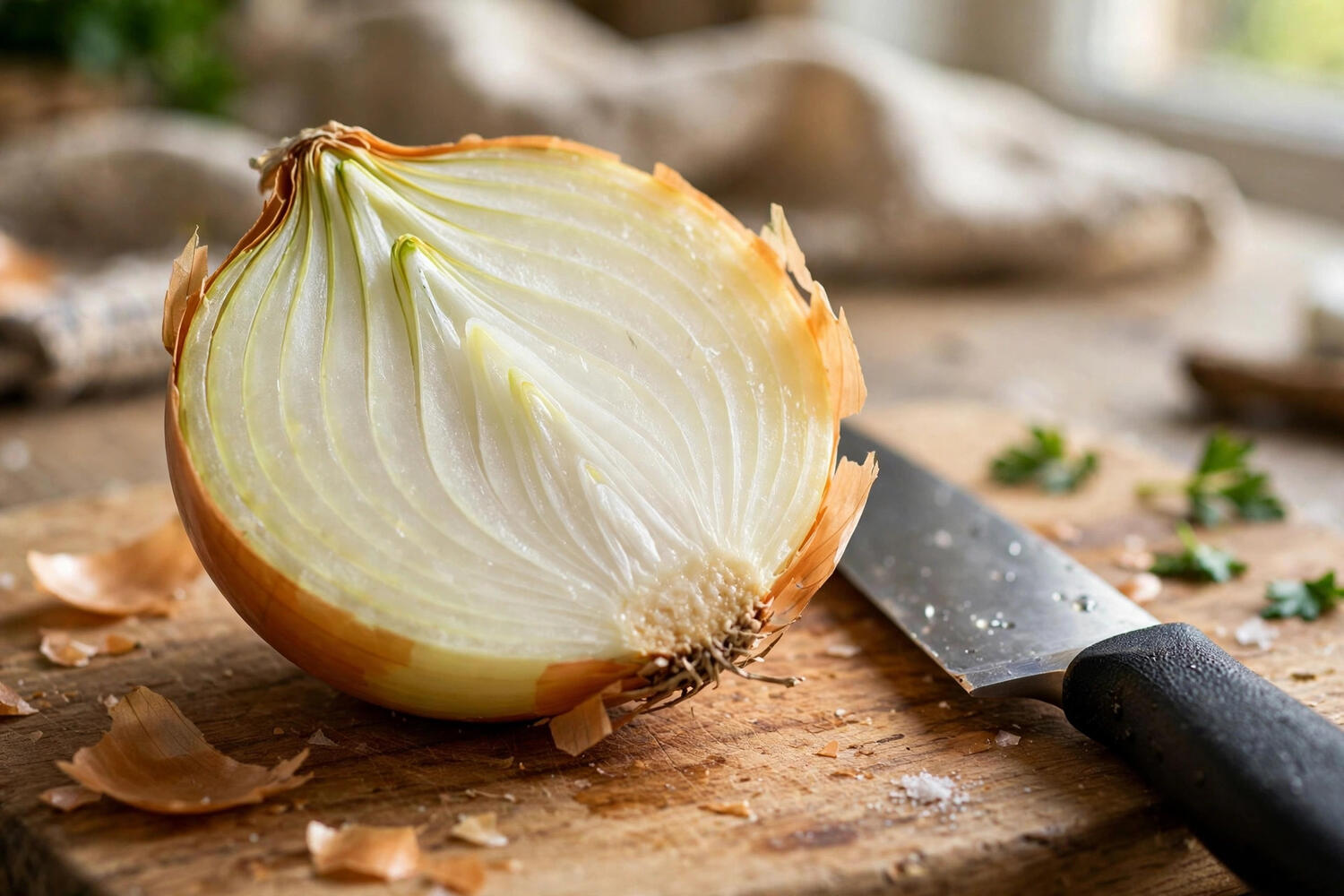
The root end of the onion — the hairy little nub — contains the highest concentration of sulfur compounds. Cut it off first and you release the worst of the gas right at the start. Instead, halve the onion through the root so each half stays held together by it, do all your slicing and dicing, and deal with the root nub last, when there is almost nothing left to cry over. You will still get a puff of gas at the end, but the job will essentially be done.
Trick 5: The Right Cutting Technique
How you cut matters as much as what you cut with. Work quickly and decisively — dawdling over each slice gives the gas more time to accumulate. Use smooth, single strokes rather than sawing back and forth, which mangles more cells. And cut with the onion’s pole-to-pole orientation in mind: slicing along the grain (root to tip) ruptures fewer cells than chopping across it, though for diced onion you will do both. The practical takeaway: sharp knife, confident strokes, steady rhythm, done fast.
Tricks 6 Through 8: Goggles, Bread, and Honest Assessment
Onion goggles — the sealed swim-goggle-looking things — genuinely work because they physically block the gas from reaching your eyes. They look absurd. Everyone who owns them swears by them. If you cook with onions daily, they are a legitimate quality-of-life purchase.
Holding bread or a match in your mouth is folklore with a kernel of plausibility (the idea is that breathing through the bread filters the gas), but in practice it does almost nothing. I tested the bread trick three times out of duty. I cried three times.
Lighting a candle nearby supposedly burns off the gas. The effect is negligible — a candle flame is far too small to meaningfully change the air around your board. Pretty ambiance, useless chemistry.
Contact lenses are the accidental trick: lens wearers often report less tearing, likely because the lens partially shields the eye’s surface. Not a reason to get contacts, but a nice side effect if you have them.

What About Sweet Onions?
Vidalias, Walla Wallas, and other sweet onions contain less sulfur, so they genuinely produce less tear gas. If your recipe allows the substitution, choosing a sweet onion is the laziest effective trick on this list. Red onions sit in the middle; standard yellow onions are the worst offenders and, unfortunately, the ones most recipes call for. White onions are sharp too. When a recipe just says “onion,” a sweet onion is almost always an acceptable swap for raw applications and a fine one for cooking.
When Nothing Works: The Nuclear Options
For truly sensitive eyes, or for the vat of onions that becomes French onion soup, combine everything: chilled sweet onion, sharp knife, fan blowing, root end last, fast confident cuts. And if you are doing restaurant quantities, step away from the board every few minutes — the gas dissipates, your eyes recover, and you come back fresh. There is no prize for suffering through it in one go. Your eyes watering is your body working correctly; the goal was never zero tears, just fewer of them.
How to Cut Onions Without Crying: The Pre-Cut Checklist
After years of testing, here is the routine I actually use when a recipe calls for three onions and I value my eyesight. Thirty minutes before cooking, the onions go in the fridge. When it is time, I hone my chef’s knife — ten strokes per side on the steel — and set a small fan blowing across the board. I halve each onion through the root, peel, and slice with fast, confident strokes, saving the root nubs for last. Total tears: usually zero, occasionally a light misting on onion number three.
The whole routine adds maybe two minutes of prep and removes the entire problem. Compare that to the folk remedies: bread in the mouth, candles, chanting. The checklist works because it stacks three real mechanisms — less gas produced (sharp knife, cold onion), gas blown away (fan), worst gas saved for last (root end). Any one of them helps; all three together are close to total. Laminate this paragraph and tape it inside your cabinet door. I am only half joking.
What to Do When You’re Already Crying
Sometimes the onion wins anyway — you forgot to chill them, the knife is dull, there are six of them. When tears are already flowing, step away from the board for two minutes; the gas dissipates quickly once you stop generating it, and your eyes clear. Rinse your face and hands with cool water, which washes the irritant off the skin around your eyes. Do not rub your eyes — your fingers are coated in onion juice and rubbing grinds it in.
If you wear contacts, consider taking them out for heavy onion sessions; trapped irritant under a lens is miserable. And if your eyes are still streaming when you return, the fan was probably not positioned right — it should blow across the board, perpendicular to your face, carrying gas sideways. A fan blowing toward you just delivers the gas express. Get the airflow right and even the most vengeful yellow onion becomes manageable.
The Two-Minute Onion Reset
Here is the whole method in one breath: chill the onions, hone the knife, fan across the board, halve through the root, cut fast with smooth strokes, root nubs last. Six steps, two minutes of setup, near-zero tears. Sweet onions when the recipe allows. Goggles when nothing else suffices. Everything else on the internet is decoration. Master this reset and onion prep becomes the fastest, most tear-free two minutes of your cooking day instead of the part you dread.
Frequently Asked Questions
Why do onions make you cry?
Cutting ruptures onion cells, releasing enzymes and sulfur compounds that form a gas. The gas dissolves in your eyes’ moisture, forming a mild acid that triggers tears.
Does chilling an onion prevent crying?
It helps meaningfully — cold slows the enzyme reaction that creates the tear gas. Refrigerate 30 minutes or freeze 10 to 15 minutes before cutting, but don’t freeze solid.
Do onion goggles really work?
Yes. Sealed goggles physically block the gas from reaching your eyes, making them one of the most effective options, especially combined with a sharp knife.
Which onions make you cry the least?
Sweet onions like Vidalia and Walla Walla produce the least tear gas. Standard yellow onions are the worst offenders; red and white fall in between.
Does cutting an onion under water work?
It washes the gas away before it reaches your eyes, so yes — but it makes the onion slippery and soggy. A small fan blowing across the board achieves the same airflow effect more practically.
Why do I cry more with a dull knife?
A dull knife crushes and tears cell walls instead of slicing them cleanly, rupturing far more cells and releasing much more tear gas. Sharpening your knife is the single biggest fix.