
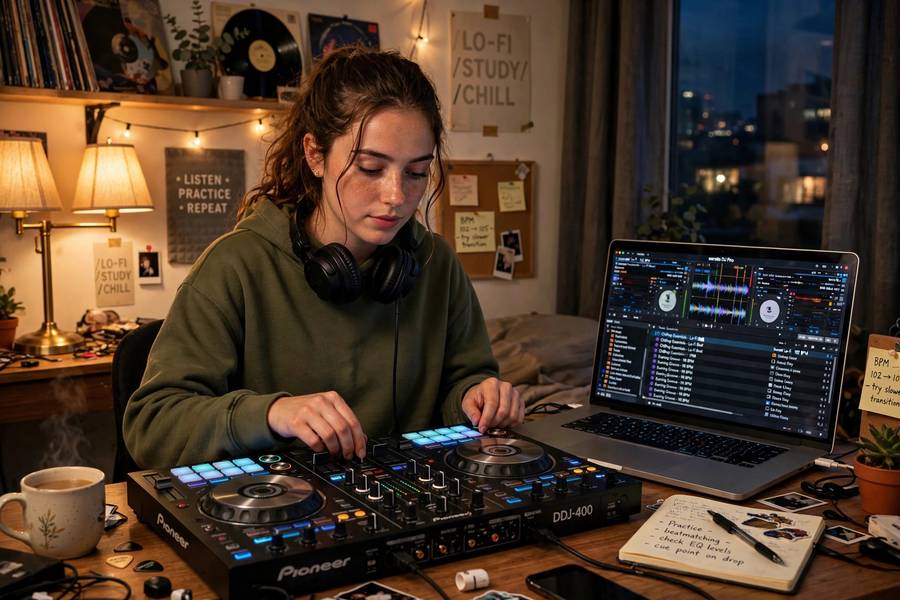
Everyone thinks becoming a DJ is about having the most expensive controller and a cool stage name. It’s not. I know DJs who started on a cracked laptop and free software and now play festivals, and I know people with $3,000 setups who’ve never played for anyone except their cat.
Here’s the truth nobody selling courses wants to tell you: becoming a DJ is 20% gear, 30% music taste, and 50% showing up. The barrier to entry has never been lower, which is great news and also why your Instagram feed is full of bedroom DJs. But the ones who actually make it aren’t the ones with the best equipment — they’re the ones who learned to read a room.
This guide covers the real path: what gear you actually need, the skills that matter, how to get your first gigs, and the mistakes that kill most beginners’ momentum before they ever play out.
Table of Contents
- What DJs Actually Do (It’s Not Just Pressing Play)
- The Gear You Really Need to Start
- Choosing Your DJ Software
- The Core Skills: Beatmatching, Phrasing, and EQ
- Building Your Music Library
- Practicing Like It Matters
- Recording Your First Mix
- Getting Your First Gigs
- Common Beginner Mistakes
- Frequently Asked Questions
What DJs Actually Do (It’s Not Just Pressing Play)
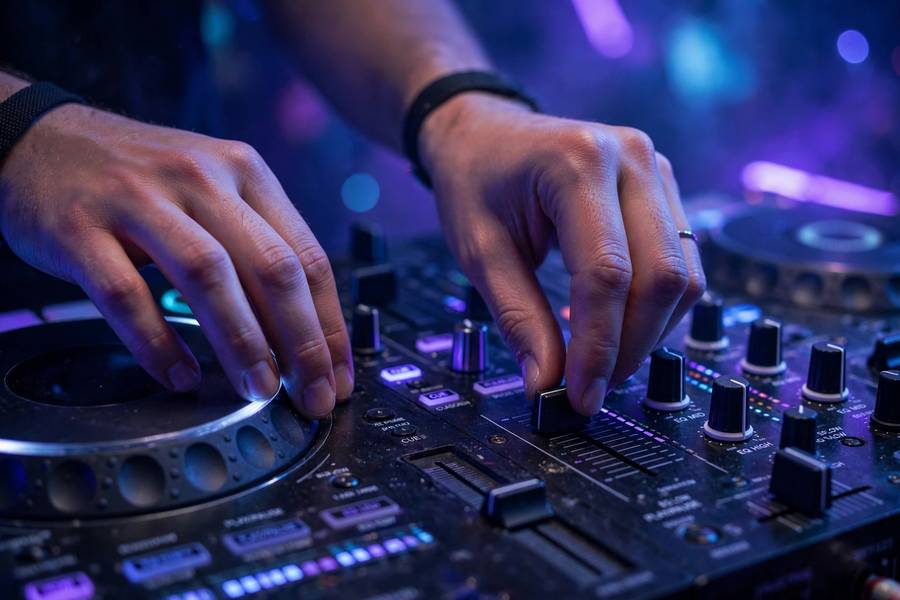
The tired joke is that DJs just press play. Anyone who’s watched a great DJ work a floor for three hours knows better. A DJ is a curator, a reader of rooms, and a live editor of energy.
Your job is to take a crowd’s mood and move it somewhere better. That means knowing your music deeply enough to pull the right track at the right moment, blending songs so the energy never drops, and recovering gracefully when a transition goes sideways (it will — even pros trainwreck sometimes).
There are different flavors of DJing, and it helps to know which one you’re chasing:
- Club/bar DJs play for dancers. Reading the floor is everything.
- Mobile/event DJs do weddings and parties. Versatility and crowd-pleasing matter more than underground cred. Check out these music festival tips to understand how live music energy works at scale.
- Radio/streaming DJs perform for listeners, not dancers. Personality and curation carry the show.
- Producer-DJs make their own tracks and DJ them. This is the festival-headliner path, but it starts with learning to produce.
Most beginners should start as open-format club DJs — it teaches you the fundamentals that transfer everywhere.
Producing your own tracks is a natural next step, and learning to write original lyrics gives your sets something no one else has.
These days plenty of DJs build their following by learning to stream your DJ sets on Twitch and playing live sets for a global audience.
The Gear You Really Need to Start
Gear forums will try to convince you that you need CDJs and a flagship mixer to be taken seriously. You don’t. Here’s the honest starter kit:
A DJ controller ($250–$500). Something like a Pioneer DDJ-FLX4 or Numark Mixtrack. It has jog wheels, faders, and pads — everything you need to learn real technique. This is the single best investment a beginner can make.
Headphones ($50–$150). You need closed-back headphones for cueing tracks in a loud room. Audio-Technica M40x or Sennheiser HD 25 are workhorses.
A laptop you already own. If it runs a browser, it probably runs DJ software. Don’t buy a new computer for this.
Speakers (whatever you have). Practice on anything. Upgrade later.
That’s it. Total damage: under $500 if you’re sensible. The skills transfer upward — everything you learn on a $300 controller applies on $5,000 club gear. The filmmaking tips for beginners crowd will tell you the same thing about cameras: the tool matters less than the person using it.
Choosing Your DJ Software
The big three are Rekordbox, Serato, and Traktor, plus VirtualDJ and the free Mixxx. Honestly? They all do the same core job. Pick based on your controller — most beginner controllers bundle free software, so start there.
What matters more than the brand:
- Learn to beatmatch by ear first, even though every software has a sync button. Sync is a tool, not a crutch. The day the sync fails you mid-gig (and it will), your ears are your backup.
- Organize your library inside the software from day one. Crates, playlists, tags — future you will be grateful.
- Learn keyboard shortcuts. Speed matters when you’re live.
The Core Skills: Beatmatching, Phrasing, and EQ
Three skills separate DJs from playlist-makers. Master these and you’re ahead of 80% of beginners.
1. Beatmatching
Getting two tracks to play at the same tempo so they blend. Start with the sync off, two tracks of similar BPM, and practice nudging the jog wheel until the kicks lock together. It’s frustrating for about two weeks, then it clicks, and you’ll never forget it — like riding a bike, but louder.
2. Phrasing
Songs are built in phrases — usually 16 or 32 beats. Great transitions happen when you start the new track at the beginning of a phrase in the old track. Mix a chorus into a verse and the energy collapses, no matter how well the beats match. Count in eights. Always be counting.
3. EQ Mixing
The bass, mids, and treble knobs are your real mixing tools. The golden rule: never have two full basslines playing at once — it sounds muddy and amateur. Swap the basslines at the transition point and your mixes will instantly sound cleaner.
Building Your Music Library
Your library is your instrument. A DJ with 200 tracks they know intimately will destroy a DJ with 10,000 tracks they’ve never listened to.
- Buy from DJ pools and stores (Beatport, Bandcamp, Traxsource) rather than ripping from streaming. You need high-quality files — 320kbps MP3 minimum, WAV or FLAC if you can.
- Know every track you own. Where’s the drop? Where does the energy dip? What’s the outro like? Listen actively, not passively.
- Organize by energy, not just genre. Tags like “opener,” “peak time,” “vocal banger,” and “cool down” are more useful mid-gig than genre labels.
- Dig constantly. The DJs who stand out are the ones playing tracks nobody else has. Spend an hour a week crate-digging.
Practicing Like It Matters
Here’s the practice routine that actually works: record every session. Listening back is brutally honest — you’ll hear every sloppy transition your live ears forgave. That’s the point.
Practice in 45-minute blocks, the length of a real set. Practice transitions between specific pairs of tracks until they’re muscle memory. Practice your “oh no” recovery — what do you do when a mix goes wrong? (Answer: cut to the new track confidently and keep moving. The crowd forgets in 30 seconds if you don’t panic.)
And practice performing, not just mixing. Talk on the mic a little. Move like you’re having fun. Bedroom stiffness follows you to the booth.
Recording Your First Mix
Once you can mix 45 minutes without a disaster, record it and put it online. Mixcloud and SoundCloud are the standard platforms; YouTube works too if you add visuals.
Your first mix won’t be perfect. Put it out anyway. The goal isn’t perfection — it’s proof of work. Promoters and friends need something to listen to before they’ll book you. A decent 60-minute mix with a tracklist beats a perfect mix that lives only on your hard drive.
Name it well, write a real description, and share it like you mean it.
Getting Your First Gigs
Nobody’s first gig is a festival. Here’s the actual ladder:
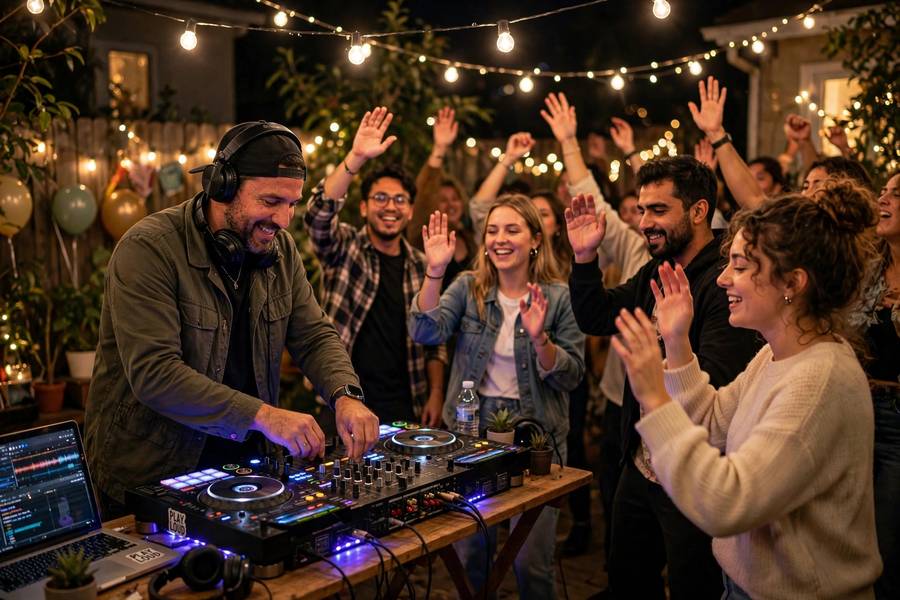
- House parties and friends’ events. Free or cheap. This is your laboratory.
- Bars and small venues. Walk in with your mix link and ask about opening slots. Weeknights are easiest to get.
- Local radio and streams. Community stations and Twitch DJ streams always need content.
- Your own night. The fastest path for many DJs: rent a small room, promote it yourself, and book yourself as headliner. You learn promotion and performance at once.
The secret to getting booked twice: be easy to work with. Show up early, don’t drink too much, play the room instead of your ego, and thank the promoter. Talent gets you the first gig; professionalism gets you the tenth.
Understanding the business side helps too — how talent agents work is worth a read once you start thinking beyond local gigs.
Common Beginner Mistakes
- Buying too much gear too soon. Skills first, toys later.
- Only practicing alone. You need live reps in front of people, even five friends.
- Playing only what you like. Your taste got you here, but the crowd pays the bills. Find the overlap.
- Redlining the mixer. If your levels are in the red, you sound bad on every system. Keep it in the green.
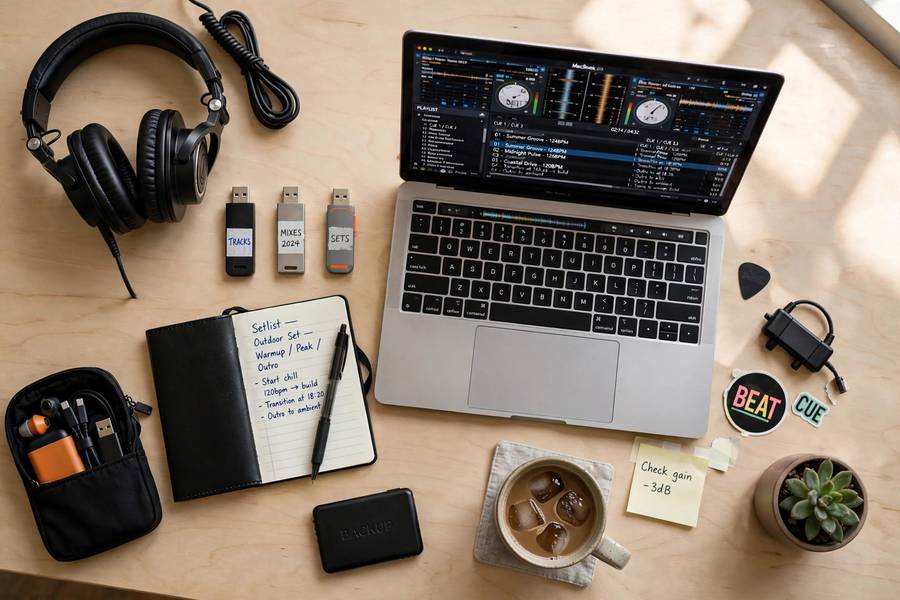
- No backup plan. Bring your music on two devices. Controllers die, laptops crash, USBs corrupt. Pros prepare for failure.
- Skipping the boring business stuff. Contracts for paid gigs, invoices, taxes — unglamorous, essential.
Frequently Asked Questions
With consistent practice (5+ hours a week), most beginners can play a solid house party set within 3–6 months and take paid bar gigs within a year. Mastery takes years, but “gig-ready” comes faster than people expect.
No. Basic theory helps (knowing what key means for harmonic mixing), but it’s optional. Rhythm, phrasing, and track selection matter far more for DJing than theory.
Yes. A $250–$500 controller, decent headphones, and free or bundled software are enough to learn everything and play real gigs. Upgrade only when your skills outgrow your gear.
No — pros use sync too. But learn to beatmatch by ear first, so you have the skill when technology fails you. Think of sync as cruise control: great to have, bad to depend on exclusively.
Beginners often play free or low-paid gigs ($50–$150) at bars and parties to build a reputation. Rates climb with demand — established local DJs charge $300–$1,000+ per night, and touring DJs far more.
Eventually, yes — original tracks are the fastest way to stand out. But learn DJing fundamentals first. Trying to learn mixing and production simultaneously usually means learning neither well.