How Long Does It Take to Write a Comedy Set?


“How long did that take you to write?” — the question every comic hears after a great set, and the answer always disappoints: years. Not years of staring at a notebook, but years of performing, rewriting, and performing again. The timeline of a comedy set is the least intuitive thing about the art form, so let me lay it out honestly.
The Short Answer (That Nobody Believes)
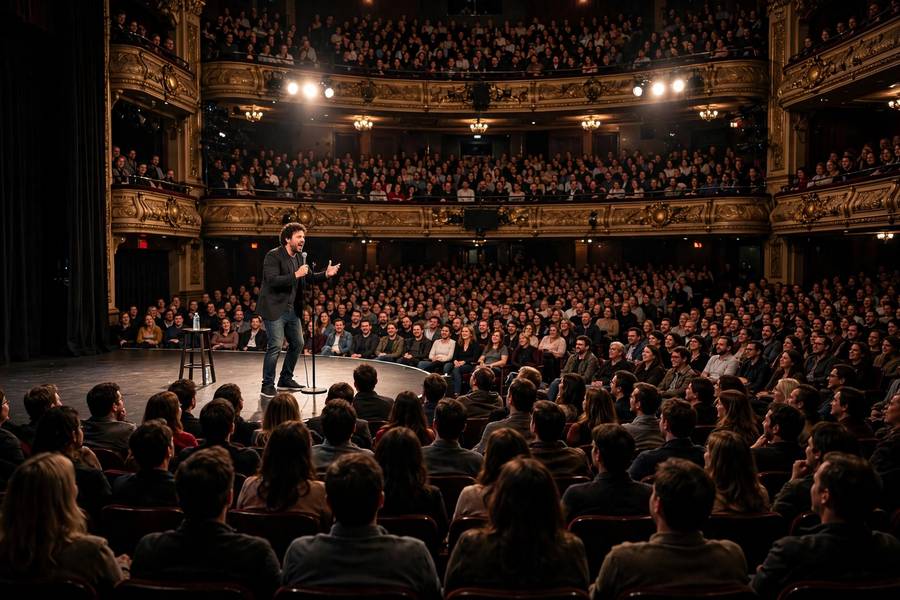
5 tight minutes: 3–12 months. 20 minutes (a feature spot): 1–2 years. 60 minutes (a headlining hour): 2–5 years. These assume regular performing — multiple sets per week. Without stage time, the clock doesn’t run at all: unperformed writing doesn’t mature, no matter how long you sit with it.
The disbelief is understandable. The words of a five-minute bit fit on an index card — how can that take six months? Because the words aren’t the product. The product is the words plus the timing, the tags discovered on stage, the wording refined across fifty performances, the confidence that lets you pause before the punchline. You’re not writing for six months; you’re developing for six months, and development only happens in front of people.
Five Minutes: 3–12 Months
The “tight five” is comedy’s fundamental unit — the five killer minutes that gets you booked, that wins competitions, that opens doors. Building one from scratch: months 1–2 are generation (writing lots of raw material, trying it at open mics, discovering which premises have legs). Months 3–6 are development (the promising bits get performed weekly, rewritten between sets, tagged and tightened). Months 6–12 are polishing (word-level refinement, order optimization, building the callbacks that make five minutes feel like a set rather than five jokes). how comedians write jokes
Experienced comics build five minutes faster — 3–4 months — because they’ve internalized the process and have a backlog of premises. Beginners should expect the full year. And the first tight five is the slowest; each subsequent one comes faster as the skills compound.
Twenty Minutes: 1–2 Years
Twenty minutes is the feature spot — the middle act at a club — and it’s where set architecture starts mattering. You can’t just do four tight fives back to back; the twenty needs flow: an opener that wins the room, chunks that build, callbacks that connect sections, and a closer that earns the headliner’s introduction.
The timeline: year one builds the raw minutes (three or four developing fives), year two weaves them into a set — discovering the order, writing the transitions, developing the callbacks that make it cohere. The weaving is its own skill: moving a bit three slots earlier can double its laughs because the audience’s energy is different there. This is covered in depth in how comedians write jokes.
The Hour: 2–5 Years
An hour-long headlining set is a major creative work — comparable to writing a novel or a film script, except it’s developed live. The 2–5 year range reflects real careers: hungry young comics in comedy cities (with nightly stage time) build hours in 2–3 years; comics with less stage access take longer.
The hour isn’t twelve tight fives — it’s an evening, with its own dramaturgy. Openers establish persona and win the room. The middle develops themes, with new material tested between proven chunks. The last fifteen minutes are the peak — the strongest, most personal material, building to a closer that sends the audience out buzzing. Between these landmarks, the comic reads the room nightly, adjusting energy, skipping what’s not working, leaning into what’s killing.
What’s remarkable: the hour is never finished. Headliners constantly rotate — new chunks enter in the middle, old bits retire or get rebuilt. The “hour” is a living repertoire, not a fixed text. Comics talk about “the hour” the way musicians talk about “the setlist”: tonight’s version of an evolving body of work.
Why It Takes So Long: The Testing Math
Here’s the arithmetic that explains everything. A bit needs roughly 20–50 performances to mature from promising to reliable. Each performance teaches something: a wording tweak, a tag discovered from an audience reaction, a pause that wasn’t there before. At 3–4 sets per week, one bit’s development takes 2–4 months of calendar time.
Now multiply: an hour contains 40–60 bits (depending on style). They don’t develop sequentially — you work several in parallel — but the calendar math is unforgiving. And stage time is the bottleneck: you can’t rush it by writing more, because unperformed writing doesn’t develop. This is why comics move to New York, LA, or London — not for the industry, but for the stage time. Ten sets a week compresses years into months.
The testing also can’t be faked. Performing for friends isn’t testing — friends laugh supportively. Open mics with real strangers are the laboratory, and the data (laughs or silence) is honest in a way nothing else is. what a cold open is
The Funnel: 10 Minutes Written, 1 Kept
The development timeline is also a selection timeline. Comics generate enormous volume — hours of raw material — and keep a fraction. The commonly cited ratio: write 10 minutes to keep 1. An hour special represents ten hours of written material, distilled through stage testing to the one hour that kills.
This is why “writer’s block” barely exists in stand-up the way it does in other writing: the problem is never generating ideas, it’s generating enough ideas to find the great ones. The funnel demands volume, volume demands the daily habit, and the daily habit — over years — produces the hour. There’s no shortcut through the funnel; there’s only the work.
Can You Go Faster?
Honestly? Somewhat. More stage time is the biggest accelerator — it’s the only variable that compresses the testing math. Better writing process helps: comics who rewrite systematically (recording sets, analyzing, revising) develop faster than those who just repeat. Good feedback from trusted comics can shortcut some dead ends — though never the stage testing itself.
What doesn’t speed it up: writing more without performing (the funnel needs the stage), taking classes instead of stage time (classes supplement, never replace), or rushing to headline before the material is ready (audiences remember the bomb longer than you do). The comics who seem to rise fast usually had years of invisible development — the “overnight success” played a thousand open mics you didn’t see.
Specials: The Forcing Function
Comedy specials compress and clarify the timeline. Taping a special finishes an hour — it fixes the set in its best form and retires it (audiences who’ve seen the special don’t want the same hour live). This creates the professional rhythm: build an hour over 2–3 years, tape it, then start the next one — often from uncomfortably close to scratch.
The post-special reset is famously brutal: headliners describe going back to clubs with notebooks of untested material, bombing like beginners, rebuilding. But it’s also the engine of longevity — comics with five specials have built five hours, each better-constructed than the last, because the process compounds. The fifth hour comes faster than the first, even though it starts from zero.
Knowing When a Set Is Done
Sets are never done — but they do reach readiness, and experienced comics recognize the signs: the laughs come in the right places without effort, the transitions feel invisible, you can handle disruptions (a heckler, a dead crowd) without losing the thread, and — the real tell — you’re slightly bored performing it. Boredom means mastery; it means the set runs itself and your brain is free.
That’s when comics start pushing new material into the middle again, and the cycle restarts. The answer to “how long does it take to write a comedy set” is really: as long as you keep performing, because the set is never finished — it’s just ready enough, for now, tonight. And tomorrow night, you’ll make it better. The full craft behind that nightly improvement is in how comedians write jokes, and the masters of the long game are profiled in the best comedy movies — where years of stage craft become film craft.
Frequently Asked Questions
A tight 5 minutes takes 3–12 months of regular performing; a full hour typically takes 2–5 years. The writing is fast — it’s the stage-testing and rewriting that takes years, since each bit needs dozens of performances to mature.
It varies by style: a rapid-fire comic might deliver 200+ jokes per hour, while a storytelling comic might do 15–20 long bits. What’s consistent is the development ratio — roughly 10 minutes written for every 1 minute kept.
Through structure and repetition. Sets are built from chunks (themed sections) in a fixed order, and hundreds of performances burn the sequence into muscle memory. Most comics also keep set lists — just topic keywords — in a pocket as backup.
You can write the words in a week, but you can’t develop the timing, tags, and audience-tested refinements that make a set actually work. A week-old set is a draft; a year-old set is a performance.
Touring comics typically build a new hour every 1–2 years, retiring old bits as new ones prove themselves. Specials accelerate this — after taping an hour, many comics start the next one almost from scratch.