Every torque and horsepower number you’ve ever read — on a spec sheet, in a review, on a forum argument — came from a dynamometer. “Dyno” for short. It’s the instrument that turns an engine’s invisible twisting force into the numbers we argue about, and understanding how it works explains a lot: why manufacturer claims differ from independent tests, why the same car makes different numbers on different dynos, and what “wheel horsepower” actually means.
I’ve strapped cars to dynos and watched the numbers roll in. There’s something deeply satisfying about it — the roar, the straps creaking, the graph drawing itself on the screen in real time. But there’s also a lot of misunderstanding about what those numbers represent. Let’s fix that.
Contents
- What a Dynamometer Actually Does
- Engine Dyno vs Chassis Dyno: The Two Flavors
- How the Measurement Works (Without the Math Degree)
- From Torque to Horsepower: The 5,252 Thing
- Why Numbers Differ: Correction Factors and Dyno Types
- What a Dyno Run Tells You Beyond Peak Numbers
What a Dynamometer Actually Does
A dynamometer measures force by resisting it. The basic principle: apply a known, controllable load against the engine’s output, measure how hard the engine pushes against that load, and you’ve measured torque. It’s essentially an extremely precise brake attached to measuring equipment.
The word comes from Greek — dynamis (power) + metron (measure). The device doesn’t “create” numbers; it creates resistance and watches what happens. Think of arm-wrestling against a machine that knows exactly how hard it’s pushing back. However hard you push to hold it still (or move it at a controlled rate) — that’s your torque.
Modern dynos are computerized, but the core idea hasn’t changed in a century: load the engine, measure the reaction force, calculate torque from the known geometry, and derive horsepower from torque and RPM. If you want the conceptual background on what torque in cars actually is, start there — this article is about the measuring, not the meaning.
Engine Dyno vs Chassis Dyno: The Two Flavors
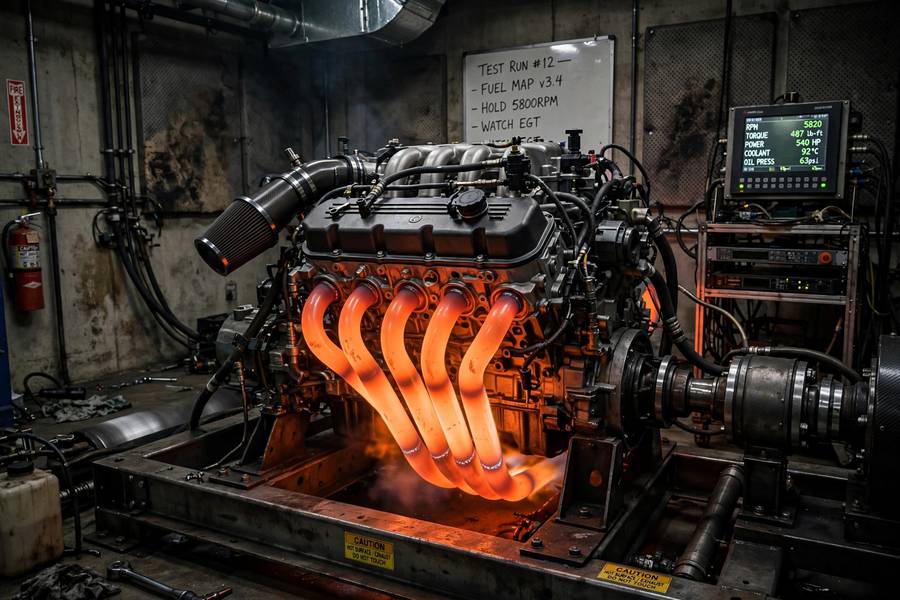
Engine dyno (brake dyno): the engine sits on a stand, bolted directly to the dynamometer — no transmission, no car, no drivetrain losses. This is how manufacturers develop engines and generate the official spec-sheet numbers. It’s the purest measurement of what the engine itself produces.
Engine dynos are expensive, permanent installations — the kind of thing you find in OEM test labs and serious race shops. Pulling an engine to dyno it is a major operation, so this isn’t something enthusiasts do casually.
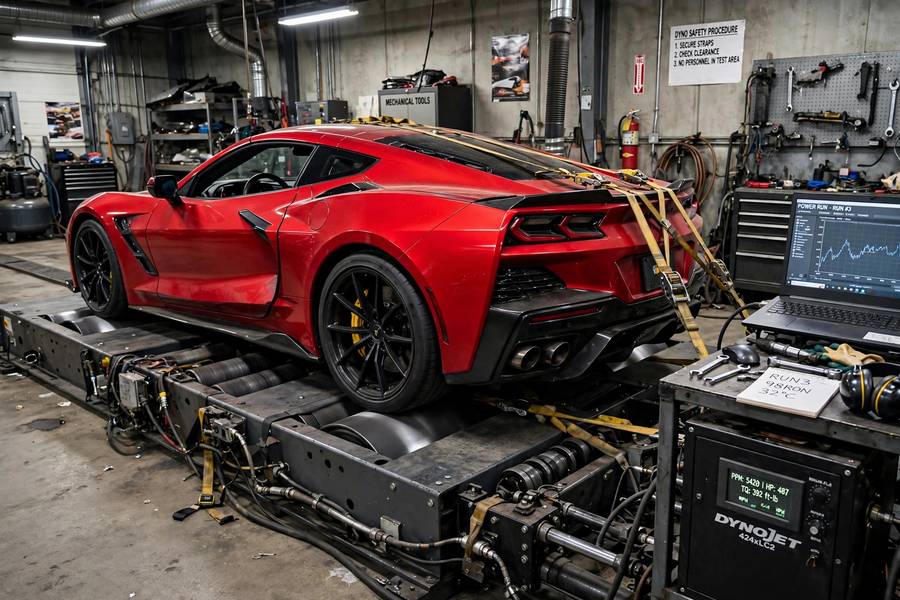
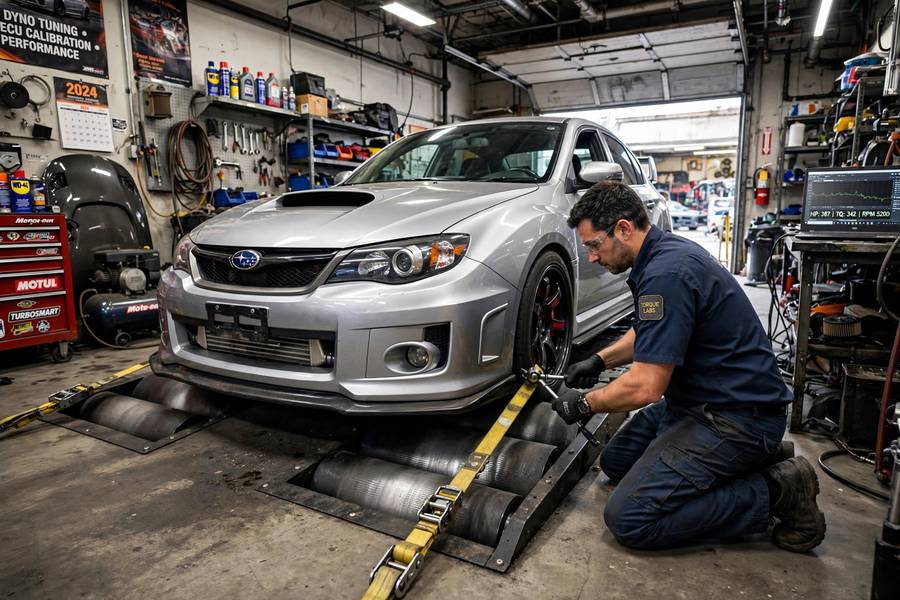
Chassis dyno (rolling road): the whole car drives onto rollers (or gets its hubs bolted to dyno units, in the case of hub dynos). The car’s wheels spin the rollers, the dyno loads the rollers, and the measurement happens at the wheels. This is what tuning shops have, what YouTube dyno videos show, and what enthusiasts mean when they say “I dyno’d my car.”
The critical difference: a chassis dyno measures wheel torque/horsepower — after the transmission, differential, axles, and tires have taken their cut. Drivetrain losses typically eat 10–20%, so a car rated 300 hp at the crank might show 250–270 hp at the wheels. Neither number is “wrong” — they’re measuring different things. Arguments about dyno numbers almost always come down to someone comparing crank numbers to wheel numbers without realizing it.
Hub dynos are the newer variant: instead of rollers under the tires, the wheels come off and the hubs bolt directly to the dyno units. This eliminates tire slip and deformation variables, giving more consistent numbers — but it’s more setup work.
How the Measurement Works (Without the Math Degree)
The two main dyno technologies work differently:
Inertia dynos (like the famous Dynojet) use a heavy roller of precisely known mass. The car accelerates the roller; the dyno measures how quickly the roller speeds up. From the roller’s known inertia and its acceleration rate, the computer calculates the force applied — that’s torque. Simple, elegant, and very repeatable. The limitation: it measures acceleration against a fixed mass, which doesn’t perfectly simulate real road load.
Load-cell / eddy-current dynos (like Mustang Dyno, Dynapack) apply a controllable electromagnetic resistance and measure the reaction force directly with a load cell (essentially a highly precise scale). The operator can hold the engine at any RPM under full load — “steady state” testing — which lets tuners optimize fuel and timing at every point in the rev range. This is the tuner’s choice for actual engine calibration work.
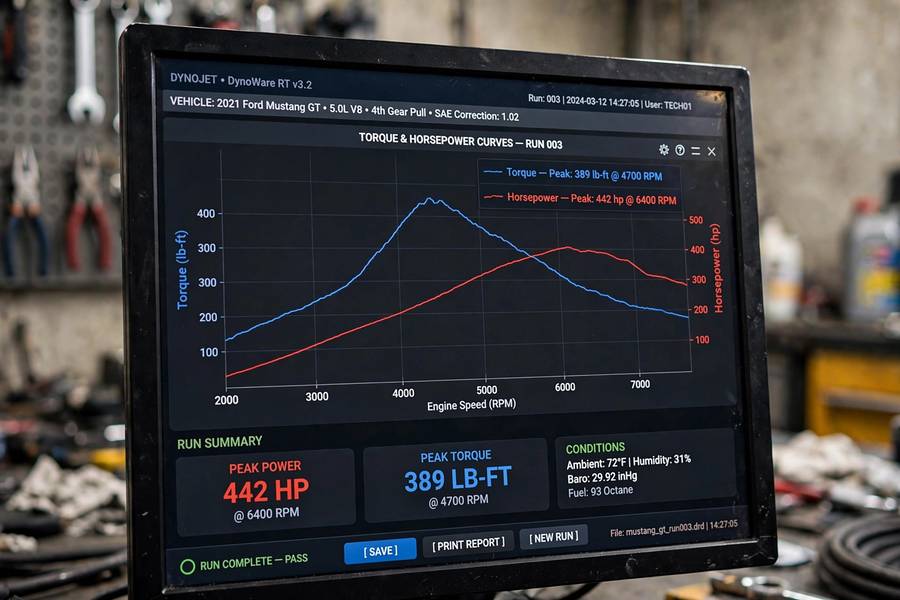
A typical chassis dyno run goes like this: 1. The car is strapped down hard — front, rear, sometimes both. Safety first; a car coming off the rollers at full throttle is a nightmare scenario. 2. The operator warms everything up — engine, transmission, tires. Cold components give inconsistent numbers. 3. The run starts in a 1:1 gear (usually 4th in a 6-speed, or whatever’s closest to direct drive) at low RPM. 4. Full throttle. The engine pulls from low RPM to redline while the dyno records torque and RPM continuously. 5. The computer draws the curves: torque and horsepower across the rev range.
The whole pull takes maybe 10–15 seconds. Then everyone gathers around the screen to argue about the numbers — the best part.
From Torque to Horsepower: The 5,252 Thing
Here’s something that confuses people: dynos measure torque; horsepower is calculated. The fundamental measurement is always twisting force. Horsepower is derived from the formula:
Horsepower = (Torque × RPM) ÷ 5,252
That magic number 5,252 comes from unit conversions (James Watt’s definition of horsepower meets rotational math). The practical consequence: torque and horsepower curves always cross at 5,252 RPM. Below that RPM, the torque number is bigger; above it, horsepower is bigger. If you ever see a dyno graph where they don’t cross at 5,252, something’s wrong with the graph.
This also explains why torque is the “real” measurement and horsepower is the derived one. Anyone quoting horsepower is really quoting torque-at-RPM, repackaged. Tuners watch the torque curve; marketers quote the horsepower peak.
Why Numbers Differ: Correction Factors and Dyno Types
“Dyno’d 280 stock, but the brochure says 300 — is my car broken?” I heard this constantly. Usually, the answer is: different measurement conditions. Here’s what moves the numbers:
Crank vs. wheel. The big one. Brochure = crank (engine dyno). Your tuner’s dyno = wheels (chassis dyno). Expect 10–20% less at the wheels. A 300-hp car showing 255 whp is completely normal, not broken.
Correction factors. Air density affects engine output — cold dense air makes more power than hot thin air. Dyno software applies correction factors (SAE, STD, DIN, EEC — different standards) to normalize results to standard conditions. SAE is the most conservative and most commonly cited in the US; STD typically reads 2–4% higher. Two identical cars can show different numbers just from different correction standards. Always ask which correction was used before comparing.
Dyno brand differences. Dynojets (inertia) typically read higher than Mustang dynos (load-based) — sometimes called “heartbreaker” dynos for exactly this reason. Neither is wrong; they measure differently. Comparing numbers across dyno brands is meaningless. Compare before-and-after on the same dyno, same day, same conditions — that’s where dynos are genuinely useful.
Conditions. Heat soak (repeated runs heating everything up), tire pressure, strap tension, even the gear used — all nudge the numbers. A “hero run” on a cold morning with favorable correction can read notably higher than the same car on a hot afternoon.
The takeaway: dyno numbers are most useful relatively (did my tune gain 20 hp?) rather than absolutely (is my car “really” 300 hp?). Anyone bench-racing absolute numbers from different dynos, different days, different corrections is comparing apples to moon rocks.
What a Dyno Run Tells You Beyond Peak Numbers
Peak numbers are the headline, but the curves tell the real story:
- The torque curve shape shows where the engine actually pulls — flat and wide versus peaky. This matters more for drivability than any peak number.
- Air-fuel ratio traces (if the shop logs them) reveal whether the engine runs safely rich under load or dangerously lean somewhere.
- Dips and spikes in the curve can indicate problems: a sudden torque dip might be knock retard (the computer pulling timing to prevent detonation), a boost leak, or a failing component.
- Before/after comparisons quantify modifications honestly. That intake that “felt faster”? The dyno either confirms it or exposes the placebo. I’ve seen $800 intakes gain 3 hp and $200 tunes gain 40. The dyno doesn’t care about your feelings or your receipts.
For buying a used car that’s modified, a dyno sheet from a reputable shop is genuinely useful documentation — it’s proof of what the car actually makes, not what the seller claims. And for stock cars, a dyno run is the best health check available: if the numbers are way off the expected range, something’s wrong, and the curve shape usually hints at what.
The dynamometer turned engine performance from mythology into measurement. The numbers still get argued about endlessly — some things never change — but at least now we’re arguing about data.
Frequently Asked Questions
With a dynamometer, which applies a known resistance against the engine’s output and measures the reaction force. Engine dynos bolt directly to the engine (crank numbers); chassis dynos measure at the wheels via rollers. Torque is the direct measurement; horsepower is calculated from torque and RPM.
An engine dyno tests the engine alone on a stand, giving crankshaft numbers with no drivetrain losses — this is how manufacturers rate engines. A chassis dyno tests the whole car on rollers, giving wheel numbers that are typically 10–20% lower due to transmission, differential, and tire losses.
Different dyno brands read differently (inertia vs. load-based), correction factors vary (SAE vs. STD), and conditions like temperature, heat soak, and tire pressure all affect results. Dyno numbers are most meaningful when comparing before-and-after runs on the same dyno under similar conditions.
SAE correction normalizes the measured power to standard atmospheric conditions (temperature, pressure, humidity) so runs on different days are comparable. SAE is the most conservative common standard; STD correction typically reads 2–4% higher on the same run.
A properly conducted dyno run on a healthy car is no harder than a few full-throttle highway pulls — it’s well within what the car is designed to handle. Risks come from pre-existing problems (weak cooling, worn components) or operator error, which is why reputable shops inspect and strap cars down carefully.