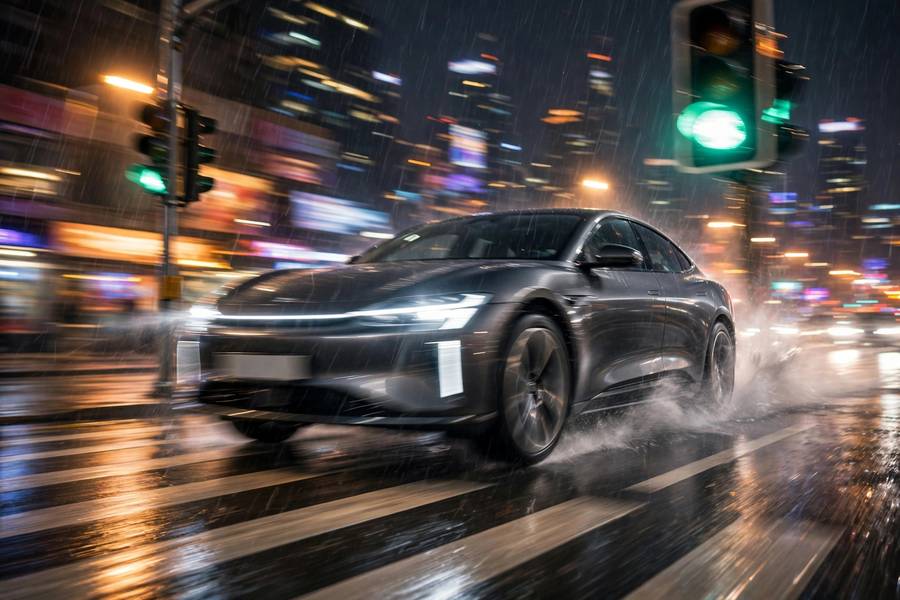
I’ll never forget the first time I drove a proper performance EV. I’d spent fifteen years around combustion engines — I knew exactly how a fast car was supposed to feel: the revs climb, the power builds, the shift hits, repeat. The EV did none of that. I pressed the pedal and the car simply… teleported. No buildup, no drama, no waiting. Just instant, silent, slightly nauseating thrust. My brain, trained on gas engines, kept waiting for the powerband to arrive. It had been there since 0 RPM.
That experience is “instant torque,” and it’s the single biggest driving difference between electric and gas cars. It’s not marketing — it’s electromagnetism versus combustion, and the physics genuinely favors the electric motor off the line. Here’s what’s happening, why it feels so different, and where gas engines still have answers.
Contents
- Why Electric Motors Make Peak Torque at 0 RPM
- Why Gas Engines Can’t Do That
- What It Feels Like: The Seat-of-the-Pants Difference
- The 0-60 Story: Where EVs Win and Where They Don’t
- Highway and Top-End: Where Gas Fights Back
- Gearing, Weight, and the Fine Print
Why Electric Motors Make Peak Torque at 0 RPM
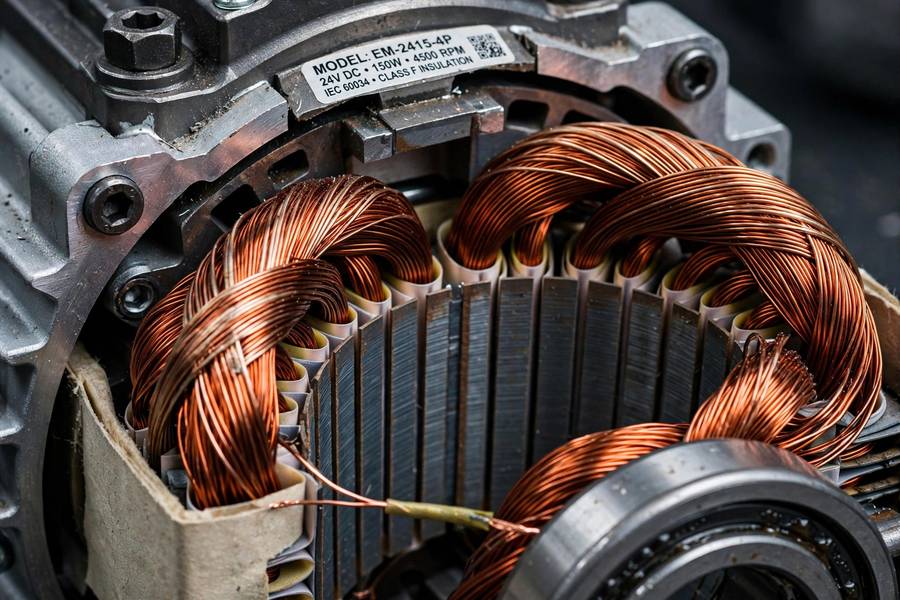
An electric motor produces torque through magnetic fields, not explosions. When current flows through the motor’s windings, it creates a magnetic field that pulls on the rotor — and that pull is strongest when the rotor isn’t moving yet. Maximum current, maximum magnetic force, zero RPM: that’s peak torque in cars, delivered the instant you ask for it.
As the motor spins faster, back-EMF (electromotive force — the motor generating its own opposing voltage as it spins) rises and reduces the effective current, so torque gradually tapers off at high motor speeds. But from standstill through typical driving speeds, the torque curve is essentially flat at maximum. No revving up to find the power. No waiting for a turbo to spool. No downshift. Just torque, now.
There’s also no drivetrain delay. A gas car’s path from your foot to the wheels goes: throttle opens → air flows in → fuel injects → combustion → crankshaft → torque converter/clutch → gearbox → differential → wheels. Each step takes milliseconds, and they add up — plus the transmission might need to downshift first, which takes real, noticeable time. An EV’s path is: pedal → inverter sends current → motor twists. That’s it. The response is effectively instantaneous, and you feel the difference every single time you touch the pedal.
Why Gas Engines Can’t Do That
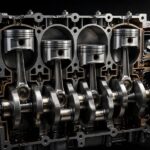
A combustion engine is an air pump that happens to produce torque as a side effect, and air pumps need speed to work. At low RPM, the engine can’t move much air through itself, combustion events are infrequent (a 4-cylinder at 1,000 RPM fires about 33 times per second — sounds like a lot until you compare it to continuous magnetic force), and torque is weak. The engine has to spin up to its happy place before it makes real power.
Turbos made this better but introduced their own delay: exhaust gases have to spin the turbo up before boost arrives, which takes a beat — turbo lag. Even the best modern turbos have a moment of “thinking about it” when you floor it from low RPM. And then there’s the transmission: an automatic needs to decide to downshift, execute the downshift, and then deliver power. A dual-clutch is fast; a conventional automatic can take the better part of a second. In a drag race, that’s an eternity.
So the gas car’s launch sequence is: floor it → wait for revs → wait for boost → wait for downshift → power arrives. The EV’s launch sequence is: floor it → power. That gap is the entire story of why a 4,800-lb electric SUV embarrasses sports cars off the line.
What It Feels Like: The Seat-of-the-Pants Difference
Numbers aside, the sensation is what converts skeptics. A fast gas car is theatrical: noise rising, gears slamming, the engine working audibly harder as speed builds. Your brain reads all that drama as speed. An EV removes the theater entirely — no sound, no shifts, no buildup — just relentless, linear pressure pinning you to the seat.
Two things surprise gas-car drivers most:
- The silence is disorienting. Without engine noise, your brain underestimates speed. I’ve watched experienced drivers glance down mid-acceleration, see the speedometer, and physically flinch. The car is going 80 and it feels like 50 because none of the usual sensory cues fired.
- There’s no “event.” In a gas car, acceleration has chapters: the launch, the powerband hit, the shift, the next gear’s pull. In an EV, it’s one unbroken surge. Some drivers find it thrilling; some find it oddly boring after the novelty wears off. It’s the difference between a roller coaster with drops and hills versus being fired out of a railgun — both fast, completely different experiences.
One more subjective note: EV acceleration is repeatable in a way gas cars aren’t. No launch technique, no perfect shift points, no worrying about the clutch. Just press and go, identically, every time. For daily driving, that consistency is genuinely pleasant.
The 0-60 Story: Where EVs Win and Where They Don’t
Let’s talk numbers, because this is where EVs look almost unfair:
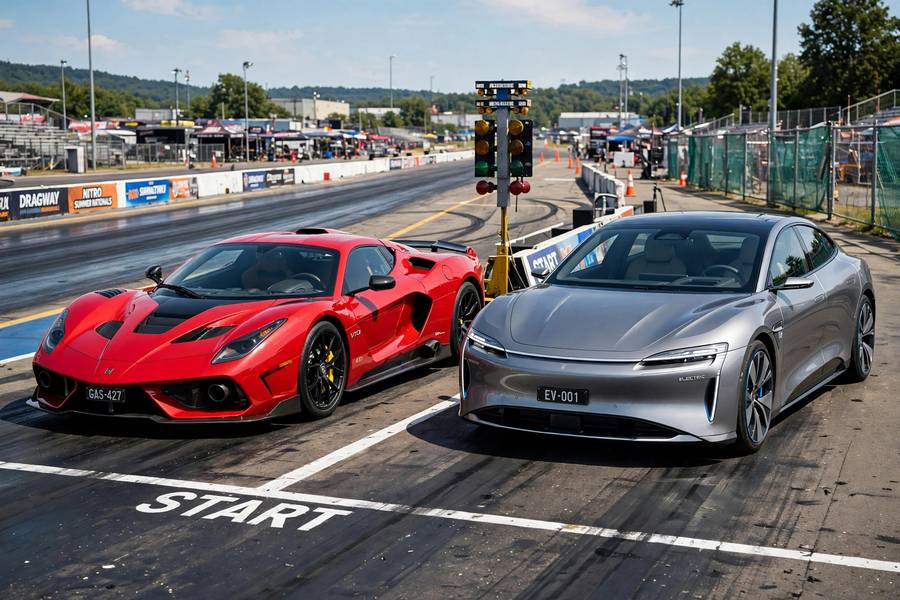
- 0–30 mph: EVs dominate absolutely. Instant max torque from zero means the hardest part of launching — getting a heavy object moving — happens at peak force. A mid-range EV crossover hits 30 mph as fast as many sports cars.
- 0–60 mph: EVs still win decisively in most matchups. The single-speed transmission means no shift interruptions — power delivery is continuous while the gas car loses time (and momentum) with every gear change.
- 60–100 mph: The gap narrows. The EV’s torque is tapering as motor speed rises, while the gas car is now in its powerband and pulling hard. A performance gas car starts reeling the EV in.
- 100+ mph and top speed: Gas (usually) wins. EVs are typically geared for low-end punch and efficiency, with modest top speeds — many are limited around 110–130 mph. Sustained high-speed running also drains EV batteries fast and builds heat in the motors.
So the honest summary: EVs own the launch and the 0–60 sprint — the acceleration you use every day. Gas cars fight back at high speeds and sustained running — the acceleration you use on a track or the Autobahn. For street driving, the EV’s advantage covers about 95% of real situations.
Highway and Top-End: Where Gas Fights Back
Beyond the drag strip, gas engines have genuine remaining advantages:
- Sustained performance. A gas car can run at full power until the tank’s empty. An EV at full power generates enormous heat in the battery and motors — thermal management eventually limits output. Track-day EVs are impressive for a few laps, then the computers start pulling power. This is improving, but physics is stubborn.
- Weight. Batteries are heavy — a long-range EV carries 1,000+ lbs of battery. That weight dulls handling and increases tire and brake wear. Gas cars (especially affordable sports cars) stay lighter and more agile.
- Refueling. Five minutes at a pump versus 20–40 minutes at a fast charger (best case). For long trips, this still matters.
- Sound and soul. Subjective, but real: many enthusiasts love the sound and mechanical character of a combustion engine. An EV’s silence is a feature to some and a bug to others.
None of these change the torque story — they’re separate trade-offs. But they explain why “EVs are faster” doesn’t automatically mean “EVs are better for everyone.”
Gearing, Weight, and the Fine Print
A few nuances worth knowing:
Most EVs use a single-speed reduction gear (typically 8:1–10:1). That reduction multiplies motor torque enormously — a motor making 300 lb-ft through a 9:1 reduction delivers ~2,700 lb-ft to the wheels, instantly, from zero. Some performance EVs (like the Porsche Taycan) use a 2-speed gearbox to extend high-speed performance — the industry may head that way as the tech matures.
Traction is the real limit. With that much instant torque, the tires become the bottleneck. EVs need sophisticated traction control to avoid turning every launch into a burnout — and they have it, sampling wheel speed thousands of times per second. But on slippery surfaces, all that instant torque can overwhelm grip faster than a gas car’s gradual buildup. Winter tires on an EV aren’t optional; they’re essential.
“Instant” has a software layer. What you feel is filtered through the car’s programming — throttle mapping, traction control, battery temperature management. Two EVs with identical motors can feel different because of software. And as how autonomous vehicles work continues evolving, expect even tighter integration between the motors and the computers managing them.
The bottom line: instant torque isn’t a gimmick — it’s the fundamental electromagnetic advantage of the electric motor, and it’s why EVs rewrote the rules of everyday acceleration. Gas engines still have their arenas. But off the line, in the real world, the electron beats the explosion. Every time.
Frequently Asked Questions
Electric motors produce torque through magnetic fields, which are strongest when the rotor isn’t moving. Maximum current flows at 0 RPM, so peak torque is available the instant you press the pedal — no revving, no turbo spool, no downshift needed.
Off the line and to 60 mph, usually yes — instant torque and no gear shifts give EVs a decisive advantage. At high speeds (100+ mph) and sustained track use, gas cars often fight back due to better top-end gearing, lighter weight, and no thermal power limits.
A combustion engine is an air pump — at low RPM it can’t move much air, so combustion events are weak and infrequent. Torque builds as RPM rises and the engine breathes better. Turbos help low-end response but add their own spool-up delay.
Most EVs use a single-speed reduction gear (around 8:1–10:1) rather than a multi-gear transmission, since electric motors produce usable torque across a huge speed range. A few performance EVs use 2-speed gearboxes to improve high-speed efficiency and acceleration.
It can — instant max torque overwhelms slippery tires faster than a gas car’s gradual power buildup. Modern traction control manages it well, but proper winter tires are essential on an EV, arguably more so than on an equivalent gas car.