How Do Escape Rooms Work? A First-Timer’s Guide


So how do escape rooms work, exactly? If you have ever watched a heist movie and thought “I could totally do that,” an escape room is your chance to find out you absolutely could not — and have a fantastic time proving it. The premise is simple: you and your friends get locked in a themed room, and you have sixty minutes to solve a chain of puzzles that gets you out. No horror-movie stakes, no actual danger. Just you, a ticking clock, and the dawning realization that your friend who does crosswords in pen is about to become the most valuable person you know.
I have done more of these than I can count — some brilliant, a couple terrible — and this guide covers everything a first-timer needs: how booking works, what the briefing is for, how the puzzles actually function, how hints work, and the tips that separate teams that escape from teams that spend forty minutes arguing about a combination lock.
How Do Escape Rooms Work? The Basics
An escape room is a real-life adventure game played in a physical space. You book a time slot, show up with your team (usually 2 to 8 people), and a staff member — your game master — briefs you on the story and the rules. Then the door closes (or, in modern rooms, just clicks shut — you are never actually trapped), the timer starts, and you have 60 minutes to work through a sequence of puzzles that leads to your escape.
The “escape” is the framing, not the whole point. Most rooms are really about completing a mission: defuse the bomb, find the stolen artifact, solve the mystery. The puzzles are linked in a chain — solving one gives you the key, code, or clue you need for the next — and the room is designed so a first-time team finishes with a few minutes to spare if they work well together. About that: most rooms have escape rates between 20 and 40 percent, which sounds brutal until you realize the failures are half the fun.
Booking: What to Know Before You Go
Booking is done online through the venue’s website. You pick a room theme, a date, and a time. A few things worth knowing:
Public vs. private bookings. The cheapest option is a public slot, where strangers may join your group to fill the room. If the idea of solving puzzles with four random people sounds awful (or amazing — no judgment), pay the private-room premium. For birthdays and team events, private is worth every penny.
Group size matters. Every room lists a recommended player count. Take it seriously. Two people in an eight-person room will drown in puzzles; eight people in a four-person room will trip over each other. The sweet spot for most rooms is four to six.
Difficulty ratings are real. Venues rate rooms by difficulty, and first-timers should start at easy or medium. The “expert” room with a 12 percent escape rate is not a badge of honor for your first outing — it is a recipe for sixty minutes of confident confusion.
Book ahead on weekends. Friday and Saturday evening slots sell out days in advance at good venues. Weekday evenings are easier and often cheaper.
The Briefing: Listen, Seriously
Before the game starts, your game master gives you a briefing — the story, the goal, and the rules. This is not airline-safety-demo territory where you can zone out. The briefing contains actual information you will need.
The rules are mostly common sense with a few escape-room specifics: do not force anything (if a drawer does not open with a reasonable pull, it is not meant to open — nothing in a well-designed room requires strength), do not climb on furniture, do not use your phone for answers (that is cheating, and the game master is watching on camera), and do not take anything apart that is screwed down. Everything you need to solve the room is in plain sight or findable with normal searching. If you find yourself thinking “maybe I should unscrew this panel,” the answer is no.
The game master also explains how hints work — more on that in a moment — and confirms your goal. Then the timer starts, and the next hour is yours.
How the Puzzles Actually Work
Escape room puzzles come in a handful of flavors, and recognizing the type is half the battle:
Search puzzles. Finding hidden objects and clues — keys taped under tables, codes written in UV ink (they give you the blacklight), messages hidden in books. Search thoroughly but systematically: divide the room into zones and call out what you find. Nothing kills momentum like three people searching the same bookshelf while the desk sits untouched.
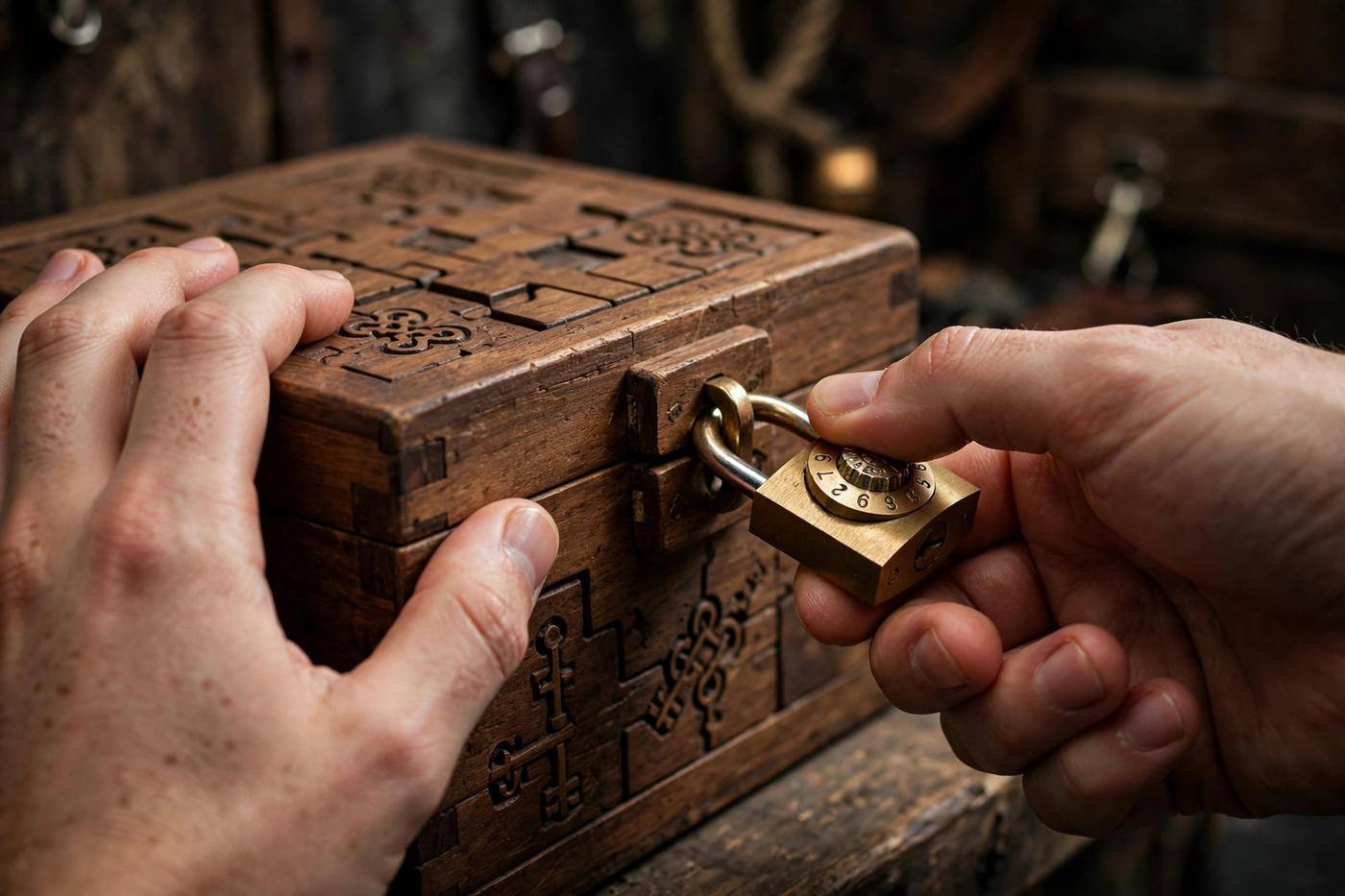
Combination locks. The bread and butter. Four-digit codes, five-letter word locks, directional locks. The code always comes from somewhere in the room — a pattern on the wall, a series of numbers in a journal, the number of something. If you are trying random combinations, stop; you missed a clue.
Logic and pattern puzzles. Ciphers, sequencing, matching symbols, math that a twelve-year-old could do under no pressure and that you will somehow get wrong under pressure. Read everything out loud — the number of times a solution was “right there in the text we all read silently” is staggering.
Physical and mechanical puzzles. Magnets, lasers, weighted switches, things that click into other things. These are the satisfying ones — the room literally transforms around you when you solve them, with hidden compartments springing open.
Team puzzles. Designed so one person cannot solve them alone — someone reads numbers from across the room while someone else arranges tiles. These exist to force communication, and they work.
The chain structure means puzzles unlock in sequence, but good rooms run two or three threads in parallel so the whole team stays busy. If everyone is standing around one lock, split up. There is always something else to work on.
Hints: How They Work and When to Use Them
Every room has a hint system, and using hints is not failure — it is the intended mechanic. The game master watches your progress on cameras and can nudge you when you are stuck. Hint delivery varies: some rooms let you ask via a walkie-talkie or a screen, some venues give you a set number of free hints, and some game masters just feed you one when you have been circling the same puzzle for ten minutes.
Here is my honest advice: ask for a hint after five to seven minutes of zero progress on a single puzzle. Pride is the number-one cause of failed escapes. A well-timed hint does not ruin the room — it unblocks the chain so you can enjoy the rest of it. The teams with the most fun are not the ones who refused hints; they are the ones who kept moving.
First-Timer Tips That Actually Help
Communicate everything. Call out what you find, what you tried, and what did not work. “I found a key, it does not fit the desk drawer, putting it on the table” takes five seconds and saves ten minutes of someone else retrying the same dead end.
Organize your solved and unsolved. Designate a spot — usually the main table — for used keys, solved clues, and open locks. Nothing is worse than re-solving a puzzle because its key got mixed back into the unsolved pile.
Do not pocket items. Everything stays visible and shared. The person hoarding clues in their jacket pocket is the villain of every escape room story ever told.
Think like a designer, not a detective. The puzzles were built to be solvable in an hour by normal people. The answer is never “the fourteenth letter of the third word on page 47.” If your theory requires a spreadsheet, it is wrong.
Wear comfortable clothes and skip the giant bag. You will be crouching, reaching, and moving around. Some venues have lockers for your stuff — use them.
Arrive early. Late arrivals eat into your sixty minutes at most venues. Fifteen minutes early is perfect.

What Escape Rooms Cost
Expect to pay roughly $25 to $40 per person for a standard room, with private bookings running higher. Premium rooms with elaborate sets and tech can push past $50 a head. It is not cheap for an hour, but split across a group it lands in the same territory as a movie night with snacks — and it is infinitely more memorable. Many venues offer discounts for weekday bookings, large groups, and return visits.
Are Escape Rooms Scary? And Other Worries
Most rooms are not horror-themed, and venues always label the ones that are. If claustrophobia worries you, know that you are never truly locked in — every room has an emergency exit, and you can leave at any time. Tell the game master about any concerns during the briefing; they deal with nervous first-timers daily and will set you at ease. Kids are welcome at most venues, usually from around age 10 up, and family rooms are a genuinely great weekend activity.
Frequently Asked Questions
How do escape rooms work for beginners?
You book a time slot online, arrive with your team, and get a briefing from a game master covering the story and rules. Then you have 60 minutes to solve a chain of puzzles — finding clues, opening locks, decoding messages — that leads to your escape. A game master watches on camera and provides hints when you get stuck.
Are you actually locked inside an escape room?
No — despite the name, you are never truly trapped. Every escape room has an emergency exit, and you can leave at any time by asking the game master. The “locked in” framing is part of the game, not a real safety situation.
How many people do you need for an escape room?
Most rooms accommodate 2 to 8 players, with 4 to 6 being the sweet spot. Follow the venue’s recommended player count: too few people and you will be overwhelmed by parallel puzzles; too many and people end up standing around. For a first visit, bring four or five friends.
What happens if you do not escape in time?
Nothing bad — the game master simply ends the game, walks you through the puzzles you missed, and usually lets you take the victory photo anyway. Most rooms have escape rates between 20 and 40 percent, so failing is completely normal and still a great hour.
Can you use your phone in an escape room?
No — using your phone to look up answers is considered cheating, and venues ask you to leave phones in lockers or pockets. Photos are usually allowed before and after the game but not during it. The game master monitors the room on camera.