What Are Einstein Rings? The Perfect Circles of Bent Starlight

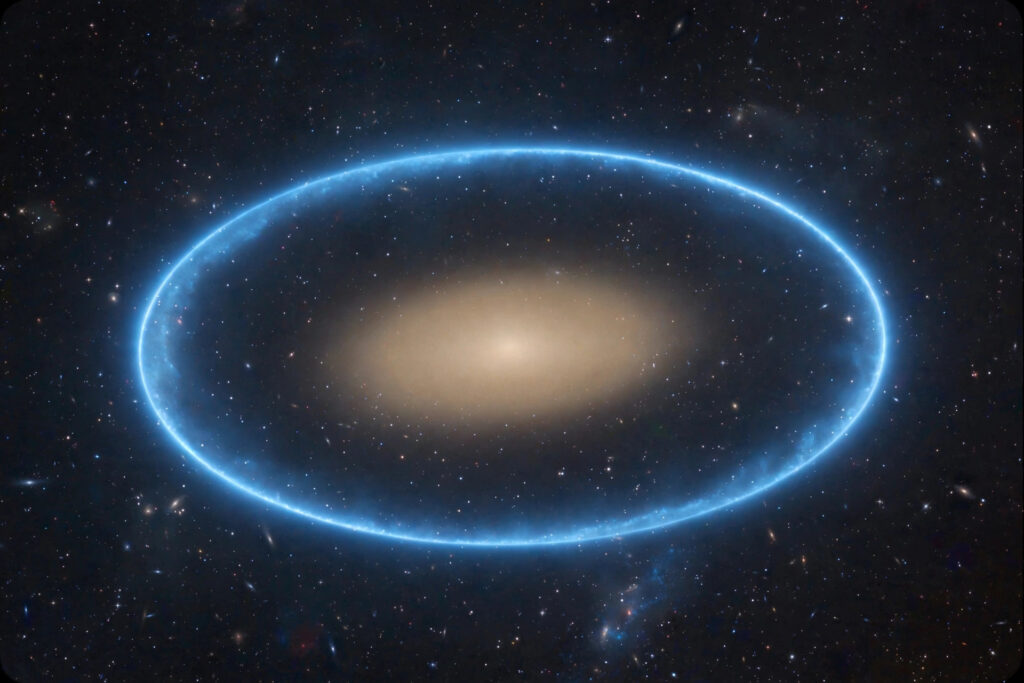
Imagine looking through your telescope and seeing a perfect circle of light floating in the dark, with a galaxy sitting right in the middle of it. Not a smudge, not a dot — an actual glowing ring, as if someone traced a halo around the galaxy with a cosmic pen. It is real, and it has a wonderful name: an Einstein ring.
An Einstein ring happens when three things line up almost perfectly from our point of view: a distant light source (usually a faraway galaxy), a massive object in front of it (a nearer galaxy), and us — the observer. The gravity of the foreground galaxy bends the light from the background galaxy around it, like a lens. When the alignment is close to exact, that bent light spreads into a complete circle. That circle is the Einstein ring.
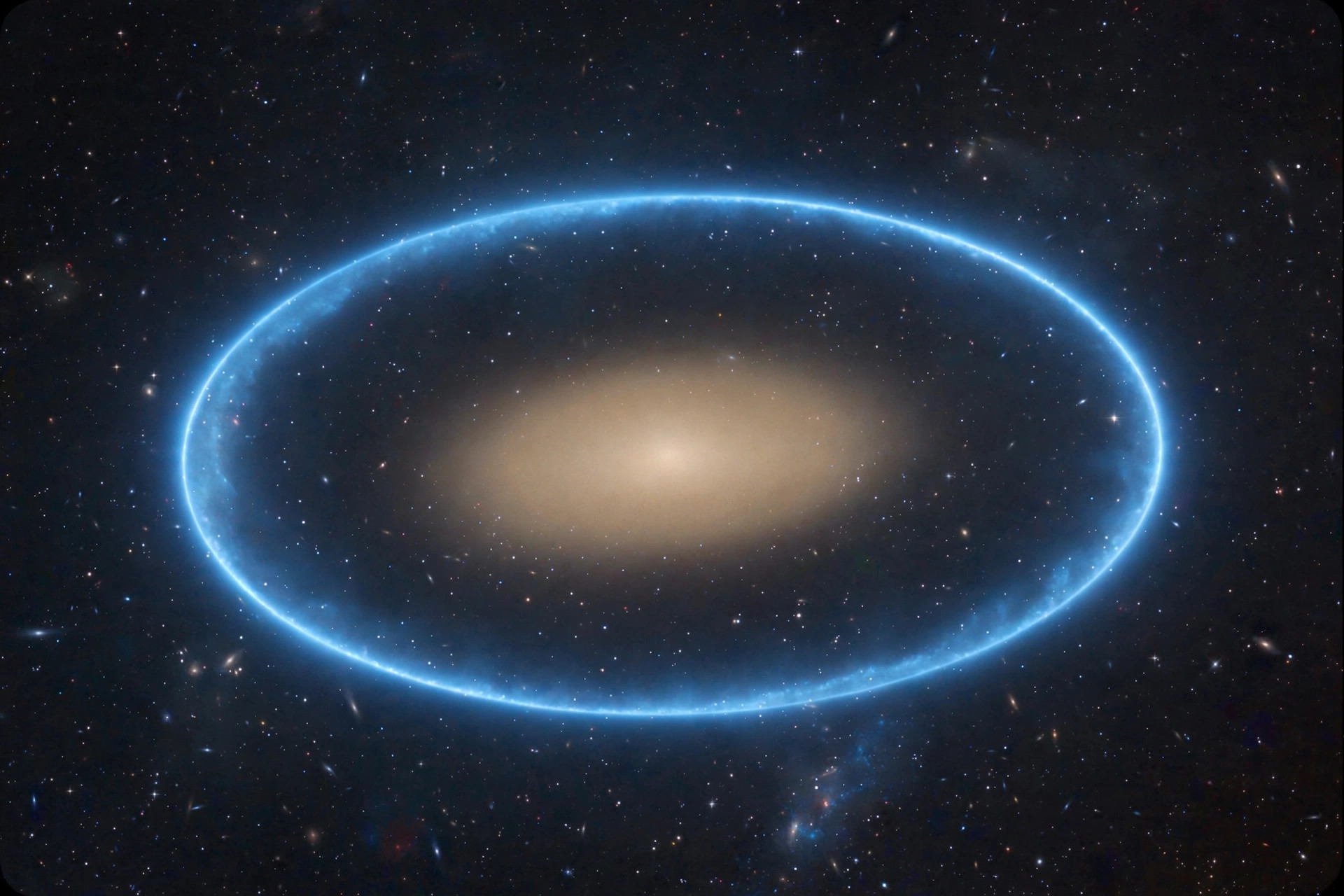
The “Einstein” part comes from Albert Einstein, who predicted this exact effect in 1936. His general theory of relativity said massive objects curve the fabric of space itself, and light traveling through that curved space must bend — not because light has weight, but because it is following the curve of the road it travels on. He worked through the math of the perfectly aligned case and described a ring of light, while assuming the alignment was so improbable nobody would ever see one. He was right about the math, and wrong about the luck. We have now found many.
Here is how I think about it: imagine looking at a candle through the bottom of a wine glass. The thick, curved glass bends the candlelight into a ring. A galaxy does the same thing to a whole galaxy’s worth of light — no glass required, just gravity. Astronomers call this whole family of effects the cosmic magnifying glass of gravitational lensing — and Einstein rings are its most beautiful special case.
Why Perfect Rings Are So Rare
A true, complete Einstein ring demands near-perfect alignment: background source, lensing galaxy, and Earth on essentially a single straight line. The universe is enormous and galaxies are scattered at all angles, so this bullseye is uncommon.
What we see far more often are *partial* rings — arcs. Good-but-imperfect alignment stretches the light into curved segments instead of closing the circle: tilt the wine glass slightly and the ring of candlelight breaks into a smear. Arcs are everywhere in deep-sky images and still extraordinarily useful. Even the best-known “rings” are nearly complete rather than mathematically perfect — real galaxies are lumpy, so real rings come with little brightness wobbles. Perfection in astronomy is always approximate, and still breathtaking.
The Einstein Radius, Explained Simply
When astronomers study these rings, they talk about something called the Einstein radius. The name sounds intimidating, but the idea is refreshingly simple: it is just the size of the ring. More precisely, it is the angular radius — how wide the ring appears on the sky.
Here is the part that makes it powerful. The Einstein radius is not random. It depends on the lensing galaxy’s mass (heavier galaxies make bigger rings) and the two distances involved (lens to us, source to us). We measure the ring’s size directly in images and usually estimate the distances — so we can work backward and calculate the foreground galaxy’s total mass, visible and invisible alike.
That is the secret superpower of Einstein rings: they are scales for weighing galaxies. Since galaxies are stuffed with dark matter — invisible stuff that holds them together but emits no light — the ring’s size gives us one of the most reliable ways to measure how much dark matter a galaxy contains. Astronomy’s most gorgeous images often turn out to be its most precise instruments.
The First Ring: MG1131+0456
The story begins with radio antennas in the New Mexico desert. In early 1987, a team led by MIT astronomer Jacqueline Hewitt was scanning radio sources with the Very Large Array as part of a gravitational-lens survey. One object, MG1131+0456, looked strange: an oval of radio emission with elongated bright spots at the ends. It turned out to be a distant quasar lensed by a nearer galaxy into an almost complete ring — published in *Nature* on June 9, 1988, the first confirmed Einstein ring in history.
It took more than fifty years from Einstein’s 1936 prediction to the first sighting. And a lovely footnote: for over three decades nobody knew how far away MG1131+0456 was. In 2020, a team led by Daniel Stern dug through archived Keck and Chandra data and pinned it down: about 10 billion light-years away. The first Einstein ring took 33 years just to measure its distance. Patience is a legitimate scientific instrument.
The first *complete* optical ring came a decade later: B1938+666, found in 1998 with Hubble. Its lens is an ancient elliptical galaxy; the lensed object is a dark dwarf satellite galaxy we would never have seen without the ring’s magnification — a reminder that rings are natural telescopes, magnifying galaxies far too faint to see otherwise.
The Cosmic Horseshoe
My favorite Einstein ring has a name that sounds like it belongs in a western: the Cosmic Horseshoe. Discovered in 2007 by a team led by Vasily Belokurov at the University of Cambridge using Sloan Digital Sky Survey data, it is a near-perfect arc curving 300-plus degrees around the giant luminous red galaxy LRG 3-757.
At the time it was the largest optical Einstein ring known — about 10.2 arcseconds across, five times any optical ring before it. The lensing galaxy sits about 5 billion light-years away, while the lensed background galaxy is furiously forming stars, seen as it was just 2.8 billion years after the Big Bang. Its light left home more than 10 billion years ago and took a curved detour around a galaxy that was not yet born when the journey started. I never quite get over that.
The Cosmic Horseshoe also proved rings could be found with strategy — searching the right kinds of galaxies with the right colors — rather than pure luck. That idea paid off enormously in the next era.
Euclid’s New Rings, Including One in Our Backyard
ESA’s Euclid space telescope, launched in July 2023, spotted a near-perfect Einstein ring during early testing in September 2023. Archive scientist Bruno Altieri noticed a hint of it in a deliberately out-of-focus test image — around the galaxy NGC 6505, only about 590 million light-years away. Practically next door.
NGC 6505 has been studied since the 19th century, yet nobody had ever seen the ring: it was drowned out by the bright light of the foreground galaxy itself, and it took Euclid’s resolution to pick it out. The ring is the bent light of a background galaxy about 4.42 billion light-years away — one that had never been observed before at all. A brand-new galaxy, discovered by noticing its light smeared into a ring. Announced in February 2025, it was Euclid’s first strong gravitational lens — and it will not be the last. Each new ring is another dark-matter scale and another natural telescope.
What Einstein Rings Teach Us
So why do astronomers get so excited about these circles? Three reasons.
First, they weigh galaxies. The ring’s size encodes the lens’s total mass — stars, gas, and dark matter together — so comparing it to the visible mass yields a direct dark-matter measurement. In the NGC 6505 system, modeling found dark matter makes up roughly 11 percent of the mass within the Einstein radius: a precise dark-matter fraction pulled out of a circle of bent light.
Second, they magnify the distant universe. Lensed background galaxies get stretched and brightened, letting us study early-universe galaxies otherwise far too faint to detect.
Third, they test Einstein himself. General relativity makes specific predictions about how rings should look — their size, symmetry, and response to the lens’s mass. Nearby, well-measured rings are ideal laboratories for checking those predictions. So far, Einstein keeps passing.
Rings Versus Arcs: A Quick Field Guide
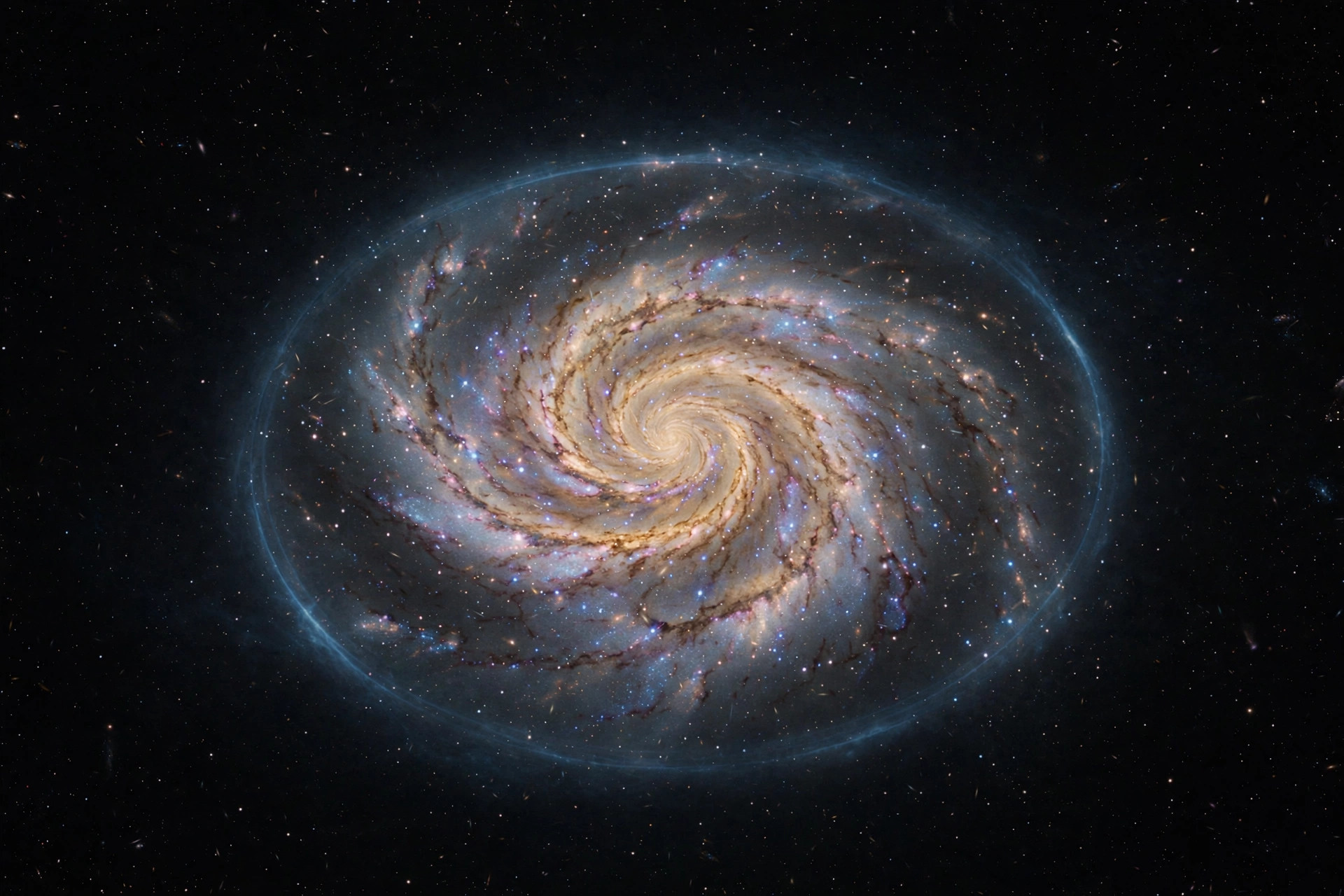
– **Gravitational lensing** is the general phenomenon: any bending of light by gravity. – **An Einstein ring** is the special case of near-perfect alignment: a full or nearly full circle. – **A lensing arc** is good-but-imperfect alignment: a curved, stretched streak — a broken ring. – **Multiple images** are poor alignment: two or four copies of the same object.
If you remember one sentence: an Einstein ring is what happens when a distant galaxy, a massive foreground galaxy, and Earth line up almost exactly, and the foreground galaxy’s gravity bends the distant light into a circle. The circle’s size tells us the galaxy’s mass, its brightness reveals otherwise-hidden galaxies, and its shape tests a century-old theory.
Albert Einstein, in 1936, working from his general theory of relativity. He calculated that a perfectly aligned massive object would bend background light into a ring — but thought the alignment so rare nobody would ever see one.
MG1131+0456 was observed in early 1987 by Jacqueline Hewitt’s team using the Very Large Array, and published in *Nature* on June 9, 1988. The first *complete* optical ring, B1938+666, was found in 1998 with Hubble.
It is the size of the ring — its angular radius on the sky. Since it depends on the lensing galaxy’s mass and the distances involved, measuring it lets astronomers calculate the galaxy’s total mass, including its dark matter.
They need near-perfect alignment of source, lens, and observer. Slight misalignments produce arcs or multiple images instead. Real galaxies are also lumpy rather than symmetric, so even famous “rings” are nearly complete rather than mathematically perfect.
A nearly complete Einstein ring discovered in 2007 by Vasily Belokurov’s team. Its light comes from a star-forming galaxy about 10 billion light-years away, bent around the luminous red galaxy LRG 3-757. At discovery it was the largest optical Einstein ring known.
The ring’s size encodes the lensing galaxy’s total mass — visible matter plus dark matter. Subtracting the visible mass gives a direct measurement of the dark matter content; the NGC 6505 ring yielded a dark-matter fraction of roughly 11 percent within its Einstein radius. —