Pull-Up Muscles Worked: What This Exercise Actually Trains


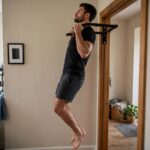
“Pull-ups work your back.” True, but about as useful as saying “squats work your legs.” The pull-up is one of the most muscularly complex upper-body movements in the gym — it recruits everything from your lats to your forearms to your abs, and different grip variations shift the emphasis in ways that genuinely change the training effect. Understanding what’s actually working lets you program smarter: you’ll know why your biceps are sore after chin-ups but your lats are wrecked after wide-grip pull-ups, and you’ll know which variation to pick for your goal.
Here’s the full anatomical breakdown from fifteen years of coaching this lift: the primary movers, the secondary helpers, the stabilizers nobody talks about, and how each grip variation changes the equation.
Primary Movers: The Engine Room
Latissimus Dorsi (Lats)
The big wings on your back are the prime mover of every pull-up variation. The lats perform shoulder adduction and extension — pulling your upper arm down and back toward your body — which is the fundamental motion of the lift. When people talk about “back width,” they’re talking about lat development, and nothing builds it like vertical pulling. EMG studies consistently show pull-ups among the highest lat-activation exercises available, which matches what every coach sees: consistent pull-up training builds a back you can’t get from machines alone.
The lats work hardest in the bottom two-thirds of the rep, where the arm is moving through its largest arc. This is why the dead-hang start matters so much — skipping it shortens the range where the lats do their best work. If your lats aren’t sore after pull-up day, your arms are doing too much of the job (see the form cues in my pull-up technique guide).
Biceps Brachii and Brachialis
Your elbow flexors are the second-biggest contributor. The biceps work hardest near the top of the rep, finishing the pull once the lats have done the heavy lifting through the middle. The brachialis — the muscle underneath the biceps — contributes throughout and is a major reason pull-ups build thick arms, not just a wide back. Anyone who says pull-ups “don’t build arms” has never done high-volume chin-ups. For direct arm work to supplement this, my arm exercise guide covers the isolation side.
Teres Major and Posterior Deltoid
The teres major — sometimes called “the lat’s little helper” — assists shoulder extension and adduction through the whole rep. The rear delts contribute as well, particularly in wider grips where the arms travel through more horizontal abduction. These smaller muscles are why wide-grip pull-ups leave your entire upper back sore, not just your lats.
Secondary Muscles: The Support Crew
Rhomboids and Middle Trapezius
These mid-back muscles retract and stabilize your shoulder blades during every rep. They’re not prime movers, but they’re working hard isometrically — holding the scapulae in position while the lats pull. Weak rhomboids show up as shoulder blades that wing or shrug during reps. Heavy rowing builds these directly, which is one reason rows and pull-ups complement each other so well in a complete back program.
Lower Trapezius
The lower traps depress the shoulder blades — the “shoulders away from ears” position that initiates every good rep. Underdeveloped lower traps are epidemic among desk workers, and pull-ups are one of the best ways to wake them up. That deep burn between your shoulder blades after high-rep sets? That’s the lower traps doing their job.
Forearms and Grip Muscles
Everything from your brachioradialis to the small muscles of your hand works to keep you on the bar. Grip is the silent limiter of pull-up performance — your lats might have five more reps in them, but if your hands open, the set is over. This is why dead hangs and farmer’s carries show up in every pull-up program I write: the pulling muscles can’t express strength the grip can’t hold.
Stabilizers: The Unsung Heroes
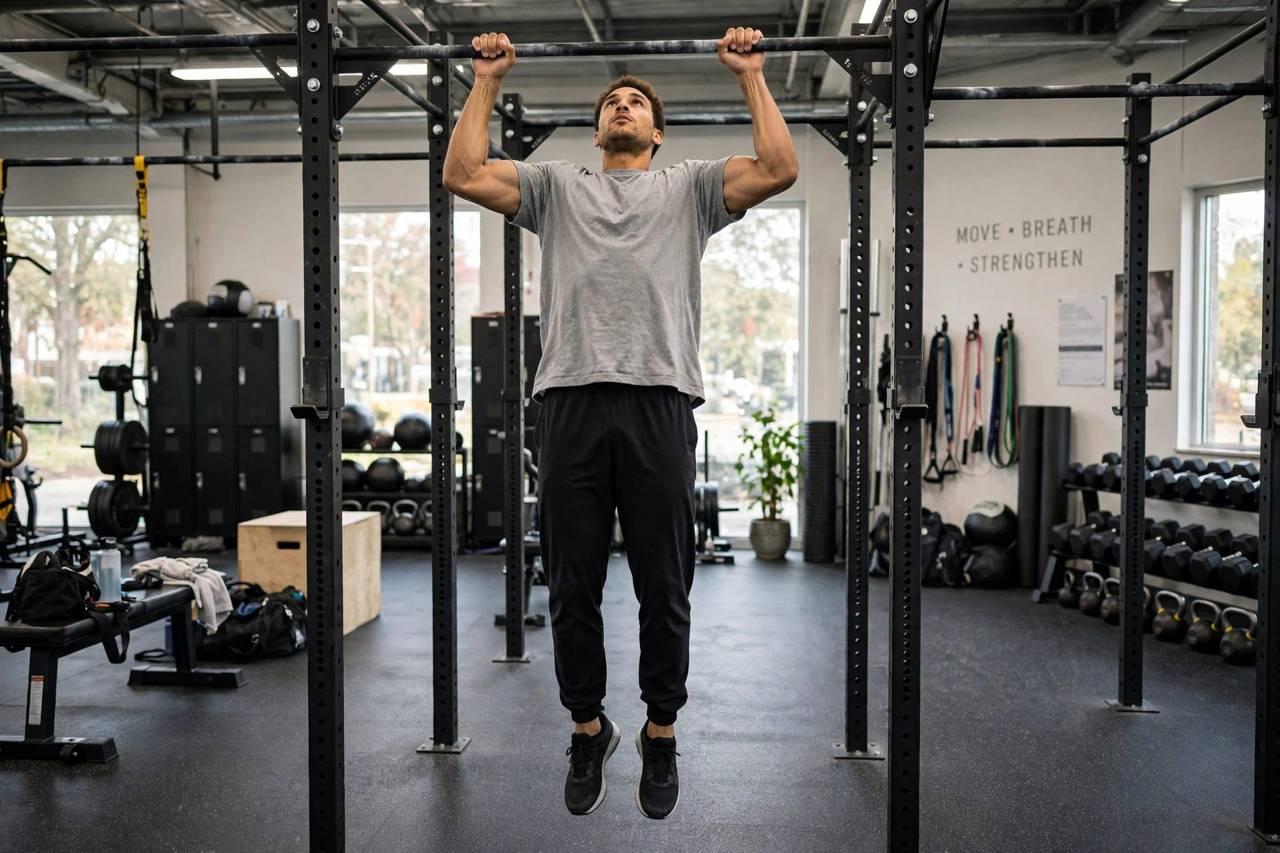
Here’s what separates pull-ups from the lat pulldown machine: your body has to stabilize itself in space. That recruits a whole layer of musculature the machine never touches.
Core (rectus abdominis, obliques, transverse abdominis): Your entire midsection braces to keep the body rigid and prevent swinging. The hollow-body position is essentially a moving plank — which is why people with strong pull-ups usually have strong cores without doing endless crunches. Anti-swing is an ab workout.
Rotator cuff: The four small cuff muscles stabilize the shoulder joint through the full range, especially at the bottom where the joint is most vulnerable. This stabilizing demand is why pull-ups build shoulder health alongside strength — when done with proper form. It’s also why sloppy, kipping reps without a strict base are risky: the cuff can’t stabilize what the prime movers are yanking around.
Glutes and legs: Squeezed glutes lock the lower body into the rigid lever. They’re not moving anything, but without them the whole structure falls apart. Lower-body tension is the difference between a clean rep and a swingy one.
Pectoralis minor and serratus anterior: These small chest and rib muscles help position the scapula during the pull. They’re minor contributors, but they’re part of why pull-ups feel like a “whole upper body” exercise rather than an isolated one.
The takeaway: a pull-up is nearly a full upper-body movement. That’s why it deserves its place as a cornerstone lift, and why the compound vs. isolation debate isn’t really a debate for this exercise — it’s about as compound as upper-body training gets.
How Grip Variations Change Muscle Emphasis
Same bar, different hands, meaningfully different training effect. Here’s how the main variations shift the load:
Standard pull-up (pronated, slightly wider than shoulders): Maximum lat emphasis, moderate bicep involvement. The classic back-builder. The wider hand position increases the lats’ mechanical advantage and reduces the biceps’ contribution — which is exactly what you want for back development.
Chin-up (supinated, shoulder width): Shifts significant load to the biceps and brachialis. Most people can do 2 to 3 more chin-ups than pull-ups because the biceps are stronger elbow flexors in the supinated position. Best choice when arm development is the priority, or as a slightly easier variation for building volume.
Neutral grip (palms facing each other): The joint-friendly middle ground. Good lat activation, strong bicep contribution, and the most comfortable position for shoulders and elbows. If you have cranky elbows, neutral grip is usually the variation that lets you keep training. I program these heavily for clients over 40.
Wide grip: Slightly more lat and teres emphasis, slightly less bicep — but with reduced range of motion and more shoulder stress. The difference in lat activation versus standard width is smaller than gym lore suggests, while the joint cost is real. I don’t program ultra-wide grips; slightly-wider-than-shoulders gets you 95 percent of the benefit with none of the risk.
Close grip: More bicep and lower-lat emphasis, longer range of motion. A useful variation for arm-focused blocks, but watch the wrists — very close pronated grips can irritate them.

Pull-Up vs. Chin-Up: What’s the Real Difference
Since this is the most argued-about distinction in pulling, let’s settle it with mechanics rather than opinions. The pull-up (overhand) puts the biceps at a mechanical disadvantage, forcing the lats and upper back to do more of the work — it’s the better back-builder. The chin-up (underhand) lets the biceps contribute maximally, making it the better arm-builder and the easier variation for most people.
EMG research backs this up: lat activation is similar between the two, but bicep activation is significantly higher in chin-ups. In practice, I program both. Pull-ups as the primary heavy variation for back development, chin-ups as the secondary variation for volume and arm growth. They’re not competitors — they’re complements. Anyone who tells you one is “better” is selling simplicity, not results.
Programming by Muscle Goal
Goal: wider back. Standard-grip pull-ups, 4 to 5 sets of 6 to 10 reps, twice a week. Add weight when you hit 10 clean reps. Supplement with heavy rows for thickness. The lats respond to progressive overload like any muscle — the variation matters less than adding reps or load over time.
Goal: bigger arms. Chin-ups, 4 sets of 8 to 12, plus neutral-grip work. The supinated grip loads the biceps through a full range under heavy load — it’s one of the best bicep builders that exists, and it doesn’t require a single curl. Add direct arm work after if you want, but the chin-up is doing the heavy lifting (literally).
Goal: max pull-up numbers. Train the specific variation you’re testing — specificity rules. But rotate a secondary variation every 4 weeks to avoid overuse and staleness. Volume in the 30 to 50 rep range per session, 2 to 4 times weekly depending on the phase.
Goal: shoulder health. Neutral grip, moderate volume, perfect form, full dead hangs. The combination of loaded scapular depression and rotator cuff stabilization is genuinely therapeutic for most cranky shoulders — provided you build up gradually and never train through sharp pain.
Goal: full upper-body development. Rotate all three main grips across the week: pull-ups on day one, chin-ups on day two, neutral grip on day three. You hit every muscle in the chain with slightly different emphasis, and the variety keeps elbows and shoulders happy long-term.
Frequently Asked Questions
Minimally. The pectoralis minor assists with scapular positioning, but the chest is not a meaningful contributor to pull-ups. If your chest is sore after pull-ups, your form is likely off — possibly shrugging or pulling with internally rotated shoulders. Pull-ups are a back, bicep, and core exercise; train chest separately.
Yes, as stabilizers. Your entire core braces hard to prevent swinging and maintain the hollow-body position — it’s essentially a moving plank. You won’t build visible abs from pull-ups alone (that’s body fat), but the core strength transfer is real. People with strong pull-ups rarely have weak midsections.
The standard pronated grip, slightly wider than shoulder width, maximizes lat involvement by putting the biceps at a mechanical disadvantage. That said, lat activation differences between grips are smaller than commonly claimed — progressive overload matters far more than grip width. Pick the grip your shoulders tolerate and add weight or reps over time.
Yes — especially chin-ups (underhand grip), which load the biceps heavily through a full range of motion under your entire bodyweight. Many lifters build impressive arms with high-volume chin-ups and minimal curl work. Standard pull-ups build the brachialis well too. For maximum arm growth, chin-ups are the variation to prioritize.
Because your arms are doing the lats’ job — the classic sign of poor scapular initiation. You’re pulling with bent-arm yanking instead of depressing the shoulder blades first. Fix it with scapular pull-ups as a warm-up and the “elbows to ribs” cue. Within two weeks the soreness should migrate to your lats, where it belongs.
The pull-up isn’t a back exercise or an arm exercise — it’s an upper-body exercise that happens to build the best back in the gym as a side effect. Train it with intent, vary the grip with purpose, and let the anatomy do the work.