B2B vs B2C Sales Cycles: Length, Stages, and How to Sell Faster


I once watched a founder lose a $80,000 deal because he followed up like he was selling shoes. Three emails in four days, a ‘limited time discount,’ and a final ‘just checking in!’ The prospect — a VP evaluating vendors for a six-month rollout — went silent forever. He wasn’t rude. He was just done with someone who clearly didn’t understand how buying works in his world.
The sales cycle is the invisible architecture underneath every revenue number. B2B and B2C cycles don’t just differ in length — they differ in shape, in who participates, and in what kills deals at each stage. Understand the architecture and you stop fighting it.
How Long Each Cycle Really Takes
Let’s start with honest numbers. A typical B2C sales cycle — from first awareness to purchase — runs a few minutes to a few weeks. Impulse buys happen in seconds. Considered purchases like mattresses or laptops might take 2–4 weeks of research. Even big-ticket consumer items like cars rarely exceed 2–3 months. hiring your first employee
B2B cycles start where B2C ends. Small B2B purchases (under $5,000, single decision-maker) can close in 2–6 weeks. Mid-market deals ($5K–$100K) typically run 3–6 months. Enterprise deals ($100K+) routinely take 6–18 months, and I’ve seen complex infrastructure sales stretch past two years.
Why the gap? It’s not that B2B buyers are slow — it’s that the cost of being wrong is career-level. A consumer who buys the wrong headphones loses $200. A manager who buys the wrong CRM loses a year of team productivity and possibly their credibility. The cycle length is proportional to the risk, and smart sellers respect that instead of resenting it.
The B2C Cycle: Five Fast Stages
Stage one is trigger — the buyer realizes they want something. Marketing’s job here is visibility: be present when the want forms. Stage two is research, and it’s gotten brutally short. Most consumers check reviews, compare two or three options, and decide within days.
Stage three is evaluation, which in B2C mostly means price and social proof comparison. Stage four is purchase — and here’s where B2C lives or dies on friction. Every extra click, every forced account creation, every surprise shipping fee murders conversion. Amazon didn’t win on price; it won on one-click.
Stage five is post-purchase, which too many B2C sellers ignore. The unboxing, the follow-up email, the easy return — this stage determines whether you get a repeat customer or a one-star review. In subscription and repeat-purchase businesses, post-purchase IS the sales cycle, running continuously.

The B2B Cycle: Seven Slow Stages
B2B starts with problem identification — and here’s the kicker, the buyer often doesn’t know your category exists yet. The best B2B marketing creates the problem awareness, not just the solution awareness. If you wait until they’re comparing vendors, you’re already late.
Stage two is requirements gathering: the buying team defines what they need. Smart sellers try to influence these requirements early, because whoever shapes the criteria usually wins the deal. This is why ‘educational’ content is actually competitive strategy.
Stage three is vendor research — the long list. Stage four is evaluation — the short list, demos, trials, reference calls. This is where most of the calendar time goes, and where deals go quiet. Silence doesn’t mean disinterest; it usually means internal meetings you’re not invited to.
Stage five is negotiation and procurement, which has its own timeline entirely. Legal reviews, security questionnaires, budget approvals — each can add weeks. Stage six is decision and signature. Stage seven is implementation and onboarding, which determines whether the deal expands or churns in year two.
My B2B vs B2C overview covers the structural differences behind these stages if you want the full picture.
Where Deals Actually Die
In B2C, deals die at checkout. The data is unambiguous: roughly 70% of online shopping carts are abandoned. The killers are surprise costs, forced registration, slow pages, and limited payment options. Fix these and you fix most of the problem — it’s gloriously mechanical.
In B2B, deals die in the dark middle — stages three through five. The causes are different: champion leaves the company, budget gets reallocated, a competitor reframes the requirements, or the buying team simply loses momentum. The number one killer of B2B deals isn’t a competitor. It’s no decision — the status quo wins by default.
This changes your entire approach. B2C optimization is about removing friction at the moment of purchase. B2B optimization is about maintaining momentum across months of silence. Different disease, different medicine.

How to Shorten a B2B Cycle (Without Being Pushy)
You can’t turn a six-month cycle into a two-week one. But you can shave 20–30% off with the right moves. First, multi-thread early — get to three or more stakeholders in the first month. Single-threaded deals die when your one contact goes on vacation.
Second, front-load the hard questions. Ask about budget, timeline, and decision process in the first real conversation. Sellers avoid this because it feels pushy; in reality, buyers respect it. Nothing wastes more time than a four-month ‘opportunity’ with no budget.
Third, make the internal sell easy. Your champion has to pitch you to people you’ve never met. Give them a one-page business case, an ROI summary, and answers to the objections their boss will raise. You’re not just selling to your contact — you’re arming them to sell for you. starting a business
Fourth, create legitimate urgency tied to their timeline, not yours. ‘Discount expires Friday’ is your urgency. ‘Your current contract renews in March and migration takes eight weeks’ is their urgency. Only the second one works.
How to Speed Up a B2C Cycle
B2C speed is almost entirely about friction and timing. Offer guest checkout. Show total price early. Make mobile flawless — most of your traffic is on phones and most of your drop-off is there too.
Retargeting windows matter more than most stores realize. Someone who abandoned a cart yesterday is hot; someone from 30 days ago is cold. Tier your follow-up: email within hours, SMS within a day for high-value carts, then let it go. Chasing cold carts with escalating discounts just trains customers to abandon on purpose.
Social proof near the buy button shortens deliberation. Reviews, ‘bought X times this week,’ stock indicators — these aren’t gimmicks, they’re decision accelerators. The B2C buyer wants permission to stop researching and just buy. Give it to them.
Measuring Cycle Health
Track cycle length by segment, not just overall. Your average might be 90 days while enterprise deals take 200 and SMB takes 30 — one number hides three different realities. Segment by deal size, industry, or lead source and optimize each separately.
Watch stage-to-stage conversion, not just overall win rate. If 80% of deals die between demo and proposal, your problem isn’t lead quality — it’s your demo or your follow-up. The stage where deals stall tells you exactly what to fix.
And benchmark against yourself, not the industry. ‘Average B2B cycle’ statistics are nearly useless because they blend software with manufacturing with services. Your trend line matters more than anyone else’s number. If your cycle is shrinking quarter over quarter, your process is improving — that’s the signal.
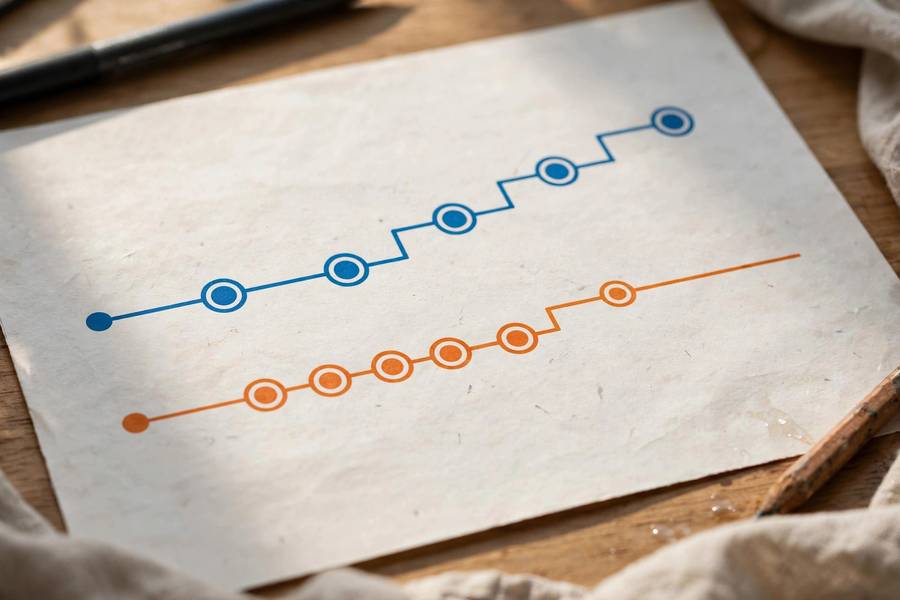
Red Flags: When Your Cycle Is Broken
Some cycles are long by nature. Others are long because the process is broken. Here’s how to tell the difference.
Red flag one: the same stage always stalls. If every deal slows down at legal review, your problem isn’t selling — it’s contracting. Standardize your terms, offer a pre-approved ‘fast track’ agreement for deals under a threshold, and get legal involved earlier instead of at the finish line. I’ve seen this single fix cut enterprise cycles by three weeks.
Red flag two: you’re always surprised. If deals you marked ‘commit’ keep slipping, your qualification is broken, not your closing. Implement a real qualification framework — budget, authority, need, timeline — and be ruthless about it. A pipeline full of unqualified deals isn’t a pipeline; it’s a fantasy.
Red flag three: discounting increases as the quarter ends. This means you’ve trained buyers to wait. The fix is painful but simple: hold pricing discipline for one quarter and let a few deals slip. Your win rate will dip temporarily, then recover — and your margins and cycle predictability will improve permanently. The companies with the shortest cycles are usually the ones that discount least, because their buyers learn that waiting gains them nothing.
In B2C, the equivalent red flag is a sudden conversion drop with no traffic change — usually a broken checkout, a new shipping fee, or a competitor’s promotion. B2C diagnosis is faster because the feedback loop is days, not quarters. Use that speed: test checkout changes weekly, not quarterly.
It varies wildly by deal size: 2–6 weeks for small purchases under $5K, 3–6 months for mid-market deals, and 6–18 months for enterprise. The key variable is risk — the more the buyer stands to lose from a wrong choice, the longer the cycle.
The top killer is ‘no decision’ — the status quo wins by default. Other common causes: champion leaves, budget gets reallocated, or the buying team loses momentum during long evaluation phases.
Ecommerce averages 2–3%, but the more useful metric is cart abandonment (around 70% industry-wide). Most B2C revenue leaks happen at checkout, not at the ad.
By 20–30%, yes. Multi-thread early, qualify budget up front, arm your champion with internal selling tools, and tie urgency to the buyer’s timeline rather than yours.