An ecommerce store is an ecommerce store, right? You list products, people buy them, you ship. That assumption has killed more B2B ecommerce projects than any other single misconception I’ve encountered in twenty years of advising companies.
The truth: B2B and B2C ecommerce are different species that happen to share a shopping cart icon. Pricing logic, checkout flow, catalog structure, payment terms, and the entire post-purchase experience diverge sharply. Build a B2C store for B2B buyers and they’ll bounce — not because your products are wrong, but because your store doesn’t speak their language.
Table of Contents
- Catalog and Product Discovery
- Pricing: Public vs Negotiated
- Checkout and Payment Terms
- Account Structure and Permissions
- Marketing and Customer Acquisition
- Fulfillment and Post-Purchase
- Choosing the Right Platform
- Key Takeaways
- Common Mistakes When Building for the Wrong Buyer
Catalog and Product Discovery
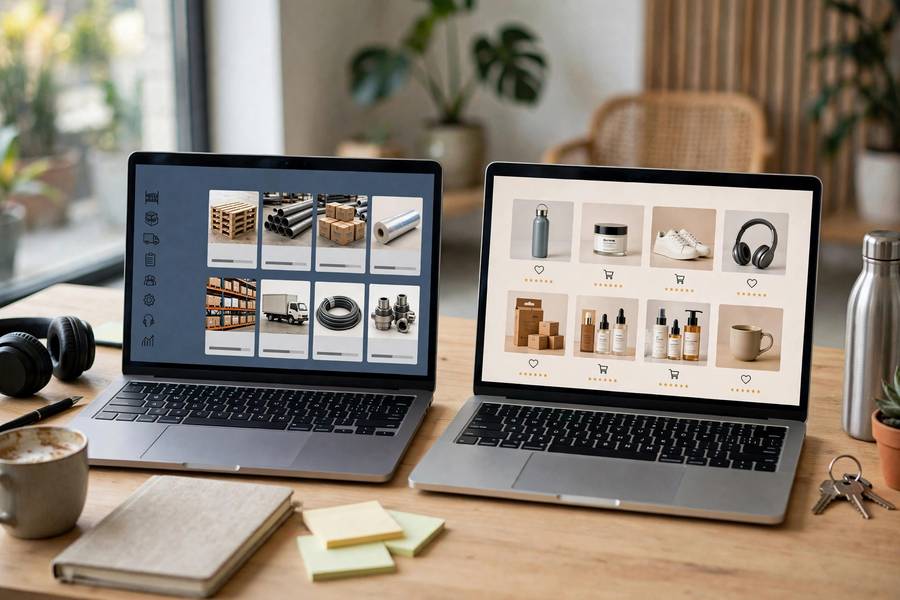
B2C catalogs are built for browsing and desire. Rich imagery, lifestyle photography, curated collections, ‘you may also like’ — the entire experience is designed to make someone who arrived for one thing leave with three. Search is simple because the buyer usually knows what they want in plain language.
B2B catalogs are built for specification and repeat ordering. Your buyer knows the exact SKU, the technical spec, or the part number — they need to find it in seconds, reorder it in bulk, and see contract pricing applied automatically. Faceted search by technical attributes isn’t a nice-to-have; it’s the core interface.
The practical difference: B2C invests in discovery (inspiration, recommendations, content). B2B invests in retrieval (search accuracy, bulk order forms, saved lists, punchout catalogs that integrate with the buyer’s procurement system). A B2B store without quick-order-by-SKU is like a B2C store without product photos — technically functional, commercially dead.
Pricing: Public vs Negotiated
B2C pricing is public, simple, and psychological. Three tiers, charm pricing, strikethrough discounts, free-shipping thresholds. The buyer sees the price, compares it in seconds, and decides. Transparency is the expectation — hidden pricing in B2C reads as shady.
B2B pricing is tiered, negotiated, and often invisible until login. Customer-specific price lists, volume breaks, contract terms, quote-based pricing for large orders — the price a buyer sees depends on who they are. This isn’t deception; it reflects real cost differences in serving a 10-unit buyer versus a 10,000-unit buyer.
The technology implication is significant. Your B2B platform must support customer groups, custom price lists, quote workflows, and approval chains. Shopify and WooCommerce can do this with apps and extensions, but it’s not their native strength — platforms like BigCommerce (B2B Edition) or Adobe Commerce were built for exactly this complexity.

Checkout and Payment Terms
B2C checkout is a sprint: guest checkout, digital wallets, one-click, done in under a minute. Every field you add costs you conversion. Payment is immediate — credit card, PayPal, Apple Pay, buy-now-pay-later. The transaction ends when the payment clears.
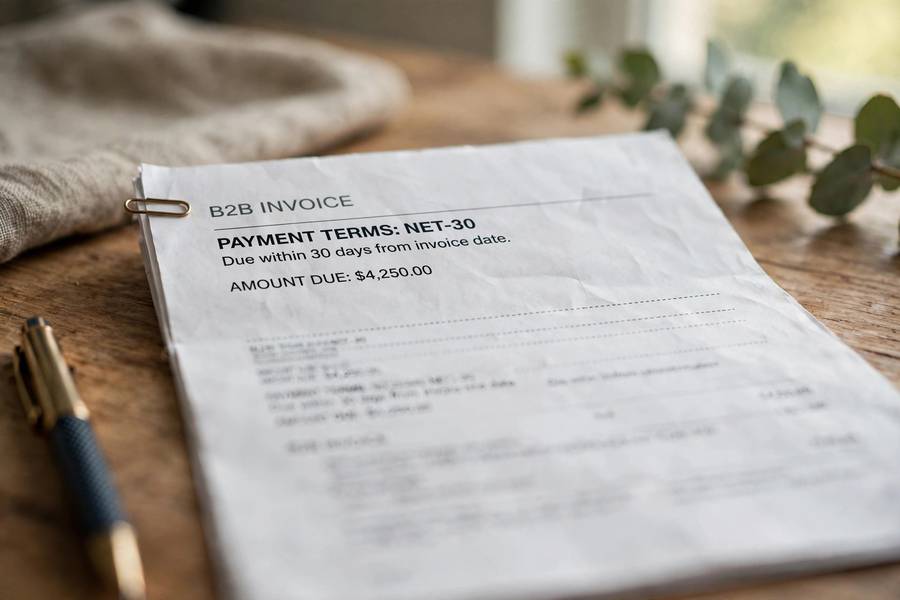
B2B checkout is a workflow: purchase orders, net-30/60/90 payment terms, credit limits, multi-level approvals. The buyer placing the order often isn’t the one paying for it. Your checkout must support ‘order now, pay later on terms’ — which means credit checks, spending limits per user role, and integration with the buyer’s accounts payable.
This is where most B2B ecommerce projects underestimate scope. It’s not just a store with different prices — it’s a store wired into the customer’s procurement process. Get the payment terms wrong and the best catalog in the world won’t save you, because the buyer’s finance team will veto the purchase.
Account Structure and Permissions
B2C accounts are individual: one person, one cart, one order history. Personalization means recommendations based on browsing. Simple.
B2B accounts are organizational: a company with multiple users, roles, and permissions. The purchaser can order up to $5,000; the manager approves up to $50,000; finance sees all invoices. Order history belongs to the company, not the individual — critical when your contact changes jobs and their replacement needs continuity.
Self-service is the B2B battleground. The best B2B stores let buyers check order status, download invoices, manage users, and reorder favorites without calling anyone. Every phone call your store eliminates is margin earned — B2B support calls cost $6–$12 each, and they scale linearly with revenue unless your self-service is excellent.
Marketing and Customer Acquisition
B2C ecommerce marketing is traffic volume: SEO for product keywords, paid social, influencers, email flows for abandonment and win-back. The funnel is wide and fast — thousands of visitors converting at 2–3%.
B2B ecommerce marketing is account targeting: SEO for problem keywords (not product keywords — buyers search the problem first), LinkedIn, trade publications, and sales-assisted onboarding for key accounts. The funnel is narrow and slow — dozens of qualified accounts converting at much higher values.
The content strategy diverges completely. B2C content is lifestyle and comparison (‘best X for Y’). B2B content is specification and proof (‘how [company] cut procurement costs 30%’). Same format — articles, video — utterly different substance. For the strategic layer above tactics, my B2B vs B2C guide covers how the models shape every marketing decision.

Fulfillment and Post-Purchase
B2C fulfillment is optimized for speed and delight: same-day shipping, beautiful packaging, easy returns. The unboxing is marketing. Returns are expected — 20–30% in apparel — and the return experience determines whether the customer ever comes back.
B2B fulfillment is optimized for reliability and integration: scheduled deliveries, pallet quantities, advance shipping notices, EDI integration with the buyer’s warehouse system. The delivery isn’t marketing — it’s operations. A late B2B shipment doesn’t lose one order; it can lose the account.
Returns work differently too. B2C returns are consumer-friendly by law and expectation. B2B returns are governed by contract terms — restocking fees, RMA processes, warranty claims. Your policies need to reflect commercial reality, not consumer protection norms.
Choosing the Right Platform
For B2C, the choice is straightforward: Shopify dominates for good reason — ease of use, app ecosystem, and checkout optimization. WooCommerce works for content-led brands. The decision is mostly about team skill and budget.
For B2B, evaluate differently. Ask: does it support customer-specific pricing natively? Quote workflows? Multi-user accounts with permissions? Punchout/EDI integration? Net terms checkout? If the answer to three or more is ‘via app’ or ‘custom development,’ keep looking.
The hybrid play — serving both B2B and B2C — usually means either two storefronts or a platform with genuine B2B depth. Trying to bolt B2B onto a pure B2C platform produces the worst of both: a consumer experience cluttered with B2B complexity, and B2B buyers fighting a checkout built for impulse purchases.
Whatever you build, get the business foundation right first — entity, taxes, liability. My LLC formation guide is the practical starting point most ecommerce founders skip until it costs them.
Key Takeaways
B2B and B2C ecommerce differ in catalog design (discovery vs retrieval), pricing (public vs negotiated), checkout (instant vs terms-based), accounts (individual vs organizational), and fulfillment (delight vs reliability). The platforms, marketing, and metrics follow from these structural differences.
Build for the buyer you actually have. A B2B store needs SKU search, contract pricing, and procurement integration. A B2C store needs speed, simplicity, and social proof. Get the fundamentals right and the technology choices become obvious.
Common Mistakes When Building for the Wrong Buyer
I’ve audited enough ecommerce builds to spot the failure patterns blindfolded. The most expensive mistake is building B2C and bolting on B2B later — usually when a big account asks for terms and the founder hacks together a manual process. Six months later they’re drowning in spreadsheets, manual invoices, and pricing errors. If there’s any chance you’ll serve business buyers, architect for it from day one, even if you launch B2C-first. starting a business
The mirror mistake is over-engineering: building full B2B complexity — quotes, approvals, EDI — for what turns out to be a straightforward B2C business. Every feature you build for a buyer you don’t have is maintenance cost with zero return. Start with the buyer in front of you; add complexity when real accounts demand it, not when you imagine they might.
A subtler error is copying competitors’ feature lists instead of studying buyer behavior. Your competitor’s B2B portal has punchout integration because their top three accounts required it — not because it’s best practice for everyone. Talk to your actual buyers about how they want to order before you spec the build. Ten customer conversations will save you more than any platform comparison matrix.
Finally, don’t neglect the human layer. The best B2B ecommerce still has a phone number answered by someone who knows the products, and the best B2C still has reviews from real buyers. Technology serves the relationship; it doesn’t replace it. Build the store for the buyer, staff the experience for the human, and the model takes care of itself.
B2C ecommerce optimizes for fast individual purchases with public pricing and instant checkout. B2B ecommerce handles negotiated pricing, bulk orders, payment terms, and multi-user company accounts.
For simple B2B (small catalogs, basic volume discounts), yes with apps. For complex B2B — customer-specific pricing, quotes, punchout, net terms — consider BigCommerce B2B Edition or Adobe Commerce.
Because the person ordering usually isn’t the person paying. B2B checkout must handle purchase orders, credit limits, approval chains, and net payment terms tied to the buyer’s finance processes.
They search by SKU, part number, or technical specification — not by browsing lifestyle imagery. Fast accurate retrieval beats inspirational discovery in B2B catalogs.