Email Marketing for Small Business Beginners (Your First 5 Emails)


If I had to save one marketing asset from a burning business, it would be the email list. Not the social following, not the website traffic — the list. Here’s why: you own it. No algorithm decides who sees your emails. No platform can throttle your reach or ban your account. An email list is the only audience you truly control, and for small businesses, it consistently produces the highest revenue per hour of effort of any marketing channel.
Yet most beginners overcomplicate email marketing into paralysis — researching platforms for weeks, designing templates, planning elaborate sequences. You need none of that to start. You need a list, five emails, and a monthly rhythm. This guide covers exactly that. For the retention strategy email supports, see our article on retaining customers in a small business — both essential plays in how to grow a small business.
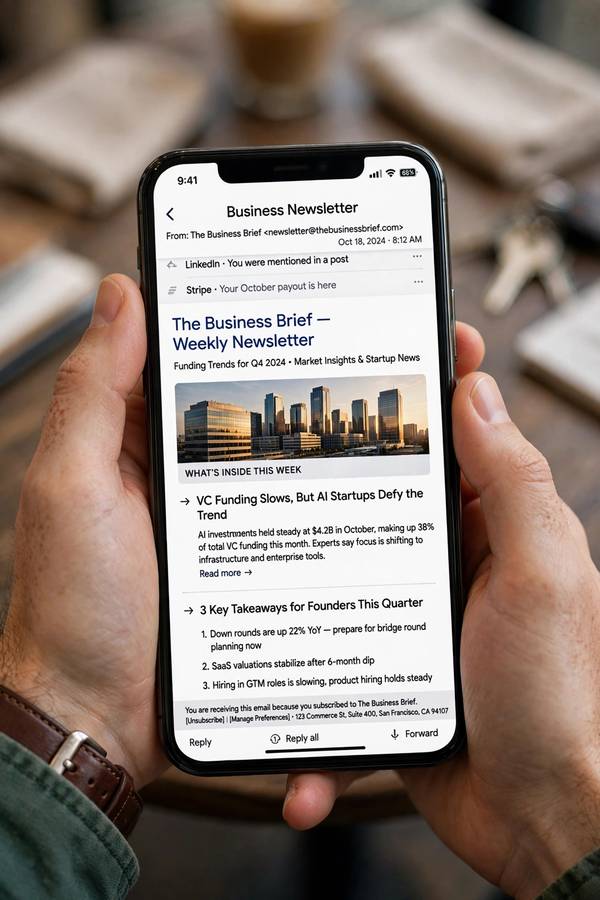
Why Email Beats Social for Small Business
The math is straightforward. A typical small business email list sees 20–40% open rates — meaning a fifth to nearly half your audience actually sees your message. Organic social reach hovers in the low single digits. Same effort, 10x the visibility.
Then there’s intent. Email subscribers opted in — they asked to hear from you. Social followers tapped a button once, maybe accidentally, three years ago. The email audience is warmer by definition.
And the economics: email marketing costs almost nothing at small list sizes (most platforms are free under 500–1,000 subscribers). Your cost per send is fractions of a cent. Compare that to paid social, where every impression costs money, or organic social, where every post costs hours for minimal reach.
Finally, email drives action. It’s where promotions convert, where announcements land, where the “we’re having a sale this weekend” message actually reaches people in time. Social is for discovery; email is for revenue. You need both eventually, but if you’re choosing where to invest first, the list wins.
Starting Your List From Zero
Zero subscribers is fine — everyone starts there. What matters is building the collection habit into every customer interaction:
At the point of sale. “Can I email you the receipt — and add you to our list for occasional updates?” The receipt email is the highest-opened email you’ll ever send; the signup ask rides along naturally. For online stores, the checkout opt-in checkbox does this automatically.
On your website. One signup form, above the fold or as an exit popup. Offer a reason: a discount on first purchase, a useful guide, early access to new products. “Join our newsletter” converts poorly; “Get 10% off your first order” converts well. The incentive just needs to be real and immediate.
In person. A simple signup sheet or tablet at the counter. “We send one email a month with [specific benefit] — want in?” Train staff to ask; make it part of the checkout script.
At events. Markets, fairs, workshops — anywhere you meet potential customers. A clipboard with a clear value proposition collects dozens of emails per event.
From existing contacts. Past customers, inquiry emails, quote requests — anyone who’s done business with you or asked about it. (With proper permission — see the legal section.)
The golden rule: never buy an email list. Purchased lists are full of dead addresses, spam traps, and people who never asked to hear from you. They destroy your deliverability — meaning your emails start landing in spam for everyone, including legitimate subscribers. Build it person by person. A list of 200 real customers outperforms a purchased list of 20,000 every time.
Picking a Platform Without Overthinking
Beginners agonize over this choice. Don’t. Any established email platform handles the basics: signup forms, sending, basic automation, unsubscribe management. The differences only matter at scale.
What you actually need at the start: a signup form you can embed, the ability to send to your list, open/click tracking, and automatic unsubscribe handling. That’s it. Every major platform offers this on a free tier.
What you don’t need yet: advanced segmentation, complex automation workflows, A/B testing suites, CRM integrations. You’ll grow into these; starting with them just delays your first send.
How to choose in 15 minutes: pick one with a free tier covering your list size, a signup form that’s easy to embed on your site, and an interface you don’t hate. Sign up, connect the form, send your first email this week. You can migrate later — email lists export easily, and switching platforms takes an afternoon. The cost of choosing wrong is tiny; the cost of choosing nothing is months of lost list-building.
One practical tip: use a proper sending domain setup (the platform will guide you through SPF/DKIM records — it’s a 10-minute DNS task). This dramatically improves deliverability versus sending from a free Gmail address through the platform. Do it on day one.
The First Five Emails to Write
Don’t plan a 52-week content calendar. Write these five, in this order:
Email 1: The welcome. Sent immediately when someone subscribes. Thank them, deliver whatever you promised (the discount code, the guide), set expectations (“one email a month with X”), and introduce yourself briefly — a real human, not a brand voice. The welcome email gets the highest open rate of any email you’ll send. Make it count.
Email 2: Your story. A few days later. Why you started the business, what you believe, what makes you different. People buy from people — especially in small business. This email builds the connection that turns subscribers into customers.
Email 3: Your best content or offer. Share the single most useful thing you know related to what you sell — a guide, a tip, a behind-the-scenes look. Demonstrate expertise generously. Generosity in email 3 earns attention for email 30.
Email 4: Social proof. Customer stories, testimonials, reviews, before-and-after. Let other customers make your case. Specific results beat vague praise — “saved 10 hours a week” beats “great service!”
Email 5: The offer. A clear, time-bound reason to buy: a new product, a seasonal promotion, a limited consultation slot. You’ve earned the right to sell by delivering value in emails 1–4. Make the call to action singular and obvious.
After these five, you shift to the monthly rhythm below. But these five — automated as a welcome sequence for every new subscriber — work for you 24/7 from the day you write them.

Subject Lines That Get Opened
The subject line is the only part of your email that 100% of recipients see. It’s worth 30 seconds of thought per send:
Keep it short. Under 50 characters displays fully on mobile, where most email is read. Long subjects get cut off mid-thought.
Be specific, not clever. “Your 10% code expires Friday” beats “Don’t miss out!!!” Specificity creates a reason to open; vagueness creates a reason to delete.
Use the recipient’s perspective. “How to [achieve desired outcome]” or “[First name], quick question” — frame around their interest, not your announcement. “Our new product launch!” is about you. “The [problem] fix you’ve asked about” is about them.
Create open loops sparingly. Curiosity works (“The mistake costing you $500/month”) but overuse trains subscribers to distrust you. Use curiosity for genuinely interesting content, not routine promotions.
Avoid spam triggers. ALL CAPS, excessive exclamation points, “FREE!!!”, “guaranteed income” — these trigger both spam filters and human skepticism. Write like a person, not a late-night infomercial.
Test informally. You don’t need A/B testing software at the start — just notice which subject styles get better open rates over time and do more of what works. Your audience will train you if you pay attention.
The Monthly Rhythm
Consistency beats intensity. One good email a month, every month, outperforms a frantic burst of five emails followed by six months of silence.
The monthly template: – Something useful (a tip, a guide, an insight) — 60% of the email – Something human (behind the scenes, a story, a thank-you) — 20% – Something commercial (an offer, a new product, an event) — 20%
This ratio keeps unsubscribes low because most of what you send is valuable, not salesy. When you do sell, the audience is warm and receptive.
Pick a schedule and keep it. First Tuesday of the month, every month. Predictability builds habit — subscribers start expecting and opening your emails. Irregular sending trains them to ignore you.
Batch the work. Write the email in one 60–90 minute session per month. Don’t tinker daily. Email rewards focused execution, not constant attention.
Seasonal adjustments: it’s fine to send more during genuinely busy periods (holiday season for retail, tax season for accountants) — just return to the baseline after. And always honor the value ratio even when sending more.
The Three Numbers to Track
Ignore everything else at the start. Track these three:
1. List growth. Are you adding subscribers net of unsubscribes each month? Growing slowly is fine; shrinking is a warning. If growth stalls, the problem is collection (not enough signup opportunities), not content.
2. Open rate. 20%+ is healthy for small business lists; 30–40% is excellent. Declining opens mean your subject lines weakened or you’re sending too often. Below 15% consistently means something structural needs fixing — usually list quality or relevance.
3. Click rate. 2–5% of recipients clicking your links is normal. Clicks measure whether your content motivated action — the bridge between reading and revenue. Low clicks with good opens means your content is interesting but your calls to action are weak.
What about unsubscribes? Some unsubscribes are healthy — they clean your list of the uninterested. Worry only about spikes: if a particular email causes 3x your normal unsubscribe rate, that topic or tone missed. Otherwise, 0.5% or less per send is completely normal.
Beginner Mistakes to Skip
Waiting until the list is “big enough.” Email 50 people. A list of 50 real customers who open at 40% reaches 20 humans — more than most social posts. Start now; the list compounds.
Designing before writing. Plain-text-style emails with one link routinely outperform designed templates for small businesses. They feel personal, load instantly, and don’t trigger image-blocking issues. Fancy can come later; revenue comes now.
Selling in every email. The fastest way to train subscribers to ignore you. Follow the value ratio — earn the sale emails with useful ones.
Inconsistency. Three emails in one week, then nothing for four months. Pick monthly, keep it, and let compounding work.
No call to action. Every email should have one clear thing for the reader to do — reply, click, visit, buy. Emails without a next step are just journaling with an audience.
Ignoring permission rules. Only email people who opted in, always include a working unsubscribe link, and never buy lists — it’s both the law in most places and basic trust.
Ignoring replies. When subscribers reply (and they will, to personal-feeling emails), answer them. That conversation is the relationship deepening in real time — it’s the whole point.
Your list is an asset that appreciates. Every subscriber is a future customer you can reach for free, forever. Start collecting this week, write your five emails, settle into the monthly rhythm. A year from now, you’ll wonder why you waited.
Email is one channel of a bigger content engine — what content marketing maps the rest of it.

Frequently Asked Questions
Start collecting emails at every customer touchpoint (checkout, website, in person), pick any established platform with a free tier, and write five starter emails: welcome, your story, your best tip, social proof, and an offer. Then settle into one email per month.
One quality email per month is the right baseline for most small businesses — frequent enough to stay remembered, infrequent enough to avoid annoyance. You can send more during genuinely busy seasons, then return to baseline.
Follow this sequence: a welcome email delivering what you promised at signup, your business story, your single most useful tip, customer testimonials, then a clear offer. This builds trust before asking for the sale.
No — never. Purchased lists contain dead addresses and people who never consented, which destroys your deliverability (your emails land in spam for everyone) and violates anti-spam laws. A list of 200 real customers outperforms 20,000 purchased addresses.
20%+ is healthy, 30–40% is excellent for small business lists. Track open rate, click rate (2–5% is normal), and net list growth monthly. Declining opens usually signal weak subject lines or sending too frequently.