

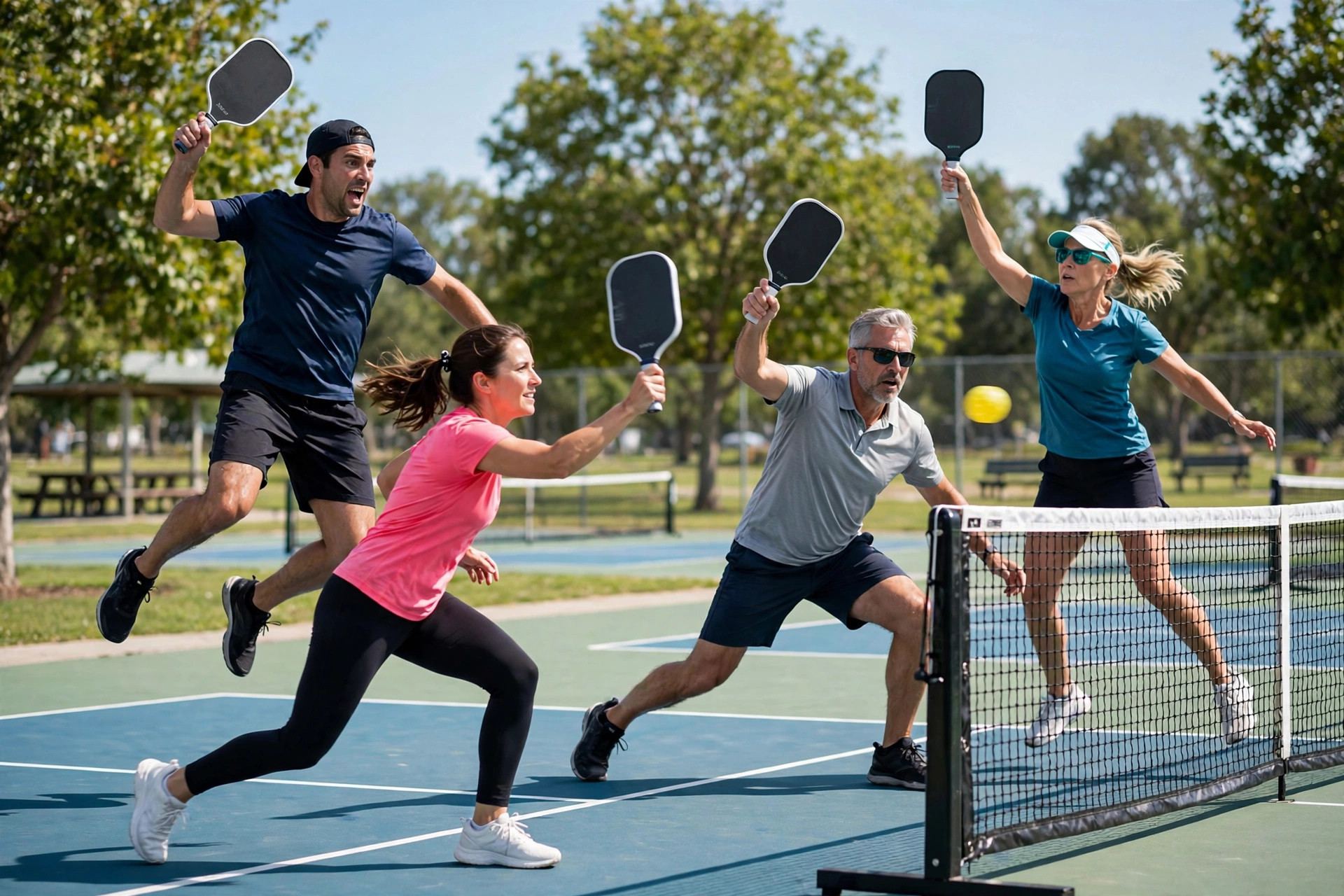
My first pickleball game lasted about forty minutes, and I spent the first fifteen completely lost. Not “I’m bad at this” lost — “why did the server just call out three numbers?” lost. The score was announced as “four, two, one,” and I stood there holding a paddle shaped like an oversized table-tennis bat, nodding like I understood. I did not understand.
Then someone explained the rules between games — the real ones, with the why behind them — and the whole sport clicked. Pickleball looks chaotic from the sideline and feels beautifully logical once you know the rules. Here’s everything you need before your first game, explained through what actually happens on the court.

What Pickleball Actually Is (The 30-Second Version)
Pickleball is a paddle sport played on a badminton-sized court with a slightly lowered net. You hit a perforated plastic ball — think a wiffle ball with ambition — back and forth with solid paddles. It borrows from tennis, badminton, and table tennis all at once.
It’s usually played as doubles. A typical rally has a friendly arc: serve, return, a few groundstrokes, then everyone creeps toward the net for the fast, soft exchanges that make the sport addictive. Easy to start, genuinely hard to master — and the first hour is mostly just learning the rules.
The Court and Equipment in Plain English
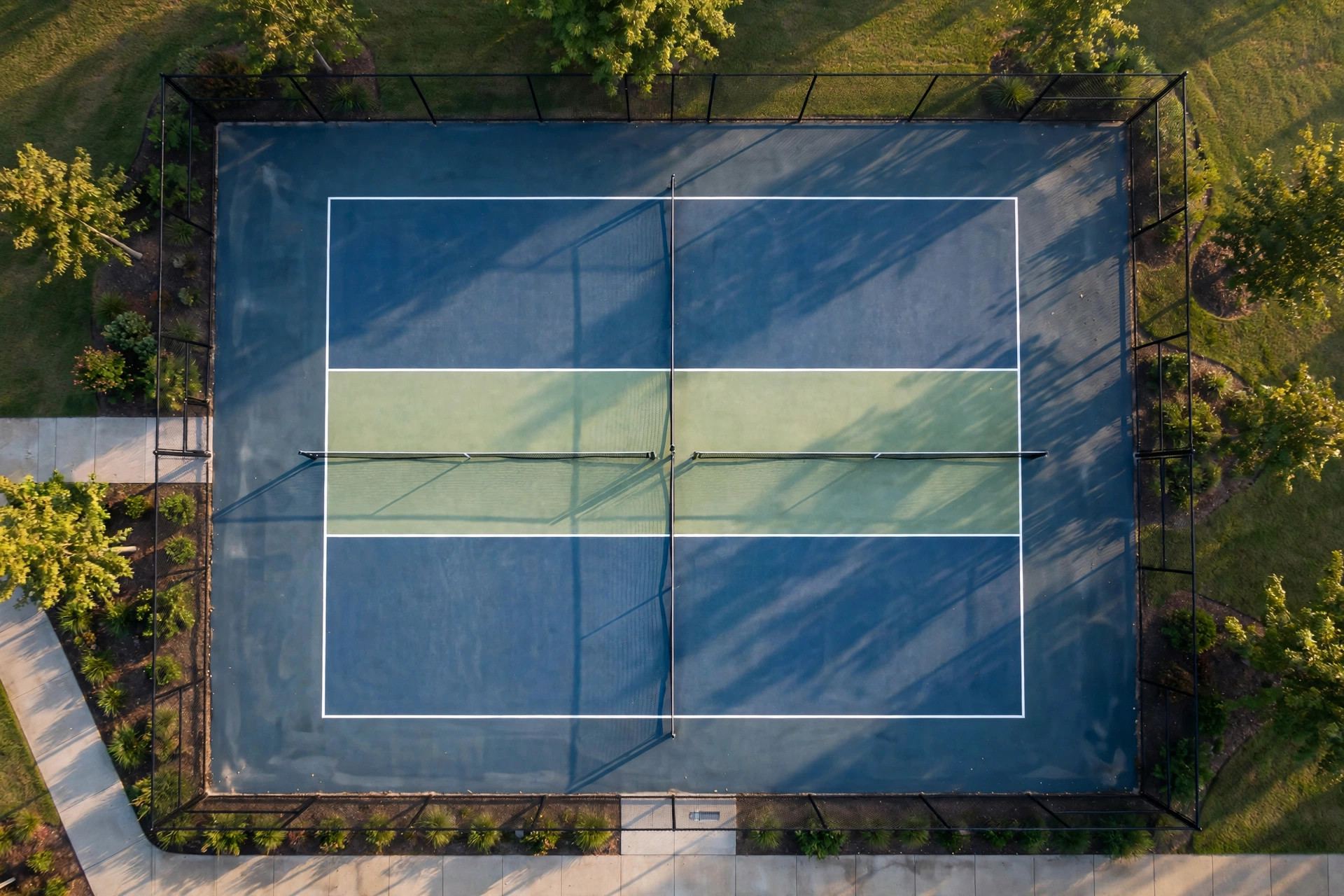
You don’t need to memorize court dimensions, but three zones matter:
- The baselines and sidelines. Standard stuff: hit it out, you lose the rally.
- The non-volley zone — “the kitchen.” A 7-foot box on each side of the net, with its own famous rule. More below.
- The service boxes. Left and right boxes on each side, like tennis. Serves must land diagonally in the opposite one.
Equipment is simple: a solid paddle, the perforated ball, and a net 36 inches high at the sidelines. Wear court shoes if you have them — the lateral movement is real. If you’re planning to play regularly, it’s worth figuring out the best time of day to get on the court around your schedule.
Serving Rules
The serve in pickleball is deliberately un-intimidating — no 130-mph bombs here. The rules keep it gentle:
- Underhand only. Contact below the waist, upward arc. No overhand serves, no sidearm trickery.
- Diagonal. Serve from behind the baseline into the diagonally opposite box — one foot behind the line, no stepping on or over it.
- One serve attempt. No second serves — miss it and the rally (and possibly the serve) goes over.
- The drop serve option. You can also just drop the ball and hit it after the bounce — no tossing. Many beginners find this easier, and it’s fully legal.
The serve isn’t a weapon here the way it is in tennis — the rules neutralize serve dominance. It starts the point; it doesn’t win it.
The Two-Bounce Rule (The Rule Every Beginner Breaks)
This is the rule that confused me in my first game, and the one every new player violates at least once:
Each side must let the ball bounce once on their first shot of the rally. The serve bounces on the returner’s side (bounce one). The return of serve must bounce on the server’s side (bounce two). After those two bounces, the ball can be volleyed (hit out of the air) or played off the bounce for the rest of the rally.
Without it, the serving team would rush the net and smash the return like tennis servers do. The rule forces both teams to start from the baseline — longer, fairer rallies. It’s the great equalizer of pickleball.
The practical takeaway: on the first two shots, let it bounce. After that, do what you want. Once this clicked, my whole first-game confusion evaporated.
The Kitchen: Pickleball’s Famous No-Go Zone
The kitchen (the non-volley zone) is the 7-foot area on each side of the net, with one famous rule: you cannot volley the ball while standing in it.
Let’s be precise, because the details matter:
- Volleying means hitting the ball out of the air. If it bounces first, you can hit it from the kitchen all day. The rule only bans volleys.
- Your feet can’t touch the kitchen or its lines during a volley — including the follow-through. Momentum carrying you in is a fault. I’ve seen games decided by a toe on the line.
- You CAN stand in the kitchen. This surprises everyone. Standing in the kitchen is legal; volleying from it is not. You can camp there, let the ball bounce, and dink it back.
Why the kitchen? Without it, tall players would just stand at the net and spike everything. The kitchen forces the soft game — the dinks, the drops, the patience — which is where pickleball’s real beauty lives. It isn’t a punishment; it’s what makes the sport a sport instead of a smash contest.
How Scoring Works
Now the three numbers that baffled me in game one:
Only the serving side can score. Win a rally on return and you don’t get a point — you get the serve (a “side-out”). This is the biggest difference from tennis, and it shapes all the strategy.
The score call has three numbers: server’s score, receiver’s score, then which server. In doubles, each team gets two serves (one per player) except at the very start. So “four, two, one” means: serving team has 4, receiving team has 2, first server’s turn. When the first server loses a rally, the serve passes to their partner (“four, two, two”). When the second server loses a rally, it’s a side-out.
The opening exception: at the very start of the game, the serving team only gets ONE serve before a side-out. So the first score call of the game is something like “zero, zero, two.” That “two” confused me for a full game. Now you know.
In singles, it’s simpler: two numbers, server’s score then receiver’s, since there’s only one server per side.
Winning a Game
Games go to 11 points, win by 2 — at 10-10, play continues until someone leads by two. Tournament games are sometimes 15 or 21 (still win by 2).
Matches are usually best-of-three. Between games, switch sides — and in the deciding game, teams switch when the first team reaches 6, to even out sun and wind. The sport thinks of everything.
Faults: How Rallies End
A fault ends the rally immediately:
- The ball lands out of bounds (lines count as in — except the kitchen line on the serve).
- The serve misses the diagonal box — including the kitchen line, which is short on a serve and therefore a fault.
- A player volleys from inside the kitchen (or momentum carries them in).
- The two-bounce rule is violated — someone volleys the serve or the return of serve.
- The ball bounces twice on one side before being returned.
- A player, paddle, or clothing touches the net during a rally.
- The ball hits a player (below-the-wrist paddle-hand contact is still live).
- An overhand or illegal serve.
If the serving side commits the fault, they lose the serve (or it’s a side-out). If the receiving side commits it, the serving side scores a point. Simple once you see it in motion.
Doubles Positioning Basics
Since you’ll almost certainly start with doubles, here’s the positioning that matters: the serving team starts back; the receiving team starts forward. The server stays at the baseline (the two-bounce rule keeps them there), while the returner’s partner waits at the kitchen line and the returner joins them after the return.
The golden rule of positioning: get to the kitchen line and stay there. The team that controls the kitchen line controls the point. Beginners hang back at the baseline, scared of the net — and get picked apart by dinks. Move up. The kitchen line is where pickleball is won.
One more doubles note: communicate. “Mine!” and “yours!” and “bounce it!” will save more rallies than any technique. The best doubles teams I’ve watched aren’t the most athletic — they’re the loudest.
5 Mistakes Every Beginner Makes
I made all of these. Knowing them in advance shortens the process:
1. Volleying the serve or return. The two-bounce rule again — your racket-sport muscle memory screams “attack the short ball.” Resist. Let it bounce.
2. Standing in the kitchen to volley. Especially on the follow-through — you smash a great volley and your momentum steps you onto the kitchen line. Fault. It happens to everyone.
3. Staying at the baseline. The single biggest strategic error. The kitchen line is home base; the baseline is where rallies go to die. Move up behind your shots.
4. Hitting everything hard. Beginners try to win every point with power. Pickleball rewards the soft game — the dink that barely clears the net beats the drive that sails long. Power has its place; it’s just smaller than you think.
5. Forgetting only the server scores. I’ve watched beginners celebrate winning a rally on return as if they’d scored. You didn’t score — you earned the serve. Now go score with it.
If the quick footwork is what worries you, some off-court work helps more than you’d think — building the leg strength for quick court movement made my own lateral movement noticeably sharper within a few weeks.
Frequently Asked Questions
Serve underhand diagonally, let the serve and the return each bounce once (the two-bounce rule), never volley from inside the 7-foot kitchen zone, and remember only the serving side can score. Games go to 11 points, win by 2. That’s the whole sport in one paragraph — everything else is detail.
Each side must let the ball bounce once on their first shot of the rally: the serve must bounce on the returner’s side, and the return of serve must bounce on the server’s side. After those two bounces, volleys are allowed. It exists to stop the serving team from rushing the net and dominating, keeping rallies longer and fairer.
The kitchen is the 7-foot non-volley zone on each side of the net. You cannot hit a volley (ball out of the air) while standing in it — including if your momentum carries you in after the shot. You CAN stand in the kitchen and hit the ball after it bounces. It exists to prevent net-camping smashes and force the sport’s signature soft game.
Yes. If the receiving side wins a rally, they don’t get a point — they get the serve (a side-out). This is the biggest scoring difference from tennis and shapes all pickleball strategy: you have to earn the serve before you can earn points.
Games are played to 11 points, win by 2 — so at 10-10, play continues until someone leads by two. Tournament games are sometimes played to 15 or 21 (still win by 2). Matches are usually best-of-three games, with teams switching sides in the decider when the first team reaches 6.
A fault ends the rally: hitting the ball out, failing to land the serve in the diagonal box, volleying from the kitchen, breaking the two-bounce rule, letting the ball bounce twice, or touching the net. If the serving side faults, they lose the serve; if the receivers fault, the servers score a point.
Your First Game Checklist
The pocket version for your first game:
- Serve underhand, diagonal, below the waist. One attempt.
- Let the serve bounce. Let the return bounce. Then play.
- Never volley from the kitchen — but you can stand in it.
- Only the serving side scores. Win the rally on return = win the serve.
- Games to 11, win by 2. Call the score as three numbers.
- Get to the kitchen line. Communicate. Dink more than you think.
The rules will feel like a lot for about twenty minutes, and then they’ll disappear into the background and leave just the game. If this got you onto the court, there’s more where it came from in my other sports explainers. Now go lose your first game gloriously. The second one is where the addiction starts.