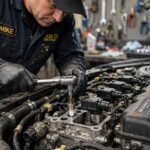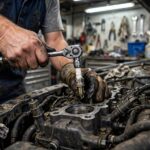
“How much to change the plugs?” might be the most common question I hear after “is it serious?” And the honest answer is the one customers hate: it depends — mostly on your engine, not your plugs. I’ve done plug jobs for $40 in parts in a driveway and $600+ at a dealer for the same basic service. Same plugs, wildly different bills. The difference is almost entirely labor and access.
Let me give you real numbers — what the parts cost, what shops charge, why some cars are cheap and some are brutal, and how to tell a fair quote from a padded one. These are typical U.S. ranges as of 2026; prices vary by region, but the structure is the same everywhere.
Contents
- The Short Answer: Typical Cost Ranges
- DIY Cost: Just Parts and Your Saturday
- Independent Shop Cost
- Dealer Cost
- Why Some Cars Cost So Much More
- What a Fair Quote Includes
- When the Quote Is Too High
- Is It Worth Doing Yourself?
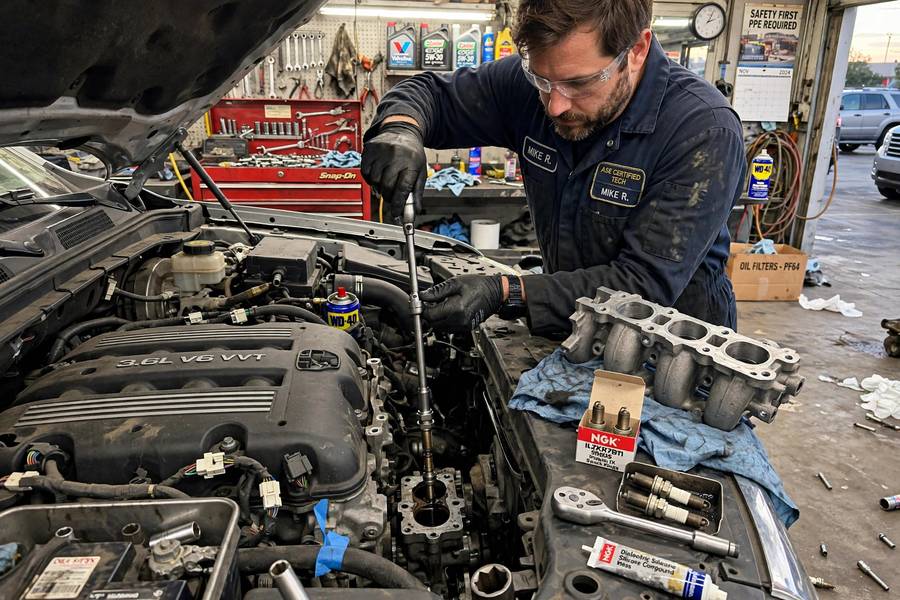
The Short Answer: Typical Cost Ranges
| Approach | Typical total range |
|---|---|
| DIY (parts only) | $20–$80 |
| Independent shop | $150–$350 |
| Dealership | $250–$600+ |
| Difficult-access engines (V6, boxer, some turbos) | Add $100–$300 to the above |
Most four-cylinder cars with easy plug access land at the low end of every range. The moment the engine buries the plugs under an intake manifold — or asks for sixteen of them — the numbers climb. Keep reading for why.
A quick note on what these numbers are: typical ranges I’ve seen across the industry, not quotes. Your specific car, your city’s labor rates, and your plug type all move the needle. Use these to calibrate your expectations, then get a real quote for your car.
DIY Cost: Just Parts and Your Saturday
Doing it yourself, you’re paying for plugs and maybe a couple of tools you don’t own yet.
Plugs: $2–4 each for copper, $4–8 for platinum, $8–15 for iridium. A four-cylinder needs four plugs ($8–60 in parts); a V6 needs six ($12–90); a V8 needs eight ($16–120). The infamous Hemi V8s with two plugs per cylinder need sixteen — even at modest per-plug prices, that’s real money in parts alone.
One-time tools (if you don’t own them): a spark plug socket ($8–12), a gap gauge ($5–10), and a torque wrench ($25–40). Call it $40–60 to tool up, and you own the tools forever. The torque wrench alone will pay for itself across every future job — brakes, tires, everything with a spec.
So a DIY plug job on a typical four-cylinder runs $20–80 all-in, and the second time you do it, it’s just the cost of plugs. That’s the math that makes this one of the best DIY jobs in existence: an hour of your Saturday replaces a $200 shop bill. The full procedure — including the mistakes that turn a cheap job expensive — is in my guide to how to change spark plugs.
Independent Shop Cost
A good independent shop typically charges $150–350 for a standard plug replacement. Here’s how that breaks down:
- Parts: $30–100 (plugs, often with a modest markup — that’s normal and fair)
- Labor: 1–2 hours at $100–150/hour in most markets
That labor estimate assumes normal access. The job really is about an hour on an easy four-cylinder: pull coils, swap plugs, gap, torque, done. You’re paying for the tech’s time, the shop’s overhead, and — this matters — their liability if something goes wrong. A stripped thread on their watch is their problem to fix, not yours.
Independents are usually the sweet spot for this job: dealer-level competence on routine work at significantly lower labor rates. If you have a shop you trust, this is their bread and butter.
Dealer Cost
Dealers typically run $250–600+ for the same job. The parts are usually OEM (fine, sometimes genuinely better), but the big difference is labor rates: $150–220/hour at many dealerships versus $100–150 at independents.
Is the dealer ever worth it for plugs? Honestly, rarely — with two exceptions. First, if your car is under warranty and you want a spotless service record with zero arguments later. Second, some European and luxury cars where the dealer techs do that specific engine’s plug job weekly and know every quirk (looking at you, rear-bank plugs on transverse V6s). For a mainstream car, the independent shop does the identical job for less.
One thing to watch at dealers: the upsell stack. “While we’re in there” is a profitable sentence. Plugs lead to coil packs lead to a throttle body cleaning lead to a fuel system service. Some of those are legitimate; many are margin. A plug job doesn’t automatically require new coils — more on that below.
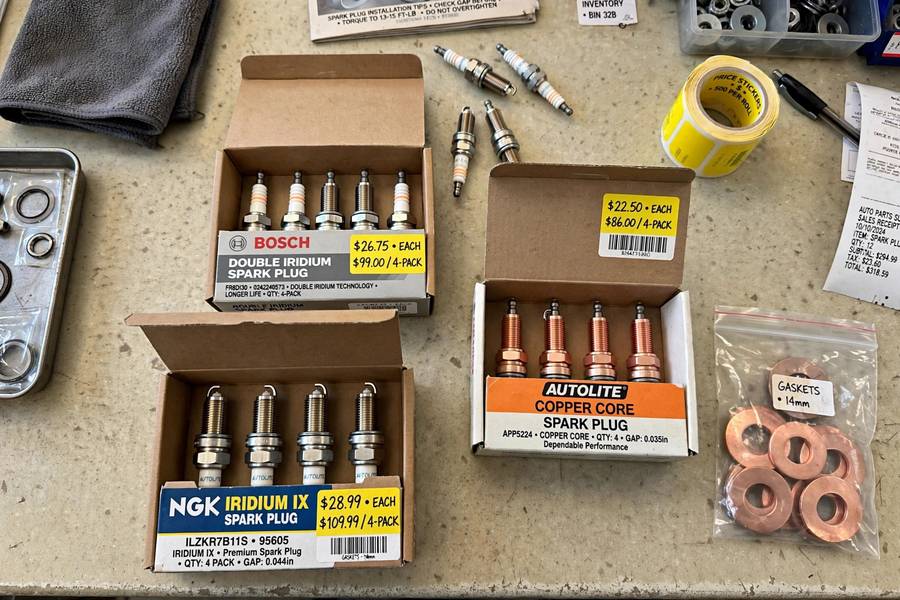
Why Some Cars Cost So Much More
This is where the ranges explode, and it’s all about access:
Transverse V6 engines. The front three plugs are easy; the rear three hide under the intake manifold or against the firewall. The manifold has to come off — new gaskets, more labor, sometimes two extra hours. A $200 job becomes a $400–500 job. This is the single most common “why is it so expensive?!” I hear.
Hemi V8s with 16 plugs. Twice the plugs, twice the parts cost, and the lower bank is fiddly. Expect the high end of every range.
Boxer engines (Subaru). Plugs point sideways into the fenders. On some models the engine needs to be lifted slightly for access. Labor climbs fast.
Turbocharged and performance engines. Often iridium or ruthenium plugs at $12–15 each, sometimes with specific torque procedures, and occasionally buried under intercooler piping.
Anything where “book time” says 3+ hours. Some cars genuinely book three or four hours for plugs. That’s not the shop padding — that’s the manufacturer admitting the plugs are buried. When book time is high, DIY becomes dramatically more attractive if you’re patient, because you’re replacing expensive labor hours with your own free Saturday.
The flip side: an inline-four with the plugs staring at you from the top of the valve cover is a 45-minute job. If you’re quoted $400 for that car, something’s off. Which brings us to…
What a Fair Quote Includes
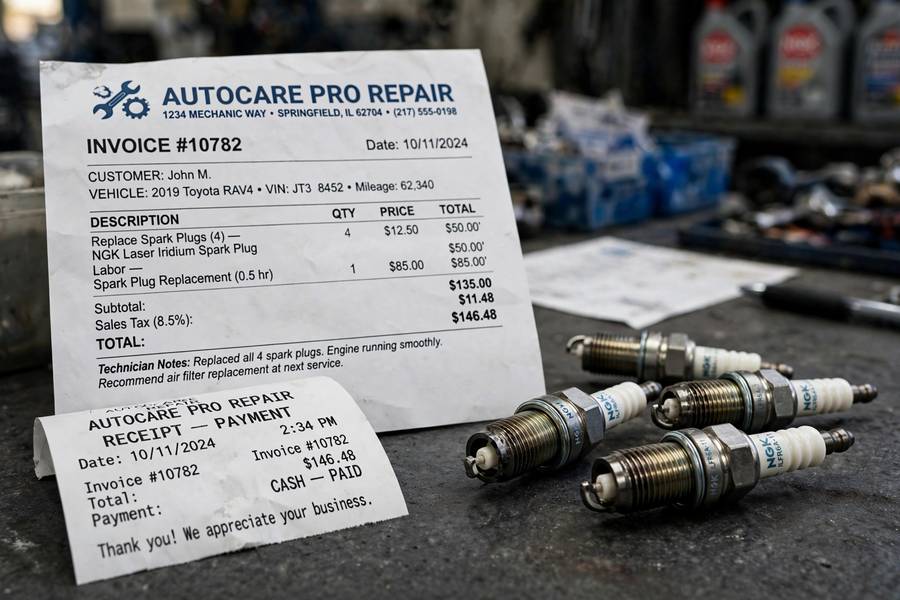
A legitimate plug replacement quote should itemize:
- The plugs themselves — brand and part number. You want to see actual plug names, not just “spark plugs — $89.” This also lets you verify they’re the correct spec for your engine.
- Labor hours and rate — should roughly match the book time for your car. One to two hours for easy access; more for buried plugs.
- Shop supplies / misc — a few dollars for anti-seize, dielectric grease, shop towels. Normal. A $40 “shop supplies” line on a plug job is not normal.
- Tax. Obviously.
What it should NOT automatically include: coil packs, wires (most modern cars don’t have them), throttle body service, fuel injector cleaning, or a “tune-up package” you didn’t ask for. Coils get replaced when they fail or test bad — not reflexively with plugs. I’ve seen $200 plug jobs quoted at $600 because of preemptive coil packs on a car with 60,000 miles and healthy coils. Ask them to test the coils; a bad coil shows up clearly.
When the Quote Is Too High
Red flags I’ve learned to spot:
- Labor hours far above book time for your car. Look up the book time (it’s public information) and compare.
- Platinum-priced parts for a copper-plug car — or mystery “premium plugs” with no part number listed.
- Mandatory coil packs with no test results and no misfire codes.
- The vague “tune-up” bundle where you can’t tell what you’re actually paying for.
What to do: get a second quote from an independent shop, and ask both shops the same question — “what exactly is included, and what’s the book time on my car?” The honest shop answers without hesitation. Also, if your car is due for other routine maintenance, bundling can make sense — staying on top of basics like how often to change your engine oil at the same visit saves a second trip, as long as each line item is priced fairly on its own.
And if you’re shopping for a car rather than maintaining one: a used car with 95,000 miles on original plugs is a negotiation point, not a dealbreaker. Knowing how to buy a used car with your eyes open about upcoming maintenance is worth real money — a $300 plug job the seller “forgot” to mention is a $300 discount you can ask for.
Is It Worth Doing Yourself?
For most people, with most cars: absolutely yes. It’s the rare job where the DIY savings are huge, the skill requirement is modest, and the risk is low if you follow the procedure — cold engine, hand-thread the plugs, gap them, torque to spec. The tools cost less than the labor you’d pay once, and you keep them.
The exceptions: if your car’s book time is 3+ hours because the intake manifold has to come off, be honest about your patience and your workspace. It’s still doable, but it’s a full-day job with more ways to go wrong (vacuum leaks from a pinched gasket, forgotten connectors). And if the very idea of working on your engine stresses you out, there’s no shame in paying a professional — a $250 shop bill is cheaper than a $500 thread repair from a rushed DIY job.
Either way, don’t defer it indefinitely. Overdue plugs don’t just run rough — they stress your ignition coils, waste fuel, and can eventually damage the catalytic converter. A $200 maintenance item ignored becomes a $1,000 repair with depressing reliability. The cheapest plug job is the one you do on time.
Frequently Asked Questions
Typical ranges: $20–80 DIY (parts only), $150–350 at an independent shop, and $250–600+ at a dealership. Difficult-access engines (transverse V6, boxer, some turbos) add $100–300. Prices vary by region, plug type, and engine.
It’s almost entirely labor for access. On transverse V6 engines the rear plugs hide under the intake manifold, which must be removed. Some engines book 3+ hours of labor. The plugs themselves are cheap — you’re paying for the hours to reach them.
Not automatically. Coils should be tested and replaced when they fail or show weakness — a bad coil causes clear misfires. Preemptive coil replacement on a healthy engine is often an upsell. Ask the shop to show test results or codes before agreeing.
Yes — dramatically. A DIY plug job on a typical four-cylinder costs $20–80 in parts versus $150–350 at a shop. You need a spark plug socket, gap gauge, and torque wrench (about $40–60 in one-time tools). The main exception is engines with buried plugs requiring 3+ hours of disassembly.
Overdue plugs cause rough idle, misfires, poor fuel economy, and hard starting. Worn plugs force ignition coils to work harder (coils cost far more than plugs), and persistent misfires can overheat and damage the catalytic converter — turning a $200 maintenance item into a $1,000+ repair.