Here’s a party trick I used to do with customers: “Your engine makes 300 lb-ft of torque. Your wheels? They’re getting hit with over 3,000.” The look on their faces was always the same — somewhere between disbelief and ‘you’re making that up.’ I wasn’t. The gearbox and differential multiply engine torque enormously before it reaches the tires, and understanding that multiplication explains a lot about how cars actually accelerate.
Engine torque is what the spec sheet advertises. Wheel torque is what actually pushes the car. They’re connected by gearing, and the relationship between them is the key to understanding gear ratios, why first gear feels violent, and why your car can climb a steep hill in low gear but barely crawls in sixth.
Contents
- Engine Torque: The Number on the Spec Sheet
- Wheel Torque: What Actually Pushes the Car
- The Multiplication: How Gearing Does It
- A Worked Example: From 300 to 3,000
- Why First Gear Feels Like a Rocket and Sixth Feels Lazy
- The Trade-Off: Torque Multiplication Costs Speed
- What This Means for Mods and Driving
Engine Torque: The Number on the Spec Sheet
Engine torque is the twisting force the engine’s crankshaft produces — the number manufacturers measure on an engine dyno and print in brochures. “300 lb-ft @ 3,500 RPM” means the crankshaft is twisting with 300 pound-feet of force at that engine speed. If you need the fundamentals, I covered them in the pillar article on torque in cars.
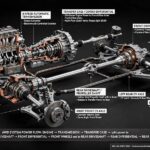
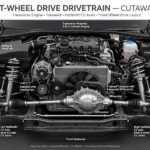
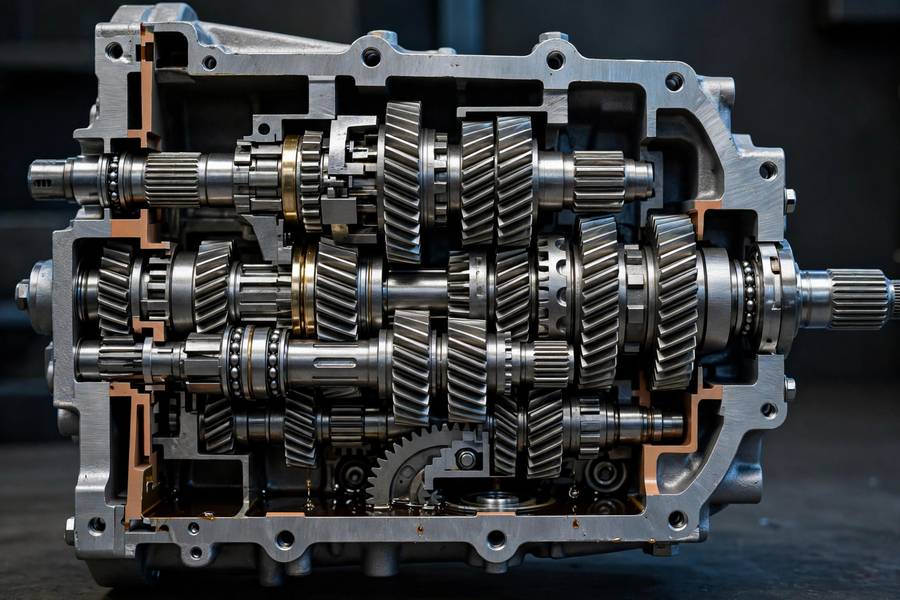
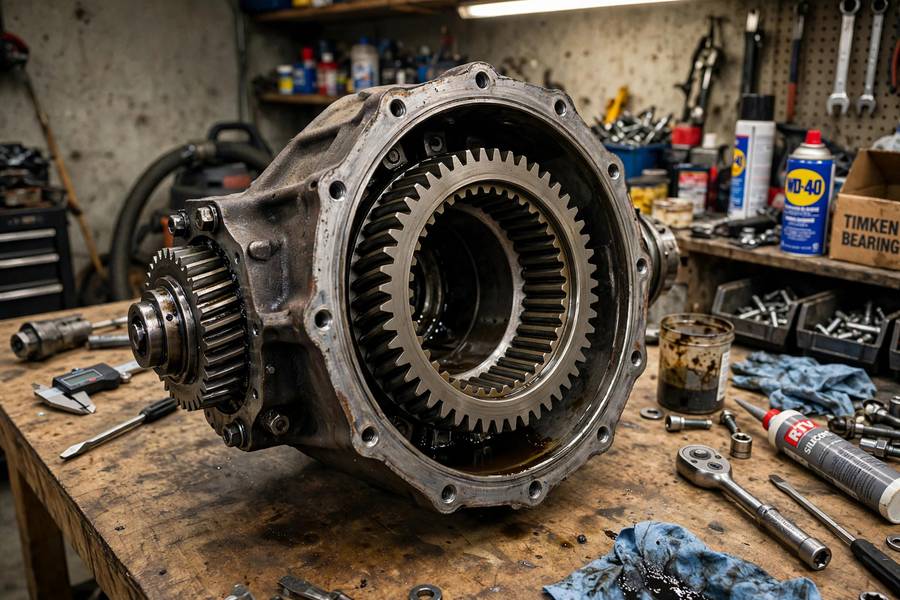
Here’s what people miss: engine torque alone doesn’t move the car. It’s just the input to a system. Between the crankshaft and the tires sit the transmission gears and the final drive (differential), and those gears transform the engine’s output — trading speed for force — before a single pound-foot reaches the road.
Think of it like a bicycle. Your legs produce a certain force on the pedals (engine torque). But the gear you select determines how much of that force reaches the rear wheel versus how fast the wheel spins. Low gear: easy pedaling, massive force at the wheel, slow speed. High gear: hard pedaling, less force, high speed. Your car works exactly the same way.
Wheel Torque: What Actually Pushes the Car
Wheel torque is the twisting force delivered at the driven wheels — the actual force twisting the tires against the pavement. This is what accelerates the car, climbs the hill, and tows the trailer. Everything upstream (engine, gearbox, differential) exists to produce this number.
The relationship is simple multiplication:
Wheel torque = Engine torque × gear ratio × final drive ratio × drivetrain efficiency
Drivetrain efficiency accounts for friction losses — typically 10–15% for manuals, 15–20% for conventional automatics. The gears do the multiplying; friction takes a small cut.
This is why wheel torque is always much larger than engine torque in low gears. Total gear multiplication in first gear is often 10:1 to 15:1. That 300 lb-ft engine is delivering 3,000–4,500 lb-ft to the wheels in first gear. In top gear, multiplication might be only 2.5:1 to 3:1, so the wheels see 750–900 lb-ft. Same engine, wildly different wheel torque — the gears decide.
The Multiplication: How Gearing Does It
Each gear pair in the transmission multiplies torque by its ratio. A 3:1 gear ratio means the output shaft turns once for every three turns of the input — and delivers roughly three times the torque (minus friction losses). Then the final drive in the differential multiplies it again, typically by another 3:1 to 4.5:1.
The total multiplication in any gear is the transmission ratio times the final drive ratio:
| Gear | Trans ratio | Final drive | Total multiplication | Wheel torque (300 lb-ft engine) |
|---|---|---|---|---|
| 1st | 3.5:1 | 3.7:1 | ~13:1 | ~3,900 lb-ft |
| 2nd | 2.1:1 | 3.7:1 | ~7.8:1 | ~2,340 lb-ft |
| 3rd | 1.4:1 | 3.7:1 | ~5.2:1 | ~1,560 lb-ft |
| 4th | 1.0:1 | 3.7:1 | ~3.7:1 | ~1,110 lb-ft |
| 5th | 0.8:1 | 3.7:1 | ~3.0:1 | ~900 lb-ft |
| 6th | 0.65:1 | 3.7:1 | ~2.4:1 | ~720 lb-ft |
(These are illustrative numbers for a typical 6-speed; your car’s ratios differ, but the pattern is universal. Figures before drivetrain losses.)
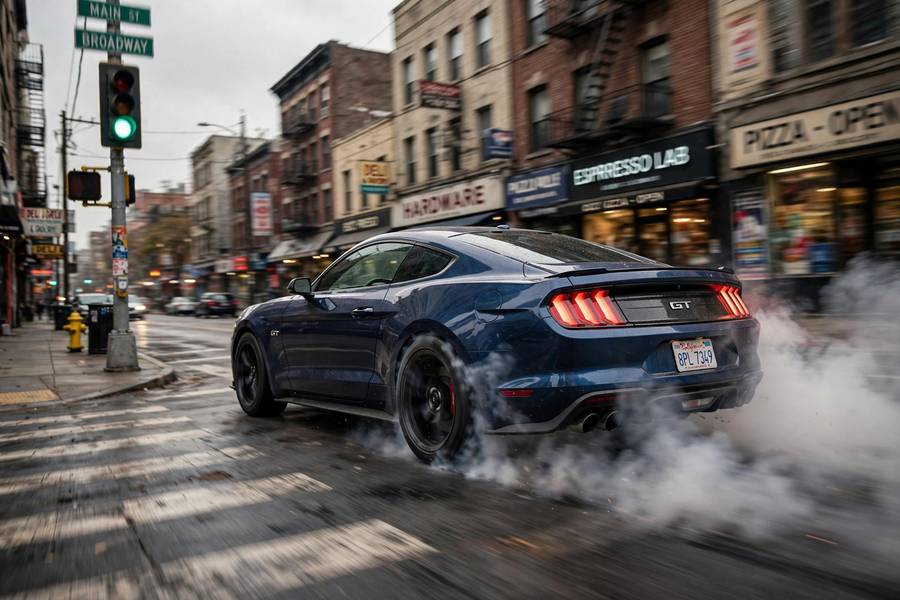
Look at that first-gear number: nearly 4,000 lb-ft at the wheels from a 300 lb-ft engine. That’s why a hard launch in first gear can break the tires loose — the tires can only handle so much twisting force before they give up and spin.
A Worked Example: From 300 to 3,000
Let’s walk through it concretely with a real-ish car: a 2.0T sedan making 300 lb-ft of engine torque.
In first gear (3.5:1 transmission ratio, 3.7:1 final drive): – 300 × 3.5 = 1,050 lb-ft at the transmission output – 1,050 × 3.7 = 3,885 lb-ft at the wheels (before ~12% drivetrain loss) – After losses: roughly 3,400 lb-ft of wheel torque
In sixth gear (0.65:1, 3.7:1 final drive): – 300 × 0.65 = 195 lb-ft – 195 × 3.7 = 722 lb-ft (before losses) – After losses: roughly 635 lb-ft of wheel torque
Same engine, same 300 lb-ft input — but first gear delivers more than five times the wheel torque of sixth gear. This is the entire reason gears exist: to let one engine produce both stump-pulling force and highway cruising speed.
And this is also why EVs feel so strong: no multi-gear multiplication needed (mostly single-speed), but the motor’s instant torque goes through a reduction gear of around 8:1–10:1, delivering massive wheel torque from zero RPM.
Why First Gear Feels Like a Rocket and Sixth Feels Lazy
Now the seat-of-the-pants experience makes sense. Floor it in first gear and 3,400 lb-ft twists the tires — violent acceleration, possible wheelspin, the whole drama. Floor it in sixth at the same speed and you get 635 lb-ft — a gentle push, maybe not even enough to accelerate briskly.
This is why downshifting works. When you need to pass on the highway, dropping from sixth to fourth roughly doubles your wheel torque instantly, without the engine making a single extra pound-foot. The engine didn’t get stronger — the multiplication changed. Every “the car woke up when I downshifted” moment is wheel torque multiplication in action.
It’s also why towing in overdrive is a bad idea. In top gear, wheel torque is at its minimum — the engine strains to maintain speed against the load. Dropping a gear or two multiplies wheel torque back up and the engine relaxes. Your transmission will thank you.
The Trade-Off: Torque Multiplication Costs Speed
Physics doesn’t give free lunches. Gears multiply torque by reducing speed by the same factor. That 13:1 multiplication in first gear means the wheels turn 13 times slower than the engine. The engine screams at 6,000 RPM while the wheels turn at a leisurely pace — which is why first gear tops out around 30–40 mph.
This is the fundamental bargain of every gear: – Low gears: enormous wheel torque, low wheel speed. For launching, climbing, towing. – High gears: modest wheel torque, high wheel speed. For cruising efficiently.
You can’t have both at once from a fixed gear — which is exactly why transmissions have multiple gears (or a CVT’s infinite ratios): to keep giving you the right bargain for the moment. Maximum wheel torque when you need force; minimum engine RPM when you need efficiency.
What This Means for Mods and Driving
A few practical takeaways from the multiplication math:
Final drive swaps are the sleeper mod. Changing the differential’s final drive ratio from 3.7:1 to 4.3:1 multiplies wheel torque in every gear by ~16%. The car accelerates harder everywhere, at the cost of higher cruising RPM (and worse highway fuel economy). It’s one of the most effective performance mods per dollar — and one of the least discussed.
Bigger tires reduce effective gearing. Going from a 26-inch to a 30-inch tire is like raising your gear ratios — less wheel torque, lazier acceleration. This is why lifted trucks with big tires feel sluggish unless the owner re-gears the differentials. When you’re changing a tire size, you’re changing your gearing too.
Wheel torque is what breaks parts. Axles, differentials, and CV joints fail based on wheel torque, not engine torque. That’s why a “mild” engine tune that adds 50 lb-ft can snap axles in first gear — that 50 became 650 at the wheels.
Braking is the reverse. How brakes work is essentially wheel torque in reverse — the brakes apply stopping torque at the wheels, and it’s the wheel torque (not engine torque) that determines stopping force. Same physics, opposite direction.
The spec sheet tells you what the engine does. The gears decide what the car does. Now when someone quotes engine torque at you, you’ll know the rest of the story — and you’ll know why the number at the wheels is the one that actually matters.
Frequently Asked Questions
Engine torque is the twisting force at the crankshaft (the spec-sheet number). Wheel torque is the force actually delivered at the driven wheels after the transmission and differential multiply it through gearing — typically 3–13 times the engine figure depending on the gear.
Wheel torque = engine torque × transmission gear ratio × final drive ratio × drivetrain efficiency (roughly 0.85–0.90). For example, 300 lb-ft × 3.5 (1st gear) × 3.7 (final drive) × 0.88 ≈ 3,400 lb-ft at the wheels.
Lower gears have higher numerical ratios, which multiply engine torque more. First gear’s total multiplication (transmission × final drive) is often 10:1–15:1, while top gear might be only 2.5:1 — so first gear delivers 4–5 times the wheel torque of top gear from the same engine.
For actual acceleration, yes — wheel torque is what pushes the car. But you can’t evaluate wheel torque without knowing the gearing, which is why engine torque plus gear ratios together tell the full story. Two cars with the same engine torque can accelerate very differently with different gearing.
Effectively, yes. Larger-diameter tires act like taller gearing — the engine’s torque fights a longer moment arm at the contact patch, so acceleration suffers. This is why trucks with oversized tires often need lower (numerically higher) differential gears to restore performance.