Here’s a question that stumps more truck owners than you’d think: is your 4WD part-time or full-time? Most people bought the truck, not the engineering lecture, so they never learned. But the answer changes how you drive in winter, what maintenance the truck needs, and whether that 4WD dial is a sometimes-tool or an always-on system. I’ve explained this across a shop counter hundreds of times. Here’s the version with the grease wiped off. For the bigger picture of how these systems relate, see my AWD vs 4WD comparison.
Table of Contents
- The One-Sentence Difference
- Part-Time 4WD: How It Works
- Full-Time 4WD: How It Works
- The Center Differential: The Part That Changes Everything
- When to Use Each Mode
- How to Tell Which System You Have
- Maintenance Differences
- Which Is Better for You?
- Frequently Asked Questions
The One-Sentence Difference
Part-time 4WD locks the front and rear axles together and must only be used on slippery surfaces; full-time 4WD drives all four wheels continuously through a center differential and can be used on any surface, with a lock available for the slippery stuff. One demands your judgment every time you engage it. The other handles the judgment itself and only asks for your input at the extremes.
If you remember nothing else: part-time = driver decides, slippery surfaces only. Full-time = always on, pavement-safe, lock it when things get serious. Mixing those two up is how transfer cases get rebuilt.
Part-Time 4WD: How It Works
Part-time 4WD is the classic truck system, and it’s beautifully simple. In 2WD mode, only the rear wheels are driven; the front driveshaft and axle are disconnected and idle. When you shift into 4WD High, the transfer case engages the front output shaft and locks the front and rear driveshafts together — a fixed 50/50 power split, both axles turning at identical speeds.
That lock is the whole system. There is no center differential, no clutch pack allowing speed differences, no electronic negotiation. It’s a mechanical marriage of the two axles, for better (unstoppable traction in mud and snow) and for worse (destructive binding on dry pavement, because turning requires the axles to rotate at different speeds).
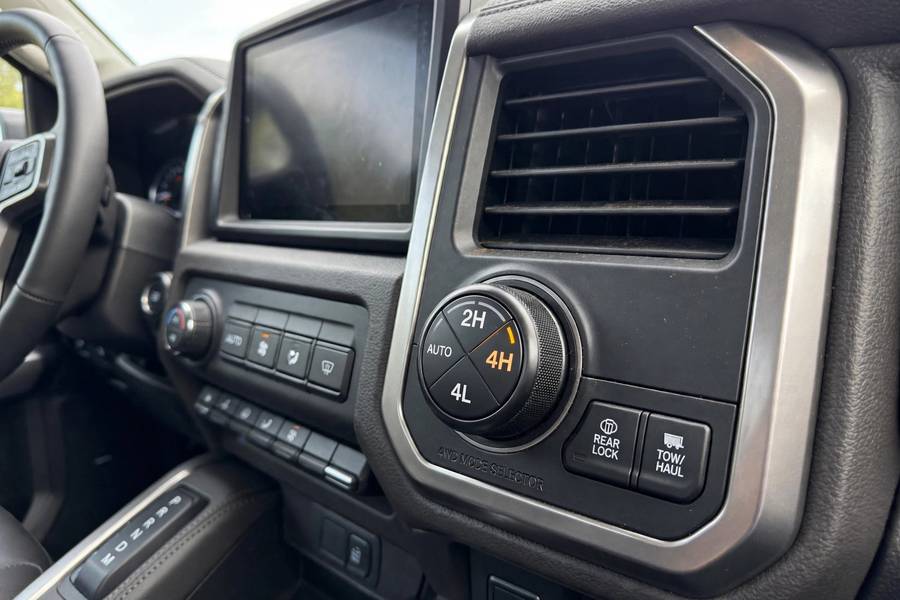
Typical part-time transfer cases offer three selections: 2H (two-wheel drive, high range — daily driving), 4H (four-wheel drive, high range, locked — slippery surfaces), and 4L (four-wheel drive, low range, locked with gear reduction — crawling and extreme traction). Some add a 4WD Auto mode that engages the front axle via clutch pack when slip is detected — a halfway house toward full-time behavior.
Full-Time 4WD: How It Works
Full-time 4WD keeps all four wheels driven all the time, and the trick that makes this possible on pavement is the center differential. This device sits in the transfer case (or in its place) and allows the front and rear axles to rotate at different speeds — exactly what’s needed for cornering on high-traction surfaces — while still distributing power to both.
Most full-time systems split torque with a slight rear bias in normal driving (common ratios are 40/60 or 30/70 front/rear) and can vary the split as conditions change. The center differential may be a mechanical Torsen-type unit, a planetary gearset, or an electronically controlled clutch pack. Whatever the hardware, the effect is the same: seamless all-wheel traction with no driver input and no pavement restrictions.
When the going gets truly rough, you lock the center differential — via a button, dial, or lever — and the system behaves like part-time 4WD: front and rear axles locked together at the same speed, 50/50 split, maximum traction. Unlock it when you’re back on grippy surfaces. The lock is the “serious mode”; the unlocked center diff is everyday life.
Full-time 4WD shares real DNA with car-based systems, and if you drive one daily it behaves more like an AWD crossover than a locked truck. For that side of the family tree, what all-wheel drive is breaks it down in plain language.
The Center Differential: The Part That Changes Everything
Everything about the part-time/full-time distinction flows from this one component. A center differential does for the front-rear axle pair what a regular differential does for the left-right wheel pair: it allows speed differences while transmitting power. Without it, locked axles bind in turns on grippy surfaces. With it, they don’t.
This is also why full-time 4WD and full-time AWD are mechanical cousins. Both use a center differential (or equivalent) to permit axle speed differences. The practical difference between them is packaging and intent: full-time 4WD systems typically include a low-range gear and a lockable center diff for serious off-road work, while AWD systems usually skip the low range and prioritize on-road behavior. Same family, different jobs.
One maintenance note specific to center diffs: they need their fluid changed on schedule, and they’re sensitive to mismatched tires just like AWD systems. A center differential constantly working to absorb a circumference difference between axles will overheat and wear prematurely. Four matched tires isn’t a suggestion on these vehicles — it’s a requirement.
When to Use Each Mode
For part-time 4WD, the mode map is strict. 2H: dry pavement, wet pavement, any high-traction surface — your default. 4H: snow-covered roads, mud, sand, gravel, any consistently slippery surface — engage before you need it, disengage when the surface improves. 4L: crawling, steep grades, deep mud, pulling heavy loads at low speed — stopped, in neutral, foot on brake to engage. 4WD Auto (if equipped): mixed conditions, light snow, rain — the system decides.
For full-time 4WD, life is simpler. Normal mode (center diff unlocked): everything — pavement, rain, light snow, gravel. It’s your always-on setting and it needs no thought. Center diff locked: the same situations where you’d use part-time 4H — deep snow, mud, serious off-road. 4L (if equipped): crawling and extreme traction, same rules as part-time low range.
The most common mistake I see with full-time systems is owners who never use the center diff lock because they don’t know it exists. Read your manual, find the lock control, and exercise it occasionally on a loose surface. A lock actuator that hasn’t moved in three years may not move when you need it.
How to Tell Which System You Have
Check your owner’s manual first — it’s the authority. But quick field identification: look at your 4WD selector. If it offers 2H/4H/4L (or 2WD/4WD High/4WD Low), you have part-time 4WD. If there’s no 2WD option — just High/Low or a center diff lock button — you have full-time 4WD. The absence of a 2WD mode is the giveaway: full-time systems never disconnect an axle.
The badge on the tailgate sometimes helps — “Full-Time 4WD” or “4×4” markings vary by manufacturer — but badges lie by omission more than commission. The selector and the manual don’t lie. And if you’re buying used, verify before you buy: I’ve seen part-time trucks advertised as “full-time 4WD” by sellers who didn’t know the difference either. A five-minute check of the selector saves a very expensive misunderstanding.
Maintenance Differences
Part-time 4WD maintenance centers on the transfer case: fluid changes every 30,000 to 60,000 miles (check whether yours takes ATF or gear oil — using the wrong one is a classic DIY error), plus exercising the system monthly so seals and actuators don’t seize from disuse. The front axle components — hubs, CV joints, front diff — get a relatively easy life since they’re disconnected most of the time.
Full-time 4WD adds the center differential to the service list: its fluid needs changing on the same interval, and it’s the component most sensitive to neglect. Because all four wheels are always driven, the front drivetrain wears continuously — CV joints, front differential, and driveshaft components live a harder life than in a part-time truck. Budget accordingly: full-time 4WD costs more to maintain over the long run, roughly 20 to 30 percent more in drivetrain service in my experience.
Both systems share the non-negotiables: matched tires all around, differential fluid changes front and rear, and U-joint inspections. The drivetrain is only as healthy as its most neglected fluid.
Which Is Better for You?
Choose part-time 4WD if: you want the toughest, simplest system; you do serious off-roading or heavy towing; you like mechanical simplicity and lower maintenance costs; you don’t mind managing modes. It’s the work truck choice — the system that assumes you’re paying attention and rewards you for it.
Choose full-time 4WD if: you want maximum traction with zero thought; you drive mixed surfaces daily (pavement to gravel to snow in one commute); winter is your main concern rather than rock crawling; convenience outweighs absolute simplicity. It’s the daily-driver choice for people who face real weather — the system that never needs you to remember anything until the extremes arrive.
There’s no wrong answer, only a wrong assumption. The only real mistake is not knowing which one you have. Now you know how to check.
Frequently Asked Questions
Part-time 4WD locks the front and rear axles together with no center differential, so it can only be used on slippery surfaces — dry pavement causes destructive binding. Full-time 4WD uses a center differential that allows axle speed differences, so it works on any surface, with a lockable mode for extreme traction.
Check the 4WD selector: 2H/4H/4L options mean part-time 4WD. No 2WD option — just High/Low or a center diff lock — means full-time 4WD. Your owner’s manual is the final authority, and it’s worth verifying when buying used.
Yes. The center differential allows the front and rear axles to rotate at different speeds in turns, so there’s no binding. Only the locked center-diff mode is restricted to slippery surfaces, just like part-time 4WD.
They’re mechanical cousins — both use a center differential for always-on traction. The practical difference: full-time 4WD typically includes a low-range gear and lockable center diff for serious off-road work, while AWD usually skips low range and prioritizes on-road behavior.
Part-time 4WD is simpler, tougher, and cheaper to maintain — ideal for serious off-roading and work trucks. Full-time 4WD is more convenient and safer for mixed-surface daily driving and winter commuting. The right choice depends on whether you prioritize ultimate toughness or everyday ease.